


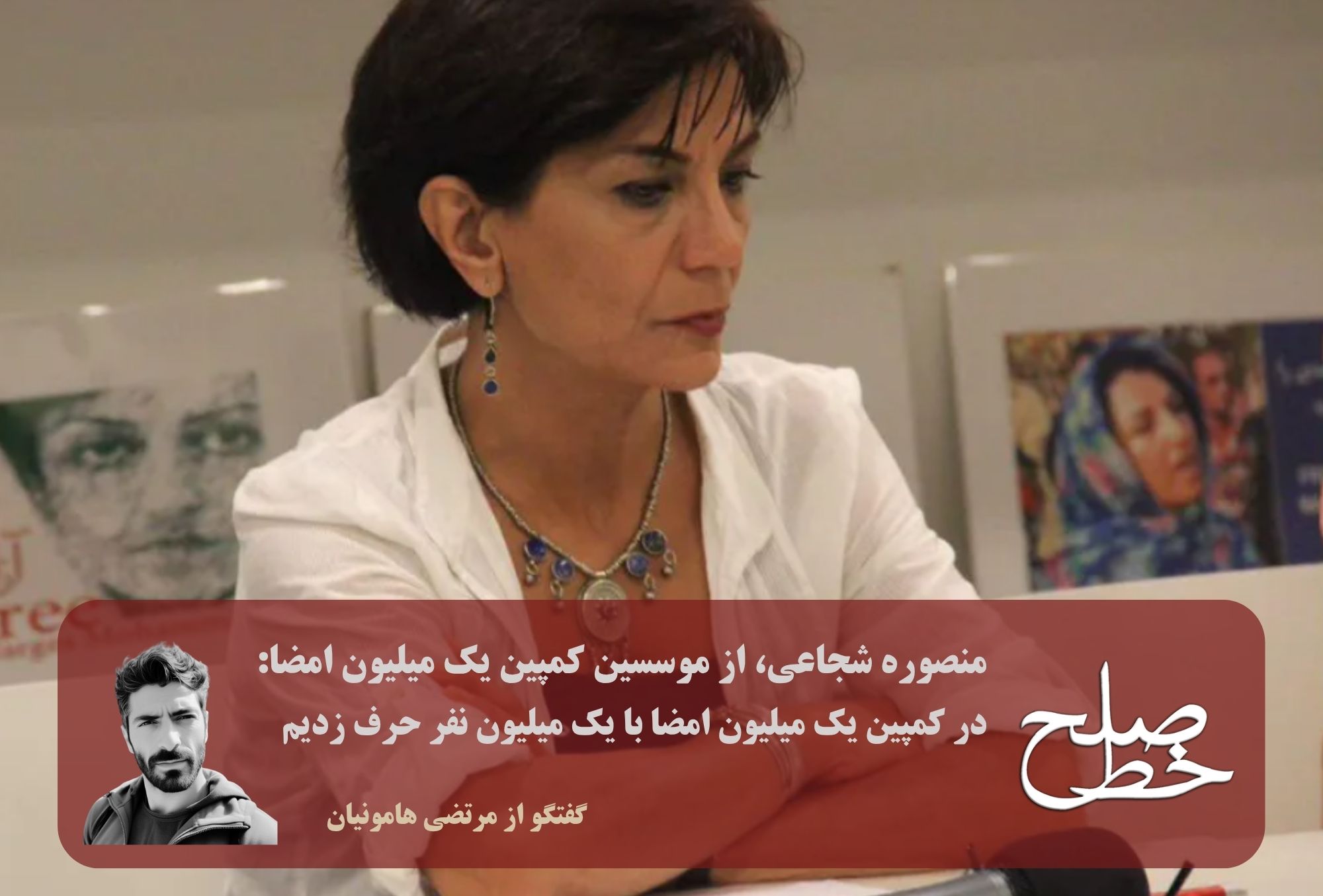
Mansoureh Shojaee: In the One Million Signatures Campaign, We Spoke with One Million People/ Morteza Hamounian
The One Million Signatures Campaign to Change Discriminatory Laws was one of the important and influential experiences of the Iranian women’s movement in the 2000s; a campaign launched in September 2006 (Shahrivar 1385) with the aim of changing unequal laws against women, whose activities were based on direct dialogue with people, legal education, and a presence in cities and regions across the country. Although the campaign ultimately did not achieve its stated goal of collecting one million signatures, it succeeded in taking the issue of legal discrimination against women beyond the limited circles of civil society activists and turning it into part of the broader public conversation.
The twentieth anniversary of the campaign’s launch provided an opportunity to speak with Mansoureh Shojaee, a researcher, writer, veteran women’s movement activist, and one of the founders of the One Million Signatures Campaign, about the experience and legacy of this movement—from how the idea for the campaign took shape and how it connected with women in different parts of the country, to the diversity and internal disagreements within the women’s movement, the relationship between legal demands and the political developments of 2009 (1388), and the connection between this experience and the “Woman, Life, Freedom” movement.
What follows is Peace Mark Monthly Magazine’s full interview with Mansoureh Shojaee:
If we go back to the days before the campaign was formed, how did the idea of collecting one million signatures come up? What led you from the initial discussions to the conclusion that it could actually be put into practice? In addition, to what extent was the idea of the One Million Signatures Campaign in Iran inspired by the experience of the women’s movement in Morocco, specifically the campaign to collect one million signatures as part of the struggle to reform the Moudawana—the Moroccan family law?
In fact, the Moroccan idea inspired the beginning of our work. Of course, the Moroccan campaign focused only on the issue of polygamy and was formed in 1992. A year later, King Hassan, the then king of Morocco, changed some of these laws. But those changes were not what the Moroccan women’s One Million Signatures Campaign had sought, and eventually, in 2004, they compelled Morocco’s King Mohammed VI to change the laws.
Under these laws, when a man wants to take a second wife, the first wife has the right to go to court right then and there and request a divorce. The law gives her that right. Also, if the first wife agrees to her husband’s second marriage, both the first and second wives must appear in court. The first wife must declare her consent. The second wife must also say that she knows the man she is marrying already has a wife. In other words, within a framework of legal transparency consistent with their own Sharia laws, this is how the matter is handled.
These reforms took place two years before Iran’s One Million Signatures Campaign.
I regret that in Iran, which has a history of progressive laws, such reforms never took place. In any case, the idea was initially raised at the Women’s Cultural Center by one of the center’s young members, and there were lengthy discussions about planning and implementing it. Not continuously, of course, because other issues would arise. In fact, it was one of the issues at the top of the center’s agenda. Ultimately, in the One Million Signatures Campaign to Change Discriminatory Laws, as its name suggests, the issue was not merely polygamy, but also other laws concerning inheritance, child custody, diya, divorce and marriage laws and their conditions, as well as a broad range of legal discrimination against women—particularly because Iranian society, especially in the central regions and areas with greater access to resources and cultural opportunities, remained a more progressive society than Morocco even in the post-revolutionary period.
The campaign’s focus on changing discriminatory laws provided a clear and shared demand. But how closely was this demand connected to the priorities of women who were more preoccupied with livelihood issues or everyday problems? Was there ever a point when you felt there was a gap between the issue you were raising and what they saw as their main problem?
Whatever field you want to work in, economic issues are important. But when, as a social movement, you define a task for yourself, you are not Superwoman, able to solve everything. You move toward solving the part that is within your capacity. Yes, in our history, for example, women actively participated in the Tobacco Movement. We also had the Bread Movement. But those were movements in which everyone participated. This, however, was a discourse that had emerged within the women’s legal-rights movement. In the women’s legal-rights movement, our focus was on the laws.
Let me go back two or three years before the One Million Signatures Campaign. In 2003, we had a large coalition in Iran called the Hamandishi Coalition, in which 350 women and 90 organizations participated. That is a significant number. Once a month, we would all gather together. For perhaps a year, we held meetings to determine the coalition’s priorities. Ninety organizations and institutions from different currents—including reformists, Muslim feminists, secular feminists, leftists, liberals, national-religious groups, and other currents—were gathered together. When I say there were 90 groups and 350 people, what I specifically mean is that plurality was the defining feature of this gathering. Even if you disregard the numbers, you can see its diversity. We all reached the conclusion that discriminatory laws were the priority at that time. Who determined that priority? Ninety organizations and 350 members, although they were all based in the center.
When, two or three years later, we reached a point where the necessity of forming the campaign was completely evident, we were no longer those 90 groups and 350 members. That was because, from the perspective of some members and organizations, this movement appeared “radical,” particularly during Ahmadinejad’s presidency. The large demonstration on June 12, 2005 (22 Khordad 1384), in front of the University of Tehran, was the Hamandishi Coalition’s last demonstration. After that, when we wanted to hold a program for March 8 at Daneshjoo Park, the first loss of members from Hamandishi occurred. This was because groups that were specifically close to the reformists and believed in activities centered on the “development and empowerment of women”—some of whom, without financial support, had less capacity to continue their activism—had fundamentally not been nurtured in the context of street struggles, and some could not even imagine going into the streets and being beaten.
So our numbers declined and became smaller. But qualitatively, we became closer to one another. That was because we said that whether Ahmadinejad was in power or anyone else or any other political current, we wanted our rights and would continue working against discriminatory laws. We went into the streets—not to demonstrate, but to connect with people. We knocked on people’s doors. We went to villages and remote areas. I have said in other interviews that our members would cross the Karun River by boat to speak with feudal khans. I myself went to Minab and to the city’s market of women goat sellers and interviewed them. On holidays, some people went to the mountains around Tehran, while others simultaneously traveled to other cities and held educational workshops in cities such as Tabriz, Kermanshah, Sanandaj, Gorgan, and other cities in different provinces across the country.
Before the education committee was formed—or, more accurately, before responsibilities were divided among members, which was done very precisely—all of us went into the streets and different neighborhoods of the city to collect signatures and, more importantly, to speak with the city’s women and men. That is, before the education committee and workshops were designed, the activists went to streets, weddings, funerals, parties, and generally wherever women gathered. For example, they would go to neighborhood parks in the early evening, when women had brought their children there to play. North or south Tehran made no difference to us, because thoroughly discriminatory family laws are not related to economic or social class. This is a general issue—unless the men in a family happen to be enlightened men, who might belong to the affluent or middle classes, the working class, or other disadvantaged classes. In other words, our issue had nothing to do with the center or the margins, or the north or south of the city.
We wanted to have an educational workshop in every city if we could not go to every home, village, and city ourselves. These workshops had three sections: “The History of the Women’s Movement,” “Rights and Laws,” and “Communication Skills.” At first, we even managed to hold workshops at universities or in the offices of grassroots organizations. But once arrests and threats began, our options were limited to the homes of people who voluntarily wanted workshops to be held in their cities and neighborhoods. And even those workshops were sometimes attacked. For example, in Khorramabad, in a workers’ settlement, we held an educational workshop in the home of one of the workers there. During the first half of the workshop, the door was suddenly broken down, the workshop was disrupted, and we were attacked with batons and rifle butts.
When you traveled from Tehran to other cities, what concerns and issues were priorities for these women that, at first, had seemed less important from your perspective?
In tribal communities, disadvantaged communities, and communities where polygamy was common—particularly among Sunnis, who do not practice temporary marriage and where men can marry up to four women, sometimes all living together in one large house—there were two approaches. One approach, which was the majority view, was unequivocal opposition to polygamy. There was another approach that did not strongly oppose it.
For example, at the goat sellers’ market in Minab, a woman had brought her goat to sell. When we spoke, she said, “If I didn’t have a co-wife, who would look after the children so I could come here and sell my goat?” In other words, she had accepted that her husband would take a second wife so that one woman could look after the children while the other came to sell the goat. Another woman said that her husband was a man of the sea. In Hormozgan, particularly among poorer groups, a “man of the sea” means a man who goes fishing or works as a sailor. She said, “When my husband goes to sea, we can’t be alone. But when there are two or three women in one house, we’re not alone.”
Another case was in Sistan and Baluchestan Province. A woman told me, “Well, if the table is already spread, having two more women sit beside it doesn’t make much difference.” Of course, bear in mind that these cases, which come from my own personal experiences, were very few in number, which is precisely why they have remained in my memory. In other words, these were exceptions in attitudes toward polygamy in some parts of the country. Because, without question, polygamy was also a serious issue in disadvantaged communities.
When we came back to Tehran, polygamy was less common, and it was specifically and almost exclusively seen among two entirely different classes: poor families who had married off their daughters for money, and extremely wealthy families in which very affluent men were the family’s sole source of wealth. As you know, one of the conditions for polygamy under Sharia law is financial means. Because these men had money, they had gone and taken several wives. Their wives objected as well.
On the issue of child custody, most people were also strongly opposed to the highly discriminatory law. If you remember, the result was that we managed to raise the age of custody for girls to nine. Before us, Ms. Ebadi had managed to raise it to five following the murder of Arian Golshani and what happened afterward. But through the campaign, we managed to raise it to nine. Another example was that we managed to bring about some modifications concerning diya and a wife’s inheritance from her husband. Of course, these issues were of greater importance in the center.
Was there any instance in which women in smaller cities came up with an initiative that changed the course of your work?
Which women?
Those same women who were active in smaller cities.
Fundamentally, the method of working differs in every geographical setting. Before entering a community, we discussed understanding our audience. The workshops themselves had three sections. One was the history of the women’s movement, and I happened to be among those who taught that section. Another section dealt with laws and rights, which young lawyers would come and teach. The third section was communication skills, which social workers taught, and sometimes, when we were short-staffed, I would help with that section as well. In other words, in every section we had specialists who came and taught with commitment and dedication.
The workshops were essentially a form of training of trainers. We had agreed that in any city, once the number of volunteers reached twenty, they would let us know and we would go there. After that, it was up to the local women to decide where the program would be held. At first, venues were made available to us, until the incident at Shiraz University, when they did not allow the workshop to be held and the activists who had gone to Shiraz had to return to Tehran immediately. After that, it was no longer the case that places such as cultural centers would provide us with space. So women in other cities held the programs in their homes.
It was the same in Tehran. When arrests increased in Tehran, we no longer had venues, and cultural centers would not give us space. We went to the homes of people we did not know at all. That was the interesting thing: we did not know many of these people. Imagine, for example, that we approached someone in the street for a signature. The person showed enthusiasm, and then we would say, “Come and help us.” They would ask, “How can I help?” We would say, “Gather ten or fifteen people in your neighborhood or area.” In Tehran, the number twenty was not important to us. They would do this, and we trusted them and went to their homes.
A relationship of trust had formed between activists and ordinary people in society, and it reached a point where people all considered themselves members of the campaign. Can you believe that perhaps three or four times people approached me in the street and asked me to sign? Each time, I stopped and listened to them. I said nothing; I just listened so they could say what they wanted to say. Once, near Qeytarieh Park, a young woman spoke with such passion and enthusiasm that I finally could not contain myself. When she finished, I hugged her and said, “How fortunate we are to have people like you.” She asked why. I said, “My dear! I was one of the people who, together with my friends, played a small role in designing the campaign. I am a member of the very campaign in which you are an activist.” What I mean is that this was how we worked, and this was how the issue penetrated different layers of society.
At the time, how did you envision the path toward changing the law? How did you think collecting signatures and bringing people on board would force the government to retreat? During the campaign’s activities, where was this assumption confirmed, and where did it need to be reconsidered?
In my view, this does not need to be reconsidered at all, because we see evidence of it a decade later in the “Woman, Life, Freedom” movement. Without the laws having changed, women have established their own law in society—because of their independence of action, their rightful demands, their avoidance of violence, and because they regard their bodies as their own and believe that each person has authority over their own body. It is a kind of right to self-determination: from body to homeland!
In fact, we did not have this degree of freedom of action in the campaign, because laws change when the government decides to change them, the legislature approves those changes, and after approval they are communicated to the executive branch. Our work was very difficult, because we had to change the law as a whole. We always said that the campaign was a process-oriented movement. That is, although during the campaign’s three years of activity we did not reach one million signatures, I can confidently say that we spoke with one million people. It was through this, as well as complementary methods such as producing content, that the discourse of equality and the discourse against discriminatory laws circulated throughout society.
We learned. Even when someone refused to sign and cursed at us, we learned about society’s sensitivities. That was as educational for us as when someone hugged and kissed us. In fact, our work was full of trial and error. We ourselves were learning as well. The plan was for the signatures to be collected and given to members of parliament, who constitute the legislative branch. Our model was precisely the Moroccan model. But unfortunately, I can say that the Islamic Republic is the most reactionary and repressive government even among Islamic countries.
The campaign’s arguments emphasized that its demands did not contradict Islam. How did you view this way of framing the demands? Was it a way to broaden support, or did it sometimes limit your ability to criticize the roots of discrimination?
As I said, priorities were determined. This priority was determined within a diverse group of 350 people. Many people in that group wore hijab. I do not mean only Ms. Azam Taleghani or Ms. Fatemeh Govaraei. Many of the activists in the group, from national-religious currents or reformists, wore hijab and chadors. Of course, they opposed compulsory hijab. Ms. Taleghani in particular was extremely radical on this issue; may her memory be honored. I learned from her and from her courage.
In this process, when we wanted to reach the minimum common demands, we would step back on some issues, and on other issues they would step back. It was one step forward and two steps back. In this one-step-forward, two-steps-back process, we could not make hijab one of the priority demands. One reason given by those who did not consider hijab a priority was that discrimination had become so deeply institutionalized in family law that women had had enough. Another reason was the importance of preserving the group’s diversity, and at that time raising the issue of compulsory hijab would have made the campaign more vulnerable from a security standpoint.
Look, we are talking about 2006 (1385). At that time, people had not reached this level of courage and resistance to compulsory hijab. We could not raise it in society at that time. Lenin’s most famous phrase is: “Concrete analysis of concrete conditions.” We can apply that throughout every process of struggle we undertake. The conditions at the time required their own particular analysis. When you analyzed them, you saw that raising this issue would impose greater costs.
Whenever security forces, particularly outside Tehran, wanted to crush us and distort the host community’s perception of us, they would say, “Be careful—these are the kind of women who want to go without hijab and take four husbands.” In Khorramabad, in the same workers’ settlement I mentioned earlier, I heard this with my own ears.
Or, for example, I refer you to Maryam Foumani’s account on Voice of America television, on the program Meydan. She recounted that at the gathering held at Haft-e Tir on June 12, 2006 (22 Khordad 1385), while Maryam and the other friends in the middle of the square were being beaten with batons, fists, and kicks by male and female police officers, apparently one or two of our friends were on the pedestrian bridge and personally heard a passerby say, “Let’s go help them so they don’t get beaten.” Another person said, “These are women who say they don’t want hijab.” At that moment, the three or four people who had apparently intended to help the women changed their minds and said, “Then leave them!” This does not mean that such reactions were necessarily because they believed in hijab or because they were Muslims—no! The issue was that many people would say, “With everything going on, why should anyone demonstrate over hijab at all?”
In the final article of the campaign statement, our demand was that women belonging to religious minorities should have the right to choose their own clothing. Why should an Armenian, Christian, Zoroastrian, or Baha’i woman have to wear hijab when she does not believe in it? In fact, in this section, we raised our criticism of compulsory hijab within the framework of respect for other religions. Just look at what the conditions were like: when we wanted to criticize hijab, this was the channel through which we expressed it. Of course, in the final clause we had said that clothing should be a matter of choice. But we raised compulsory hijab specifically through the issue of women from religious minorities: if they did not believe in it, there was no reason for them to be subjected to pressure over it.
During the protests of 2009 (1388), what happened to the effort to preserve women’s independent demands? Was there a point when you found yourselves facing a choice between joining the broader protests and pursuing the campaign’s demands?
I would not call it a choice. I would say that this was a shift in the women’s movement after the revolution. Before the revolution, too, during the movement to nationalize the oil industry, we saw a similar shift in parts of the women’s movement. But after the revolution, the shift from a legal-rights discourse to a political discourse before the 2009 (1388) election occurred within the mainstream of the movement with the announcement of the formation of the “Women’s Convergence to Raise Demands During the Election.”
If you remember, the Convergence’s slogan at the time was, “We vote for women’s demands.” What did that mean? Most members of the Convergence participated in the election individually, not as the Convergence. Many did not participate either. But that was not our concern. Our point was that if you wanted to vote, you should vote for someone who, in the programs they announced and would presumably implement, had paid attention to women and had written about women.
We supported no candidate, so as not to create the impression that we were the election headquarters of this or that candidate. We were women’s election headquarters. You could say that with this slogan, through that Convergence, we created the women’s movement’s election headquarters. We had worked extensively on this issue, and its formation was announced on a small scale on International Women’s Day, March 8, 2009 (Esfand 1387). But in May 2009 (Ordibehesht 1388), at Roshangaran Publishing House, we formally announced its establishment.
From my perspective, the composition of the roundtable we invited for the announcement may have been one of the most beautiful images of pluralism in the women’s movement up to that time. At one end of the table sat Ms. Azam Taleghani, wearing a chador and maghnaeh, and at the other end sat Ms. Simin Behbahani. Also seated at that table were Shahla Lahiji, Elaheh Koolaee, Farzaneh Taheri, Parvin Bakhtiarnejad, and a number of other women.
I should also say that this Convergence was not supported by the entire women’s movement. But there is no doubt that the dominant current of the women’s movement stood behind it. Many members of the One Million Signatures Campaign criticized this coalition and, although they did not attend the first meeting, joined later. In any case, disagreements existed. It is true that we lost some people in that coalition as well, but in exchange for those losses, a number of new people joined us. It was like any decision and any discourse, with some people in favor and others opposed.
I would describe it as a shift from a legal-rights discourse to a political discourse at that stage. The coalition’s activities continued until March 8 during the Green Movement—that is, International Women’s Day in 2010 (1388). At the time, I had been out of Ward 209 of Evin Prison for one week. We gathered again in Ms. Rahnavard’s office. Everyone from secular activists to leftist feminists was present. All the people I mentioned who had been part of the Convergence—from Haleh Sahabi to Zahra Rahnavard, Noushin Ahmadi Khorasani, Nasrin Sotoudeh, Shahla Farjad, Minoo Mortazi, Zohreh Tonekaboni, and others—were there.
There, in that statement, we declared our solidarity with the Green Movement and emphasized that we, as some members of the women’s movement, while insisting on our own demands, would stand alongside the Green Movement and the people in the streets. We also wrote a final statement, which is available on the Feminist School website. There was some debate there over whether to include the issue of hijab in the statement. In the first version of the statement, we had included the issue of hijab. Then discussions took place and the issue was framed differently. I think there was some disagreement over hijab there.
Here I want to give you an example of the position taken by part of the women’s movement during the movement to nationalize the oil industry, which is mentioned in Noushin Ahmadi’s book Hijab and Intellectuals. During Mosaddegh’s time, despite Dr. Mosaddegh’s commitment to democracy, women were not granted the right to vote. The Tudeh Party Women’s Organization prepared a complaint stating that this government, too, was denying us the right to vote, and sent it to the United Nations.
Another part of the movement—for example, liberal feminists such as Mehrangiz Manouchehrian and Sediqeh Dowlatabadi and others—went and spoke with Mosaddegh. They told him, “You are a national hero and an advocate of freedom, so why are they not approving women’s right to vote? What are we supposed to do?” Dr. Mosaddegh reportedly replied that, at that moment, the clerics could immediately use the issue and withdraw their support, thereby harming the nationalization of the oil industry. Mosaddegh asked them for time, and these women, through negotiation with the national government and with consideration for the issue of oil nationalization, determined their priorities.
What I mean is that when you enter politics, it is a different story. You give something and you get something. The tactics and the playing field change.
How much of an impact did geographical distance have? After leaving Iran, which parts of your communication and joint activities with fellow campaign members were you able to continue, and which parts became more difficult?
Geographical distance is a terrible thing for an activist. I mean, as an activist who has been active for fifty years—whether in the student movement, the women’s movement, or environmental movements—I believe that an activist’s field of action is their homeland, and once you leave, you are fundamentally not very influential.
Of course, my activity in the campaign had stopped one year before I left Iran. But I knew that the others had formed study groups and were trying to maintain their connections. Still, street work and collecting signatures were no longer possible in the way they had been before. The repression of 2009 (1388) left no space for activists to go into the streets to collect signatures or hold workshops. It was an atmosphere in which even simply walking down the street could cause you to be regarded as a criminal.
Thank you for the time you gave to Peace Mark Monthly Magazine.
 Created By: Morteza Hamounian
 September 23, 2026
Tags
Compulsory hijab Mansoureh Shojaei Peace Line 185 Women's movement Women's rights