


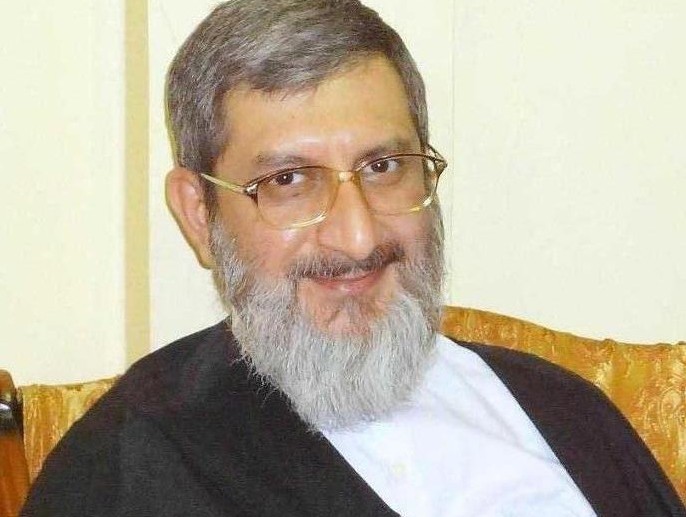
Ayatollah Mesbah Yazdi: Fasting in public is neither punishable nor forbidden / Ali Kalai
This is a caption
این یک عنوان است.
Ali Kalai
Ayatollah Abdolhamid Masoumi Tehrani, a well-known cleric and resident of Tehran, has tasted the bitterness of imprisonment, torture, and security crackdowns in the Islamic Republic in the past three decades due to his activities and unique religious views. He has been a student of renowned scholars and clerics such as Ayatollah Seyed Ahmad Khansari, Mohammad Taghi Davoudi, Hassan Saeed Tehrani, Mojtaba Tehrani, and Mohammad Reza Mahdavi Kani. He has also received permission to engage in independent religious reasoning from esteemed scholars such as Ayatollah Golpayegani, Ayatollah Marashi, and Ayatollah Khoi.
Mr. Masoumi Tehrani’s resume shows that he has been striving for coexistence among religions and faiths all over the world throughout these years. This calligrapher, painter, and illuminator has repeatedly presented his works to believers of other religions and faiths.
A few days after the end of this year’s Ramadan, we had a conversation with this critical cleric of the Islamic Republic regarding the actions during this month with an issue that is referred to as “public fasting” by official authorities. He stated that “we do not have anything fundamentally called fasting” and spoke of reconciliation by saying that “we have become narrow-minded” and these narrow-mindedness “results in nothing but hypocrisy and deceit.”
This familiar clergyman also emphasized that “religion is not the foundation of such an issue; just as the Quran orders not to meddle in people’s lives. And the issue of fasting is one of the examples of my connection with God.”
Abdolhamid Masoumi Tehrani continued by considering the illegality of the punishments imposed for fasting, saying that during the time of the Prophet and the four caliphs after him, the conditions were much more just than the centuries that followed.
The complete explanation of this conversation is presented below for your consideration:
What is your definition and understanding of the term “fasting” from your esteemed perspective?
This discussion is a bit detailed, but I will briefly mention it. We do not have anything called “fasting” as a foundation. Every religion has its own customs and rituals, and those who believe in it strive to perform those rituals. Islam also has rituals, such as prayer, fasting, pilgrimage, etc. These are individual rituals and acts of worship. In Islam, it is commanded to fast, but it is not said that you should fast in any way or form; rather, exceptions have been made so that it is not difficult for individuals. For example, if someone is traveling or sick, or for any reason cannot fast, it is stated that they can make up for it on other days outside of the month of Ramadan, or give a ransom; meaning to feed a poor person.
When we talk about individual rituals such as fasting, it means that the individual is obligated to perform them. In the early days of Islam, the Prophet did not have religious police to control those who performed these rituals or those who did not. In fact, we have become narrow-minded and have created the term “fasting” to be in conflict with fasting. It means that either the person is fasting and therefore religious, or they are breaking their fast, which means they have no religion.
The issue of fasting is being discussed in public here. Is this type of fasting a result of Islamic law and teachings, or is it a concept created and practiced in Muslim culture?
This is a social issue and is constructed in culture. Before the revolution, restaurants were open, but they hung curtains in front of the windows. No one cared about who was fasting and who wasn’t. It was the people who showed consideration. This is a private matter and has nothing to do with anyone else. We cannot impose this version on people in a society, that because some are fasting, others are obligated to not eat. So what do Muslims in the West do? Apparently, with the mindset they have, they expect people in Western countries to also respect those who are fasting and refrain from eating in the streets. But what about those who are fasting? They are the ones who have their own lives. These narrow-mindedness has recently emerged and has no result other than hypocrisy and appearance. In the foundation of religion, there is no such issue; just as the verse of the Quran orders not to meddle in people’s lives. Fasting is one of the examples of the relationship
Private matters are defined in the personal domain. It is not a public matter and is part of the public domain. How so?
If you want to look at the issue this way, then the topic of prayer is also relevant. In the sense that it is now noon and the call to prayer has been made; so when you should be in the mosque, what are you doing in the street!? In the Quran, we have the command to fast. But even the Quran has made exceptions for some people. We cannot go to someone who is openly breaking their fast in public and see what problem they have and which group they fall under – such as being sick or traveling, etc. In the end, that person must have a valid excuse for eating. The problem here is that you have equated fasting and breaking the fast with being religious and irreligious; when even the Quran does not make such a distinction. Even the Prophet did not behave in such a way.
These practices, such as fasting or wearing a veil, have become politicized, while they are personal matters in religion and by presenting them, they have kept us all occupied.
Is this “public fasting” considered a violation of forbidden actions?
The prophet could not declare anything forbidden for himself, and likewise, a jurist cannot do this. When there is no mention of something being forbidden in the Quran, it cannot be considered as such. The problem here is that when the Arab Muslims left Hijaz, they were faced with cultural contradictions and because they were in positions of power, they tried to impose their beliefs on societies. This mistake has continued until today. We must have cultural interactions with other societies, not impose our culture on them. We consider ourselves justified in imposing our opinions, even though other societies are multicultural and multi-religious. You cannot put a part of them in a state of excuse just because you are in the majority.
Assuming that this issue is considered a sinful act in traditional beliefs, do you think every sinful act should be considered a crime and have social consequences?
Good. In the Quran, a series of actions have been declared as forbidden, but there is no punishment for them. Not every forbidden act has a punishment. Eating in public during fasting is not forbidden. We have created this principle ourselves. It means that some people who fast, because they have the power, expect society to respect their beliefs. But they themselves are not willing to respect the beliefs of others. This is a cultural problem. For example, idolatry is forbidden in Islam. Of course, this does not only refer to making statues. This idol can be the body of an Imam, a statue, an idea, or a person. Or for example, if you kill someone during Hajj, you have committed a forbidden act. In religious rituals, it has been specified what to do if you commit a forbidden act. For example, free a slave, fast, or feed a poor person. Islam does not say to put this person to sleep and whip them. In Islam
Every year during the month of Ramadan, we hear about some citizens being arrested under the title of “publicly breaking the fast” by law enforcement and other institutions, and being sentenced to strange punishments such as burial and so on. Please share your opinion about this practice.
First, something must be considered a crime in order for punishment to be determined for it. The Quran itself has allowed for you to break your fast in certain circumstances, but it has not allowed for you to meddle in personal matters between a servant and God. This issue of fasting is a matter between the servant and his God. If there is any punishment for it, it is of the hereafter. We are not representatives of God to judge the actions of people as right or wrong.
But if you tell the interpreters that the work you are doing is against the law and reason, they say it is the law of the Islamic Republic. According to the law of the Islamic Republic, a person should not fast in public during the blessed month of Ramadan, and this act is considered against the law of the Islamic Republic. The same thing is said about hijab. The laws are different in the West. But these gentlemen do not accept their laws and do not act accordingly. They think that everyone in the West should also wear hijab. If they have the power, they say that because we are fasting, restaurants should also be closed there. This is the narrow-mindedness that we have fallen into. That is, the religious interaction and tolerance that existed at the beginning of Islam – as I explained – clashed with cultural contradictions in modern Muslim societies, and these contradictions continue. Islamic jurists have also been unable to overcome these contradictions, and religious intellectuals have also been unable to save
The question here is whether during the rule of the Prophet or the four caliphs after him, such behaviors regarding public fasting did not occur?
Good. They were much more righteous than they are today. As we move away from that era – in fact, according to the believers, the further we get from the golden era of the Umayyad and Abbasid caliphates (as a great Islamic empire) – the psychological pressure on Muslims increases. Because they have lost their old credibility and greatness of their empire. There is still no understanding of the concept of nation in Islamic countries; they are thinking about the ummah. They do not understand that they have been divided and are living in new countries under the name of nation. This ummah mentality still remains in them and they are longing for the past. In fact, they are moving towards radicalism and fundamentalism, which we can clearly see the result of. The reason for this is our inability to have proper interactions with other cultures in today’s world. Because of our shortcomings, we have turned to violence. Otherwise, if someone has a correct word, they would not
In those times, we didn’t have such strange and bizarre narratives. Our storytelling in Islam began in the second century. All these calamities have also arisen from these narratives. In these narratives, there are all kinds of contradictions and this has become a problem. You don’t see in the Quran that there is a worldly punishment for fasting, abandoning prayer, or even drinking alcohol; while in the narratives, there are punishments prescribed for them. For example, for the one who abandons prayer permanently, if their intention is to deny the principles of monotheism and prophethood, then they are considered an apostate. Even in the Quran itself, there is no ruling for the punishment of an apostate. Instead, it uses the term “their deeds will be in vain” (in Surah Al-Imran, verse 22). But these gentlemen say that an apostate must be killed. The problem is that they want to run society based on religion. The one who
You mentioned the issue of referral to the laws of the Islamic Republic of Iran. According to Article 638 of the Islamic Penal Code, a punishment of 10 days to two months imprisonment and 74 lashes is prescribed for those who break their fast during Ramadan. According to Article 3 of the same law, its implementation is mandatory for all individuals present in the country, whether they are sick, religious minorities, or citizens of other countries traveling in Iran. Does this law not violate the rights of individuals and have no impact on some national interests, such as the tourism industry?
Apart from affecting national interests, it also affects social culture. In a way that in society, deceit, lies, and hypocrisy have become prevalent. Before the revolution, there were no such laws and no one cared about others’ fasting or not. If someone was religious, they would go to the mosque, and if they were fond of entertainment, they would go to the tavern. But now we see that someone may have a beard and a turban, but “when they are alone, they do something else.” These existing laws not only destroy the mental and social culture but also have no value. In a healthy society, honesty and truthfulness should prevail, not deceit, hypocrisy, pretending to be holy, and tying a turban. A manager who has to work 24 hours a day, when will they have time to pray so much that they have to tie a turban on their forehead?! The late Mr. Khansari, who repeated his prayers three times in his lifetime,
According to the principle of innocence and the verse “There is no compulsion in religion,” what is your solution for dealing with such issues in order to create a more humane situation in accordance with the current conditions?
Fixing this habit, in my belief, means that the law should be separated from government. This is relevant to a time when humans were not capable of legislating for themselves. It is not even relevant to the early Islamic period. It goes back to the era of primitive religions. These laws were all derived from those heavenly thoughts that kings, magicians, prophets, or priests would declare. Over time, societies progressed towards finding more connections with each other and wrote laws based on their social experiences. And after that, religion was categorized in the realm of moral issues, individual worship, and spiritual matters. We must separate the law from government and place it in the realm of ethics, and it should be related to the individual’s relationship with God. In social laws, it is not possible to impose a religious ideology on all members of a society; because it only results in religious extremism. Just as it happened in the Middle Ages or during the Ottoman period, and is currently happening in Iran.
As you mentioned, please kindly explain briefly about the concept of “enjoining good and forbidding evil”. Many refer the whole discussion of dealing with public fasting to this issue. Considering that this issue is at least one of the branches of religion from the perspective of Shia, please elaborate.
The Quran has explicitly explained the command to do good and forbid evil. However, the problem is that our scholars, in order to prove a point, change its meaning from its original context. In the first part of verse 71 of Surah Al-Tawbah, it is said, “And the believing men and believing women are allies of one another. They enjoin what is right and forbid what is wrong.” In this verse, allies do not mean leaders, but rather friends. This means that some believing men and women have a friendship and in their interactions, they enjoin good and forbid evil from each other. So when we do not know someone on the street, how can we, for example, tell them not to go this way? This verse is about friendship, not about strangers. We cannot bring a machine called “commanding good and forbidding evil” and impose our thoughts and beliefs on others through it. This issue is related to believers and those who are friends with
This is actually the behavior of the government trying to impose their beliefs and thoughts. This is a mistake that results in people being pitted against each other.
Perhaps this issue is raised here, that in the previous verse, namely verse 70, the issue of “Qawm” was mentioned and referred to Qawm-i-Nuh, ‘Ad, Thamud, Ibrahim, and others. In regards to this previous verse, is your interpretation the same as what you have stated?
“When the Quran speaks about a community, it is referring to a group of individuals. When people become indifferent towards each other, like when a brother puts a hat on his brother’s head, the result is a disorganized society. The issue is that in these societies, people did not fulfill their duty of friendship and acquaintance. Just like our society today, where people do not show mercy towards each other. Brothers put hats on each other’s heads and neighbors turn against each other. The meaning of this verse is to not be indifferent towards your neighbors and loved ones, like in those previous societies. This is the duty of a believer towards their surroundings. In our society, where everyone is distrustful and tries to empty each other’s pockets, there is no unity and this is a form of punishment. We have brought this punishment upon ourselves through our actions.”
Finally, if you have any points, please let me know.
As a final point, I would like our people to not act with “love and hatred” in their thoughts and behaviors. Our ancestors acted with love and hatred and we have been affected by this situation. If we continue this trend, the “Well of Evil” will become worse. Let’s think correctly and not give our minds to anyone. Of course, let’s not act emotionally either.
Thank you for the opportunity you have given us to use the peace line.
 Created By: Ali Kalaei
 June 22, 2019
Tags
Abdulhamid Masoumi Tehran Ali Kala'i Ayatollah Abdolhamid Masoumi Tehrani Enjoin what is good and forbid what is evil. Enjoining good Fasting Lifestyle Monthly Peace Line Magazine No from the denier peace line پیمان صلح ماهنامه خط صلح