


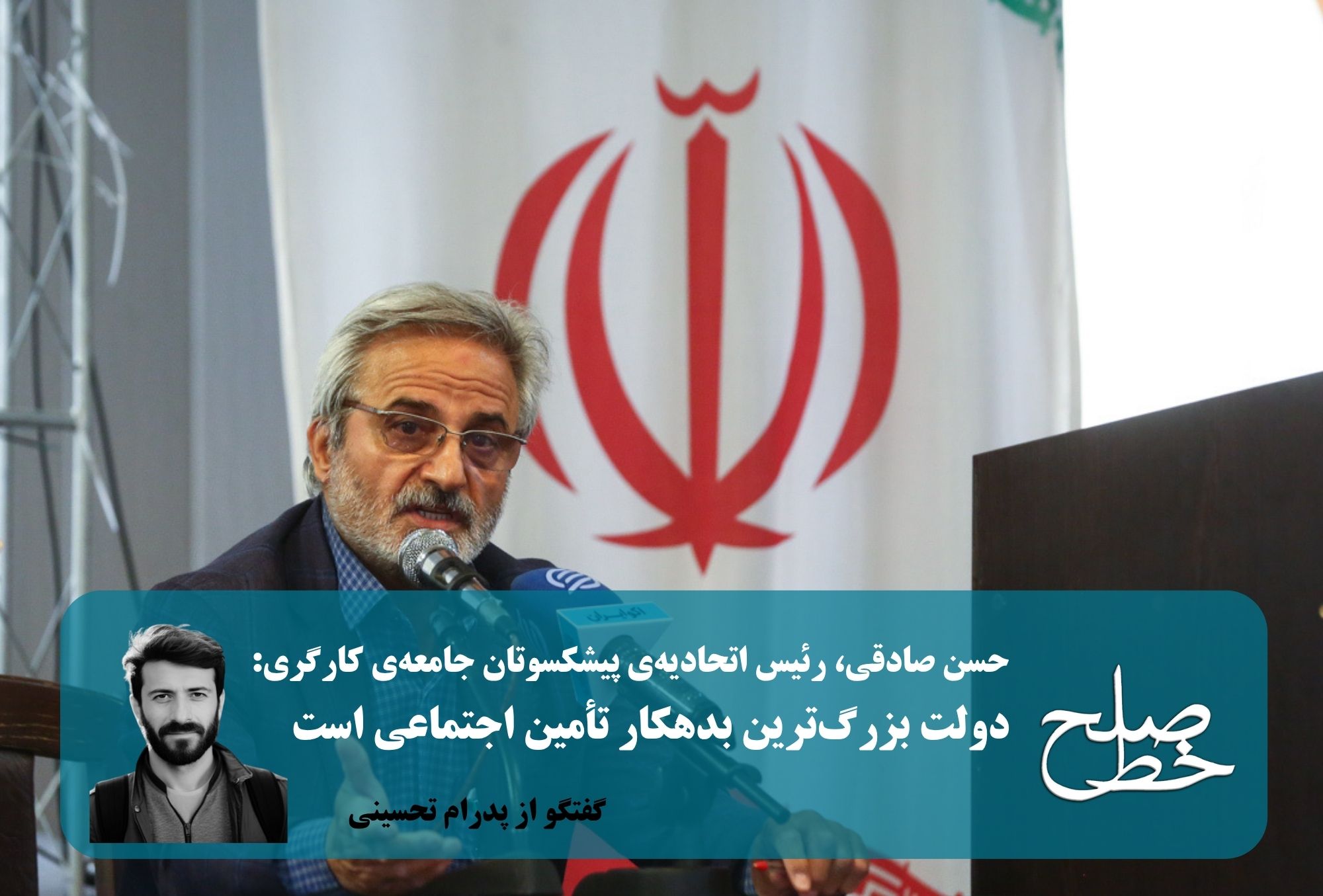
Hassan Sadeghi: The Government Is Social Security’s Biggest Debtor/ Pedram Tahassoni
In recent years, as the shadow of crisis has grown heavier over the country’s pension systems, conversations with those who have spent their lives working in this field have become all the more vital. The social security system, as one of the main pillars of social justice and economic sustainability, reflects—both in Iran and elsewhere—the relationship between the state, labor, and economic institutions. Understanding the reasons behind the erosion of this pillar, and seeking ways out of the current situation, is not just an analysis of one institution; it is a reconsideration of the future of welfare, labor, and national trust.
The following interview aims to explore the roots of the pension fund crisis, critique past policies, and outline a path forward for rebuilding an institution on which the lives of millions of workers and retirees depend. This conversation is with Hassan Sadeghi, Deputy Secretary-General of the Workers’ House and President of the Union of Veteran Workers—one of the most knowledgeable figures in the field of social security and its challenges.
Below is the full interview of Peace Mark Monthly Magazine with the President of the Union of Veteran Workers, regarding the outlook and challenges of Iran’s social security system:
Before we get to the main questions, let’s begin with this: As someone who has held responsibilities in labor affairs and is considered an expert in this area, what do you see as the main problem with the pension funds? Where did this problem begin, and why has it come to this point today?
The problem with Social Security began when the approach shifted from an insurance-based model to a welfare-based one. Governments transferred their responsibilities in welfare and labor-related areas onto the funds. This has led the funds to a point where they can no longer even cover the pensions of retirees or fulfill the obligations outlined in their own charters.
Why was this problem never solved? Why has it continued to this day? Is it that there were no solutions, or were there solutions that no one wanted—or was allowed—to implement?
When we take a broad view, if the national economy is in trouble, the funds will naturally suffer too. It was government economic policies that crippled the insurance institutions. Furthermore, governments failed to meet their obligations to the funds—especially the Social Security Organization. With funds dependent on the state, such as the Civil Servants or Steel Pension Funds, the government somewhat stabilized them through direct support and tax-based connections. But with Social Security, no such approach has been taken. Today, the government is the largest and primary debtor to the Social Security Organization. Thus, both the macroeconomic situation and the governments’ disregard for their commitments have brought us here. Today, the government owes Social Security approximately 990 trillion tomans, while an additional 50 to 70 trillion tomans are owed by the private sector—a result of economic conditions that have made it impossible for them to fulfill their obligations.
As you know, one of the main causes of imbalance in the funds is government debt. During your time at the union, was there any agreement with the government to resolve this issue—or plans for such an agreement?
According to Article 28 of the 1975 law, the government is required to contribute 3% annually in the national budget and deposit it into the Social Security account. When something is explicitly mandated by law, there’s no need for negotiation or agreement. The law is clear. For that reason, we consider Social Security a creditor and the government a debtor.
In the face of pressure to raise the retirement age and potential protests, how can parametric reforms (such as increasing retirement age or changing the pension formula) be implemented in a way that maintains intergenerational fairness?
Raising the retirement age isn’t an effective solution. The issues of the Social Security Organization won’t be resolved just by increasing years of service. We must first look at all three sides of the organization.
The first side is the economic aspect. Right now, the Social Security Organization has 360 companies, but they only yield about 1.3% economic return. In other words, only about 15 of them are profitable; the rest have failed to fulfill their commitments or deliver the expected profits to the organization. This situation needs to be reviewed. Social Security must move away from direct ownership and toward professional shareholder management.
The second side is the government, which needs to update and pay its debts. The government should create a five-year repayment schedule to gradually eliminate its massive debt and include these commitments in the annual budget, connecting Social Security to the tax system. Social Security cannot be funded solely through insurance—it needs to be funded through insurance and taxation.
The third side is parametric reform, which involves more than just age and years of service. The Social Security law itself needs to be revised. The 1975 law set a 7% contribution from workers, 20% from employers, and 3% from the government. Both the government’s and the workers’ shares need to be reassessed. Payment obligations must increase so the organization can maintain its current level of services. Of course, some of the supportive laws passed over the years to address specific problems must also be reconsidered. Provisions for early retirement, which have removed people from the workforce prematurely and shifted them to pension coverage, should be reviewed—though the rights of workers in mining or in jobs with chemical or acoustic hazards must be protected.
What are the pros and cons of merging pension funds? Do you think this could reduce administrative costs and increase efficiency?
If their payment models and administrative structures were aligned, maybe. But they’re not. For example, in the Social Security Fund, the worker contributes 7% and the employer 20%. How can we place that side-by-side with the Steel Fund and merge them? Their contribution structures and insurance methods are completely different. They’re not homogeneous, so they can’t be merged. Moreover, Social Security covers nearly 53% of Iran’s population. It must be treated as a special case, and the government’s approach should be both supportive and insurance-based—anchored in the tax system. Even if we merged the funds, if the government still fails to meet its obligations, the result would only be to accelerate Social Security’s bankruptcy. Their payout structures are also different.
What mechanisms have you adopted to follow up on survivor benefits, arrears, and financial transparency in the fund? Have you assessed how much of the fund’s shortfall stems from government obligations (such as unpaid debts or delayed allocations)? Have negotiations with the government made any progress?
Our long-standing focus has been on ensuring that the government and employers fulfill their commitments. Governments have tried to settle Social Security’s claims by transferring ownership of certain state-run production units. These units may once have been thriving, but due to economic conditions—sanctions and such—they eventually struggled. As I mentioned, those 360 units have, instead of resolving problems, become burdens on the Social Security Organization.
We have consistently criticized the government, urging them to pay the fund in cash. And if they do want to transfer shares, they should transfer profitable ones—so they can contribute to Social Security’s sustainability. Unfortunately, this issue has been largely overlooked, making it difficult to realize the goals we’ve long pursued.
Another point: when Social Security faces pressure, no group is more vulnerable than the workers and retirees—the rightful stakeholders. So, they become the target: the government starts picking at their already-small benefits, essentially holding their income hostage and adjusting it arbitrarily. We have always opposed this.
Instead of pressuring the government to pay what it owes, they reduce their commitments to the target community. We’ve always objected to this approach. At the same time, some supportive laws passed in the past—with our involvement—now need to be revised, to help extend the lifespan of Social Security.
If a realistic vision is outlined where all three defined sides—economic, insurance, and government commitments—move together toward reform and fulfill their obligations, Social Security can stand on its own until at least 2061 (1440 Hijri), providing effective services.
One criticism of the funds is the lack of transparency in their financial performance. How can communication with retirees and contributors be improved to increase transparency and build public trust?
Parliament has a supervisory system. Social Security itself has a supervisory body called the High Supervisory Board for Social Security Performance. Their reports confirm your point—that transparency has not been adequately ensured. Reports from this board often reflect a lack of transparency.
One of the long-standing demands of retirees has been precisely that both Parliament and the supervisory board should monitor and report on transparency. However, I believe that if the Shasta holding company—the economic arm of Social Security—moves from business ownership toward professional shareholder management, we’ll see much better transparency and definitely greater retiree satisfaction. Currently, the economic branch is just a haven for thousands of board members benefiting from positions, while delivering no real value to retirees or beneficiaries.
Has there been any polling or outreach among retirees to identify their financial reform priorities? If so, what were the results?
Yes. We’ve held many meetings with parliamentary representatives. Both the Speaker of Parliament and other MPs have acknowledged our concerns and offered their support. As a result, this year’s budget included nearly 200 trillion tomans in debt settlements—this was the result of our outreach, which made them realize the need to include part of the government’s obligations in the national budget. This dialogue continues between us and the Board of Trustees, the Social Security Supervisory Board, the Planning Commission, and the Labor and Welfare Commission. This has increased their sensitivity to the issue and led to greater oversight.
If you had the power to enact a major structural reform today (without political limitations), which element would you prioritize—justice in resource allocation, generational balance, ending business ownership, stronger oversight, transparency, or appointments reform?
I’m not a politician.
I meant regardless of political affiliation—as a senior expert in the field.
All of those elements are equally important. You can’t prioritize one over the other. I would consider all of them together, because the survival of Social Security for future generations depends on it. They are all top priorities. None outweigh the others.
Do you think the generational gap can be bridged? After all, the large 1980s generation is approaching retirement, putting extra pressure on the system.
Social Security is based on a very sound and expert-backed structure. The reason is that the 1975 law anticipated all of this. From the founding of the Workers’ Welfare Fund in 1951 (1330) to 1953 (1332), and its later renaming in 1975, the conventions embedded in this law provided a solid foundation. The current crisis comes from how we administered the system—not the structure itself. We’ve been using Social Security as a short-term fix for other problems, shifting the burden onto it. That’s the source of today’s issues—not that the system is inherently flawed.
So yes, if we reestablish the three pillars properly and manage them scientifically, Social Security can serve future generations. With minor reforms, it could provide satisfactory services until at least 2051 (1430 Hijri), provided we treat all the components you mentioned as equal top priorities.
The generation about to retire is large, which will add significant pressure. How can the less numerous younger generation fill the insurance contribution gap?
Right now, as I speak with you, there are 2.3 million Snapp and SnappFood delivery workers—motorcyclists—who aren’t insured. We have uninsured housewives and women heads of household. Many construction workers and drivers also lack insurance. If we extend insurance coverage beyond mandatory plans—using commercial insurance as well—Social Security will be able to support the next generation.
But we must focus on expanding the scope of social insurance and block insurance evasion. Right now, the support ratio is declining because of insurance evasion, economic stagnation, and lack of investment.
Naturally, if the country experiences economic growth, Social Security will thrive and have more impact. As you know, in all insurance and social security institutions, the driving engine is the economy. Our governments have yet to understand that Social Security can be a powerful tool for economic development, solving social issues, and reducing poverty and inequality.
Unfortunately, in recent decades, the government has failed to meet its obligations and has become the largest debtor to the Social Security Organization.
Thank you for taking the time to speak with Peace Mark Monthly Magazine.
 Created By: Padram Tahsini
 October 23, 2025
Tags
expensive Increase in retirement age Paragraph peace line Pedram Tahsini Poverty and inequality Retirement Retirement boxes Social security 2 Social Security Organization Swelling Worker's house ماهنامه خط صلح