


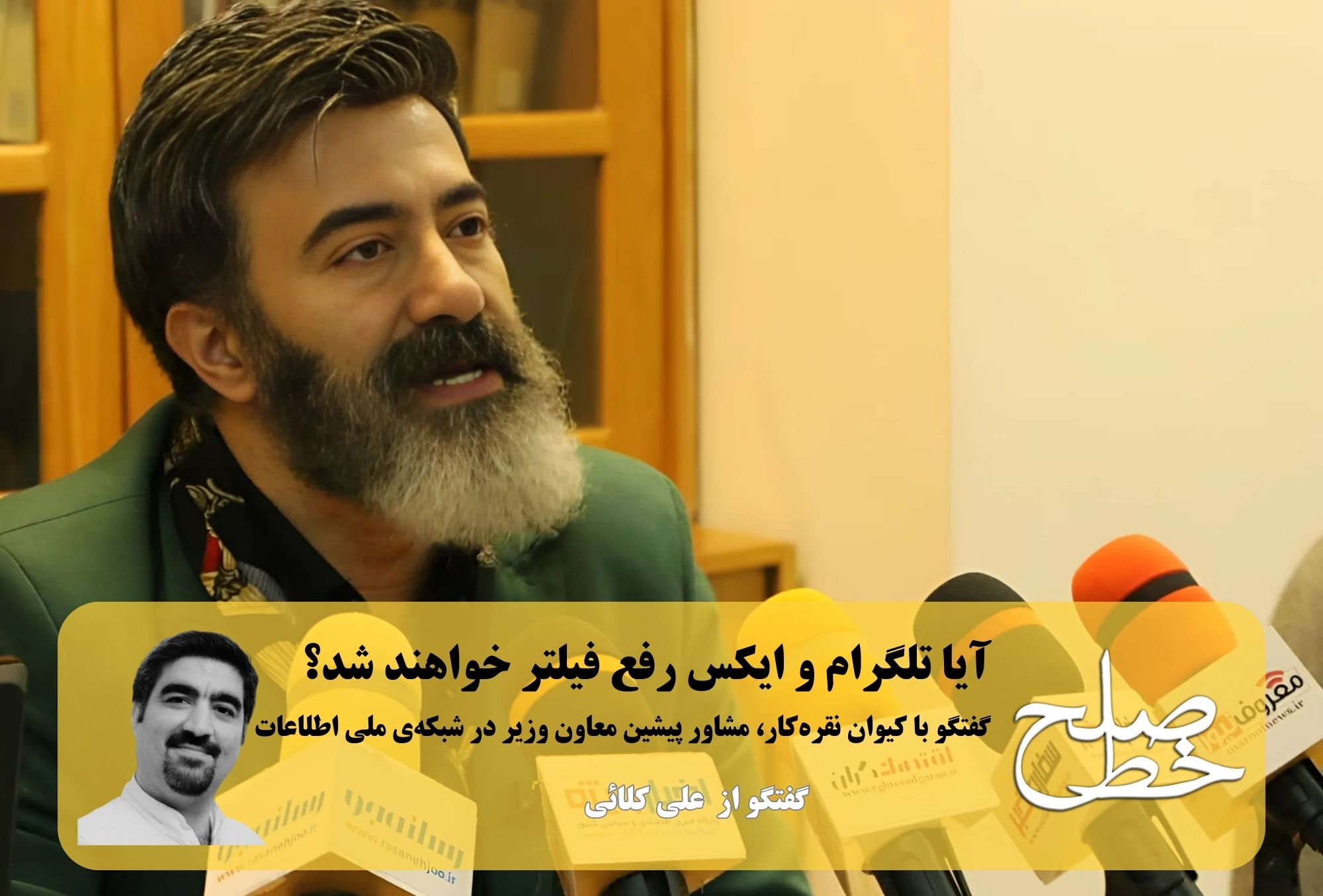
Will Telegram and X Be Unblocked? An Interview with Keyvan Noghrehkar/ Ali Kalaei
The issue of filtering and removing restrictions on various internet platforms has been a highly debated topic in Iran over the past few years. While the Minister of Communications has stated that lifting the ban on all platforms is on the government’s agenda—and recently, WhatsApp and Google Play were unblocked—public opinion and observers are left questioning whether we can expect other platforms to follow suit soon. Which platforms will take precedence, and, in a country where many citizens already have access to VPNs, what purpose does filtering serve?
To explore the various aspects of this issue, Peace Mark Monthly Magazine conducted an exclusive interview with Keyvan Noghrehkar, a digital media expert and former advisor to the Ministries of Industry, Mines, and Trade, as well as Communications. Mr. Noghrehkar, who has hosted and provided expert commentary on numerous technology programs for national radio and television networks, analyzed the reasons for filtering, the role of government and other authorities, the influence of economic cartels, and the consequences of filtering on businesses. He also discussed the national information network and the development of the internet in Iran, presenting his views on current strategies and future prospects.
Below is the full text of Peace Mark Monthly Magazine’s interview with Keyvan Noghrehkar.
The Minister of Communications has stated that unblocking platforms is on the government’s agenda. Recently, WhatsApp and Google Play were unblocked. Can we hope that other platforms will also be unblocked in the near future?
Filtering has been a long-standing issue in our country. It’s not just about WhatsApp and Google Play—which were recently unblocked after being filtered for years—but a broader context that prevents us from assuming all platforms will be unblocked in a short period. For instance, YouTube, Twitter (X), and Facebook have been under the filtering regime in Iran almost since their inception. So, unblocking many of these platforms might not be a priority. For users, Instagram might be the most pressing platform to unblock, as it was filtered more recently and serves as a key hub for many businesses.
However, more critical than the timeline is understanding the reasons for filtering. These reasons reveal that filtering goes beyond the government’s scope. With this in mind, we can evaluate whether the government is capable of lifting the filtering or not.
Filtering occurs for various reasons, including political and security-related concerns, which are distinct issues. The security perspective involves certain views about specific messaging apps and social networks. Politically, there’s a diplomatic angle, questioning why we should rely on foreign applications when domestic alternatives exist. Additionally, religiously motivated groups advocating for filtering are influential and powerful.
Finally, economic cartels, which have emerged from the sale of VPNs in recent years, often play a stronger role than the aforementioned groups in maintaining the filtering regime to expand VPN use. Consequently, unblocking platforms might not happen soon—or even be considered necessary. From an optimistic standpoint, Instagram seems to be the first candidate for unblocking. Telegram, on the other hand, is unlikely to be unblocked, and while YouTube may face fewer political and security concerns due to the existence of local alternatives like Aparat, religious sensitivities could keep it filtered. Twitter (X) and Facebook, due to their heavier political weight, are also unlikely to be unblocked. Based on these factors, we can speculate on the future of social media platforms in Iran.
Do you believe Instagram will be the next platform to be unblocked, given the current trends?
If government officials, the Ministry of Communications, and the administration aim to restore economic activity and rebuild public trust, Instagram is an excellent candidate. It was widely used until recently and played a significant role in many business operations, contributing to the economic livelihood of account holders on the platform.
If Telegram were to be unblocked, its more robust features and advantages would bring heightened political and security concerns. WhatsApp, now unblocked, is much more transparent, with features like phone numbers visible, making it less politically and security-sensitive. Google Play’s unblocking is relatively insignificant in comparison.
It seems the government has approached this issue cautiously. While WhatsApp and Google Play have been unblocked, Instagram, Telegram, and other platforms remain filtered. This strategy allows the government to claim it has kept its promises while simultaneously satisfying the four influential groups—security, political, religious, and economic. Given that a large portion of the population already uses filtered platforms like Instagram, Telegram, and Twitter (X) via VPNs, the continuation of filtering also sustains the demand for VPNs. In this light, the unblocking of WhatsApp hasn’t brought any major changes, and further developments seem unlikely.
In the past, we’ve seen Google and Gmail filtered. Users once woke up to find they couldn’t even access their emails. What is the root cause of this pervasive filtering?
As you mentioned, there have been instances where the entire internet was effectively shut down for days. The reasons vary. Sometimes, security concerns drive the decision to cut off internet access entirely. Other times, political factors tied to the ruling administration play a role.
During the tenure of Minister Taqipour, for example, the focus on the national information network and localized internet services (such as a national email service, operating system, or search engine) led to cutting off access to foreign platforms to push users toward domestic alternatives. At the same time, significant budgets were allocated to these projects, creating financial incentives for some. These efforts were often portrayed positively by the media, which in turn encouraged the government to continue, despite the psychological and financial toll on citizens. Ultimately, these projects failed, squandering large sums and causing public frustration.
During President Rouhani’s administration, the situation improved slightly, though Telegram was filtered during this time due to national security concerns. Such decisions are often tied to broader government policies rather than individual administrations. Understanding these dynamics helps us identify the underlying reasons for filtering and how it might be addressed.
Many citizens, regardless of age, use VPNs to bypass filtering. Given this reality, does filtering achieve anything?
In my view, it does not. From one perspective, social networks are not inherently security threats; while they may spark some activity, their overall impact is not significant. Yet, the belief that they pose political and security risks persists among decision-makers, justifying the continuation of filtering.
However, public use of social networks often focuses on business, education, and entertainment. If we look at the data, the top priorities for Iranian users on these platforms are entertainment, education, and, to a lesser extent, other topics. The more open the space, the greater the potential economic benefits. With more accessible tools, security concerns would naturally diminish.
You mentioned economic cartels in relation to filtering. How significant is their influence?
Their influence is undeniable. Currently, economic cartels exert far more power than security, political, or religious motivations. These cartels, benefiting financially from VPN sales, actively work to maintain the filtering regime and even influence decision-makers to uphold filtering policies.
VPN sales generate substantial revenue, creating a powerful incentive for these groups to perpetuate the current situation. These cartels leverage their financial power through media and social platforms, influencing policymakers who, in turn, ensure filtering remains intact.
During elections, promises to lift filtering are often made. Who ultimately holds responsibility for the current state of filtering?
This issue resonates with voters and serves as a tool for electoral campaigns. Reformists aim to relax restrictions, while conservatives uphold their traditional policies. However, filtering is ultimately a governance issue, decided by bodies like the Supreme Council of Cyberspace. The council’s composition includes government representatives alongside other influential members, meaning decisions do not solely rest with the administration.
Filtering platforms like Instagram and Telegram has severely impacted small businesses. Shouldn’t we prioritize lifting these restrictions to support the economy?
Absolutely. Platforms like Instagram and Telegram, with their features and flexibility, can significantly boost small and medium-sized businesses, as well as larger enterprises. Unblocking these platforms would undoubtedly foster economic growth.
After WhatsApp was unblocked, the idea of “class-based internet” emerged. What are your thoughts on this?
This concept ties back to economic cartels. When filtering exists, users turn to VPNs, which come with a cost, fueling a cycle of revenue. The government, seeking to profit, imposes higher fees for accessing certain unblocked platforms, creating a dual cost burden for users—VPN expenses and elevated internet costs. This approach benefits the government while sustaining filtering and satisfying other influential groups.
Finally, is transitioning to a national internet feasible given Iran’s infrastructure and resources?
To clarify, if the aim is to emulate North Korea’s closed internet model, that won’t happen. Iran’s internet infrastructure relies on broader connectivity. However, a national information network, like those in South Korea, China, or Russia, can be beneficial if implemented correctly.
The goal should be to store sensitive domestic data (e.g., medical, financial, or educational) on local servers while maintaining high-speed, affordable internet. Unfortunately, current efforts have not yielded the intended quality or affordability, leaving room for improvement.
Thank you for your time and insights.
 Created By: Ali Kalaei
 January 20, 2025
Tags
Ali kalaei Censorship Facebook Filter breaker Filtering Filtering Mafia Freedom of speech Google Play National Information Network Social media Social networks Telegram Twitter Virtual space VPN WhatsApp X YouTube فساد ماهنامه خط صلح