


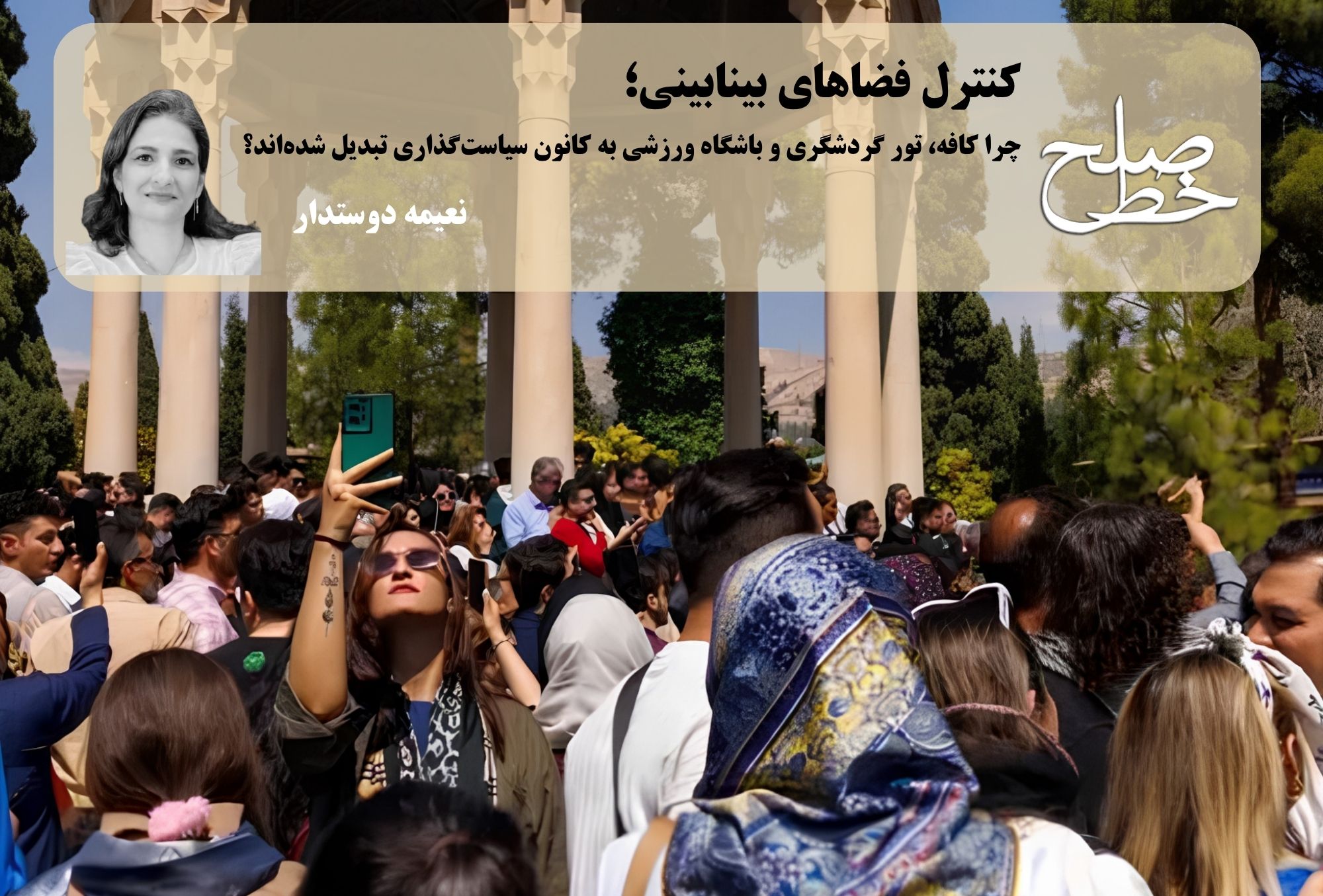
Why Have Cafés, Tourism Tours, and Sports Clubs Become Focal Points of Policymaking?/ Naeimeh Doustdar
Between July 11 and August 1, 2026 (20 Tir to 10 Mordad 1405), at least 72 well-known pages and accounts on Iranian social media were blocked or seized, the administrators of at least 21 pages were forced to publish pledges, and at least 23 business establishments in different cities were sealed. The scope of the measures extended from bloggers and online businesses to cafés, sports clubs, fashion and beauty activists, and tourism tour organizers. In Qazvin, police also reported action against 56 Instagram pages, and in Rasht more than 3,000 pieces of content were removed from pages belonging to 32 business establishments. According to a report by HRANA (1), these figures represent the minimum identifiable cases, and because some measures overlap, they cannot be added together.
At first glance, the cases are different: a café is sealed because women without mandatory hijab were present, the page of a tourism agency is blocked after publishing images of women with optional clothing, a sports coach or blogger is summoned by police, and the owner of an online business is forced to remove content and publish a pledge. When these cases are placed alongside one another, it appears that a significant part of the Islamic Republic’s social control apparatus is now focused on places and activities that do not appear political on the surface.
These spaces occupy a special position. Cafés, clubs, tourism tours, Instagram pages, and many cultural and service businesses are spaces between private life and the formal public sphere. They are neither homes, where the government faces greater restrictions on entry, nor official institutions, where government rules are already established. In these intermediate spaces, citizens meet one another, see different ways of life, and in practice create norms that do not necessarily correspond with the government’s official norms.
When Disobedience Moves from the Street into Everyday Life
The “Woman, Life, Freedom” movement fundamentally changed the government’s relationship with these spaces. Its most important social consequence was not limited to street protests. One of its most lasting results was the transfer of disobedience from moments of protest into everyday life. For a significant number of women, not wearing mandatory hijab shifted from being an exceptional and costly act to becoming part of ordinary life.
In recent months, there have even been reports of a noticeable decline in the presence of officers associated with hijab enforcement on the streets of major cities. In Tehran, women without headscarves were present on streets, in restaurants, and in cafés, and this situation, despite the fact that the mandatory hijab law had not been repealed, had become part of the city’s everyday reality. The law known as the “Hijab and Chastity” law, despite having been passed, was not implemented, but previous laws and mechanisms for dealing with women and businesses remained in place.
This situation has created a fundamental problem for the government. If a law formally remains in force but is routinely violated by a large part of society, the issue is no longer only the implementation of that law; the authority of the institution that enacted it is also called into question. From this perspective, hijab for the Islamic Republic still goes beyond a dress code, but the government’s ability to determine the boundaries of legitimate conduct in the public sphere is under question.
However, broad and direct confrontation with women in the streets after the experience of the 2022 (1401) protests carries a high political cost. Taking action against businesses offers the government another route: transferring part of the cost of enforcing coercion from the state to society.
When a café is threatened with closure because of customers’ clothing, the café owner is effectively pressured to play the role of a monitor. When a tourism agency may face the blocking of its page or a judicial case because of passengers’ clothing, the tour organizer is forced to control customers’ behavior. The same logic applies to gyms, beauty salons, restaurants, and other business establishments. In such a model, the government does not need to have an officer on the street monitoring every woman; it delegates part of the surveillance to business owners.
The HRANA report (1) provides clear signs of such a pattern. In multiple cases, page blocking, content removal, compulsory pledges, and the sealing of business premises occurred simultaneously or within a short period of one another. Some individuals have also said that after being summoned, their mobile phones were examined, content identified by officers was removed from their accounts, and they were then required to publish pledges.
This method represents a kind of “distribution of control”: social control is transferred from the official officer to the café manager, tour organizer, shop owner, and club manager, creating a network of self-control and mutual monitoring.
Why Now?
The timing of these measures is also significant. The period of war and security crisis, for various reasons, was accompanied by a relative retreat by the government in some social areas. Reports from Tehran in late June and early July described a widespread presence of women without mandatory hijab and a noticeable decline in direct intervention. Even in some government-organized gatherings, women without hijab appeared in images published by official media.
But afterward, the measures intensified once again. Seven cafés in the Sanaei and Iranshahr Street areas of Tehran were sealed on July 20, 2026 (29 Tir 1405). In other cities as well, cafés and business establishments were shut down for reasons including the presence of women with optional clothing, playing music, or what officials called “failure to observe Islamic proprieties.”
This shift can be analyzed within the framework of rebuilding authority after a period of crisis. Governments in wartime conditions may temporarily push some internal conflicts to the margins in order to increase social cohesion or avoid opening a new front at home. But a temporary reduction in pressure does not necessarily mean a policy change. After the emergency subsides, the political apparatus may try to reestablish boundaries that receded during the crisis.
In Iran’s case, this issue is accompanied by an additional difficulty: society has not remained at the point where it stood before the war. The presence of women without hijab has become more normalized in many cities, and fully reversing this change would require a much greater cost than before. Under such conditions, pressure on intermediary spaces may be a lower-cost alternative to restoring widespread patrols and direct street confrontation.
Of course, there is still no public document proving that all recent measures resulted from a single centralized directive, and the HRANA report (1) also emphasizes this limitation. But the geographic scope of the measures, similarities in methods, repeated use of expressions such as “norm-breaking,” “contrary to public decency,” “society’s psychological security,” and “culturally harmful content,” as well as the simultaneous involvement of institutions such as FARAJA, the Cyber Police, the Public Places Supervision Police, FARAJA Intelligence Organization, and judicial authorities, at least point to the existence of a common pattern.
It is not only the number of closures that matters. The temporary closure of a few establishments can affect the behavior of hundreds or thousands of other businesses. A café owner who sees a similar establishment closed because of customers’ clothing may impose restrictions before receiving any warning. A tour organizer refrains from publishing travel images. A sports coach cancels a group program, and a blogger modifies content in advance. In this way, the “chilling effect” of enforcement can be far broader than the number of official cases.
This is also the point at which social control policy becomes intertwined with the economy. Sealing a café cuts off the income of the business owner and employees, and blocking the page of a shop or tourism agency can directly eliminate its customer acquisition channel. In an economy where small businesses are already facing declining purchasing power, instability, and internet disruptions, the threat of closure is a powerful tool for compelling them to cooperate. Reports from café owners also indicate that closures, under conditions of recession, unpaid rents, and declining customer numbers, create additional economic pressure.
In this way, private businesses become an intermediary link between the state and citizens: the government asks business owners to enforce rules whose direct implementation in society has become difficult and costly.
Politics Over “Ordinary Life”
From this perspective, what is happening today in cafés, tourism tours, sports clubs, and social networks is not merely a dispute over hijab or a collection of business violations. The main conflict concerns the definition of “ordinary life.”
For a large part of society, a woman sitting in a café without a headscarf, women and men running together in a sports event, group travel, or posting images of everyday life on Instagram may no longer be considered political acts. It is precisely this normalization that becomes problematic for a system that has derived a significant part of its ideological identity from regulating public behavior. When behavior the government considers prohibited becomes a social norm without political organization or even an explicit declaration of protest, controlling it becomes more difficult than suppressing a specific gathering.
This is why intermediary spaces become important. These are places where social change can multiply without parties, organizations, or demonstrations. People see one another, new behaviors gain social legitimacy, and the boundary between “norm-breaking” and ordinary life shifts.
The removal of benches and seating areas in front of some cafés on Sanaei and Iranshahr streets after the wave of closures, if viewed alongside the other measures, becomes meaningful from this perspective. The issue is not only the economic activity inside a business establishment; the way citizens occupy and use the city is also contested.
This policy, however, faces a fundamental contradiction. The Islamic Republic can close a café, block a page, or force a tour organizer to sign a pledge, but to return society to its condition before “Woman, Life, Freedom,” it would have to change behavior that, in parts of society, has moved beyond protest and become an everyday habit.
For this reason, the new wave of enforcement may perhaps be understood less as a sign of the complete power of the control apparatus and more as a sign of the difficulty it faces in restoring previous boundaries. The government still possesses extensive judicial, law enforcement, and economic tools, but it is now confronting a society that has, in practice, set aside part of the official rules.
Footnote:
1- From Blocking Pages to Sealing Cafés: A New Wave of Pressure on Cyberspace and the Public Sphere, HRANA News Agency, August 1, 2026 (10 Mordad 1405).
 Created By: Naeimeh Doustar
 August 23, 2026
Tags
Social control