


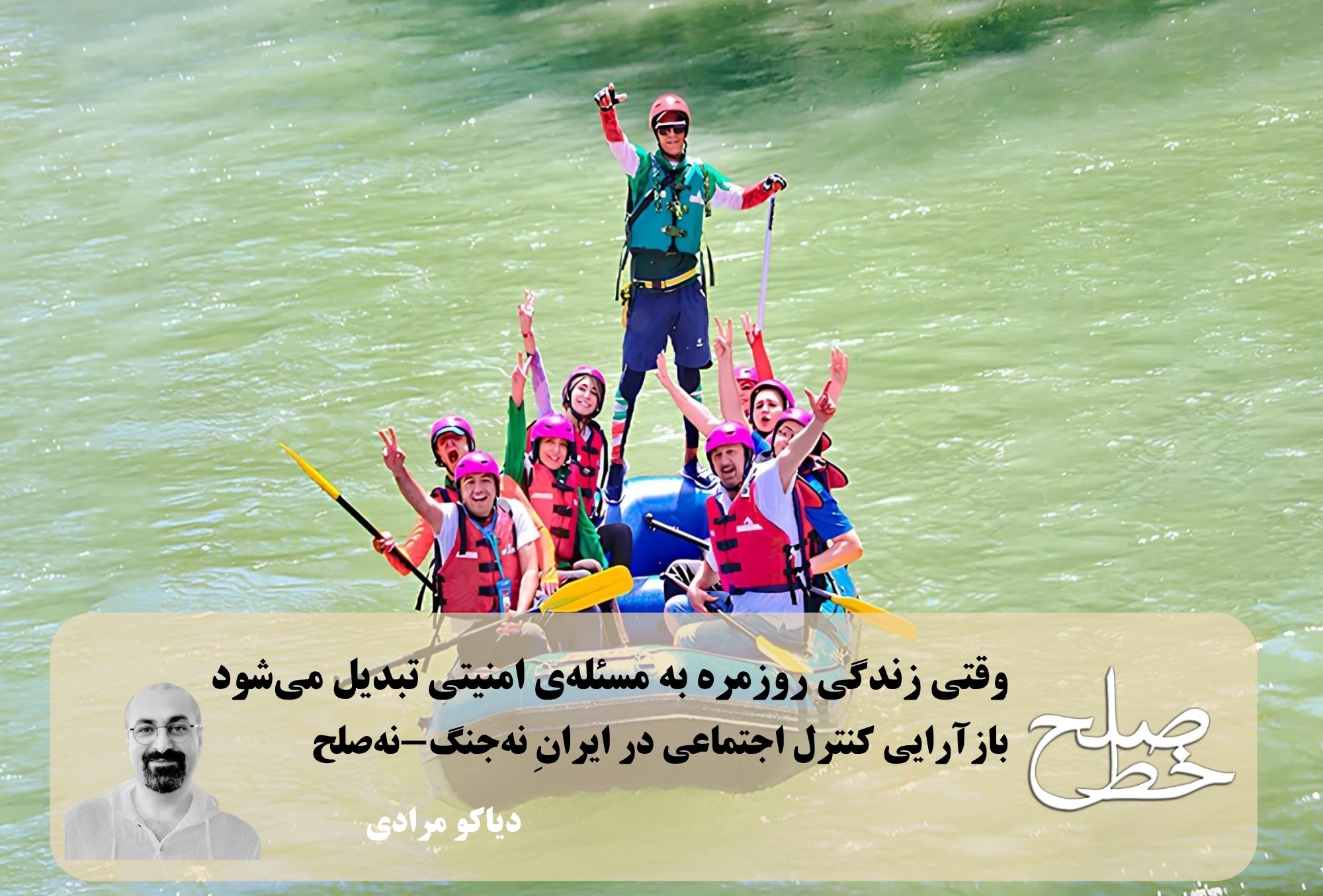
When Everyday Life Becomes a Security Issue/ Diako Moradi
In recent months, as the discourse of war has relatively subsided, significant signs have emerged of intensified government intervention in areas that, at first glance, are not directly political: the sealing of cafés and café-bookstores, measures against tour operators, the blocking of Instagram pages, the summoning of bloggers, removal of content, compulsory pledges, and pressure on online businesses. Viewed separately, each of these incidents could be explained in commercial, judicial, or cultural terms. But considered together, they raise a more important question: in the current state of “neither war nor peace,” is the Islamic Republic restructuring its policy of social control and shifting it from the sphere of direct political repression into the realm of everyday life?
Drawing on documented human rights reports and concepts such as governmentality and biopolitics in the thought of Michel Foucault, the right to the city in Henri Lefebvre’s theory, the public sphere in the thought of Jürgen Habermas, and theoretical literature on preventive control in authoritarian systems, this article examines the proposition that the recent wave cannot simply be regarded as a “return to cultural restrictions.” The deeper issue is the control of spaces, networks, and relationships through which society can reproduce itself independently of the state.
Within this framework, a café is not merely a place to drink coffee, just as Instagram is not merely a medium for publishing images and a tourism tour is not merely a recreational activity. These spaces can provide opportunities for meeting, building trust, representing different ways of life, and creating horizontal networks. From this perspective, the recent wave can be seen as part of a shift from the “repression of protest” toward the “management of the possibility of collective action” and, at a deeper level, the restriction of social autonomy.
The human rights significance of this trend lies precisely here. The issue is not merely the number of businesses sealed or pages blocked; it is the expansion of state intervention into freedom of expression, privacy, gender equality, freedom of assembly and association, the right to equal enjoyment of public space, the right to participate in cultural life, and the right to livelihood. Ultimately, what appears on the surface to be a dispute over a headscarf, an Instagram image, or a few café tables returns to a more fundamental question about the boundary between state power and society’s right to live its own life.
Introduction
In recent months, alongside news about war, foreign policy, sanctions, and the economic crisis, seemingly smaller but persistent reports have emerged from different parts of Iran: a café is sealed, a blogger’s page becomes inaccessible, a tour operator faces restrictions, thousands of Instagram posts are removed, a business owner is forced to publish a pledge, and several cafés in one urban area are shut down almost simultaneously.
None of these incidents, on its own, is sufficient to establish the existence of a single, centralized policy. Such a claim would require more documents and evidence from within the Islamic Republic’s decision-making structure. But in analyzing social control policies, it is not always necessary to wait for a document titled “nationwide directive.” Recurring patterns, geographical scope, similarities in the language used, and the presence of a relatively consistent set of law enforcement, security, and judicial institutions can themselves be subjects of analysis.
A detailed report by the Human Rights Activists News Agency (HRANA), covering the period from July 11 to August 1, 2026 (20 Tir to 10 Mordad 1405), provides one of the clearest available pictures of this trend. (1) According to the data compiled in this report, during this short period alone, at least 72 widely followed social media pages or accounts were blocked, seized, or made inaccessible; the administrators of at least 21 pages were forced to publish pledges; and at least 23 business establishments were sealed. HRANA emphasizes that some of these figures overlap and should not be added together. At the same time, these statistics do not include every case. For example, police in Qazvin reported action against another 56 Instagram pages, while in Rasht the removal of more than 3,258 posts from the pages of 32 business establishments was reported. Because the names of these accounts were not published, they were not included in HRANA’s main statistics.
The diversity of the groups targeted by these measures is also significant. According to the same report, approximately 25 cases involved bloggers and content creators, 19 involved commercial and service businesses, 10 involved fashion and beauty, nine involved sports, five involved art and music, and four involved tourism and nature excursions. This diversity indicates that the phenomenon is not confined to a single profession or a particular form of social activity.
The language used to justify these measures is also noteworthy: “norm-breaking,” “contrary to public decency,” “the psychological security of society,” “culturally harmful content,” “unhealthy advertising,” and “contrary to public morality and decency.” The legal problem with these terms is not merely their conservative nature; the principal problem is their capacity for extremely broad interpretation. The more ambiguous the definition of a violation, the more flexible the boundaries of the enforcing authority’s powers become, and the more difficult it is for citizens to predict what conduct is permitted and what is prohibited.
This is where the central question of this article emerges: why, under current conditions and as the discourse of war has relatively subsided, has pressure on these areas of everyday life increased? Is the issue merely mandatory hijab and “public decency,” or are we witnessing a broader phase of social control?
This article proceeds from the assumption that understanding the current trend requires moving beyond a simple “repression/freedom” dichotomy. The Islamic Republic continues to use classical instruments of repression—arrest, imprisonment, judicial sentences, and severe punishments—but alongside them operates a set of quieter tools: sealing businesses, commercial warnings, pledges, content removal, page blocking, threats to revoke licenses, and transferring responsibility for controlling citizens’ behavior to business owners.
At this level, the issue is no longer merely punishing a person after an act has been committed; it is shaping the behavior that the person will choose before any intervention takes place.
From Repressing Opponents to Governing Everyday Life
To understand this shift, Michel Foucault’s concept of “governmentality” provides a useful analytical tool. Power in modern society does not appear only in the form of police, prisons, and direct commands. One of the most effective forms of power emerges when individuals internalize the rules desired by those in power in their everyday conduct and regulate themselves before any officer intervenes. In such a model, the objective is not merely punishment; it is the production of predictable behavior.
This distinction is important for understanding the recent wave. If a café owner faces the risk of closure because of a customer’s clothing, there is no longer any need for an officer to remain permanently beside every table. To protect their investment, employees, and income, the café owner is compelled to assume part of the responsibility for implementing government policy. The same logic applies to tourism tours. If publishing an image of women without mandatory hijab can result in an agency’s page being blocked, the tour operator will, on the next trip, think not only about the quality of the journey but also about the conduct, clothing, and photographs of the travelers. The situation is similar for online businesses. Before posting a photograph, a content creator asks: Could this image be deemed an instance of “norm-breaking”? Could the page be shut down? Could the audience I have spent years building disappear? Here, power is no longer located only outside the individual. It has entered their everyday calculations.
Some accounts collected by HRANA make this mechanism more tangible. The owners of certain pages have said that they were first summoned by telephone, their phones were examined, and in some cases an officer used the same phone to access the account, remove the targeted content, and publish a pledge. In other cases, orders to remove content and publish a pledge were communicated by telephone.
The significance of the pledge lies precisely here. A pledge is not merely an administrative document. The individual must announce to their audience that they have accepted the boundary established by those in power. In this way, punishment is transformed from a private matter into a public display of discipline.
But this process also has a very serious legal dimension. In a legal system based on the rule of law, citizens must be able to predict which acts are prohibited, what the legal basis for a restriction is, which authority issued the order, and how they can challenge it. Widespread use of elastic terms such as “norm-breaking” or “cultural harm” diminishes this predictability.
Article 19 of the International Covenant on Civil and Political Rights, to which Iran is also a party, does not categorically prohibit restrictions on freedom of expression, but it establishes specific conditions for such restrictions: they must be provided by law, pursue a legitimate aim, and be necessary and proportionate. Consequently, the mere fact that an expression is considered undesirable or incompatible with the official conception of morality is not sufficient to justify every form of restriction. This is precisely where a matter of cultural policy becomes a human rights issue.
When the boundaries of prohibition are unclear, citizens behave not according to the law, but according to what they anticipate those in power will demand. And when a person must constantly guess at invisible red lines, self-censorship is no longer a personal choice; it becomes part of the mechanism of governance.
From this perspective, the recent wave can also be understood as a shift from “control through punishment” toward “control through uncertainty.” Citizens do not know precisely when or why they may be targeted, and this uncertainty can restrict their conduct more extensively than an explicit prohibition would.
This mechanism has another consequence: transferring the cost of implementing policy from the government to society. Police do not need to monitor every woman in every café; the café owner does it. There is no need for every tour to be placed under direct surveillance; tour operators learn what must not be seen. There is no need to censor every online page; a few highly visible cases are enough to make thousands of people more cautious. In this situation, power becomes dispersed, but it does not become weaker. On the contrary, it operates through society itself.
Cafés, the Right to the City, and the Struggle Over Public Space
Cafés are perhaps the clearest example through which to observe this transformation. On July 20, 2026 (29 Tir 1405), at least seven café-restaurants in the Sanaei and Iranshahr areas of Tehran were sealed: Joe Café, 1401, Sam Café, Do Bar, Maan, Novok, and Theory. Published reports did not provide a uniform explanation for these measures, citing reasons ranging from failure to observe “Islamic proprieties” and mandatory hijab to commercial violations.
A few days later, reports emerged about the removal or demolition of platforms, planters, and outdoor seating areas in front of some cafés on Sanaei Street, as well as the removal of benches on Iranshahr Street. Due to insufficient information, it is impossible to state with certainty that all of these measures formed part of a single decision. Their timing, however, raises a question that goes beyond the status of a few businesses: is the issue merely a café’s violation, or has a particular form of “gathering” itself become a source of sensitivity?
Henri Lefebvre’s concept of the “right to the city” helps illuminate this issue. In this view, a city is not merely a collection of buildings, streets, and infrastructure managed by the state or municipality. A city is produced through the lives of those who inhabit it. Citizens are not merely consumers of urban services; through their presence, social interactions, culture, memories, and relationships, they participate in producing the meaning of the city. The right to the city, therefore, is not merely the right to move through the streets; it is also the right to remain in the city. The right to sit, to be seen, to meet, to build relationships, and to experience difference.
It is from this perspective that cafés become significant. For many young people, a café is not merely a place to drink coffee. It is a space between the home and formal institutions—a place where a person can sit with friends for a few hours, study, work, listen to music, have a romantic relationship, or simply be among others. Cafés should not be romanticized. Many cafés in Tehran are commercial and class-based, and access to them is not equal for all citizens. But these limitations do not erase their social importance. In a city where many forms of young people’s presence in public space are subject to surveillance, cafés have become important spaces for social interaction.
From this perspective, Tehran is not a uniform city. One can speak of a kind of cultural geography within it. Some spaces are closer to official, religious, and governmental culture; others are gathering places for Generation Z, students, artists, writers, and groups with different ways of life, with a broad spectrum between the two. This distinction should not be reduced to a simplistic division between “Hezbollah cafés” and “opposition cafés.” Such a binary distorts the city’s social reality. Many of those who sit in cafés in Iranshahr or Sanaei are not politically active at all. Indeed, the importance of the issue lies precisely in its non-political nature.
A society is truly pluralistic when people are not required to explain their political identity before being able to live differently. A religious café should have the right to operate, just as a café with different music, clothing, and customers should enjoy the same right. The human rights issue begins when one of these ways of life enjoys greater structural security while another is constantly exposed to warnings, closure, or intervention. At that point, we are dealing with something beyond cultural disagreement: inequality in the right to enjoy the city.
Jürgen Habermas’s concept of the “public sphere” can also be introduced here. In a broad sense, the public sphere is a space where people communicate with one another outside the formal structures of the state and discuss shared affairs, culture, and their lives. Historically, the European café was one of the classic examples of such a space.
Tehran’s cafés cannot simply be equated with that historical experience, but they share one characteristic: the possibility of horizontal communication. Political power generally controls vertical communication more easily. The state speaks to citizens, official media produce messages, and administrative institutions issue orders. Horizontal communication among citizens, however, is more difficult to control. Cafés, bookstores, gyms, nature excursion groups, and social networks provide precisely this possibility for horizontal communication. From this perspective, even if no political discussion takes place in a café, that space remains part of society’s capacity for independent communication.
Civil society is likewise not limited to registered human rights organizations or political parties. Civil society is made up of thousands of small relationships: groups of friends, local associations, cafés, sports clubs, hiking groups, bookstores, artistic networks, and online communities. These relationships build trust, and trust produces social capital. Social capital is not inherently directed against the government, but a society with independent networks and trust will also possess a greater capacity for collective action in moments of crisis.
This helps explain why an “ordinary space” may acquire significance from a security perspective. The issue is not necessarily that a revolution is being planned in a café, but rather that society is communicating with itself there without the government.
From “Woman, Life, Freedom” to the Politics of the Body: When Disobedience Becomes Everyday Life
No analysis of the recent wave would be complete without considering the “Woman, Life, Freedom” movement. One of the movement’s most important consequences was not merely several months of street protests; it was a transformation in the relationship between a significant part of society and government commands. This change is perhaps more visible in the issue of hijab than anywhere else.
Mandatory hijab remains part of the Islamic Republic’s legal structure, but in the everyday life of Iranian cities, a significant number of women have decided to abandon it. A gap has emerged between “official law” and a “changing social norm.” This gap creates a fundamental problem for the government.
A state can have a law, but a law has social power only when it is either accepted or can be effectively enforced. When large numbers of people routinely disregard a rule, the issue is no longer merely individual violation; the normative authority of the law itself is called into question.
Here, Foucault’s concept of “biopolitics” becomes important. Modern power does not govern only territory; bodies, health, sexuality, population, and ways of living also become objects of politics. In the Islamic Republic, hijab has never been merely a matter of covering hair. It has been part of a gender order through which women’s presence in public space has been defined and regulated. The “Woman, Life, Freedom” movement fundamentally challenged this relationship. This is precisely why its slogan went beyond a limited demand concerning clothing. “Life” was placed at the center: who decides about the body and the way one lives? Afterward, disobedience to mandatory hijab in many places shifted from an exceptional form of protest into everyday conduct, and this change may be more difficult for those in power to confront than temporary protest. A street demonstration can be dispersed, a political leader can be arrested, or an organization can be banned. But how can millions of everyday decisions be controlled?
A practical answer can be seen in some current policies: if directly controlling every individual is difficult, the social environment surrounding them is controlled instead. The café must control the customer’s hijab. The tour must control the traveler’s image. The shop must control its model. The gym must control the athlete’s clothing. The online page must control what is visible. In this way, control shifts from the woman’s body to the network in which she lives.
The case of Dalahoo Travel Agency is noteworthy from this perspective. The agency’s Instagram page was blocked after it published photographs of women without mandatory hijab on tours, and the page’s content was removed. Several other activists and organizations in the tourism sector were also among the documented targets of these measures. This policy sends business owners a clear message: the cost of a customer’s behavior may be transferred to you.
From a human rights perspective, this issue extends far beyond hijab. When a business is closed or its page blocked because of a customer’s clothing, individual freedom, gender equality, and the right to livelihood become intertwined. Pressure on women is reproduced through pressure on their social environment. As a result, it is no longer only the police who enforce hijab; café owners, tour managers, shopkeepers, and employers are also placed under pressure to implement part of the same policy. This is the point at which the politics of the body becomes social policy.
But the other side of the story is equally important. Iranian society after “Woman, Life, Freedom” is not merely a repressed society; it is also a changed society. This distinction matters. Focusing exclusively on repression can sometimes remove society’s agency from the analysis. If the government is compelled to pay a higher cost to enforce mandatory hijab, one reason is that social resistance has also expanded. Women who appear in public without mandatory hijab are not merely “subjects of repression”; through their everyday conduct, they are also changing the boundaries of public space. This agency can also be seen in cafés, art, music, social media, and the lifestyles of a new generation. From this perspective, what is taking place is not a one-way relationship between power and society, but a continuous struggle over the definition of what is normal. The government is trying to restore one norm. Part of society no longer regards that norm as normal. And perhaps the most important arena of this struggle is neither parliament nor the protest street, but everyday life itself.
The State of Neither War Nor Peace: From Repressing Protest to Managing the Possibility of Protest
The central question remains: why now?
A definitive answer would require internal information about the Islamic Republic’s decision-making process that is not publicly available. Any explanation in this section should therefore be understood as analysis rather than established fact. Nevertheless, the state of neither war nor peace may explain part of the answer.
During periods of war or immediate external threat, governments typically confront the question of internal cohesion. Even authoritarian systems may temporarily downplay certain social divisions or show greater flexibility in implementing some policies, because during moments of external threat, producing an image of a “united nation” becomes important. But as the immediate threat subsides, internal divisions return to the surface.
For the Islamic Republic, these divisions are numerous: economic crisis, generational discontent, the issue of women, cultural divides, declining public trust, and the experience of several waves of protest. Under such conditions, security policy can shift from responding to protest toward preventing the conditions in which protest might emerge.
This distinction is important. Reactive repression occurs when people have taken to the streets and the government deploys forces to disperse them. Preventive control begins earlier. Spaces for gathering are restricted. Widely followed networks are pressured. Informal communities become subjects of scrutiny. The economic cost of disobedience rises. And individuals are pushed toward self-regulation. Here, the objective is not necessarily to suppress an “existing protest,” but to manage the “possibility of future protest.”
The example of Nima Takido is interesting in this respect. He is not known as a political activist, nor is his principal content political. Nevertheless, the large gathering of his fans at Iran Mall revealed a reality about Iran’s new society: without television, a political party, a mosque, or a formal organization, an individual can build a network of hundreds of thousands or millions of followers and encourage large numbers of young people to gather in one place.
This gathering should not be described as political. But the “capacity to gather” is important from the perspective of political sociology. In a networked society, mobilizing power does not necessarily arise from hierarchical organizations. Horizontal networks can also connect people to one another within a short period.
This issue is particularly important for Generation Z. A substantial part of this generation’s cultural authority has developed outside official institutions. Music, fashion, humor, language, celebrities, and even conceptions of success do not necessarily come from the Islamic Republic of Iran Broadcasting or schools. The state still possesses immense political and security power, but its cultural monopoly has been severely eroded. This creates a form of asymmetry: the state controls the hard instruments of power, while society has developed the capacity to produce meaning and independent relationships through culture and social networks.
Under such conditions, the temptation to turn a cultural issue into a security issue increases. But this policy faces a serious paradox. The more the government intervenes in everyday life in order to prevent society from becoming political, the more everyday life itself becomes politicized. A café owner who simply wants to run a business, when faced with closure because of a customer’s clothing, acquires a direct experience of political power. A woman who merely wants to decide about her own body suddenly finds herself confronting the legal and law enforcement apparatus. A teenager whose favorite content creator’s page is shut down experiences censorship not as political theory, but as an everyday reality. A tourism manager, without engaging in any political activity, may suddenly find themselves on the threshold of a security or judicial case. In this way, by securitizing everyday life, the government can expand political experience to groups that had no intention of entering politics.
This is the paradox of authoritarian control: a policy designed to depoliticize society can itself contribute to its politicization.
Epilogue
The recent wave of measures against cafés, tourism tours, bloggers, online businesses, and social media pages cannot be explained by a single cause. Mandatory hijab is an important part of it, security concerns are another, and efforts to reconstruct social authority also have a place in the analysis. At the same time, without access to internal government documents, all of these developments should not be declared the product of a single “master plan.”
Yet even with this caution, the existing pattern cannot be ignored. What matters is the change in the level and method of intervention. Power moves from the street to the café. From the café to the Instagram page. From the page to the mobile phone. From the mobile phone to the individual’s decision before posting an image. And from there, into the citizen’s mind.
At this stage, control no longer occurs only when an officer stands in front of an individual. The individual may restrict themselves before the officer ever appears. This is precisely where the human rights issue assumes particular importance.
Human rights are not only about political prisoners, torture, or executions, although these are among the gravest forms of human rights violations. Human rights are also about the quality of ordinary human life: whether a woman can decide what to wear; whether a young person can gather with friends in a public space; whether a café owner must become an enforcer over customers; whether an online business can operate without fear of sudden removal; and whether citizens know under what law, and to what extent, the state can intervene in their lives.
In this sense, the central issue in the recent wave is not the number of cafés that have been sealed; it is the boundary between the state and society. On one side stands a political structure that continues to seek authority over significant parts of citizens’ public and private lives; on the other stands a society that, in recent years—particularly after “Woman, Life, Freedom”—has moved away from the official order in many areas. This distance is not merely political; it is also generational, cultural, and social.
In Tehran today, within the span of a few streets, one can encounter very different social worlds: a religious space close to official culture, a café filled with Generation Z youth, a bookstore with an intellectual audience, a gym with its own network, and an establishment catering to a more traditional clientele.
In a democratic order, the existence of such differences is not a problem; it is a sign of social life. The problem begins when political power seeks to determine which of these worlds has a greater right to exist. The right to the city, freedom of expression, and the right to privacy acquire meaning precisely in protecting this pluralism. Freedom is not merely the right of those whose way of life is approved by the government or the majority; freedom has meaning when difference, too, can be lived without fear.
From this perspective, perhaps the most important development in Iran in recent years is that parts of society have changed their lives before any change in the political structure. Women have not waited for the law to be reformed before deciding how to dress. The new generation has not waited for official media to change before producing its own culture. Small businesses have not waited for traditional structures before building their own economic networks. Nor do young people necessarily need official institutions in order to form social relationships. It is precisely this transformation that has made the government’s challenge more difficult.
Street protests can be stopped by force, but social change cannot be reversed using the same tools. A café can be sealed, but the generational experience formed within that café cannot be sealed. A page can be shut down, but the need of millions of people to communicate cannot be eliminated. A woman can be pressured because of her clothing, but society cannot easily be returned to a point at which that dress code was accepted without question.
For this reason, the current wave may be seen as a sign of the government’s power, but at the same time as a sign of its limitations. It has power because it can close, remove, and punish. It has limitations because it is compelled to repeat these actions again and again. Ultimately, the central conflict is not about coffee, headscarves, or Instagram; it is about who has the right to define “ordinary life”: the state or society? And perhaps this is precisely why a small café on Iranshahr Street can become a human rights issue—not because political activity necessarily takes place there, but because the human right to sit, to be seen, to build relationships, and to live differently is itself part of the meaning of freedom. If this right is accepted only so long as it conforms to the way of life approved by those in power, then we are no longer dealing with a right, but with a conditional privilege. Human rights begin from the opposite premise: the state must justify its restrictions, rather than requiring citizens constantly to justify their ordinary freedom.
From this perspective, what must be carefully documented and monitored in the months ahead is not merely the number of closures, summonses, and blocked pages. It is necessary to examine whether control is expanding from specific individual conduct to spaces and networks; whether business owners are increasingly being made responsible for customers’ behavior; whether ambiguous concepts such as “norm-breaking” are replacing clear legal rules; and whether everyday life is increasingly becoming a sphere of intervention by security and law enforcement institutions. Restrictions on freedom do not always begin with prison; sometimes they begin much earlier: at the moment when a person, before choosing what to wear, posting a photograph, inviting friends to a café, or planning a trip, first asks themselves: “What will the government say about this choice?” When such a question becomes a permanent part of everyday life, control is no longer exercised only over the street; it has entered human life itself.
Footnote:
1- From Blocking Pages to Sealing Cafés: A New Wave of Pressure on Cyberspace and the Public Sphere, Human Rights Activists News Agency (HRANA), August 1, 2026 (10 Mordad 1405).
 Created By: Diako Moradi
 August 23, 2026
Tags
Gender equality Social control