


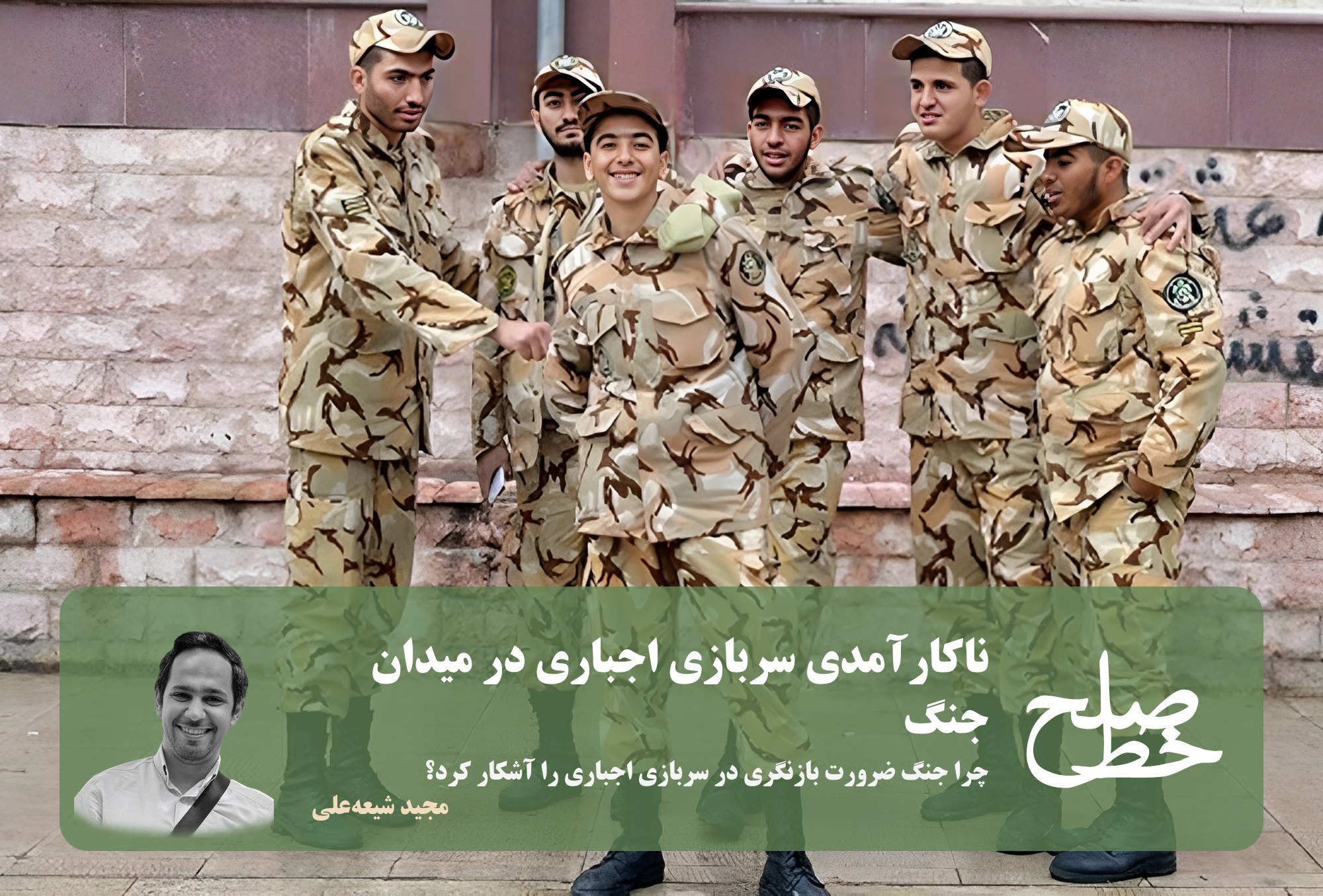
The Inefficacy of Mandatory Military Service on the Battlefield / Majid Shieh-Ali
In recent years, criticism of mandatory military service has been severe. These criticisms stem from diverse perspectives. Many have highlighted the economic impact of removing young labor from production and its resulting harm to the economy. Another group has underscored the psychological crises arising from unhealthy environments and phenomena such as suicide during this period, placing them at the center of their critiques.
Other groups have approached the issue from a human rights perspective, emphasizing the discrimination and injustice inherent in the system. Because conscription is compulsory for all men until near retirement age, lasts for an extended period, and involves harsh conditions, it is regarded as one of the strictest conscription laws, further intensifying the volume and severity of these criticisms. In this context, news of conscripts dying in military clashes at various levels periodically brings the issue back to the headlines. Various branches of government, including the administration and parliament, have repeatedly sought to pass legislation to enable gradual reforms, only to hit a wall against the military establishment. But what is the military apparatus’s rationale for maintaining the status quo?
One of the central arguments of critics has been that, in practice, mandatory military service mostly fails to provide military training and does not utilize conscripts for operational defense; rather, it constitutes a form of forced labor without minimum wage. Countless vital hours of citizens’ lives wasted merely guarding insignificant sites is a recurring theme in accounts of these conditions. Nevertheless, Iran’s military and security apparatus views conscription strictly through a national security lens. What conception of national security, then, has led to viewing this precarious and unproductive system as an instrument of deterrence?
In security studies, various schools of thought conceptualize how security is provided across societies in different ways. One of the most prominent traditions in security studies is realism. In realist perspectives, international relations exist in an anarchic state; consequently, this anarchic order dictates that states strive to balance power according to regional and global dynamics and establish deterrence through the acquisition of power. Although such an understanding of power relations and politics has had adherents throughout human history, its systematic formulation belongs to the modern era, with its primary theories and rigorous frameworks developed during the twentieth century, particularly amid the Cold War.
One of the latest theories formulated near the end of the Cold War was a variant of realism known as offensive realism. John Mearsheimer, the pioneer of offensive realism, emphasized a fundamental premise: in this anarchic environment where states constantly fear for their survival, no conditions exist under which they can feel entirely secure. Consequently, they will always seek to maximize their power relative to their rivals. This path entails two primary steps: first, attempting to achieve hegemony within their own region—meaning that no power capable of challenging them exists up to the reach of the seas; second, striving to prevent other powers from establishing hegemony in other regions. Since global hegemony is virtually unattainable, only continuous power maximization against competitors is inherent to global politics. But what does the acquisition of power actually mean?
In Mearsheimer’s framework, state power can be assessed in various ways, but his principal emphasis rests on the infantry. Through a historical analysis of major conflicts, he argues that other military tools and tactics have never been able to replace the infantry; only boots on the ground can compel an adversary to submit, while air, naval, and even nuclear strikes serve merely as support for military invasion and are not independently effective. From this perspective, a government seeking to enhance its power along these lines must build an extensive infantry, whether by organizing its own citizens into regular or paramilitary formations or mobilizing foreign nationals. Examining this perspective suggests that the national security doctrine of the Islamic Republic may have been substantially influenced by his theories, as it has not only vigorously maintained domestic conscription but has also mobilized various paramilitary forces at home and across the region. Yet, after more than a year of wartime conditions, has mandatory military service proven effective?
On one hand, Mearsheimer’s premise regarding the inadequacy of air and naval strikes in forcing capitulation found support in the test of recent warfare. Even Iran’s infantry presence in other countries played a role in its national security. However, conscripts subjected to forced labor without adequate training were simply turned into casualties of various strikes—victims who, despite being listed as military casualties, lacked military expertise or background, enjoyed none of the benefits of military personnel, and, above all, were not engaged in actual military operations. Consequently, even if Iran were engaged in a conflict with a power attempting territorial conquest through ground forces, conscription would still prove ineffective. First, the ruling establishment would likely rely on human wave tactics drawing from ideological forces.
Second, even if it opted for an alternative strategy, it would require a professional army comprising forces with more than a few months of training and several years of operational experience to perform effectively in military engagements. In practice, the inefficacy of conscript forces during wartime has been laid bare to the ruling establishment. But is there reason to hope for reform?
Many social scientists believe that social transformations emerge from the crucible of war. Wars intensify military competition and compel governing authorities to apply rationality and science across multiple domains. They foster modern organization and technology—not only within military structures, but inevitably throughout other sectors of society to support the military effort—and their growing dependence on society forces them to grant social concessions. Similarly, in Iran, the modernization process emerged from the Russo-Persian Wars. Therefore, on the one hand, one can hope for an increase in the impact of social pressure in the postwar landscape; on the other, greater rationality, particularly in military policymaking, is likely to take hold. Consequently, articulating and reiterating previous critiques may prove effective this time, potentially bringing substantial change to the unjust and costly system of mandatory military service.
 By: Majid Shia’ali
 November 22, 2026
Tags
Armed forces Compulsory military service Inefficacy of Conscription John Mearsheimer Majid Shia Ali National security Offensive Realism peace line Peace Line Monthly Peace Mark 187 Soldier's Suicide