


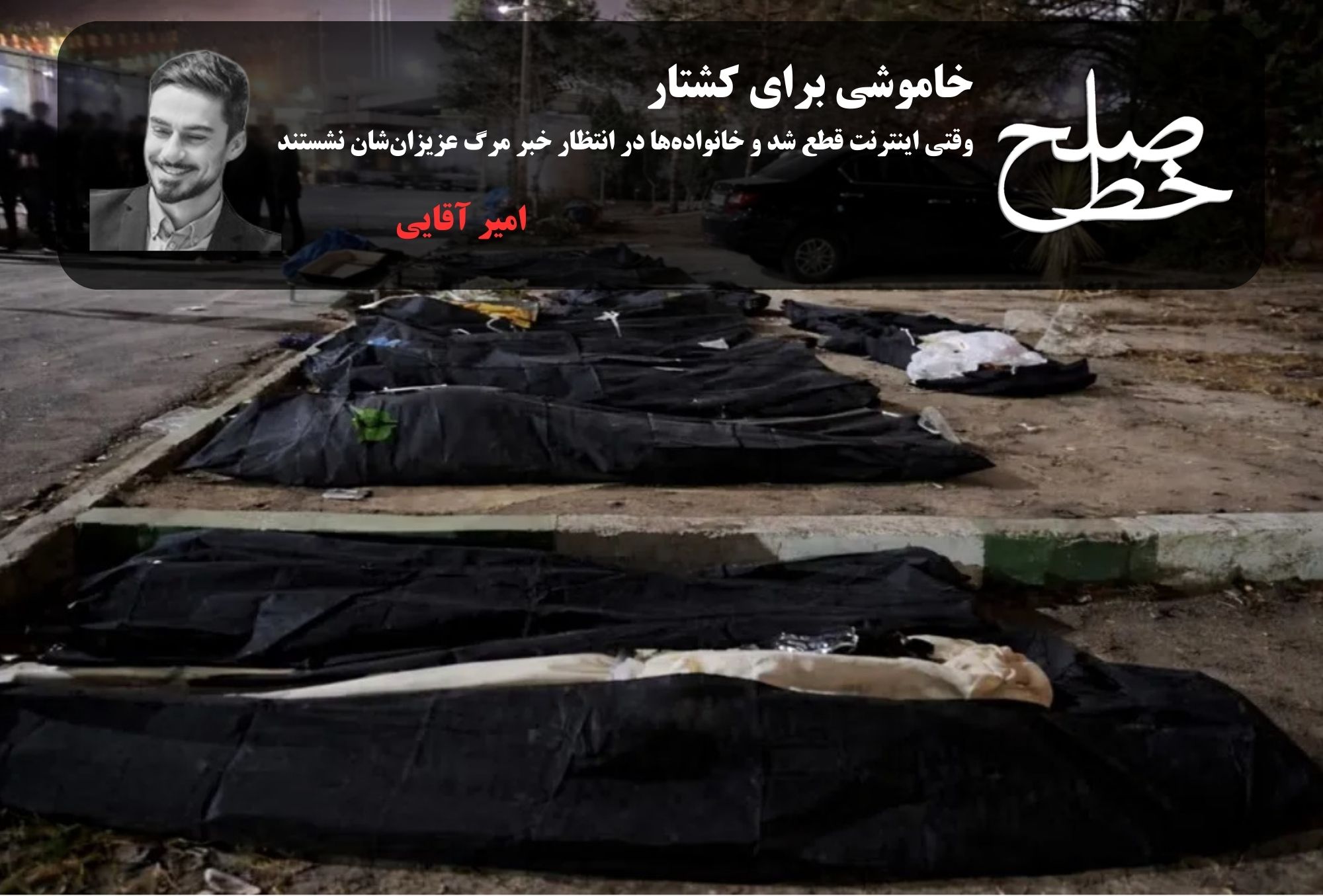
Silence for the Killing/Amir Aghaei
The following text is a scribble by a young man from inside Iran about the internet shutdown during the recent protests. It was originally supposed to be a report on the internet shutdown, but I couldn’t. No matter how much I tried to maintain an impartial tone of reporting, I couldn’t. No matter how much I tried to write about the 20 days of internet shutdown as an outside observer, I couldn’t forget the scenes I see every day at the crossroads. I couldn’t erase from my memory the lifeless young people lying in long stretches by the river with white cloths on their bodies, waiting for an ambulance, into an eternal sleep. Therefore, look at the following text not as a report, but as a heartfelt note that also speaks of the internet shutdown. I hope that dear readers will forgive the peace, confusion, and incoherence of the humble pen, which is a sign of the worn-out and troubled psyche of a repressed and grieving citizen.
***
What can I say? What story can I tell more than what everyone has seen? To sum it up in one word: “They plunged Iran into a digital blackout, they put the people through the wringer, and that’s it.” Now, we, the people of Iran, are counting the seconds in this endless suspense until this hell ends.
This silence began at dusk on January 18, 1404, at the same time as people were rioting across the country. None of us could believe what was happening. When eight o’clock came, we, the people of Iran, began chanting slogans on every street and alley. Thousands of people had gathered in places in the city where no one would have thought of gathering in previous periods of protests. In other parts of our city, which had always been the focus of the forces of repression, gatherings were also impossible. Before that, no one had been able to push them back in all these years, but this time gatherings had formed in these parts as well.
I went to a part of the city where I guessed that the dominant slogans would not be the ones I hear most in the media, but I guessed wrong. The first slogan was the one I didn’t want to hear, but it didn’t matter. What mattered was that we all had one thing in common, and that was to overthrow the dictator. When they saw the flood of people, they must have been scared, and rightly so, so they decided to shut down Iran and turn on the killing machine.
For about ten days before the protests began in scattered forms, mainly in the bazaar and various cities, we had all been asking each other the same question: “So when are they going to cut off the internet?” We wondered why it had taken so long! It seemed like they should have done this as a first step. But our surprise didn’t last long. They cut off the internet from the very first day of the incident, Thursday evening, 18 January 1404. They not only blocked the internet, but also blocked calls and text messages.
On that day and the day after, Friday, January 19, 1404, Iran experienced a communications blackout on a scale that was surprising even to Iranians who had experienced the 1401 protests, the November 2019 blackout, and the Twelve-Day War. During those two days, a large portion of the national internet—or what the system calls the National Information Network—was also unavailable. Citizens who wanted to use the services of prominent Iranian online businesses like Digikala and Snap also had problems during those two days. If you’ve lived in Iran, you know that logging into many sites requires a one-time password, or OTP, which is sent to the user’s phone number via text message. The Islamic Republic’s fear of protesters communicating with each other reached a point where it blocked even sending OTP text messages, without exception, for the first two days. This problem was gradually resolved, but the government continued to block text messages in the days following Friday. The blocking of phone calls also remained in place for several days after that. Other citizens were waiting for the phone calls to be cut off as darkness approached. With the internet, text messages, and phone calls cut off, we no longer had the opportunity to find out if each other was alive. Every loved one who was separated from their loved ones to participate in the protests did not know if they would be alive in another hour, and every parent who watched their child go did not know when they would be able to learn of their child’s death if he was killed. What about the fathers who, like Sepehr’s father, searched for their children’s bodies for days and perhaps weeks in the heavy shadow of the digital blackout?
The oppressors kill, the government claps its hands.
Since the nationwide internet shutdown in November 2019, which led to an unprecedented bloody massacre, some members of parliament at the time have tried to regulate the internet shutdown. These efforts have never been fruitful, and the disruption of access to the free flow of information has manifested itself in the form of disruptions and temporary shutdowns during the protests following the death of Mahsa Amini in 1401. After that, during the recent protests, the internet was shut down on the orders of the Supreme National Security Council headed by Masoud Pezzekian. The government that came to power with the slogan of opening up the internet is now watching the bloody massacre of people in the shadow of the internet shutdown in the most optimistic way.
Fatemeh Mohajerani, the government spokesperson—the same woman who shouted at the Pezizkian election rally that she wanted a government to come to power so that no more blood of the “Mehrshads” would be shed on the ground—in the midst of the internet shutdown and the killing of the defenseless people of Iran, without her voice trembling or recalling the instrumental use and propaganda of the names of the victims of the 1401 protests, introduced the internet shutdown as a decision that no one has the right to disobey. Pay attention to her words: “The damage that was caused following the events of January 8 and 9 was of a security nature, and based on the diagnosis and considerations of security policymakers, the national internet shutdown was put on the agenda. It is obvious that the government’s approach is to support the internet and businesses related to it, but in a situation where security considerations are prioritized, we are all forced to comply with these decisions.”
While the blood of thousands of innocent Mehrshads has not yet been wiped from the asphalt of the streets, the government spokesman easily put the first word to the last and said that everyone must obey the killing machine.
At a time when the most brutal crackdown on protests since the beginning of the revolution had brought the wave of protests to a halt and millions of Iranians were waiting for the internet to return to its previous semi-open state, the government did not have the courage to reopen it. Meanwhile, the Ministry of Communications and Information Technology, as the main custodian of the internet in the country, was simply shirking its responsibility. The ministry’s first statement on the internet shutdown, issued on January 9, revolved around the same point – hiding behind “competent security” institutions.
During this time, the digital suppression apparatus, hand in hand with the street-level suppression apparatus, also disrupted the narrow path to internet access, namely Starlink. According to reports from various media outlets such as Forbes and France 24, during the 1404 protests, the Islamic Republic also succeeded in disrupting users’ access to the Starlink satellite internet by deliberately interfering with GPS signals. According to experts, the digital suppressors were also able to disrupt satellite communication channels by sending powerful noise and fake signals.
Neither the internet returned nor the lives lost.
Finally, on February 26, 1404, the restrictions on the internet that had been in place since January 8 were gradually lifted. According to internet experts and specialists, the internet situation has not even returned to the pre-protest era. Digital repressive institutions in Iran are seeking to create a whitelist of online sites and services so that in the event of similar protests in the future, it will be easier to cut off access to information.
According to the Shargh newspaper, which is close to the Pezizian government, relevant decision-makers have classified internet access into eight levels. Level eight means a complete shutdown and level one means normal internet access. Of course, the internet situation in Iran was never normal even before the protests, despite widespread filtering and disruption, but level one refers to the same situation. According to the newspaper, the internet in Iran has reached level two since February 27, 1404.
Data from global internet monitoring groups such as Cloudflare and Netblocks also shows that the internet in Iran has not yet returned to its previous state. Now we all know that the precious lives of the children of Iran are never going to return to earth, and the Islamic Republic is still maintaining a situation similar to martial law in the country, in the shadow of deliberate and widespread disruption of the internet, so that the people, angry and mourning the previous massacre, do not think of raging again.
 Created By: Amir Aghayi
 February 20, 2026
Tags
Amir Aghaei Crime against humanity Criminal Internet Internet freedom Internet outage Kahrizak Massacre 1404 peace line Peace Line 178 Suppression The Di 1404 Uprising Uprising of 1404 ماهنامه خط صلح