


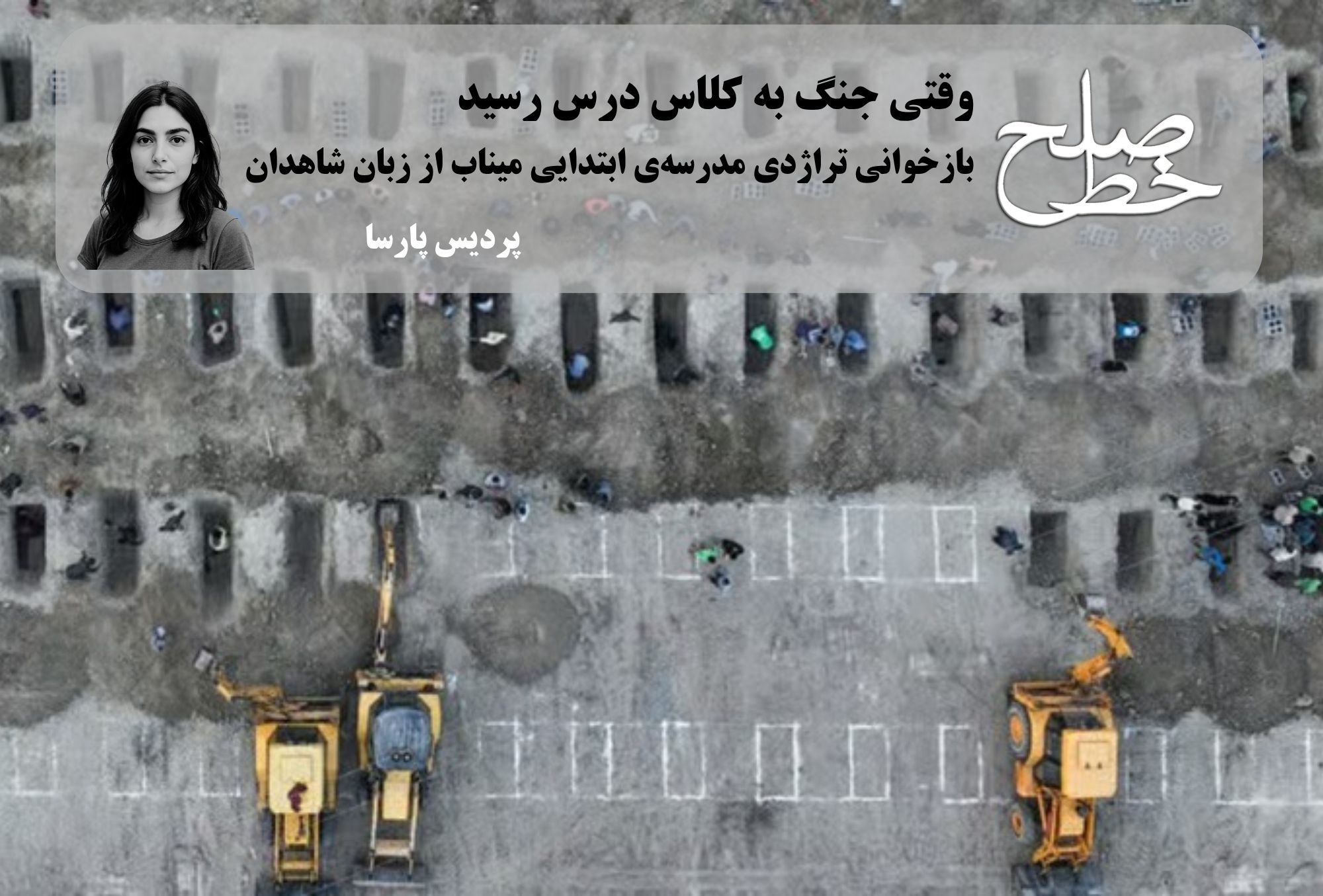
Reexamining the Tragedy of Minab Elementary School Through the Words of Witnesses/ Pardis Parsa
In the first hours of the military operation known as “Epic Wrath,” which began on February 28, 2026 (9 Esfand 1404), a series of air and missile strikes targeted various infrastructures across Iran.
Meanwhile, Minab County in Hormozgan Province, due to its strategic proximity to logistical and military infrastructure, became one of the main centers and targeting priorities. However, what happened in this area was not only a military event, but a profound human and social catastrophe, whose peak was embodied in the missile strike on “Shajareh Tayebeh Elementary School.”
The area where the school was located was considered sensitive because of its proximity to the “Seyed al-Shohada” military complex and the headquarters of the Asef Brigade of the Islamic Revolutionary Guard Corps Navy. Precise geographical assessments and satellite data show that Shajareh Tayebeh School was located 238 meters from Shahid Absalan Clinic, affiliated with the Navy Medical Command, and 286 meters from the Seyed al-Shohada Cultural Complex.
Despite this physical proximity, this educational center had been completely separated from the military section by tall walls for at least ten years before the attack and had a wholly civilian identity. The school’s exterior and interior walls were covered with colorful, childlike murals depicting trees, colored pencils, microscopes, and cheerful symbols. The markings in the schoolyard for physical education classes and the presence of children’s play equipment such as slides were undeniable evidence that, even in satellite images, clearly showed the educational and civilian nature of this building in contrast to the military facilities around it.
Shajareh Tayebeh School, one of Minab’s important educational centers, had a concrete frame and two floors. The school’s internal and external architecture had been engineered in such a way that, in accordance with the requirements of Iran’s education system, gender segregation was fully observed. The first floor was allocated to the classrooms and administrative spaces of elementary school boys, and the second floor formed the educational environment for girl students. Separate playgrounds and independent entrances distinguished the two sections of the school from one another.
On Saturday, February 28, 2026 (9 Esfand 1404), at the time of the incident, a total of 403 elementary school students were present at this educational center. The demographic composition of these students included 186 boys, located on the first floor, and 174 girls, located on the second floor. In addition, a preschool section was also operating in this complex, where 43 young children were present that day. Alongside the students, 36 people were present in the building as educational staff, administrators, assistant principals, educational counselors, and service personnel. Based on these figures, at least 482 people were present in the school at the moment of impact, and according to official statistics, the deaths of 168 people and the injuries of 96 others have been confirmed.
According to witnesses, after hearing news of the start of the war, the school principal held a meeting and, after consulting with the teachers, decided to close the school. It was decided that each teacher would call a number of parents and ask them to come pick up their children. For this reason, a small number of parents who had been contacted earlier or had arrived at the school sooner managed to take their children out of the school. However, seven parents who had approached the blast radius to rescue their children themselves became victims of the second and third explosions.
What Happened to Shajareh Tayebeh School?
The missiles struck this educational complex in a multi-stage process using advanced Tomahawk missiles. The first missile hit the schoolyard or its vicinity sometime between 10:23 and 10:45 in the morning. Although this initial explosion did not directly destroy the main structure of the building, the blast wave it created was so powerful that it shattered all the school’s windows on both floors.
The breaking of the windows, the deafening sound of the explosion, and the scattering of objects inside the classrooms created terror and panic among the young children. The school administration and teachers tried to evacuate students from the classrooms, which were filled with broken glass and exposed to open space. Reports by Red Crescent rescuers and survivor testimonies indicate that the educational staff moved the students to apparently safer spaces such as the prayer hall and central corridors, which were believed to have greater structural strength and to be farther from the windows. This decision, made in an effort to save the children’s lives, had tragic consequences in the face of the missiles’ attack pattern. The second and third missiles struck precisely the central core of the building. These missiles, capable of penetrating concrete, passed through the outer layers and exploded in enclosed spaces and corridors.
The intensity of these explosions was such that the structural integrity of the building was completely destroyed. Large sections of the ceiling and floor of the second floor, the girls’ section, collapsed with their full concrete weight onto the corridors, classrooms, and prayer hall of the first floor, the boys’ section, and the stairways connecting the two floors were destroyed. With the destruction of the staircases, the escape route for survivors on the upper floor was blocked, and many children were trapped under the rubble of the second floor.
Physical assessments after the attack by rescue teams and observers show that more than 50 percent of the school’s two-story building was completely destroyed and reduced to piles of soil and concrete. In addition to the rubble, the heat from the explosions caused fires in parts of the building, so that the school office and several classrooms in both the girls’ and boys’ sections burned completely.
A more detailed examination of the destruction map showed that, of the entire school building, only four classrooms in the girls’ section were spared total destruction; in the boys’ school as well, only the school office, three classrooms in the corridor, and the preschool classrooms preserved their overall structure despite serious damage.
Accounts of Victims and Survivors
Field reports from the first hours of relief efforts indicate that the schoolyard, which only shortly before had been a place for children’s play, had turned into a temporary gathering place for dismembered bodies. The severity of the injuries was such that identifying many of the victims seemed impossible in the first hours and even days. The horrific destructive power of the Tomahawk missiles was such that many children’s bodies were completely torn apart.
One of the most painful pieces of evidence of the intensity of this attack’s destructive force is the fate of a student named “Makan Nasiri.” Makan was a seven-year-old child and a first-grade student. The account of his mother, “Asiyeh,” shows the speed with which the catastrophe unfolded. Asiyeh tells Peace Mark Monthly Magazine that only a few minutes before the explosion, Makan’s teacher, “Mandana Salari,” had called her to ask her to come pick up her child due to the emergency conditions. But before Asiyeh could react, the missile explosions destroyed the school. Makan is the only victim of this tragedy of whom no part of his body was found. Despite days of searching, layer-by-layer rubble removal, and repeated DNA tests on discovered human remains, no trace of this child was found. The only remains found of Makan were one torn athletic shoe, which the blast wave had thrown 100 meters away from the site of the incident, among the branches and leaves of nearby trees.
Among the educational staff as well, one of the most painful cases concerns a teacher named “Zohreh Shahriari,” who was in the sixth month of pregnancy. During the collapse of the rubble, Zohreh and her unborn fetus both died under piles of cement. The body of another teacher named “Razieh Zamani,” like that of Makan Nasiri, was never found.
Pieces of many students’ bodies were found dozens of meters away on the ground or in trees. Of one little girl, only a dress remained, and of another, only traces of blood were found. The number of casualties was so high that local cold-storage facilities, such as the cold storage facility in the port of “Tiab,” which had previously been used to store fish and food, were also used to keep bodies.
The father of “Mohammad Mehdi,” one of the victims of this attack, tells Peace Mark Monthly Magazine about the events of that day:
“In the morning, after hearing the news of the explosions in Tehran, my wife’s phone rang. They had called from the school saying come and take the children. I was getting ready to go when, after three or four minutes, the sound of an explosion came. It was so loud that we heard it at home. Just then, one of my friends called and said he had gone near the school and had seen that the school had been hit. He said there was so much traffic that it was impossible to go there. I immediately told my wife to call the teacher. But the teacher’s phone was unreachable. That was when it dawned on me. We immediately started the car and went with his mother. Near the school, I stopped the car; I didn’t lock it or anything. We got out and just ran. When we reached the school, we froze. It was destroyed. Now I have found out that my son had been in the yard with his friends at that time; I think they had physical education. The blast wave threw these children. They hit the wall very hard. His shoulders and his friend’s shoulders were broken. His eyes had popped out. His body was full of holes…
The part that hurt me most was when I was in the cold storage, among those bones, hands and feet, and pieces of children’s bodies, looking for my son; it was a very bad situation. The condition of the children’s bodies in the cold storage was so bad that sometimes I could not even tell which part of the body a piece belonged to. Only some bodies were intact; the rest were only pieces of the bodies of innocent children.
Before I found my child, I saw and walked through two halls full of corpses; I searched at least fifty body bags before I reached Mohammad Mehdi. In the second cold storage, I searched two rows. In the last row, with five left until the end, I saw that my Mohammad Mehdi was lying there.”
The mother of “Sana,” who was able to find her injured daughter in the hospital, tells Peace Mark Monthly Magazine about the events of that day:
“It was around ten-something when my phone rang, and at the same time there was a terrifying sound. Our house is not far from the school. When that sound came, I was screaming, worried about my child. My husband and I set off toward the school. There was traffic on the way too. Near the school, I got out of the car and ran toward the school. When I reached the entrance of the boys’ school—you first reached the boys’ school entrance; the girls’ section was farther ahead—when I saw the school, I went mad. Half the school had collapsed. The rubble had come down. The other half was catching fire. I was crying, screaming, I climbed onto the rubble. I didn’t know where I should find my child. It was a very hard day. I went toward the girls’ school. Teachers and students were running toward the street. Their faces were dusty and bloody. I saw a man holding a child in his arms whose head had split open and whose brain was visible, and blood was pouring from it. I was no longer in control of myself. Someone told me there was a child farther over in the trees, but she couldn’t be identified. When my husband arrived, I told him to go himself, because I did not have the heart to see. We searched everywhere but could not find our daughter. Finally, they told us to go to the hospital; many had been sent to the hospital. We went to the hospital. There, every curtain I pulled aside, I did not see my daughter; every room I entered, I could not find her. Ambulances kept arriving at the hospital entrance. When I went near the fourth ambulance, they were saying, move aside, this one is alive. When I saw her socks, I recognized her. My daughter’s face was full of dust and burned. I shouted: This is my daughter.
My daughter’s face and ears were burned, her hands and feet were completely burned, and her head was injured too. My child was in the ICU for two nights and two days. After that, she was hospitalized in the burn ward for thirteen days.
Even now, when I think about that day, I start crying. My daughter was found, but all those mothers and fathers…”
Eleven-year-old “Zahra” is one of the students who managed to survive from the second floor, which had been severely destroyed. In an interview with the media, she described the day of the incident as follows:
“That day we were at school. When the teachers came out of the meeting, they said, you are dismissed, you can go home. We will now call your parents one by one to come pick you up. We got curious and asked what had happened. They said, go watch the news. A few minutes passed. I was in class when the first missile hit. The window glass of our classroom broke and fell, and all the children were shouting and asking for help. They hit with the second missile a little later too. After the second missile, the corridor collapsed and a light slowly came and brightened. Part of the upper floor fell onto the lower floor, and the stairs were gone. A lot of rubble had fallen, and we came down over it. With the help of our teacher and a few of my friends, I went downstairs. As I was coming down over the rubble, I fell to the ground. A man was lifting the rubble. He told me, just run, go run. I got up and ran outside. All the parents had come. They were shouting, calling their children’s names, looking for their children, and crying. It was very, very bad.”
“Fatemeh” is another student who survived. She describes her experience this way:
“We were in class. We had opened our writing book. Our teacher said the school might close. We were all happy when suddenly there was a sound. We did not understand what happened. Then our teacher came into the classroom and said, children, nothing has happened, don’t be afraid. Everyone come into my arms. We went into our teacher’s arms. Then another sound came. I and a few other children were thrown out of the teacher’s arms. When I looked around, I saw the children had fallen on the ground and were bloody. Two people who had not been thrown out of our teacher’s arms were martyred. When we were thrown, suddenly it was like an earthquake. There was smoke. Dust rose. Then a more terrifying sound came. Again, we did not understand what had happened. I closed my eyes. When I opened my eyes, three men were standing above us. They pulled me and my classmates out and took us to the hospital in their cars.”
One of the teachers who survived recounts the events of that day in an interview with a Peace Mark Monthly Magazine reporter:
“At the classroom door, I held the children in my arms. It was all smoke. We could no longer breathe. We could not see anywhere at all. Blood was coming from my head. The sound of another explosion came. After the second explosion, the school was badly destroyed; it had collapsed. The physical education teacher of the boys’ school was standing downstairs and saying, come down. I handed the children down one by one. We sent down the children whose condition was worse first. Thank God, a few of the children were not hurt. When I came down, I saw a student whose eye had been destroyed and whose face was covered in blood. He himself could not feel it. I took that student’s hand and we ran toward the school entrance.”
The legal and moral responsibility for the tragedy of Shajareh Tayebeh School in Minab lies with both sides of this conflict. On the one hand, the United States military, by firing advanced, penetrating Tomahawk missiles at this school, flagrantly violated the fundamental rules of international humanitarian law, because the wholly educational identity of this structure and the presence of civilians were clear even in satellite data. On the other hand, Iran’s military and governing structure, by locating military headquarters within less than 300 meters of an educational center with a capacity of more than 400 children, ignored the basic principles of passive defense, and by failing to evacuate or preemptively close schools under emergency conditions, effectively exposed educational environments to danger, leading to this bloody outcome.
This missile attack marked the beginning of a new phase of collective and lasting trauma in Minab County, one that will affect the psychological structure of the region for decades. The children who survived this incident are now struggling with the most severe symptoms of post-traumatic stress disorder and the terror caused by the sudden loss of the concept of security. The parents of the victims have also faced deep psychological crises, especially families who, because their loved ones’ bodies were completely dismembered, did not even find a sign for mourning and have suffered trauma and “ambiguous grief.”
Ultimately, an examination of the Minab tragedy proves that in power equations and offensive strategies, civilian populations and civic spaces are always the first and most defenseless vulnerable targets.
 Created By: Pardis Parsa
 June 22, 2026
Tags
Dual infrastructure Dual-use infrastructure Infrastructure Iran-US war Minab School Operation Epic Fury Pardis Parsa Rocket Shajarah Tayyiba School The war between Iran and Israel. Tomahawk missile United States Army