


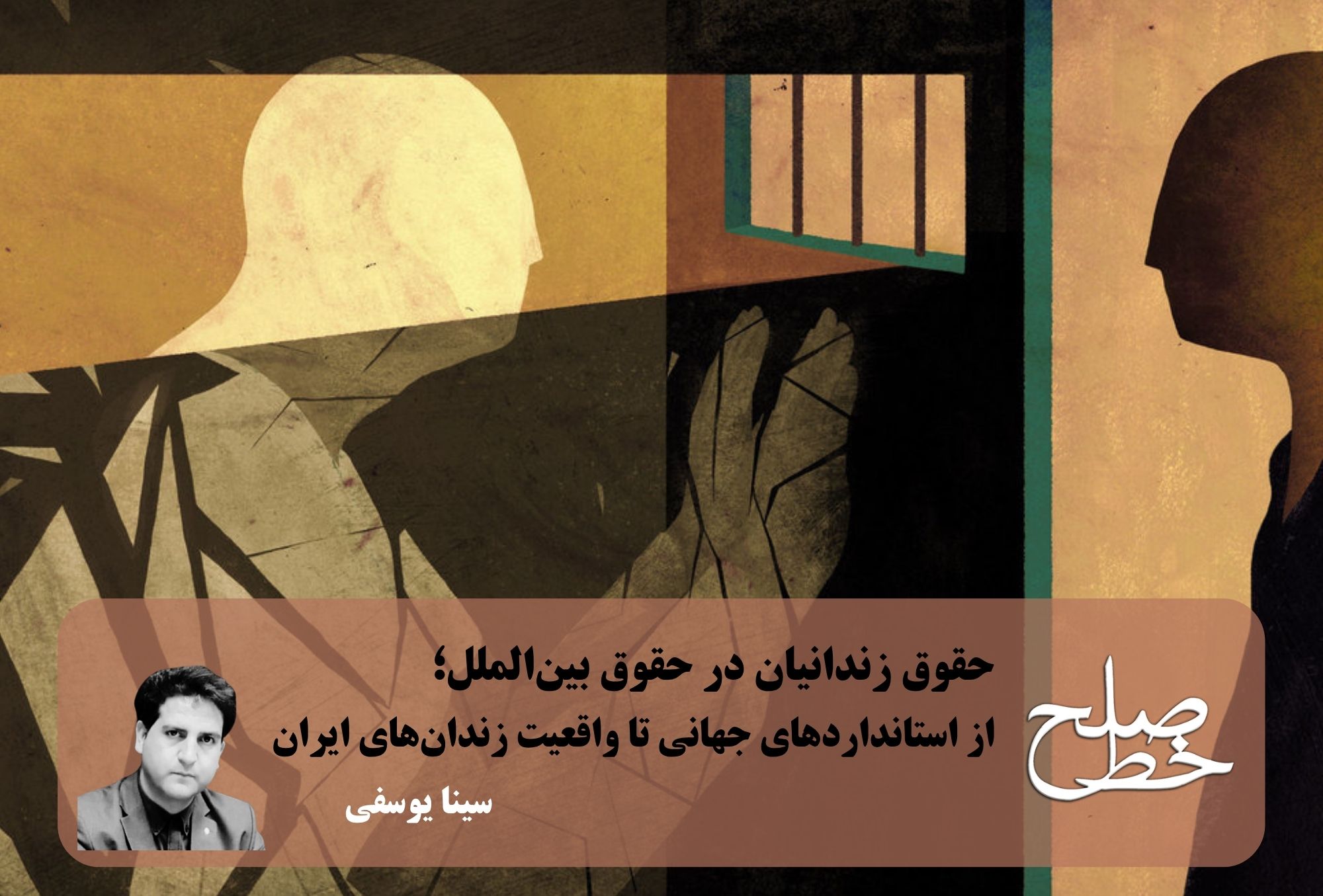
Prisoners’ rights in international law; from global standards to the reality of Iranian prisons/Sina Yousefi
The extent to which a legal system adheres to the rule of law cannot be measured solely through criminal laws or court decisions; one of the most accurate measures of its assessment is the way in which individuals who are deprived of their liberty for any reason are treated. Contrary to popular belief, prison is not a space outside the realm of law, but rather an environment where the state exercises its authority and control over the body, mind, and life of individuals more than anywhere else, and for this reason, its legal obligations are at the highest level. With the same logic, international law has developed a relatively coherent set of binding rules and specialized standards over the past decades to protect individuals deprived of their liberty; rules that aim not only to prevent torture, but also to guarantee the preservation of human dignity, physical and mental health, fair trial, and the prevention of abuse of power in closed environments where public oversight is limited.
However, the experience of Iranian prisons shows that the gap between this legal framework and the existing reality is not simply due to a case-by-case violation of some regulations. In many political and security cases, the arrest and detention of defendants in detention centers and prisons has become part of the process of producing evidence and advancing criminal investigations, a process in which solitary confinement, deprivation of effective access to a lawyer, severance of contact with family, deprivation of medical treatment, psychological pressure and, in many cases, physical torture, are not exceptional treatment, but rather a means of extracting confessions and solidifying the narrative of the security institutions. Therefore, examining the international legal framework of prisoners’ rights in relation to Iran is not just a matter of introducing UN treaties and standards, but also an attempt to assess the fundamental question of how one of the most comprehensive protection systems in international law has remained virtually ineffective in the face of a structure that has transformed detention into a tool of political control and the production of confessions.
The legal framework for the protection of persons deprived of their liberty is not, contrary to popular belief, limited to one or two international instruments, but rather is the result of a network of binding rules and specialized standards that have been formed in international law over decades. Among them, the International Covenant on Civil and Political Rights – to which Iran has also acceded since 1975 – is considered the most important binding document in the field of prisoners’ rights. Article 7 of this Covenant prohibits, without any exception, any torture or cruel, inhuman or degrading treatment or punishment, and Article 10 obliges states to treat all persons deprived of their liberty with humanity and respect for their inherent dignity. The importance of these provisions is that the state’s obligation is not limited to simply refraining from torture, but also encompasses the set of conditions of detention, access to medical services, the possibility of contact with family, the enjoyment of a fair trial, and the preservation of the prisoner’s physical and mental health. Alongside this Covenant, the Convention against Torture is considered the most comprehensive specific document in the field of prevention, criminalization and prosecution of torture, although the Islamic Republic of Iran has not yet joined it. However, non-membership of this Convention does not mean exemption from international responsibility, because the prohibition of torture is today not only part of customary international law, but also one of the peremptory rules, rules from which no state, regardless of its membership or non-membership in a treaty, can deviate. From this perspective, the practice that has been observed in Iranian political and security cases for years, including the long-term detention of defendants in detention centers managed by security agencies, the application of physical and psychological pressure to obtain confessions, the denial of effective access to a lawyer, and the courts’ repeated reliance on confessions whose credibility has always been seriously questioned, is not only in conflict with UN recommended standards, but in many cases is in clear conflict with binding obligations of international law that Iran has also committed itself to complying with.
If international treaties outline the limits and foundations of states’ obligations, specialized UN standards clarify how these obligations are to be implemented. The most important of these documents is the “UN Standard Minimum Rules for the Treatment of Prisoners,” or Mandela Rules, which are today considered the most authoritative international standard for the management of prisons and the treatment of persons deprived of their liberty. These rules consider human dignity to be the starting point for all prison-related regulations, and range from accurate recording of the status of detention and segregation of prisoners to access to independent medical services, contact with families, continuous inspection of prisons, and strict restrictions on the use of solitary confinement. The Bangkok Rules, in light of the specific needs of women prisoners, have also developed standards on medical care, support for imprisoned mothers, prohibition of discrimination, and observance of gender considerations; an area that has always been a source of concern in Iranian prisons, especially for women political prisoners. In addition to these documents, the Istanbul Protocol, as the most authoritative international guideline for identifying, documenting, and investigating torture, plays a decisive role in the fight against the impunity of torture perpetrators, as it emphasizes that any allegation of torture must be investigated and documented promptly, independently, impartially, and by qualified experts. The importance of these documents is that, although most of them are not included in the list of binding treaties, they have been cited for years in the practice of UN monitoring bodies, special rapporteurs, international courts, and even domestic courts of many countries as a criterion for interpreting obligations arising from human rights treaties. From this perspective, assessing the situation in Iranian prisons is not possible only by measuring it against the general articles of the Covenant on Civil and Political Rights, but must also be done with more precise criteria such as the Mandela Rules and the Istanbul Protocol; The criteria based on which prisoners are held in solitary confinement for long periods, deprived of effective medical care, arbitrary restrictions on communication with family and lawyers, disregard for documenting the effects of torture, and the lack of independent mechanisms for monitoring detention centers are not merely administrative shortcomings, but also signs of a deep gap between prison management in Iran and internationally accepted standards.
However, the main problem in Iran cannot be summed up simply in the sporadic violations of these standards, because in many political and security cases, the violation of the rights of the prisoner is part of the criminal investigation mechanism, not the result of exceptional or arbitrary behavior by a few officers. In such cases, detention is often at the disposal of the security agencies from the very beginning, and the investigation phase, which should serve to discover the truth, becomes a process to consolidate the predetermined narrative of the security apparatus. Meanwhile, the detention of suspects in unofficial detention centers or places managed by intelligence agencies, the denial of effective access to a lawyer in the early stages of detention, the cutting off of contact with family, prolonged solitary confinement, continuous interrogations, threats, humiliation, psychological pressure and, in many cases, physical violence, are not simply violations of the rights of the detainee, but are also tools to break his resistance and extract confessions. The consequence of this situation is that confession, despite the explicit prohibition of torture in international law and even the legal prohibition of forced confessions in Iranian domestic law, has continued to maintain its central place in practice in many political cases. The publication of forced confessions by state media before the trial, the judicial authorities’ disregard for allegations of torture or ill-treatment, the refusal to conduct independent investigations into these allegations, and the reliance on confessions that defendants have repeatedly stated were obtained under duress, all indicate that in part of the Iranian criminal justice system, detention is seen not simply as a measure to ensure the presence of the defendant in the trial process, but as a decisive step in the production and consolidation of evidence against him. Therefore, many of the violations that are visible from the perspective of the Mandela Rules, the Istanbul Protocol, or the Covenant on Civil and Political Rights are not isolated from each other, but rather interconnected parts of a mechanism in which the undermining of the prisoner’s human dignity becomes a tool for advancing investigations and securing security objectives.
The persistence of this situation cannot be explained solely by weak law enforcement or the misconduct of some officers. A significant part of the problem lies in the accountability structure of Iran’s criminal justice system, one in which security detention facilities lack effective and independent oversight, allegations of torture and ill-treatment are rarely the subject of impartial investigation, and officers or officials involved in the detention and interrogation process face little risk of legal accountability. In such circumstances, standards such as the Mandela Rules or the Istanbul Protocol are not rendered ineffective simply by a lack of political will to implement them, but are fundamentally at odds with the logic that governs some security cases. This logic does not prioritize discovering the truth through independent investigations and respecting the rights of the accused to defend themselves, but rather relies above all on establishing the narrative of the security institutions and providing evidence that can support that narrative in later stages of the proceedings. When courts base their decisions on disputed confessions rather than independently examining allegations of torture, when independent doctors are unable to examine detainees, when access to lawyers is limited or delayed at the most sensitive stage of investigations, and when oversight bodies are denied effective access to security detention facilities, violations of prisoners’ rights are no longer simply a series of isolated violations, but part of an institutional cycle that reproduces itself. Therefore, the gap between the international legal framework and the reality of Iranian prisons cannot be closed simply by amending a few regulations or issuing administrative directives, because the issue goes back to the distribution of power, the independence of judicial institutions, and the existence of real mechanisms of oversight and accountability before it is a matter of regulations. Until these fundamental components change, even the most advanced international standards will become a yardstick for measuring the gap between legal obligations and reality, rather than a practical guarantee of prisoners’ rights.
International law, especially in the area of the treatment of persons deprived of their liberty, does not today face a normative vacuum. A set of binding treaties, interpretative rules and specialized UN standards have created a relatively comprehensive framework for protecting human dignity in prisons. The main problem, especially in the case of Iran, is not the absence of legal rules, but the deep gap that exists between these rules and the actual mechanism of administering detention facilities, conducting criminal investigations and judicial proceedings. When detention becomes a tool for exerting pressure, extracting confessions and managing political cases, prison also loses its original function as an institution under the rule of law and becomes a space in which legal oversight is minimized and public power finds maximum scope for arbitrary action. Therefore, prisoners’ rights should not be considered merely as part of criminal law or a set of privileges granted to convicted individuals; they are in fact a yardstick for measuring a state’s commitment to the rule of law and human dignity. A state that fails to protect the human rights of those who are fully under its authority and control has in effect violated one of its most fundamental obligations under international law. Perhaps this is why the situation in prisons, more than any other institution, provides a clear picture of the relationship between power and law in a political system, because what happens behind prison walls is not an exception to the legal order, but a condensed reflection of the quality of the same order that also governs society outside prison.
 Created By: Sina Yousefi
 July 23, 2026
Tags
Bangkok Rules International Covenant on Civil and Political Rights Islamic Penal Law Istanbul Protocol Mandela's Rules Prisoners Prisoners' harassment Prisoners' rights Right of access to a lawyer Sina Yousefi