


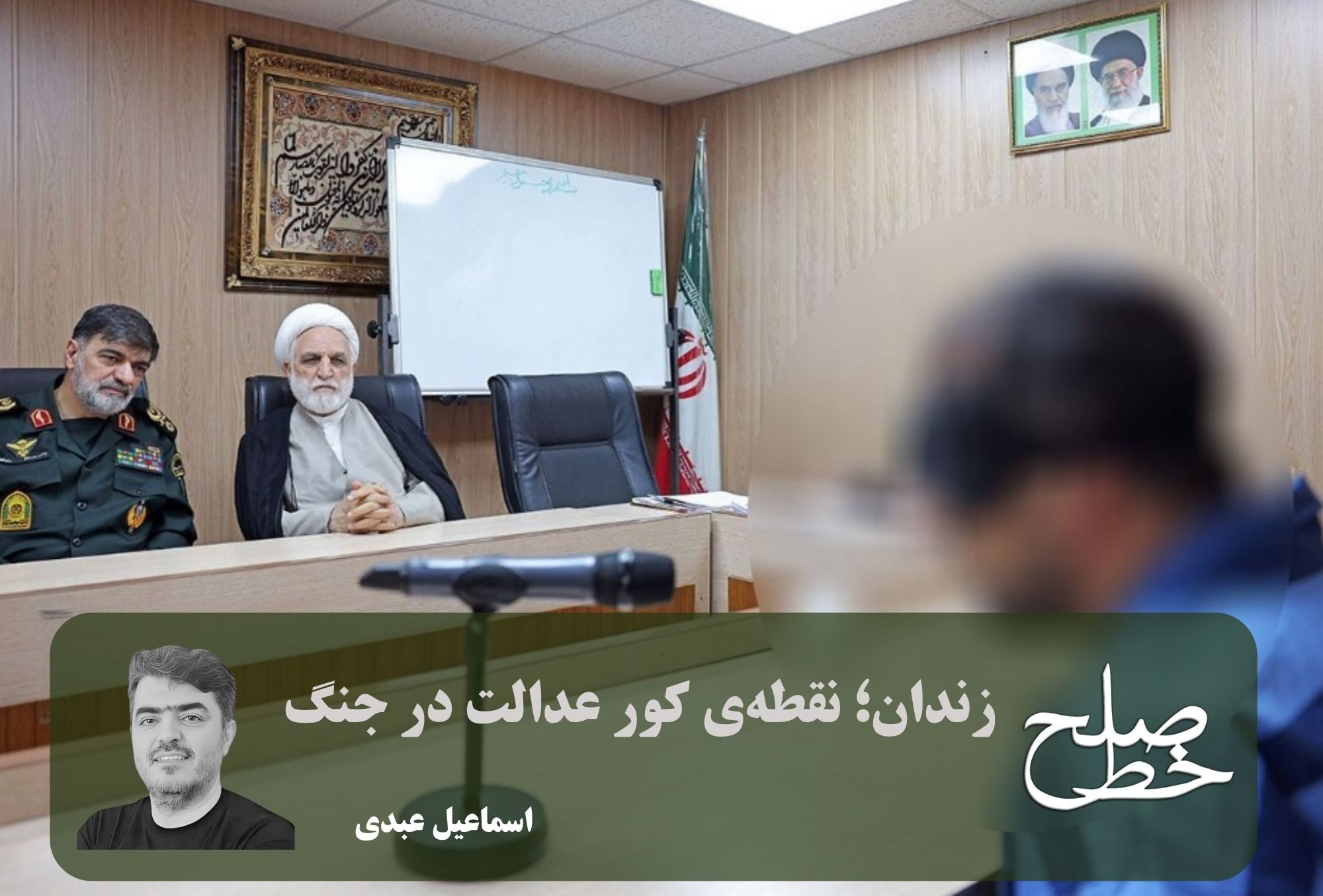
Prison: The Blind Spot of Justice in War/ Esmail Abdi
Based on nearly nine years of my own lived experience in four prisons—Evin, Rajai Shahr, Nadamatgah, and Kachouii in Karaj—I can say with certainty that the system of the Islamic Republic of Iran, despite the existence of domestic laws and its human rights claims, has consistently shown that preserving the human dignity of prisoners and respecting their fundamental rights has never been a priority.
Security and judicial policies, especially in times of crisis and war, have turned into instruments of repression, social control, and the implementation of executions and mass arrests.
During my imprisonment, I saw with my own eyes prisoners who lost their lives as a result of deliberate neglect. Among them were the Gonabadi dervish, the late Behnam Mahjoubi, and the poet and artist, the late Baktash Abtin.
Human rights documentation also shows that in this system, human rights, access to treatment and healthcare, and even prisoners’ right to life become the first victims of security and political priorities. This approach intensifies structural inequality and injustice and has severe direct physical and psychological consequences for prisoners and their families.
Now, with the outbreak of war by the United States and Israel against Iran, concerns about arrests and prison conditions have grown even greater.
Issuance of Death Sentences and Mass Arrests in Wartime Conditions
One of the most important consequences of military crises is the increase in death sentences, their rapid implementation, and mass arrests. In general, human rights reports show that:
- Death sentences are issued without fair trial, and in some cases carried out immediately, often without informing families and without access to a lawyer.
- Mass and sweeping arrests, especially among political activists, students, minorities, and critics, are carried out without observing the principles of fair trial.
- The limited capacity of prisons and wartime conditions turn these widespread arrests into a serious humanitarian and health crisis and increase the psychological and physical pressure on prisoners.
During the twelve-day war, in the summer of 2025 (1404), in addition to air attacks on Evin Prison, reports were published of widespread arrests of political activists and prisoners’ family members, many of whom were held in prisons such as Qarchak, Fashafouyeh, and Evin without access to a lawyer or medical care.
Physical and Psychological Harm to Prisoners in Wartime
In wartime conditions, the physical and psychological harm suffered by prisoners increases dramatically. The reasons include such factors as: direct or indirect attacks on prisons or nearby areas, severe shortages of food, medicine, and hygienic supplies, psychological pressure caused by the constant threat to life and health, anxiety, depression, sleep disorders, and prolonged trauma.
During the twelve-day war, attacks on Evin Prison led to the deaths and injuries of dozens of prisoners, staff members, and family members. Parts of the prison, including the medical clinic, visitation hall, women’s ward, and administrative offices, were targeted in the attacks. These events caused permanent fear, chronic anxiety, and a sense of helplessness among prisoners.
Domestic Examples of Crisis in Prisons
After the attack on Evin, prisoners were forcibly transferred to other prisons. For example, women prisoners were transferred to Qarchak Prison in Varamin and faced poor hygienic conditions, food shortages, and severe restrictions on family visits. Likewise, following the transfer of some prisoners to Greater Tehran Prison (Fashafouyeh), that prison faced overcrowding beyond capacity, shortages of food and treatment, and the transfers from Evin to Qom Prison and other centers placed even greater physical and psychological pressure on prisoners.
Under these same conditions, judicial disorder, with the interference of security institutions and the emergence of catastrophe in the increase of executions and the issuance of unjust death sentences on the pretext of espionage, has also been reported.
Domestic Legal Framework and International Instruments
A. Iran’s Domestic Laws
Articles 22 and 39 of the Constitution: preservation of human dignity and prohibition of insulting or violating the dignity of prisoners, even in crisis conditions.
The Regulations of the State Prisons Organization and the Security and Corrective Measures Organization: provision of medical care, adequate food, a hygienic environment, and access to a lawyer and family visits.
Yet in wartime conditions, implementation of these obligations is severely restricted, and mass arrests and the increase in executions are examples of the failure to observe even these domestic laws.
B. International Instruments and Laws
The United Nations Standard Minimum Rules for the Treatment of Prisoners (the Nelson Mandela Rules): emphasize equal access to medical care and an appropriate hygienic environment.
The Geneva Conventions (the Fourth Convention) and their Additional Protocols: detainees, even in wartime, must have access to minimum standards of food, water, medicine, and medical care, and deprivation of these rights is a clear violation of humanitarian law.
The International Covenant on Civil and Political Rights, Article 10: emphasizes human dignity and appropriate conditions for the detention of prisoners.
The Universal Declaration of Human Rights, Article 25: guarantees standards of living, including treatment and nutrition.
International Examples of Prisoner Crises in War
The Bosnian War (1992–1995): in detention centers such as Serb camps, numerous reports documented food shortages, poor hygienic conditions, and deaths caused by disease and malnutrition.
Abu Ghraib Prison, Iraq (2003–2006): official and media reports described abuse, poor hygienic conditions, limited access to medical services, and severe psychological pressure on prisoners.
The war in Ukraine (2022–present): international bodies, including the International Committee of the Red Cross, have repeatedly emphasized the necessity of access by prisoners of war and detainees to food, water, treatment, and independent monitoring.
Palestinian prisoners in Israel: reports by human rights bodies describe restricted access to medical services, harsh detention conditions, and prolonged psychological pressure on prisoners.
The war in Syria: mass and sweeping arrests, enforced disappearances, and numerous reports of torture and unlawful executions have been among the clearest examples of exploiting wartime conditions to suppress opponents.
A Sociological and Justice-Oriented Analysis
The condition of prisoners in wartime is a symbol of structural inequalities and the absence of attention to human dignity. Mass arrests and the increase in executions show the use of the penal system as an instrument of social and political control. Psychological pressure, illnesses caused by lack of facilities, and prolonged trauma have broad effects on the individual and collective health of prisoners and their families. Wartime crises show that the human rights and dignity of prisoners are preserved only when society is committed to social justice; otherwise, vulnerable groups bear the greatest harm.
The increase in executions and mass arrests also weakens public trust in judicial and security institutions and causes the judicial system, instead of guaranteeing justice, to become a tool for repression and the creation of fear. Justice-oriented sociologists believe that even in crisis conditions, observing human rights principles and ensuring equal access to basic services for detainees is not an option, but an ethical and social necessity.
Ways to Support Prisoners and Their Families
Strengthening Human Rights Monitoring and Judicial Transparency
Creating independent mechanisms to examine prisoners’ conditions and report to international bodies.
Monitoring trial procedures and guaranteeing prisoners’ access to lawyers and fair trial.
Providing Medical and Psychological Services
Immediate access to treatment, medicine, and psychological care even in crisis conditions.
Supporting the survivors of executions and those harmed by war in terms of physical and psychological health.
Legal Support and Legal Counseling
Providing free legal counseling and educating families about prisoners’ rights and how to legally pursue rights violations.
Social and Collective Support Networks
Creating associations and support groups for prisoners’ families and for the survivors of victims.
Raising awareness and increasing public knowledge about prisoners’ conditions and putting pressure on responsible institutions.
Emergency Mechanisms in Times of Crisis and War
Special plans for the safe transfer and emergency care of prisoners, guaranteeing access to sufficient food and immediate treatment.
Cooperation with international organizations to provide humanitarian aid in crisis areas.
Political and Diplomatic Pressure
Organizing campaigns along with pursuing cases in international forums to prevent unjust executions and mass arrests.
Laying the Groundwork for Transitional Justice
These measures not only help provide immediate support to prisoners and their families, but also create the necessary basis for transitional justice in the future; including documenting human rights violations, judicially pursuing those responsible, rebuilding social trust, and guaranteeing the accountability of state institutions.
Transitional justice makes it possible for the experiences of imprisoned victims to be recognized, for the memories of victims to be recorded, and for survivors to attain their legal and social rights.
Conclusion
Prisoners in military and wartime crises experience the greatest harms: severe physical and psychological injuries, shortages of food, medicine, and treatment facilities, mass arrests and the implementation of unjust executions, pressure on families, and a general climate of fear and insecurity.
Guaranteeing prisoners access to treatment, nutrition, and hygienic facilities, and observing the principles of fair trial, even in wartime, is a definite legal and ethical obligation. These measures not only reduce violations of human rights and humanitarian law, but also represent a symbol of society’s commitment to social justice, equality, human dignity, and resistance to structural injustice. Otherwise, wartime crises will become a ground for intensifying inequality, repression, and abuse of power, the effects of which will remain not only on prisoners but on society as a whole.
 Created By: Ismail Abdi
 March 21, 2026
Tags
Freedom Iran-US war Ismaeil Abdi Justice in humanity peace line Peace Line 179 Political prisoners Prisoners' rights Twelve-day war War War conditions ماهنامه خط صلح