


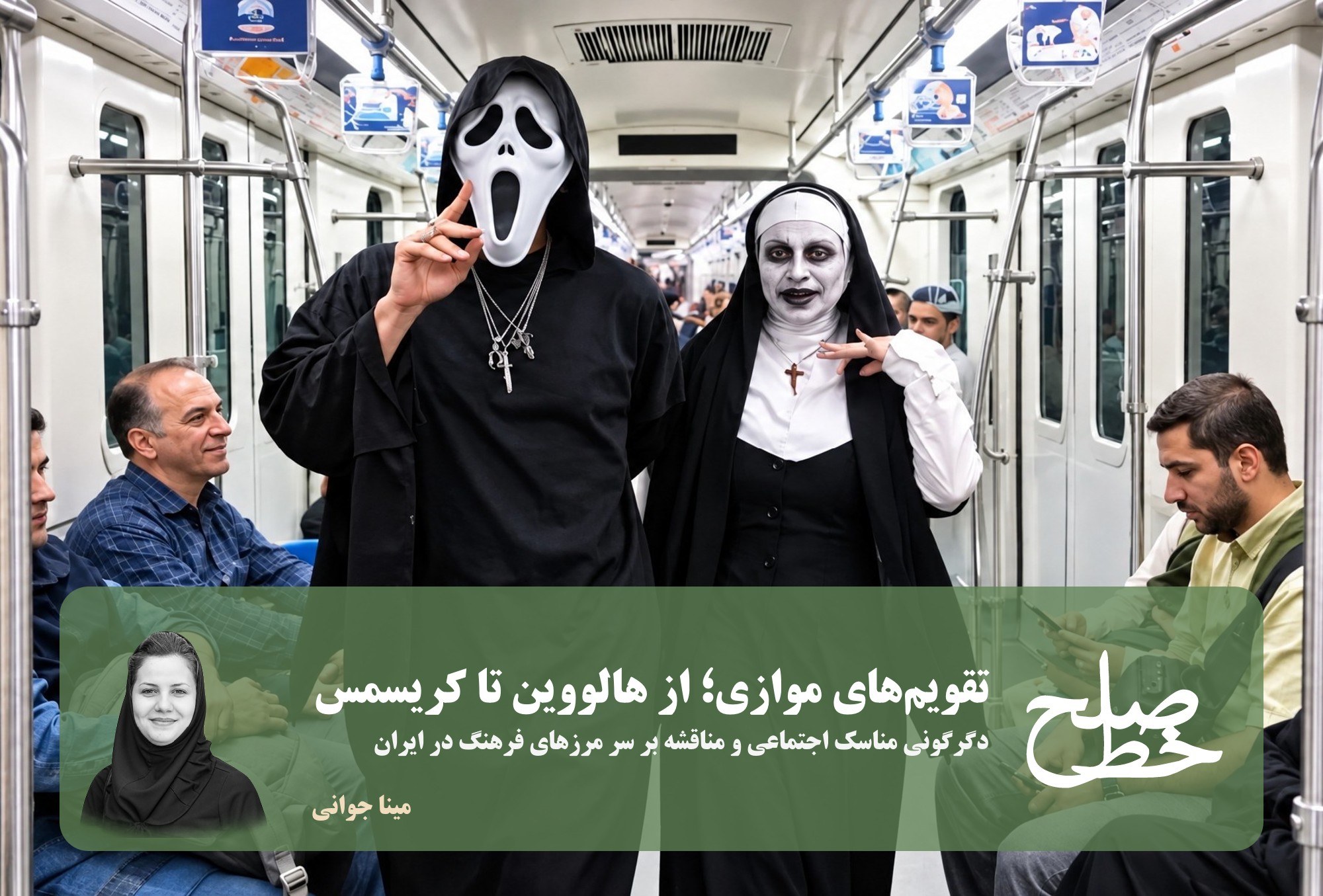
Parallel Calendars: From Halloween to Christmas / Mina Javani
A society’s calendar is not merely a list of days and historical, religious, and national occasions; it reflects the society’s symbolic order, collective memory, and the way social life is organized. Rituals, too, beyond their ceremonial or entertaining functions, provide a setting for reproducing identity, experiencing collective belonging, and shaping social relations. Yet in the contemporary world, cultural and geographic borders are no longer the sole determinants of how rituals take shape and circulate. The globalization of communication, digital media, and the transnational circulation of images and symbols have brought occasions into the everyday lives of societies whose origins may belong to very different geographies and traditions.
In Iran as well, in recent years, “Halloween,” “Christmas,” and “Valentine’s Day” have, in some urban, commercial, and social spaces, become part of the cultural experience of certain groups within society. In the process of social acceptance, these occasions acquire new meanings regardless of their religious or historical origins, and at times drift away from their original contexts. For many participants, taking part in these rituals is not an acceptance of a particular belief system or culture, but a form of leisure, socializing, cultural consumption, and lifestyle choice. In this regard, society is not a passive recipient of global patterns; through selection, reinterpretation, and re-creation, it produces new forms of social rituals.
However, this expansion cannot be viewed separately from the dispute over the definition and boundaries of official culture. While part of society embraces new patterns of celebration, entertainment, and socializing in everyday life, official institutions, based on a particular formulation of cultural identity and social values, seek to determine the boundary between desirable and undesirable culture. Under these conditions, some occasions move beyond the level of individual and collective choices and become subjects of intervention, restriction, and political and cultural contestation. The issue is no longer simply holding a celebration or welcoming an occasion; the issue is who has the right to define legitimate culture.
This tension can be seen as a sign of the formation of two simultaneous calendars in Iran’s social life: an official calendar, which defines and represents recognized occasions and rituals within a specific framework, and society’s cultural calendar, which continually expands and changes in response to social transformations, global communications, and citizens’ diverse preferences. These two calendars are not necessarily in conflict in every instance, but wherever society’s cultural choices clash with official boundary-making, a visible gap emerges between recognized culture and lived culture.
Therefore, the dispute over Halloween and Christmas should be understood in a broader context than a simple opposition between tradition and modernity, or native and foreign culture. The central issue is the relationship between the globalization of culture, the transformation of social rituals, the mechanisms of cultural governance, and citizens’ right to participate in cultural life and choose their way of living. Can the state, relying on a single definition of cultural identity, determine the limits of rituals and social choices? Where is the boundary between cultural policymaking and interference in individual and collective freedoms? And can cultural pluralism find a place within the official order without recognizing the right to choice and difference?
Focusing on the transformation of social rituals in Iran, the present article seeks to examine the relationship between the global circulation of cultural patterns, changing social preferences, and official institutions’ intervention in cultural life—a relationship in which celebrating becomes a more fundamental question about the right to choose, cultural pluralism, and the limits of power in everyday life.
The Globalization of Culture and the Reconfiguration of Social Rituals
Social rituals are mechanisms through which societies reproduce their symbolic order, give meaning to collective experiences, and delineate the boundaries of cultural belonging. Calendar occasions, celebrations, and collective rituals not only reflect established beliefs and values, but also shape and sustain them. From this perspective, the social calendar is a field for organizing collective memory and representing cultural identity—one in which society, through the repetition of rituals, redefines its relationship to the past, tradition, and the contemporary social order. Yet the communicational transformations of the contemporary world have broken the geographic and historical monopoly of rituals: transnational flows of information, images, and symbols have made it possible for rituals to circulate and be reproduced in contexts that differ from their historical origins.
The globalization of culture should not be reduced to a one-way transfer of patterns from core societies to peripheral ones. Such a view assumes recipient societies are passive and overlooks the complexity of processes of acceptance, selection, and reinterpretation. The global circulation of cultural elements is a multilayered process in which symbols and rituals acquire new meanings when they encounter new social contexts. In his analysis of global flows, Arjun Appadurai shows how media, migration, and the circulation of images and ideas open new horizons for the social imagination. Within this framework, encountering an occasion from another culture neither requires being present in its historical geography nor belonging to the society of origin; media and communication networks enable symbolic participation in experiences that previously existed within specific cultural boundaries.
The presence of Halloween, Christmas, and Valentine’s Day in societies outside their historical origins is an example of this shift in the mechanisms of cultural transmission and reproduction. These occasions do not travel transnationally with all their historical, religious, and doctrinal components; some elements are selected and rearranged to suit the needs and preferences of the host society. Christmas has a theological and religious meaning in the Christian tradition, but in some non-Christian societies it may be experienced through visual symbols, urban decorations, gift exchanges, and social gatherings. Halloween, too, in many of its contemporary forms, has moved away from its original historical and ritual context and is reproduced as entertainment, cultural consumption, and the symbolic performance of identity. Transferring an occasion into another context does not mean transferring its entire system of meaning; it involves selection, functional change, and the production of new meanings.
This transformation can be explained through the concept of “cultural localization.” Localization here is not the mechanical adaptation of an external element to local traditions; rather, it is a process through which transnational elements are redefined within the social relations and meaning systems of the host society and take on different functions in connection with generational preferences, consumption patterns, and socializing structures. Therefore, participation in a transnational ritual is not, in itself, a sign of adopting a foreign identity or breaking with cultural heritage. Such an interpretation fails to distinguish among three things: using elements of a culture, accepting its value system, and redefining one’s personal identity—whereas these three are neither simultaneous nor synonymous.
The transformation of rituals should also be seen in connection with changes in the relationship between the individual and culture. In more traditional patterns, a significant portion of social occasions was transmitted through established institutions, family traditions, religious structures, and historical memory. Today, the sources shaping cultural experience have become more diverse, and individuals can more than ever select and combine different cultural elements. This does not mean the decline of collective belonging or the end of the role of traditions; it indicates a change in how belonging is formed. Belonging is no longer necessarily determined by social inheritance and membership in a single tradition, and it can also arise from elective participation in a range of diverse experiences and rituals. Cultural identity, too, moves from a unified form based on fixed boundaries toward a more fluid condition.
This transformation is also intertwined with changes in the structures of leisure and cultural consumption. In many societies, transnational occasions have become part of the entertainment economy, cultural industries, and consumer markets: the production of occasion-related goods, the reconfiguration of commercial spaces, advertising, and the organization of collective events contribute to their economic circulation. However, explaining their spread solely through market logic overlooks the social and symbolic dimension of participation. In these occasions, people, in addition to consuming goods and services, find opportunities to display taste, experience socializing, create social distinction, and build shared memories. Contemporary rituals sit at the intersection of consumption, identity, and social relations and cannot be reduced to any one of these dimensions.
In Iran as well, the spread of certain transnational occasions should be understood in this context. Their presence in commercial, media, and collective spaces is not merely the addition of a few new celebrations to the social calendar; it signals a change in the sources shaping cultural taste, leisure patterns, and modes of expressing identity among different groups. This trend, however, is neither uniform nor generalizable to all groups: the extent and form of participation depend on generation, social class, access to media, geographic location, and cultural background. Speaking of the spread of these rituals should not lead to assuming a universal cultural preference in Iranian society.
The political significance of this transformation becomes clear when the circulation and re-creation of rituals confront official patterns of defining and regulating culture. Then the issue is no longer the acceptance or rejection of an occasion; a dispute arises over the authority to define culture and the limits of its legitimacy. When rituals become independent of official channels of cultural transmission and individuals take a more active role in choosing and reproducing them, the monopoly of official institutions in determining recognized forms of belonging and cultural participation is called into question. The globalization of rituals is therefore not only a transformation in cultural content, but also a change in power relations surrounding the production, circulation, and legitimation of culture; and the transformation of social rituals goes beyond the sociology of culture and becomes an issue in cultural governance and in the relationship between the state and society.
The Lived Calendar and Cultural Agency: Social Rituals in Relation to Citizenship Rights
The spread of Halloween, Christmas, and Valentine’s Day among part of Iranian society signals a transformation in the relationship between the individual, culture, and the social order. The issue is not the entry of a set of cross-border symbols; what matters is the change in the mechanisms of meaning-making, the selection of occasions, and the formation of new forms of social participation. In this process, culture is reproduced less through official and traditional institutions and more through everyday practices, individual choices, and interpersonal interactions.
These patterns have taken shape in connection with changing lifestyles, the expansion of cross-border communications, and shifts in leisure and socializing practices. In some urban, commercial, and private spaces, new occasions have become pretexts for gathering, gift-giving, dressing up, rearranging spaces, and producing shared images and experiences. The important point is that the legitimacy of these rituals no longer necessarily comes from official institutions or belonging to a historical tradition; friendship networks, peer groups, social media, and commercial spaces play a role in shaping and stabilizing them. In this way, part of society participates in producing a calendar whose meaning arises from the repetition of social practices and interpersonal acceptance, not from its place in the official calendar.
Participants’ motivations are not the same either: for some, these occasions are a way to diversify leisure experiences; for others, a platform to display taste and personal identity; and at times participation strengthens social ties and leads to the creation of shared memories. Reducing these practices to consumerism, imitation of the West, or conscious opposition to official values fails to explain their complexity, because it assumes the meaning of a cultural act is predetermined and independent of how it is used and reinterpreted.
The political consequence of this diversity becomes apparent when cultural choices confront official institutions’ efforts to regulate the boundaries of legitimate culture. Then the issue is no longer a difference in taste, but the limits of individuals’ discretion in shaping social life and the limits of power’s intervention in these choices. When an occasion is banned or restricted because of its foreign origin, its relationship to official values, or the way it is held, a fundamental question arises: can a ritual’s belonging to another tradition be grounds for depriving people of participation in it? And can the state, in the name of safeguarding culture, restrict citizens’ cultural choices to patterns it approves?
This question can be analyzed within the framework of citizenship rights and cultural rights. The right to participate in cultural life does not limit culture to official heritage or artistic and literary productions; it includes both access to cultural activities and ways of life, and the freedom of individuals and groups to choose, preserve, and transform cultural practices. In contemporary human-rights thinking, culture is not a fixed and exclusive domain of official institutions, but a dynamic arena of meaning-making, reinterpretation of traditions, and interaction among diverse forms of social life. On this basis, citizens are not only audiences and consumers of cultural products, but also agents who have the right to choose and participate in shaping the cultural life of society.
Alongside the right to cultural participation, freedom of thought and conscience, freedom of expression, and the right to peaceful assembly are also important in analyzing rituals—especially regarding an occasion such as Christmas, which for some citizens carries religious and identity-related meaning. But the issue is not limited to religious rituals. Even when participation in an occasion has no doctrinal meaning and is more related to leisure, socializing, or lifestyle, it cannot automatically be placed outside the realm of individual and cultural freedoms. Choosing an occasion or holding a ceremony with a different cultural origin, so long as it does not violate others’ rights, is part of citizens’ cultural choices.
In a multilayered and diverse society such as Iran, the boundaries of cultural belonging cannot be determined uniformly and from above. Democratic citizenship means recognizing differences and accepting that individuals can simultaneously belong to different traditions and meaning systems. The role of public institutions in the cultural sphere should not be reduced to imposing a single model of desirable life or judging the authenticity of people’s cultural choices. Any restriction on these choices requires a public, clear, and proportionate justification—one that cannot rest on an occasion’s unfamiliarity, its geographic origin, or its incompatibility with the cultural preferences of official institutions. Safeguarding culture cannot come at the cost of ignoring cultural pluralism and restricting the right to social participation.
The right to cultural participation, beyond access to cultural products and symbols, entails recognizing citizens’ capacity to choose and reinterpret cultural forms, in a space where they can experience diverse modes of social participation without discrimination and disproportionate interference. In this sense, the lived calendar is not merely a set of new occasions; it signals society’s demand for greater agency in defining everyday life and participating in the production of collective meanings. The dispute over Halloween, Christmas, or other transnational occasions is ultimately a dispute over the citizen’s place in the cultural order: a citizen who is not merely an audience for official culture, but also has agency in choosing, reproducing, and transforming culture.
Cultural Governance and the Politics of Boundary-Making: The State’s Resistance to the Transformation of Social Rituals
The spread of transnational occasions in Iran cannot be examined independently of the particular configuration of the relationship between the state and culture in the Islamic Republic. In this relationship, culture is not a domain independent of power relations; it is one of the main arenas for defining collective identity, regulating social behavior, and reproducing political order. Through policymaking, institution-building, discourse production, and oversight of public spaces, the state seeks to determine the boundaries of desirable culture and acceptable forms of social participation. The approach to Halloween, Valentine’s Day, and Christmas should therefore be analyzed within the framework of cultural governance—a framework in which the main issue is not simply accepting or rejecting a ritual, but the relationship between institutional authority to define legitimate culture and society’s capacity to produce and reinterpret cultural meanings.
The first level of this encounter is discursive. In part of the official discourse, the circulation of transnational symbols and rituals is framed through concepts such as “cultural invasion,” “cultural infiltration,” and the “promotion of a Western lifestyle,” as a threat to religious and national identity. This vocabulary detaches occasions from the social context and the diverse meanings they acquire in everyday life and places them in opposition between “insider” and “foreign” culture; thus, a recreational ceremony or a friendly gathering may be interpreted as a sign of a broader identity transformation. The meaning of a cultural act is no longer assessed through participants’ motives and experiences, but on the basis of its historical and geographic origin and its relationship to the official model of culture.
The problem is that an occasion’s origin becomes the criterion of its legitimacy. Cultural boundaries in this logic are imagined like political and geographic borders, as if the entry of cultural elements from outside, in itself, threatens the society’s identity cohesion. This view ignores the fluid nature of culture and the possibility of moving, combining, and reinterpreting its elements, and it fails to distinguish between the circulation of a symbol, participation in an occasion, and acceptance of the worldview of its origin. The diversity of motives and meanings of participation in transnational rituals is absorbed into a grand narrative of cultural infiltration, making it difficult to understand citizens’ cultural practices on their own terms.
Cultural governance, however, does not remain limited to discourse production. The second level of intervention is the institutional and administrative regulation of the conditions under which occasions appear in social spaces. The state and its affiliated bodies can, through trade regulations, licensing requirements, advertising restrictions, oversight of commercial centers, and threats of shutting down businesses, regulate the possibility of holding and publicly representing rituals. In this way, intervention shifts from judging the content of an occasion to controlling the social infrastructure of its performance. Cafés, restaurants, tourist centers, and shops are particularly important here, because they are not only places where goods and services are offered; they also play a role in forming small gatherings, producing shared experiences, and making an occasion visible in urban space.
The ban announced by the Iran Chamber of Guilds regarding the celebration, advertising, and sale of Halloween-related items in November 2024 is a clear example of this type of intervention. In the announcement by this institution, holding ceremonies and even advertising or selling Halloween-related items in commercial units and public places was declared prohibited, with sealing and referral to judicial authorities stipulated for violating units. (1) The scope of this prohibition extended beyond the holding of ceremonies, encompassing the commercial supply and public representation of the symbols of this occasion. The subject of the intervention was not merely the content of a celebration or the behavior of the participants; a network of economic, promotional, and social activities that contributed to the reproduction of this occasion was also subjected to restrictions.
This approach can be seen as a form of cultural regulation through controlling intermediary spaces. Official institutions do not necessarily need direct intervention in all individual practices to limit an occasion’s presence; it is enough to restrict its organization in commercial and public spaces. Pressure on organizers, business owners, and hospitality venues raises the cost of participation and reduces the possibility of turning an occasion into a public and collective experience. Economy and culture become intertwined at this point: an economic operating license can become an instrument for enforcing cultural policy, and a guild unit, in addition to ordinary economic rules, may face expectations and restrictions regarding the cultural content of its activity.
Another level of this policy is policing intervention and surveillance of public spaces, which goes beyond restricting organizers and commercial centers and relates to how citizens are present in urban space. Reports published about the crackdown on a Halloween gathering on Iranshahr Street in Tehran on 9 Aban 1405 described the presence of police and plainclothes forces, dispersal of the crowd, closure of nearby cafés, and the arrest of some individuals. (2) At the same time, reports were also published about action against guild units in cities such as Qazvin and Fardis. In Qazvin, according to a statement by the province’s police official reflected in domestic media, 19 guild units were identified and shut down for publishing images and content related to Halloween; in Fardis, there was also news of the sealing of one guild unit and the issuance of warnings to a number of others. (3)
The analytical significance of these events lies in the simultaneity of several types of intervention: administrative prohibition, oversight of commercial activity, control of presence in public space, and policing action. This simultaneity shows how a cultural occasion can become a point of intersection among different domains of governance. In reports related to the Aban 1405 crackdowns, women’s dress and the mixed-gender presence of participants were also raised alongside the Halloween ban; intervention in a cultural occasion may become linked to broader mechanisms for regulating bodies, gender, and social relations. In this situation, Halloween is no longer only an issue of cultural policy, but a platform for the simultaneous enforcement of dress codes, public order, guild activity, and citizens’ presence in the city.
From this perspective, one can distinguish between two levels of state policy: a policy that seeks to determine the legitimate content of culture, and a policy that regulates the material and social conditions under which that content appears. The first level operates through official discourse, valuation, and the production of symbolic boundaries, and the second through regulations, permits, oversight, and executive intervention. These two are not independent: cultural discourse provides the justificatory basis for intervention, and administrative and policing mechanisms turn that boundary-making into practical restriction. Understanding institutional resistance to transnational occasions therefore requires simultaneous attention to the language of cultural policy and its enforcement tools.
This approach, of course, should not be seen as a uniform policy applied indifferently across all state institutions. Different bodies—from cultural and guild institutions to policing and judicial authorities—have different duties and powers, and the intensity and method of intervention vary by city, occasion, and venue. Nevertheless, the repetition of bans and the linkage between administrative warnings and enforcement actions show that controlling cultural occasions in some cases becomes connected to a set of institutional mechanisms. Cultural policy, therefore, should not be sought only in the text of documents and declared positions; the mode of implementation, the scope of oversight, and its consequences for citizens are also part of the reality of this policy.
With regard to Christmas, a fundamental distinction is needed. For Iran’s Christians—especially Armenian and Assyrian communities—this occasion is part of their religious life and cultural memory, and it is not the same as the commercial consumption of Christmas symbols or holding non-religious parties. The official recognition of religious minorities does not, in itself, mean they enjoy unconditional access to all possibilities of cultural participation; the more important issue is the conditions under which these communities hold their rituals while also being affected by restrictions related to church activities, institutional oversight, and official boundary-making. Reports on the situation of Christians in Iran indicate restrictions on church activities, the language of ceremonies, and oversight of religious gatherings. An analysis of Christmas must therefore consider two distinct issues: the Christian community’s right to hold religious rituals, and the circulation of the symbols of this occasion in public and commercial space.
Differences among occasions are also meaningful. In official discourse, Halloween is assessed in terms of its relationship to Western culture and an undesirable lifestyle; Christmas, beyond public representation, is linked to the rights and freedoms of a religious minority; and Valentine’s Day lies more in the realm of emotional relationships, cultural consumption, and lifestyle. Not all can be analyzed under a single policy or with the same motivation. What makes them a shared issue is how official institutions confront forms of cultural participation that take shape outside the established occasions of the official calendar; and the differences show that the politics of cultural boundary-making employs different tools and intensities depending on the subject and social context.
Despite these interventions, the continued استقبال of transnational occasions shows that restrictive policy does not necessarily lead to their social elimination. The persistence of Halloween symbols, Christmas decorations in some urban spaces, and the continuation of Valentine’s Day point to the gap between official boundary-making and the preferences of part of society. This gap should not immediately be read as conscious political resistance; many people turn to these occasions simply for leisure, socializing, or participation in a cultural event, without intending to confront the political order. However, the intervention of power can change the social meaning of these choices: an act that belonged to everyday life becomes, in the face of prohibition and surveillance, a matter of the limits of citizens’ freedom and agency.
Ultimately, the dispute over transnational occasions is a dispute over cultural authority. The issue is not that the state should have no role in society’s cultural life, but the limits and foundations of that role: are public institutions obliged to enable the participation of different groups in cultural life, or are they permitted, through an exclusive definition of desirable identity, to exclude certain forms of participation from the public sphere? In a diverse society, cultural policy is compatible with citizenship rights only when it distinguishes between supporting cultural heritage and imposing a single model of life. From this perspective, the state’s resistance to transnational occasions is not merely a reaction to a few imported celebrations; it is an expression of a broader dispute that asks who has the right to define culture and how much agency citizens have in determining their own calendar, rituals, and the meanings of their collective life.
Footnotes:
1. Government spokesperson: We have so many national celebrations—where did Halloween come from?, Iran International, 9 Aban 1404.
2. A tense night on Iranshahr / The sidelines of the Halloween celebration in Tehran, Fararu, 10 Aban 1405.
3. Halloween celebration: Sealing of one guild unit and issuance of warnings to 30 others in Fardis, HRANA, 9 Aban 1405.
4. Dadpour, R. (2025). Theocratic authoritarian urbanism and performative right to the city: A case study of Tehran’s City Theatre. City, 29(5–6), 1047–1066.
5. Imani, M. (2026). Reclaiming “normal life”: Everyday resistance by Gen Z in Iran. Suomen Antropologi: Journal of the Finnish Anthropological Society, 50(1), 175–200.
6. Price, M. E. (2012). Iran and the soft war. International Journal of Communication, 6, 2397–2415.
7. Varij Kazemi, A. (2023). Everyday movements and massive socio-cultural shifts in Iran. Critique, 51(1), 181–196.(1)
 By: Mina Javani
 November 22, 2026
Tags
Christmas Cultural governance Globalization of culture Halloween Lifestyle Mina Youth Official culture peace line Peace Line Monthly Peace Mark 187 Social rituals Valentine’s Day