


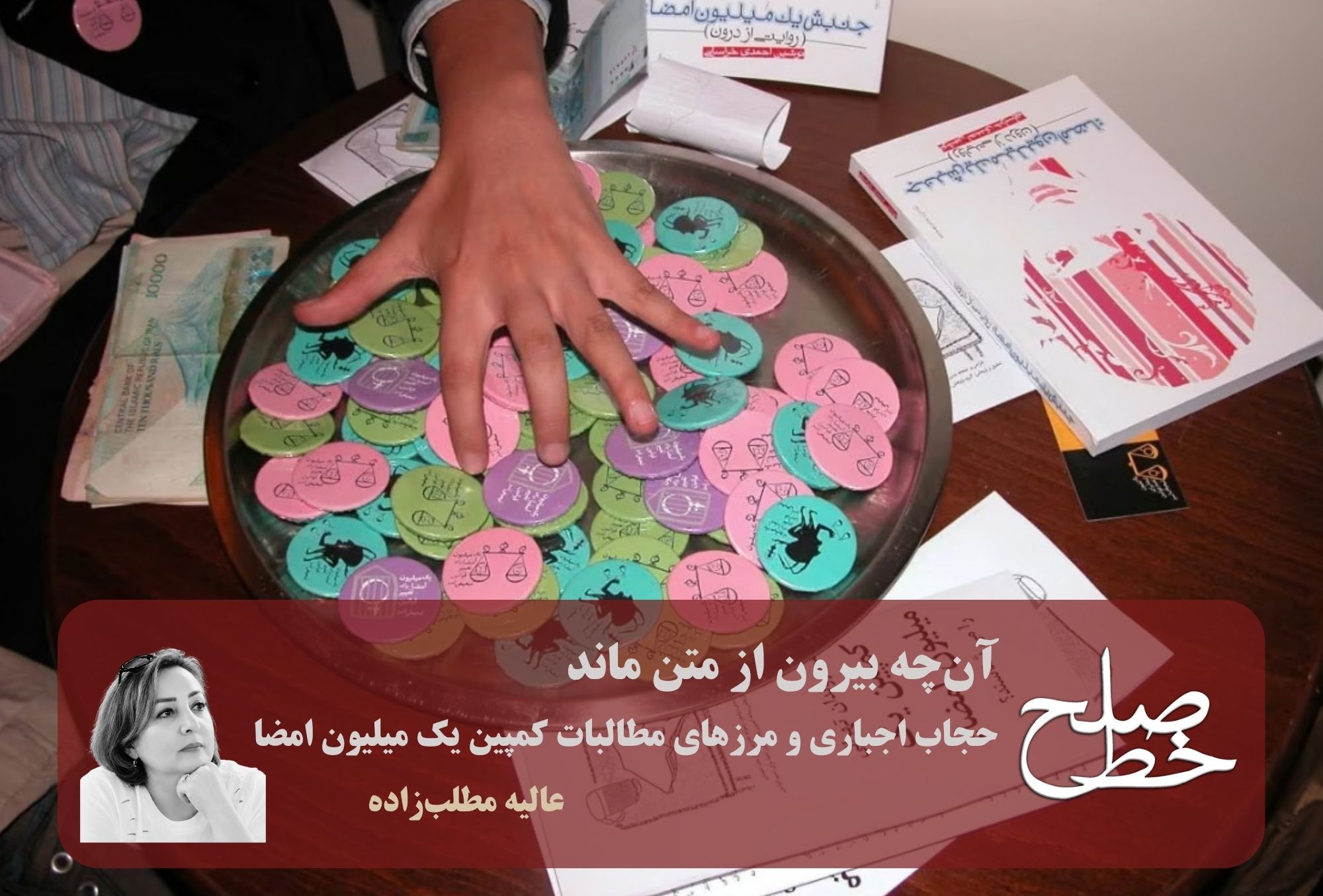
Compulsory Hijab and the Boundaries of the One Million Signatures Campaign’s Demands/ Aliyeh Motalebzadeh
I belong to a generation of women who have spent a large part of their lives in conflict with the Islamic Republic; not only in the streets, in prison, and in civil activism, but also in the media, in photographs and images, in those very places that the government, whenever it has deemed necessary, has targeted, shut down, and banned. For the women of this period, politics was not something that happened only in elections or official buildings; it had entered everyday life, and at times came so close to the very skin of life that no line could be drawn between the political and the personal. Now, when I look back at the path of the women’s movement over these past several decades, one thing occupies my mind more than anything else: not the defeats and victories, not whether we were braver in one period and more cautious in another, but the changing language of struggle; what we were able to name in each period and what, for whatever reason, we kept outside the text.
The One Million Signatures Campaign was one of the most important experiences along this path. I was involved with it, and for that reason today I cannot write about it as an outside observer. But perhaps precisely for this reason, we need to ask ourselves: What did the campaign bring into public language? What did it turn into a political issue? And what, despite its presence in women’s everyday lives, was not included in the official text of the campaign’s demands?
One of the most important of these was “compulsory hijab.” If this sentence is stated without explanation, it may convey the wrong meaning; as though women activists of that period did not see compulsory hijab or did not consider it important. Such an interpretation is inconsistent with historical reality.
From the very first months after the Revolution, compulsory hijab became one of the principal arenas of conflict over the position of women. In March 1979 (Esfand 1357), a few weeks after the Revolution, thousands of women took to the streets of Tehran to protest the rollback of their rights and the announcement of new dress regulations. The repeal of the Family Protection Law and the gradual imposition of hijab in public spaces soon demonstrated that the issue facing women was not merely the amendment of several legal provisions; the issue was how far the government could go in deciding about a woman’s life. But those protests were unable to alter the political trajectory of that period. The Islamic Republic became consolidated, and compulsory hijab gradually evolved from an order and a form of social pressure into a set of rules and enforcement mechanisms. In the decades that followed, women lived in a society in which they simultaneously confronted two realities: on the one hand, their presence in education, universities, employment, the press, cinema, and the public sphere was expanding; on the other hand, the law and the government continually drew boundaries around them. This very contradiction has shaped an important part of the history of Iranian women since the Revolution.
Perhaps it is from this point that we can understand why the language of rights became so important in the 1990s and 2000s (1370s and 1380s). When everyday life is constantly restricted by law, it is natural for law to become one of the principal arenas of struggle. Women, lawyers, journalists, and civil activists gradually developed a more precise language for explaining discrimination: the right to divorce, custody, inheritance, diya, testimony, nationality, marriage, polygamy, and the age of criminal responsibility. The issue was no longer simply that women were mistreated and subjected to discrimination; the issue was which legal provision, where, and how turned a woman into an unequal citizen. The One Million Signatures Campaign was a product of this stage.
In 2006 (1385), the campaign was formed with the aim of changing these discriminatory laws against women. Its method was also part of its significance. Rather than appearing only in street demonstrations, it transformed face-to-face dialogue, legal education, and signature collection into political tools. Its demands encompassed various areas of women’s lives, from marriage, divorce, and inheritance to diya, nationality, and polygamy. The campaign sought to demonstrate that legal discrimination was not a specialized issue for lawyers, but something that affected women’s actual lives.
Today, however, it may seem easy to ask why compulsory hijab was not simply added to the same list. Yet this question has no simple answer.
The campaign was designed for dialogue; to enable women with religious and nonreligious backgrounds, leftist, reformist, and independent women, and women with different social experiences to come together around a set of legal demands. It even sought not to define itself as being in direct opposition to Islam or as a movement seeking the overthrow of the government, and to make use of the possibility of change within existing structures. This choice had limitations, but it also made it possible to create a broader network.
Here, compulsory hijab was of a different nature. With many of the campaign’s demands, the question was what the law does to a woman; but with compulsory hijab, the woman’s body itself was directly the site upon which the law was enforced. This issue could not simply be fitted into the same language of amending a legal provision, because the issue was not merely inequality in one particular right; it was a woman’s autonomy over her appearance and her presence in public space.
Perhaps women’s rights activists at the time did not yet have the appropriate political language to explain this distinction. This admission is more important than attempting to construct an excuse or defense for the decision made at the time. Compulsory hijab was recognized as part of the system of discrimination, and it was clear what costs it had imposed and continued to impose on women; but in a project designed to reform the law and build a social coalition, this issue was not placed at the center of the official demands. Today, this decision can both be understood from within the logic of that period and criticized from outside it. If we look only from the outside, the campaign appears incomplete; if we look only from within, we may attribute everything to the political conditions of the time and close the case. Neither is sufficient.
The campaign created a language: the language of “having rights.” It said that women should enjoy equal rights under the law, within the family, and in society. This was no simple development. It had taken years for such demands to move from the margins into public discussion. Campaign activists also faced arrest, judicial cases, and security pressure because of these activities. The past, therefore, cannot be judged from the safety of the present. But history is not only for praising the efforts of past activists; it is also for seeing what they did not see.
From the late 2000s (late 1380s) onward, other forms of women’s protest gradually became visible. In subsequent years, the issue of hijab resurfaced in different ways, from everyday acts of resistance and the presence of women without hijab in public spaces to actions that, through the internet and images, could very quickly spread from one individual to a larger collective. In 2017 (1396), the Girls of Enghelab Street clearly displayed this transformation. A woman could, without an organization, without a statement, and without a list of demands, turn her own body and clothing into political action. This did not mean that law had become unimportant; something else had happened: the subject of politics had changed.
In the campaign, women’s rights activists spoke more about what rights a woman should have; in newer forms of action, a woman, without asking anything of the government, did what she regarded as her right. This difference is subtle but important. Having a right is not the same as not asking for that right. In the former, the law and the government remain the primary addressees: you ask the law to recognize you as equal. In the latter, the starting point is the individual herself: I do not ask the government for permission to make decisions about this part of my life. In my view, the significance of the “Woman, Life, Freedom” uprising in 2022 (1401) lies precisely here. The death of Mahsa (Jina) Amini in September 2022 (Shahrivar 1401), after her arrest in connection with compulsory hijab laws, sparked protests across the country that very quickly went beyond protesting the death of one woman. Women and girls were at the center of the protests, and removing compulsory hijab in public spaces became one of the most recognizable forms of disobedience. But the scope of the protests was much broader than the issue of hijab, and different social, ethnic, and generational groups participated in them. Subsequent studies have also emphasized the role of structural discrimination against women and girls in creating the conditions for these protests.
For me, the significance of the slogan “Woman, Life, Freedom” lies in precisely this expansion. If we see only “Woman,” we may regard it as a direct continuation of the women’s rights movement; but the word “Life” adds something to this equation that was less visible in many earlier languages of struggle. Life means those things that cannot be fitted into a table of legal provisions: what you wear, whom you live with, where you go, what you study, whom you fall in love with, whether you work or not, whether you have children or not, whether you dance, sing, walk in the street without worrying about an officer, a patrol, or a legal case. It means having the right not to experience life solely in the forms permitted by the government. For this reason, “Life” in this slogan is not, for me, a decorative word. The issue has moved from women’s rights to the quality of the possibility of living; and this is precisely where “Woman, Life, Freedom” is no longer merely the name of a women’s movement.
Women were at the center at the beginning of this uprising, but it soon became clear that the issue was not merely women’s participation in protest. Men, students, workers, families seeking justice, ethnic groups, followers of different religions, and various social groups each found part of their own grievances within this uprising. Field studies have also described the protests in connection with broader demands for human rights, equality, justice, and social and political change.
This marks an important difference from the One Million Signatures Campaign. The campaign sought to change parts of the law so that women’s lives would become more just; the “Woman, Life, Freedom” uprising stood at a point where the very possibility of life within the existing framework was called into question. But I do not want to conclude from this difference that one was conservative and the other radical, or that in one period we did not know the way and in another we finally found the right path. Such a narrative is both unfair and reductive of history. At that time, we faced an issue whose solution was not yet clear. Building a coalition around women’s legal rights, providing legal education, and bringing gender discrimination into public discussion were themselves important political acts. If we erase that experience, we also erase part of the groundwork that later made it more possible to speak about autonomy and the body. But newer forms of political action added something to this language that was less visible in the earlier experience: the unmediated nature of action. A Girl of Enghelab Street did not need an organization to begin her action. A woman protesting in 2022 (1401) did not need to carry a list of legal provisions to explain her demand. Her image could itself be a political sentence. This was not merely a change in tools; our conception of the activist had also changed.
During the period in which the campaign was active, a woman activist was often someone who belonged to an intellectual network, attended meetings, wrote texts, collected signatures, gave interviews, provided education, and built circles and organizations around a specific demand. In later years, forms of political action emerged that were far more individual, rapid, and visual. One person could take an action, and that same action, without any organization behind it, could become a collective experience within a matter of hours. This change cannot be explained simply in terms of courage or lack of courage. Society had changed, communication tools had changed, women’s experience of the government had changed, and the individual’s own conception of their relationship with power had also changed.
Even so, we are still in the midst of a period of transition; neither in a world where the old rules have disappeared nor in one where new rules have become established. The law imposed on women’s lives over previous decades still exists. The government continues to try to preserve the same old relationship between power and the woman’s body; at the same time, a large part of society no longer regards that relationship as self-evident and is unwilling to accept it as destiny. This gap may be one of the most important realities of Iran today: power still operates according to the old logic, but part of society no longer lives according to that same logic.
When I look at the One Million Signatures Campaign today, rather than wanting to defend or reject it, I think more about what remained outside its text; not only hijab, but the idea that a woman, before being the subject of law, is the owner of her own life. Perhaps in those years we did not have the necessary language to say this sentence; perhaps, under those conditions, in order to build a genuine coalition, we had to push certain things to the margins. Both may be true at the same time. What matters to me today is not proving that the choices of the past were correct; what matters is being able to take responsibility for those choices without rewriting history in our own favor.
For years, I have worked with images, and I know how memory is formed: which things remain in it through repetition and which things, if we do not give them a name, gradually fade from memory. Perhaps this is our task today: to name what was not said; not to erase the past, not to diminish the resistance of those who took steps along this path before us, and not to create a myth out of the new generation, but to see history as it was—a history that is neither a straight nor a uniform line. Every period added something to the language of struggle and brought something into sharper focus. The campaign taught us that discrimination can be drawn out of everyday life and translated into the language of rights. Enghelab Street showed that the body itself can be turned into a political sentence, and 2022 (1401) showed that when woman stands alongside life and freedom, the issue of women can no longer be placed in a room separate from the issue of society.
If I wanted to defend the past today, I would add nothing to this history. I would rather say that we said some things and left other things unsaid; we opened some doors and did not enter through others. The question of why those choices were made remains, and the answer should not be a defense of ourselves. The answer is to continue the same work that the women’s movement, in its different forms, has always done: to make new questions and challenges more precise and to take them more seriously, until every form of discrimination against women is eliminated.
 Created By: Aliyeh Motalebzadeh
 September 23, 2026
Tags
Bad hijab Civil society Compulsory hijab Freedom of life Mahsa Movement Peace Line 185 Unveiling Woman Women's rights