


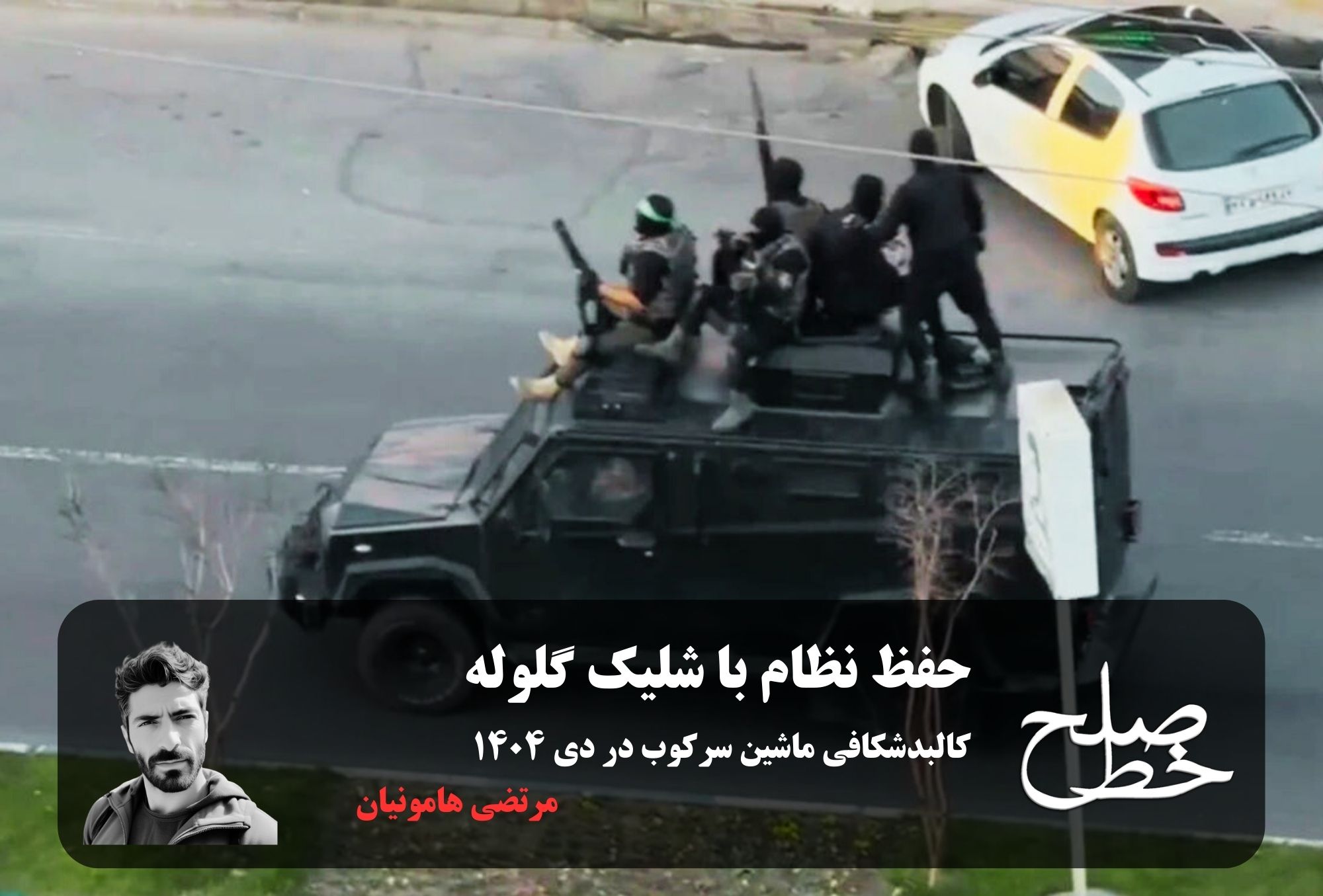
Maintaining the system by firing bullets/ Morteza Hamounian
Everyone had come. With every force they could muster to organize the suppression. In a structure where maintaining the system is an obligation, all their strength is expended to fulfill this obligation; even if this fulfillment comes at the cost of the blood of citizens. In January 1404, Iran witnessed a protest movement that began with the bazaar and spread to more than 200 cities in Iran. A protest movement that became the largest and most widespread anti-government protest since the 1979 Bahman Revolution. A protest movement that was suppressed by the government in the bloodiest possible way, resulting in a massacre that, with the sacrifice of tens of thousands of Iranian citizens, can be called the bloodiest massacre in the contemporary history of Iran and the world. The Islamic Republic’s suppression apparatus, consisting of the Revolutionary Guard Corps and Basij, the Faraj and Vaja, and the rest of the security and military institutions, all came to the scene to carry out the bloodiest repression in the contemporary history of Iran. Blood flowed through the streets, and a force that had been prepared in advance and was equipped with weapons, training, and personnel created a historic disaster.
This bloody repression was completely nationwide and was not limited to a specific city or region. Reports from various provinces (from Fars, Lorestan, and Ilam to Isfahan, Gilan, Khuzestan, Khorasan, Bushehr, and Tehran) indicate that security forces used live ammunition, machine guns, snipers, shotguns, and even cold weapons against unarmed protesters. (1) Esmail Kowsari, a former commander of the IRGC and a member of the Islamic Consultative Assembly, also said in a speech that on the evening of January 8, 1404, “the Supreme National Security Council decided that the Faraj, Basij, and IRGC forces would take armed action to neutralize the issue.” (2) This means that at least from January 8, 1404 onwards, various units and formations of forces such as the IRGC officially confronted defenseless people with weapons of war and opened fire on them. This is despite the fact that by January 8, 1404, at least 38 people had been killed, including 29 protesting citizens, 4 military-security forces, and 5 protesters under the age of 18. (3) The shots at the protesters were fired with military weapons, snipers, and Kalashnikovs. (4) Some eyewitnesses in areas such as the Tehran-Pars district of Tehran told the media that government forces entered the protesting crowd in armed vehicles and fired at people in a barrage. He said that the fleeing protesters were carrying the bodies of the dead into their homes to be collected from the streets. The citizen added: “The scenes were very horrific; they were just collecting bodies from the streets and dropping shells under the feet of the officers who were collecting them.” (5)
It is difficult to say which force has the most share in the brutal killing of Iranian protesting citizens. All these repressive forces, wherever they were, brought everything they could to the field to kill the citizens who came to life and protested and to leave a full-fledged scar on the hearts of the Iranian nation. The story was not limited to January 18 and 19, 1404 and after. Before that, the perpetrators of the crime were busy responding to the protesters with bullets. Human Rights Watch reports, citing Amnesty International, that on the afternoon of January 13, 1404, hundreds of peaceful protesters moved from the Martyrs’ Square in Malekshahi County in Ilam Province towards a Basij base, and what happened next was that the IRGC officers opened fire on the protesters. The report says that the IRGC officers opened fire from inside the base, without paying attention to who they were shooting at. Three or four people were killed immediately, and many more were injured. The protesters were completely unarmed. A similar incident occurred in Azna, where security forces opened fire on peaceful protesters near the city’s governor’s office. According to Human Rights Watch and its verification, IRGC officers fired on the people. After the crowd dispersed, some protesters gathered again outside a nearby police station, and security forces opened fire again. (6)
But what happened from the evening of January 8, 1404 onwards was unprecedented in the contemporary history of Iran. The forces that, according to Ismail Kowsari, had obtained permission to be armed, carried out a historic massacre in Iran. The forces had all kinds of weapons at their disposal. From machine guns and submachine guns to sniper rifles, from Kalashnikovs to shotguns, and weapons such as handguns and paintball guns, and cold weapons such as machetes, knives, batons, and large walking sticks. They were armed with green lasers to identify and deal with the protesters. (7) Weapons that are mainly in the hands of the IRGC and Basij, Faraja, and civilian clothing.
On January 13, 2021, the Telegram channel Vahid Online, a social media activist, published two photos from Tehran’s Sadeghieh Square on the night of January 18, 2021, showing a black pickup truck with a gun on the back. BBC Persian’s investigation indicates that the vehicle likely belonged to the Tehran Imam Ali Security Battalion, armed with a double-barreled assault rifle. The Fars News Agency also published a photo showing the Imam Ali Security Battalion parading in a black pickup truck with a gun on it. The Imam Ali Battalions are units composed of Basij forces and are part of the Revolutionary Guards’ structures to deal with street protests. These battalions are at the fourth level of the operational sector for controlling and managing or suppressing urban protests, after the police, the Faraja Special Unit, and the forces of Basij bases and mosques. In addition to the IRGC and the army, the Special Forces of the Islamic Republic of Iran’s Security Command (Faraja) also have black pickup trucks armed with Dushka machine guns. (7) Dushkas have been used before, of course, in the Nizar Mahshahr massacre in November 2019, when security forces killed civilians. (8) In addition to the Dushkas, there were snipers. Snipers armed with Dragunov sniper rifles, dressed in black, could belong to the Nopo (Special Forces of the Follower of the Province) force of Faraja and some units of the Revolutionary Guard. Another unofficial force of the Revolutionary Guard called Naxsa (Spontaneous Forces of the Islamic Lands) also uses Dragunov sniper rifles, and its military emblem features the Dragunov emblem. (7)
It was not only the streets or government buildings that were the places where citizens were shot at. Basij and IRGC forces and their uniforms opened fire on citizens from mosques that should be the house of God and a place of worship. (9) From Faraj with all its units, including Nupo, to the IRGC and Basij with all their might, including the Imam Ali and Nakhsa units and the rest of the IRGC units and battalions, everyone participated in this massacre. The IRGC, which, by forming various battalions such as the Imam Hussein Battalions, the Jerusalem Rapid Reaction Battalions, the Ashura Battalions and the Al-Zahra Battalions and the cases mentioned earlier, (10) is arming supporters of the ruling regime so that in times of need, such as uprisings and protest movements, they can take to the streets and kill protesting citizens. The existence of these forces has only one meaning. The fact that the government has been preparing for full-scale repression for years and has increased its suppression power by testing different methods each time it suppresses various protest movements and uprisings. In fact, this multi-layered and extensive structure of repression clearly shows that the Islamic Republic government was not only not surprised by the protests of January 1404, but also had prepared in advance for a full-scale confrontation, relying on its previous experiences in suppressing popular protests, including in 2009, January 1397, November 1399, and the 2014 protest movement.
The difference in January 2025, however, was in the scale, intensity, and transparency of the use of deadly force. What had previously occurred on the margins or in specific areas (such as the Kurdish provinces or Baluchistan in Iran), this time became a nationwide rule. There was no relative concealment. The government’s armed forces, with combat equipment and paramilitary formations, were openly deployed on the streets. The type of weapons used and the level of violence also sent a clear message. The government had decided not to manage the protest, but to crush it. In the meantime, the role of the Islamic Revolutionary Guard Corps (IRGC) is more prominent than that of other forces. The IRGC, as an institution whose main mission is to protect the political system and not the lives of citizens, viewed the protests from the beginning with the logic of physically eliminating the “enemy.” The IRGC’s security doctrine, which defines protesters as extensions of foreign subversion projects, provides the basis for justifying any level of violence. For this reason, the entry of the IRGC into the scene of the protests has always meant intensifying repression and increasing casualties. In addition, in justifying the repression, they were called terrorists, and Hossein Yekta, a IRGC commander and member of the Central Council of the Ammar headquarters, gave orders and threatened to kill from the official government television antenna. The Basij, which is practically the social and local arm of the IRGC, also played a key role in turning the streets into a hunting ground. This role was so prominent that the Washington Post reported on February 26, 1404, about the prominent role of the Basij forces in street repression and organized violence against the people in suppressing these protests. Due to their local knowledge and social connections, the Basij forces were able to identify protesters, block escape routes, and even pursue people in neighborhoods after the gatherings ended. This role expanded the repression from a street confrontation to a comprehensive security operation.
The uniformed forces, whose organizational identity is deliberately kept vague, were the link between the violence of the official forces and the untraceable violence. These forces, without insignia or accountability, beat, shot, and even kidnapped protesters. The use of uniformed forces allows the government to deny direct responsibility for the violence, while in fact advancing the same goals of repression. Uniformed forces, which have always been a constant in repression since the student protests of July 1999 until now, are mainly led and organized by the Basij and IRGC forces, a force that was supposed to protect the lives and property of the people, but turned into their killers. A force that citizens of other countries take refuge in in times of danger and in Iran, is part of the killing machine of citizens. The police, the Islamic Republic’s law enforcement command, or Faraja, although ostensibly a law enforcement institution, in January 1925 de facto became part of the government’s war machine against the people. The special forces, Nopo, and other units under Faraja’s command not only failed to contain the protests, but also became direct agents of the killings by using deadly weapons.
The difference between the role of the Faraj and the IRGC is more in the degree and intensity of the violence than in its nature. Another important point is the coordinating role of the intelligence agencies. The Ministry of Intelligence, the IRGC Intelligence Organization, and other intelligence communities and agencies affiliated with the Islamic Republic government prepared the ground for targeted repression by monitoring cyberspace, intercepting communications, and identifying activists. Many of those killed and arrested were previously on the watch lists and monitoring lists of these agencies. In this sense, the repression of January 1404 was not simply a reaction to the street, but rather a continuation of a project that had been planned for it.
What happened in January 1404 contains elements of a crime against humanity. A widespread and systematic attack on a civilian population, the deliberate use of deadly force, and the existence of a clear chain of command are all criteria mentioned in international documents to define such a crime. Responsibility for this crime lies not only with the attackers in the street, but also with the commanders, decision-makers, and planners of this repression.
However, the main question remains. Which force played the greatest role in the killing of defenseless people? The answer to this question requires distinguishing between roles. All forces are guilty, but not all played the same role. The force that had heavy weapons, received the order to fire, and stood at the forefront of the killing bears a much greater responsibility. Based on the available evidence, the IRGC and its affiliated units are the ones who directly contributed the most to the killing of protesters. This force, both in terms of equipment and in terms of its authority to act, was in a position that provided the possibility and authorization to use the most deadly tools. The Basij, as a complementary force and a supporting force, and in some cases, the executor, each played important roles, but the main axis of violence was the IRGC. Of course, this summary does not mean exonerating other forces. On the contrary, it shows that the January 1404 crackdown was a collective project that would not have been possible without the cooperation and coordination of all these institutions. But to accurately record historical truth, roles must be properly named and responsibilities separated.
January 1404 is a turning point in the contemporary history of Iran. A point at which the government once again openly showed that it knows no red lines for self-preservation. Killing defenseless people is not an exception, but rather part of the logic of survival in this political structure. A logic that will continue to claim victims until it is challenged. The leader of the political system had previously spoken of the God of the 1960s. Apparently, the system has returned to the era of the God of the 1960s, based on the obligation of self-preservation. The captain of tyranny is also trying to save his system’s ship from the storm of people’s anger by appealing to his God. But what happened and its impact on generations is not something that can be easily forgotten. History has proven that the flood of innocent blood will drown tyrannical systems, and historical experiences are repeated so that humanity can learn a lesson, which unfortunately it does not!
Footnotes:
1- Message to the audience: Tehran-Pars was a “hand-to-hand fight” and a volley of shots were fired at the protesters, Iran International, January 20, 1404.
2- Confession of a member of parliament: The police, Basij, and the armed Revolutionary Guard suppressed the protests, Iran Wire, February 5, 2025.
3- From the streets to the university; Iranian protests enter 11th day, HRANA, January 8, 2025.
4- A report on the arrest and release of 43 protesting citizens during the Behbahan protests, HRANA, 19 February 2025.
5- Message to the audience: Tehran-Pars was a “hand-to-hand fight” and a volley of shots were fired at the protesters, Iran International, January 20, 1404.
6- New cycle of killings during protests by authorities; increasing number of protesters killed and injured, Human Rights Watch, January 6, 2025.
7- Saifikaran, Farzad, From snipers to machine guns; What weapons were used to kill protesters in January 1404?, BBC Persian, February 1, 1404.
8- Nikunazar, Leili, Shokrollahi, Reza, A Narrative of the Massacre in Mahshahr Reeds; Whoever Left, Didn’t Return, Radio Farda, December 8, 2019.
9- Organized massacre in Najafabad; Repression forces shot at people from the police station and mosque, Iran International, 19 Bahman 1404.
10- Khoja, Adel, A complete introduction to the Imam Hussein (AS) Battalion, Military Articles, June 16, 2015.
 Created By: Morteza Hamounian
 February 20, 2026
Tags
Armed forces Arrow of Fire Basij Bullet Crime against humanity Criminal Information of the Sepah Massacre 1404 Morteza Hamounian peace line Peace Line 178 Repressive institutions Sepah-e Pasdaran The Guardians Corps Special unit Suppressing protesters Teaching Suppression The Di 1404 Uprising Uprising of 1404 ماهنامه خط صلح