


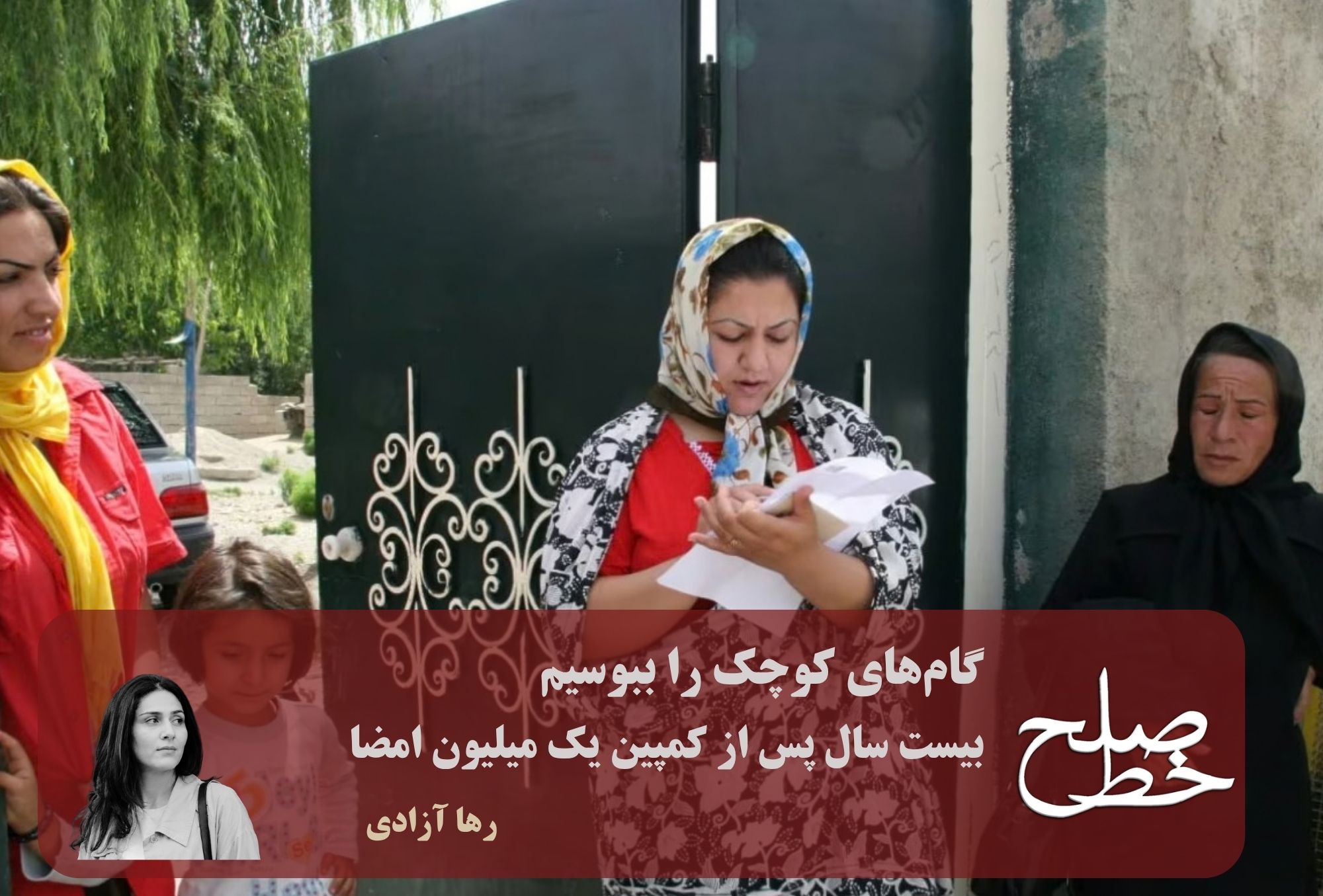
Let’s embrace the small steps/ Raha Azadi
Those who are around my age remember the One Million Signatures Campaign. Just when civil society felt that it had been pushed several steps backward by Mahmoud Ahmadinejad’s presidency, efforts—perhaps struggles—were underway to take steps forward, however small. This was one of them. Its memories now go back twenty years; its website is no longer active, and even some of its supporters have not been with us for years. The campaign may not have achieved the goals it sought, but let us look at the picture that was created by this campaign—no! Let me put it better: let us look, from a greater distance of roughly twenty years, at the larger picture of which this campaign was a part. If we move closer to a painting, we see its details, but after twenty years, we must stand far enough away to see what artistry lies within the picture as a whole. This picture shows the small steps of people who, from every position and in every role, drew a line and created a larger image of being human, as much as of being women.
Let us not deceive ourselves or fall into the trap of fleeting propaganda: women were second-class citizens during the Pahlavi era as well. This can be traced back as far as the point where history and myth kiss one another. The Civil Code is a product of the first Pahlavi period, and we have inherited regulations concerning inheritance, marriage, and the like from that era. But for at least roughly a century and a half, there have been women who were not content with being second. Certainly, each of these women had her own unique experiences and diverse political and social views; but being a woman was something they could neither escape nor ignore. Freedom is not a jewel possessed by one person while others long for it; it is a right that either “everyone” has and “we are all” free, or “no one” has. Freedom-loving women—and, of course, men—want freedom for this “everyone.” Otherwise, they would be opportunists or liars. This does not negate people’s individuality or the experiences arising from their individual and collective lives; each person is a stream joining this river from a different corner of the mountains.
From the moment the slogan of freedom was placed alongside independence and the Islamic Republic, the debate over women’s freedom also began. Hijab was the first manifestation of the new freedom that was destined to remain a subject of dispute for nearly half a century. Freedom is a concept whose goodness no one doubts, but everyone has their own conception of it. For one group, freedom means freedom from want; for another, freedom to earn an income; for one group, independence from imperialism; and for another, the ability to choose what one personally prefers. The larger picture within which the 1979 Revolution (1357) took shape was a world in which powers fought one another in the name of “freedom,” each promoting its own conception of freedom. Something similar, with some differences, occurred among Iran’s revolutionaries as well.
For one group, freedom meant liberation from the Shah and the monarchical regime, while anything beyond that was regarded as licentiousness. In other words, an individual was not free even within their own home to listen to music or maintain their own lifestyle within the privacy of their own four walls. For other groups, freedom meant gaining the right to choose freely for themselves and determine their own destiny and even that of their country, and the question of optional clothing in society should not fundamentally have been a matter of doubt. Well, it did become a matter of doubt and conflict, and over nearly half a century, precious lives were lost over it.
The issue of hijab and freedom is itself distinct from the issue of discrimination. Even if we assume that equal oppression is justice—which it certainly is not—discriminatory oppression is utterly indefensible. At a time when men, too, were arrested, beaten, and deprived of rights for short sleeves, jeans, and hairstyles, perhaps the sense of equal oppression could keep society calm. But gradually, patriarchal society freed itself, while women were left with a patriarchal definition of freedom and with discrimination. Society’s second surge can be seen in the 1990s (1370s). Women’s clothing changed to some extent, and women took a step forward. Alongside this, discussions that had previously been taboo in society also entered the public sphere: freedom, civil society, participation, the right to choose, and democracy. Perhaps women’s outcry in the streets no longer echoed “Either the headscarf or a beating,” but society was slowly following its own path, and little by little the Paykan, Mercedes, and Patrol patrols belonging to the Committees gave way to the Law Enforcement Force, established in 1991 (1370). The government, too, was gradually coming to understand that spontaneous forces (“pressure groups”? “rogue elements”? “Hezbollah supporters”?) should serve the political objectives of the ruling class more than ideological ideals. The revolutionary era was giving way to an era of consolidation, and the emerging ruling class also had to learn how to keep society calm while ensuring that its slogans continued to satisfy the phalangist, baton-wielding crowd. Batwing manteaus and analog satellite dishes were points of contention, while parties people held for themselves away from the Committees’ gaze continued to provide satisfaction. But this was not the whole story. Calm on the surface of society did not negate the turbulence and ferment in its deeper layers.
The Reform years, whether we agree with them or oppose them, had achievements. The first was the movement from a society based on velayat toward civil society, and even raising this issue could reignite the embers of the 1979 Revolution (1357), which still retained some heat beneath the rubble of war, executions, killings, and the suffocating atmosphere of the 1980s. Turning the velayi ummah back into “the people,” the “sacred system” back into “government,” and “licentiousness” back into “freedom” produced a second achievement: rights. Speaking of freedom of belief, freedom of expression, and freedom of choice—the consequence of the ummah becoming the people again—also recalled other rights, and this was where the discourse of Reform had made its mark. On the eve of Ahmadinejad’s presidency, Iranian society saw itself as possessing rights and imposed duties upon the government, and this itself appeared to be a step forward.
The return of the language of the 1980s—this time, however, in comic form—in the mid-2000s provoked ridicule and anger. A society that had taken steps forward with difficulty could no longer simply be pushed backward, and profanity from the podium and the Guidance Patrol—which became a concrete presence in the summer of 2006 (1385), almost simultaneously with the birth of the One Million Signatures Campaign—no longer frightened society. A favorable wind was blowing beneath the surface of society for the campaign, and for other initiatives, even those undertaken individually, and the opposing wind in the official sphere could not neutralize it. Some regarded the elimination of discrimination—the campaign’s central demand—as their right and believed morality, religious law, and the majority to be on their side as well. Arrests, crackdowns, and repression were also there, demonstrating the difficulty of the path and justifying the smallness of the step. But in any case, the small step had been taken. Its impact may not have reached marginalized subcultures, but it drew part of the picture, and at its own scale and for its own time, it was enough and lacked nothing. To those of us who were the age I was then, it seemed like a symbolic or even sentimental movement, but today I admit that being too close to the picture prevented me from seeing it in its entirety.
I quickly review the years that followed in my mind: women were everywhere, alongside men, if not ahead of them. In 2009 (1388), women were at the forefront; indeed, one of the leaders of the Green Movement was also a woman. Throughout the 2010s (1390s), women sought their share in society: university entrance examinations, the labor market, the economy, public and private management, and, of course, the elimination of discrimination. Women no longer saw themselves as confined within the four walls of the home; they were independent agents and introduced themselves to society as they themselves wished: through their tastes, through their presence in spheres traditionally regarded as male, and through their bodies. Discrimination could not even tolerate women’s bodies, and women had now at least taken their own bodies into their own hands.
We all remember 2022 (1401). That year, I was approaching middle age, while others were young or adolescents. A girl tragically left us and left society grieving. She was certainly not the first woman to fall victim to patriarchal relations. Society was already reacting to all forms of femicide, the killing of girls, violence, and unequal relations between women and men. But the girl’s heartbreaking death suddenly reminded us all of discrimination: she was a girl, she was Kurdish, she belonged to a religious minority. It was as though she embodied all manifestations of discrimination at once, and this moved everyone who heard about it. All of us, in some way, saw ourselves as Mahsa (Jina). All of us shared some part of the discriminatory experience she carried throughout her life and even until the moment of her death. We could now see and recognize discrimination, and we no longer attributed it to the faithlessness of the world, fate and destiny, God’s will, or the like. Whatever it was, it existed here, in this very society. We recognized discrimination, and we no longer accepted the excuse of divine command as a justification for it.
Twenty years have passed since the beginning of the One Million Signatures Campaign. Tehran’s Haft-e Tir Square has stretched its reach to remote villages, and the struggle against discrimination can be seen everywhere in Iran. Everyone, even men, has some history of experiencing discrimination in the deeply hierarchical Iranian society of these years and understands discrimination well. Although our history is full of discrimination against women, today we have taken several small steps, and we know that the path is difficult, uneven, and arduous. We know where we started, how far these small steps have brought us, and how much of the road remains. Perhaps this campaign was quickly forgotten, did not reach one million signatures, and was overshadowed in its social context by transient events, but for all its smallness, it was a steadfast step. Let us kiss these small steps and, out of respect for those who took them, let millions of women and men rise to their feet.
 Created By: Raha Azadi
 September 23, 2026
Tags
"Million Signature Campaign" Civil society Mahsa Movement Peace Line 185 Woman Women's rights