


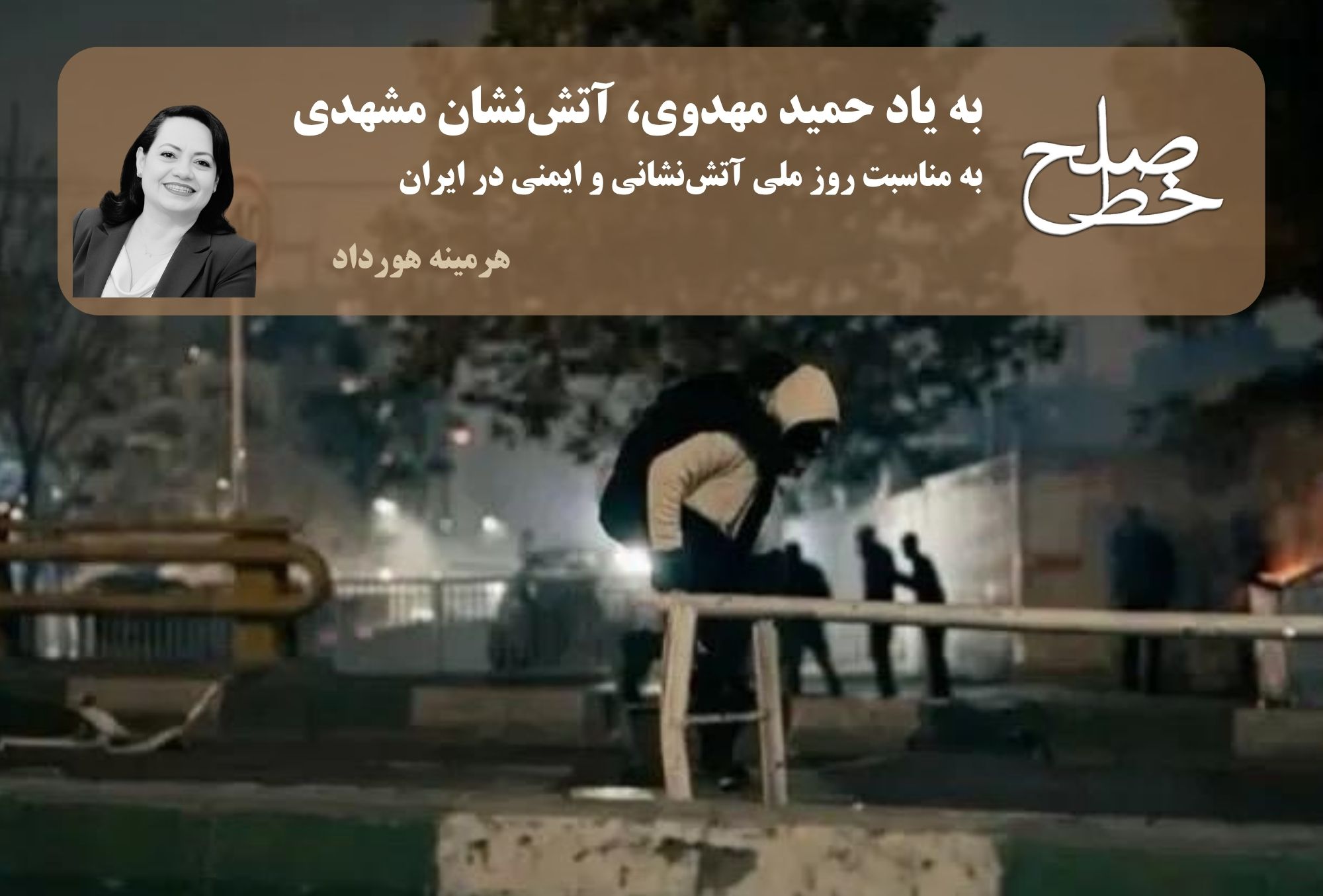
In memory of Hamid Mahdavi, Mashhad firefighter/Hermineh Hordad
In the image that remains of Hamid Mahdavi, we see a man carrying a wounded man on his shoulder and trying to pull him away from danger in the middle of an unsafe street. He is running; not to escape from another, but to save another. At that moment, the person on his shoulder is, first and foremost, a wounded human being whose life must be saved. Perhaps Hamid did not have time to think that he himself might be shot. Perhaps he knew the danger and yet he could not leave the person who needed help alone.
Hamid Mahdavi, a 38-year-old firefighter from Mashhad and international rugby referee, was shot and killed while helping the injured during protests in the city on the evening of January 8, 1404. A video of him trying to transport an injured person has cemented his name in the collective memory of the people.
But what is important in this image is not just the bravery of a firefighter. It presents us with a profound paradox: in a society where the government is supposed to protect the lives, dignity, and security of its people, how is it possible for a person who steps forward to save another’s life to become a victim of violence by forces acting on behalf of the government?
This question is the starting point of Hamid Mahdavi’s narrative; a story about a human being, about people who rush to help each other in moments of danger, and about a government that, in the face of this solidarity, instead of protecting the lives of its citizens, becomes a threatening force.
Being a firefighter is not just a job title. The meaning of the profession must be sought in the moment when others are running away from danger and the firefighter moves towards it; when a person is trapped in a fire, someone is trapped under rubble, or an accident threatens the lives of others. The firefighter goes to save people whose names he may never have heard of and to whom he has no relationship. What drives him is a responsibility that puts human life at its center.
Hamid Mahdavi had such a career. In addition to his work as a firefighter, he was an athlete and an international rugby referee, and he shared his professional experiences and training with others through social media. He had a life that cannot be limited to just his latest photo; the life of a human being who worked, learned, taught, and was present in society.
Yet the last image of him recorded in public memory is bitterly linked to the meaning of his profession. On the streets of Mashhad, as protests turned violent, he was helping an injured man in need of rescue. There was no longer a fire or a collapsed building; there was a wounded human being who needed to be removed from danger. Hamid was doing what the meaning of his profession and human responsibility had taught him: he was trying to save another life.
The bullet that hit him in the throat ended his life. But the question his death left before society still remains: Why should saving a human being on the streets of his own city come at such a cost?
In the fundamental definition of government, one of its primary duties is to protect the lives and security of its citizens. Public power is not meant to be opposed to the people; it is meant to protect their rights. No government is legitimate simply because it possesses weapons, a police force, or a judicial system. The legitimacy of public power, at least in human rights terms, is measured by how it treats people and how committed it is to their rights and freedoms.
The right to life, personal security, and human dignity are not privileges that the government can grant to those close to it and withhold from its opponents. Being a protester, having political opposition, or being on the street does not deprive a person of the right to security and the protection of the law. Even in times of protest and unrest, the government’s responsibility for human life does not disappear; on the contrary, the necessity of observing this responsibility increases.
But what we are faced with in Hamid Mahdavi’s narrative is the reversal of this duty. There are people on the street, some of whom are injured. One person goes to help another injured person. At such a moment, it is natural to expect that security forces would facilitate relief, prevent further damage, and protect lives. However, according to published reports about Hamid’s death, he was shot while helping the injured.
If the institution that should ensure the security of the people becomes the source of threat to their lives, the issue can no longer be reduced to a tragic incident or the death of an individual. Here we are faced with a crisis in the meaning of governance; a crisis in which the means of protecting the people are used against themselves, and the citizen who should have the protection of public power is left defenseless against that same power.
A government that represses people for protesting and creates a deadly barrier to helping the injured effectively stands against the most basic human bonds. In such a situation, the question is no longer just why a firefighter was killed; the question is how a power that is supposed to protect people can become a factor in threatening them.
In moments of crisis, sometimes the true face of a community is revealed. People who may not have known each other a few minutes ago rush to help pull an injured person off the street, get them to safety, or prevent further harm. One person clears the way, another holds the injured person’s hand, and yet another tries to move them. This cooperation is not always the result of a pre-determined decision; sometimes it is an immediate response to human suffering.
The image of Hamid Mahdavi is also part of this moment of solidarity. He is carrying an injured person on his shoulders and trying to move him away from danger. In that image, there is no need to ask the injured person’s name, beliefs, or political affiliation to help. The pain and danger are seen before anything else.
This behavior, while simple, carries an important meaning: society can still act on the basis of mutual responsibility, even when the circumstances surrounding it make such a possibility difficult and dangerous. People do not wait to save each other until they have decided on the wounded person’s political identity or whether it will cost them anything to help them. They lend a helping hand because there is a person in need.
Here we must note a bitter contradiction. The government claims that it needs force and coercive means to maintain public order and security. But if in the exercise of this power, citizens are forced to risk their lives to save each other, what is the meaning of security? If an injured person cannot get off the street with the certainty of receiving help, and providing aid becomes a dangerous act, who is responsible for protecting his life?
In such circumstances, people do not just help each other; they are actually trying to fill a void in the responsibility that should be the responsibility of public institutions. This solidarity should be valued, but we should not allow the praise of the sacrifice of the people to marginalize the responsibility of the government. The courage of a citizen cannot replace the duty of a responsible institution; just as the sacrifice of a firefighter should not be an excuse to forget the circumstances that took his life.
Violence is not just about firing a gun. One of its deeper consequences is creating a situation in which people are afraid to help each other, to approach a wounded person on the ground, to transport them to the hospital, or to stand by a person in danger.
When helping an injured protester could cost the life of the rescuer, the message of fear extends beyond the confines of the street. Others may also be afraid to intervene, not necessarily because they are indifferent to the suffering of another, but because they know they could be targeted themselves. In this way, violence can target human relationships and erode social trust.
But Hamid Mahdavi’s image has another meaning. He went to the aid of an injured person in a situation where it was dangerous to help. His behavior shows that fear, no matter how real and overwhelming, does not always have the last word. Sometimes human responsibility overcomes the calculation of personal safety; sometimes a person cannot see the suffering of another and pass by indifferently.
From this perspective, the main conflict is not just between a firefighter and the force that fired at him. The deeper conflict is between two logics: a logic that considers man to have rights and dignity, even in moments of disagreement and protest; and a logic that values man based on the degree of his obedience or defiance.
A government that ties security to obedience effectively deprives security of its general meaning. Security defined only for obedient individuals is no longer public security. The right to life, if it becomes dependent on political consent or behavior favored by power, is no longer a right; it is a privilege that can be taken back.
Helping an injured person, regardless of their political beliefs and positions, should not be a criminal act or punishable. If power is opposed to such behavior, it is not just a violation of an individual’s security; it is an attack on the principle of human solidarity, the very principle without which social life cannot survive.
After the release of the images of Hamid Mahdavi, his name received widespread coverage in the media and social networks. But the more an image is seen, the more dangerous it becomes: that a person’s life can be summed up in a few seconds and we forget that there was a life before that moment.
Hamid wasn’t just a man who carried an injured person. He was a firefighter, an athlete, and an active member of his community. He had a future that could go on; days when he could return to work, continue to educate others, and move on with his personal life. His death wasn’t just the passing of a paramedic on a night of protest; it was the end of a human life that could have lived many more years and been useful to others.
For his family and loved ones, this loss is not something that can be compensated for by the release of pictures or public eulogies. Society can honor his memory, but it cannot fill the void he left behind. What society can do is preserve the narrative of his life, pursue the truth of his death, and prevent the questions it raised from being forgotten.
What happened that night? What were the exact circumstances of the shooting? Who was responsible? Was there an independent investigation, and did his family have access to the truth and the possibility of a remedy? The answers to these questions must go through careful documentation, independent investigation, and transparency. Commemoration, however heartfelt and necessary, is no substitute for accountability.
If Hamid’s name is only repeated on anniversaries and under his pictures, an important part of the meaning of his death will be ignored. Remembering becomes a social responsibility when it is accompanied by pursuing the truth and defending the rights whose violation makes such deaths possible.
Ultimately, what will be remembered about Hamid Mahdavi is not just how he died; it is the choice he made in a dangerous moment. He helped a wounded man. This behavior may seem simple on the surface, but in a situation where even getting close to the wounded can be dangerous, this act takes on profound meaning.
Government, by its very definition, must be the guardian of human life and dignity; it must guarantee security for all citizens, not just those who agree with it. When public power, instead of protecting people, exposes them to violence for protesting or helping each other, we are faced with a fundamental breach of its duty. In such a situation, government has no longer simply failed in its duty; it has become a force against which people must also resist in order to protect themselves and others.
The death of Hamid Mahdavi is a mirror to this paradox: a firefighter whose job was to save lives died while performing a humanitarian task; people who should have public safety took refuge in each other to save the injured; and the power that was supposed to make this relief possible, according to published reports, became the one who threatened the life of the rescuer.
Perhaps that is why Hamid’s image has endured so much. In the midst of violence, he is still doing something whose human meaning is not tied to any government or ideology: helping a human being who is suffering.
In memory of Hamid Mahdavi, a firefighter from Mashhad; in memory of a man who did not leave another alone in a moment of danger. His memory must be kept alive, not only to praise his courage, but also to defend a world in which no one is shot to save another’s life; a world in which the government is the protector of people’s security, not a threat to them; and no one is forced to risk their life to help another.
A society whose people reach out to save each other has not yet lost its human bonds. These bonds must be preserved; and the power that endangers them must be held accountable for its responsibility.
 By: Hermineh Hourdad
 October 23, 2026
Tags
Firefighter Firefighter Day Hamid Mahdavi Hermine Hordad Nationwide protests in December peace line Peace Line 186 ماهنامه خط صلح