


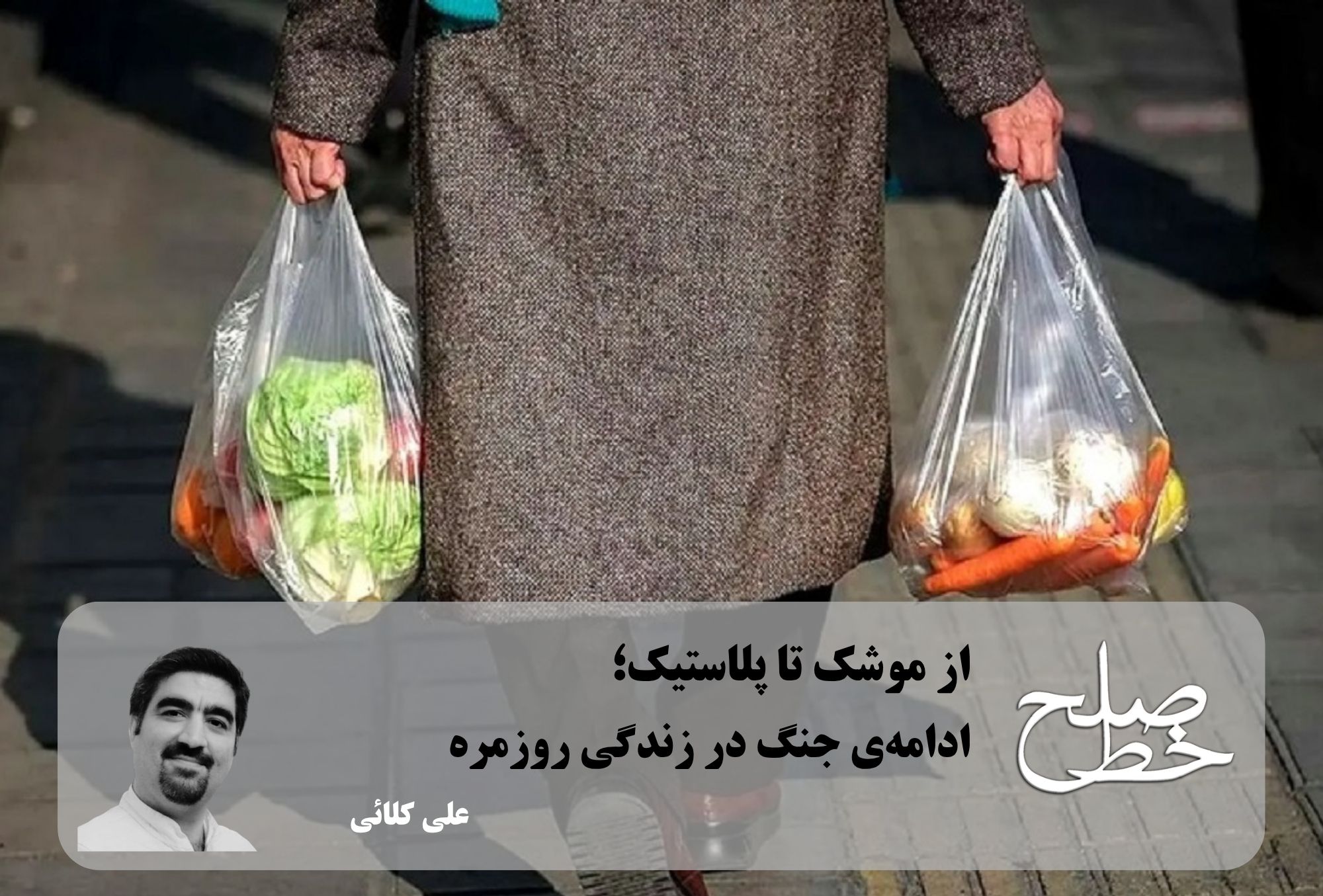
From Missiles to Plastic: The Continuation of War in Everyday Life/ Ali Kalaei
Wars do not end after they are over. This sentence may seem somewhat strange because, naturally, once a war ends, it should become part of memory. But what happens in reality is not like that. Wars sometimes continue for ordinary people in a country through refrigerators going off, reduced water pressure in homes, the rising price of a pack of diapers, the scarcity of IV fluids for hospitals, the increase in the price of bottled water, or even the shortage and rising cost of plastic bags for citizens’ shopping. In Iran, plastic bags that had previously been free are now being priced in some stores: freezer bags at 1,000 tomans, transparent handled plastic bags at 2,000 tomans, the larger version at 3,000 tomans, and special bread bags at up to 7,000 tomans. (1)
In the official narrative of wars, military targets, strategic facilities, and operational achievements are usually discussed. But many places damaged in war are not merely radars and launchers with only military functions. Refineries, power plants, electricity networks, airports, communications centers, and industrial facilities are part of dual-use sites and infrastructure; infrastructures that play a role both in military, security, and strategic fields and in people’s everyday lives. For people, a refinery is not only an industrial facility; it is tied to taxi gasoline, household gas, petrochemical feedstock, medicine packaging, water pipes, and many consumer goods. The electricity network is not merely a technical network either; water pumps, oxygen machines, elevators, cold storage, traffic lights, the internet, card readers, and online classes depend on it. An airport, too, is not merely a transportation center, but part of the supply chain for medicine, trade, and connection with the world. Therefore, damage to dual-use infrastructure does not only mean the destruction of equipment and facilities; it can also disrupt the daily life and economic activity of society.
In the recent U.S. and Israeli war with Iran, petrochemical plants were targeted. Scientific data show that plastic production in petrochemical complexes is carried out by converting raw hydrocarbons—oil and natural gas—into polymers. Put more simply, if there are no petrochemical plants, there is no plastic. Shiraz or Tabriz petrochemical plants are vital infrastructures for meeting people’s everyday needs. These sites were attacked because, according to the attacking side, the petrochemical industry provides the basic feedstock needed to produce some strategic materials and equipment. In fact, the attacking side emphasizes the dual function of an infrastructure such as petrochemicals.
Some analysts believe that targeting such places transfers war from the military field into the ordinary lives of citizens. By striking infrastructure, a country is pushed toward a situation resembling a failing state: a government that has become severely weak and ineffective and lacks the ability to run the country and provide services; a government facing security, social, economic, and political crises. When an infrastructure is targeted that appears industrial, but in practice is connected to water, food, treatment, transportation, health, and even daily shopping, the result is not only the destruction of a factory, a petrochemical institution, or an industrial structure. Its cost is transferred directly to people’s tables and even to the way people shop. The outcome of hitting a petrochemical plant becomes reduced supply of polymer grades, higher procurement costs, and concern about shortages of raw materials, which exposes the market to price fluctuations. The issue is not even only a shortage of raw materials. Part of the market turmoil is linked to the formation of artificial demand, concern about the future of the market, and intense competition to buy raw materials on the commodity exchange; (2) that is, a shortage of raw materials has been accompanied by anxiety about the market’s future, and this has intensified price turbulence. The outcome of this anxiety is rising prices, both real and artificial: real because of the blow suffered by petrochemical plants, and artificial because of people’s general fear of not knowing what tomorrow will bring.
Here, the effect is domino-like. A blow to petrochemicals does not stop at the same industrial complex. First, the production of raw materials declines. Then downstream factories that use those raw materials face shortages and price increases. After that, producers of packaging, plastic containers, pipes, medical equipment, auto parts, garbage bags, shopping bags, dairy containers, and a thousand other goods either reduce production or raise prices. In the next stage, stores, pharmacies, hospitals, bakeries, and families pay the cost of this shortage. This is the path that leads from missiles to plastic. An effect that Donya-e Eqtesad described in mid-Khordad of this year as a “war shock to the plastic market.” The report says that damage to some infrastructure and petrochemical complexes during the war confronted the polymer market and related industries with an unprecedented shock. Although this shock did not lead to a widespread shortage of goods, it raised the price of raw materials in many grades and created concern about the continuation of production in downstream industries. (3) The issue is clear. The blow was dealt to upstream industries, but down here, people’s lives and shopping have been affected.
Plastic is not a marginal commodity in the lives of Iranians today. We are talking about a country that, in 2004 (1382), ranked first in the Middle East in the production of plastic materials. (4) According to reports, in 2025 Iran also ranked tenth in plastic production in the world. (5) In other words, we are talking about a country in which plastic is part of the chain of everyday life. From shopping bags to food packaging, from hospital syringes to water bottles, from garbage bags to baby diapers, from small auto parts to water pipes, all are connected to a chain that begins with oil and gas and takes shape in petrochemicals. When this chain is hit, people understand it not in the form of media and economic reports, but in the form of new prices and everyday shortages. Shortages that the media describe as a shock, and we all know where they come from.
This is the problem with striking dual-use infrastructure. Apparently, an industrial point is targeted, but its effects spread across society. In the case of plastic, this spread is much faster and more tangible. Because plastic is present almost everywhere: in the home, kitchen, store, hospital, school, bakery, pharmacy, bus, car, production workshop, and even in municipal waste collection. If the production of polymer raw materials declines, it is not only a factory producing nylon and plastic for people’s shopping that runs into trouble. Dairy factories, detergent producers, medicine packaging units, medical equipment manufacturers, municipalities, shopkeepers, and consumer families also become involved.
Plastic is sometimes not the final product. In many cases, it is the condition that allows the final product to reach people. Milk does not reach homes without safe packaging. Meat and chicken without hygienic covering become more perishable and more dangerous. Medicine cannot be stored and distributed without safe packaging. IV fluids do not reach the patient’s body without bags and tubes. Detergents cannot sit on store shelves without bottles and caps. Municipal waste collection becomes more difficult without bags and creates more pollution. So when the price of plastic rises, the price and quality of many other goods are also affected. And this means the issue is not only plastic. The issue is food, treatment, health, transportation, urban management, and the normal routine of people’s lives. When the price of packaging increases, the producer will naturally add to the price of their goods. In this situation, it is the consumer who loses. In addition to consumers, small producers also lose; small downstream industries that sustain part of people’s livelihoods. Industries that buy raw materials from the commodity exchange or the open market and produce goods used in everyday life. When the price of raw materials rises or supply becomes irregular, these units cannot plan easily. They must either reduce production, sell their product at a higher price, reduce quality, or temporarily halt operations. In all four cases, workers, sellers, and consumers are harmed. The solution to preventing this from happening in Iran is also stabilizing petrochemical production, which can restore relative balance and calm. (6) Even then, it remains to be seen how far this can be realized in the post-war situation.
Nevertheless, not all plastic products can be placed in one category. Part of plastic consumption is related to nonessential or replaceable goods, but an important part of it is tied to society’s basic services and needs. Medical equipment, syringes, IV sets, blood bags, medicine packaging, food storage containers, water transmission pipes, and many hygienic and industrial items cannot be produced or used without plastic products. Therefore, disruption in the production and supply of petrochemical raw materials does not merely mean a shortage of some consumer goods; it can also affect the supply chain of parts of the healthcare system, food security, and public services.
On one side, of course, there is good news regarding the reconstruction of petrochemical industries, (7) which naturally takes time. On the other side, there are laws that, perhaps if implemented now, could prevent excessive plastic consumption and place less pressure on Iran’s missile-hit petrochemical industry. These are laws that, according to Somayeh Rafiei, head of the Parliament’s Environmental Faction, had been passed in previous years to ban the free distribution of plastic bags in stores, but because of the lack of executive will, these policies were not fully implemented. (8) Implementing these laws could itself help reduce pressure on plastic consumption in Iran under current conditions. One of these uses has taken place and is taking place during this year’s month of Muharram: plastic containers consumed in heyats and religious ceremonies. Perhaps implementing the laws could prevent this excessive plastic consumption in this area; of course, if the power of lawmakers and executors reaches the maddahs who, from the start of the war until the moment these lines are being written, have been holding the main squares of the city.
The issue of plastic appears small. After use, it is quickly thrown away. But this small consumer item is damaged by war and attacks on infrastructure such as petrochemical plants. When war targets infrastructure, it does not only disable a structure. It also wounds people’s trust in tomorrow. People who do not know what the price of diapers, medicine, and food packaging will be tomorrow are still living inside the war, even after the sound of explosions has gone silent.
From missiles to plastic, the distance is not great. The chain of everyday life fills that distance. That is why it was said at the beginning of this text that wars do not end after they are over.
Footnotes:
“Prices of Plastic Bags in Shopping Centers,” Fars News Agency, May 3, 2026 (13 Ordibehesht 1405).
“What Is Behind the Rise in Plastic Prices? The Impact of Petrochemical Damage on Polymer Prices,” Mehr News Agency, June 17, 2026 (27 Khordad 1405).
“War Shock to the Plastic Market,” Donya-e Eqtesad, June 2, 2026 (12 Khordad 1405).
“Head of the Union of Plastic Associations in an Interview with Mehr: Iran Ranks First in the Middle East in the Production of Plastic Materials,” Mehr News Agency, February 22, 2004 (3 Esfand 1382).
“The Majority of the World’s Plastic Is Produced by a Limited Number of Countries and Companies,” Zero Carbon Analytics, August 2025.
“The Union’s Account of the Real Situation of the Plastic Raw Materials Market,” ISNA, May 26, 2026 (5 Khordad 1405).
“The Petrochemical Industry on the Path to Reconstruction; Plastic Consumers Should Conserve,” Mehr News Agency, April 25, 2026 (5 Ordibehesht 1405).
“Why Is Plastic Still Consumed Without Restraint in Iran?” Khabar Online, June 18, 2026 (28 Khordad 1405).
 Created By: Ali Kalaei
 June 22, 2026
Tags
Domino Dual infrastructure Dual-use infrastructure Iran-US war Military base Petrochemicals Plastic Plastic products Rocket The war between Iran and Israel. War