


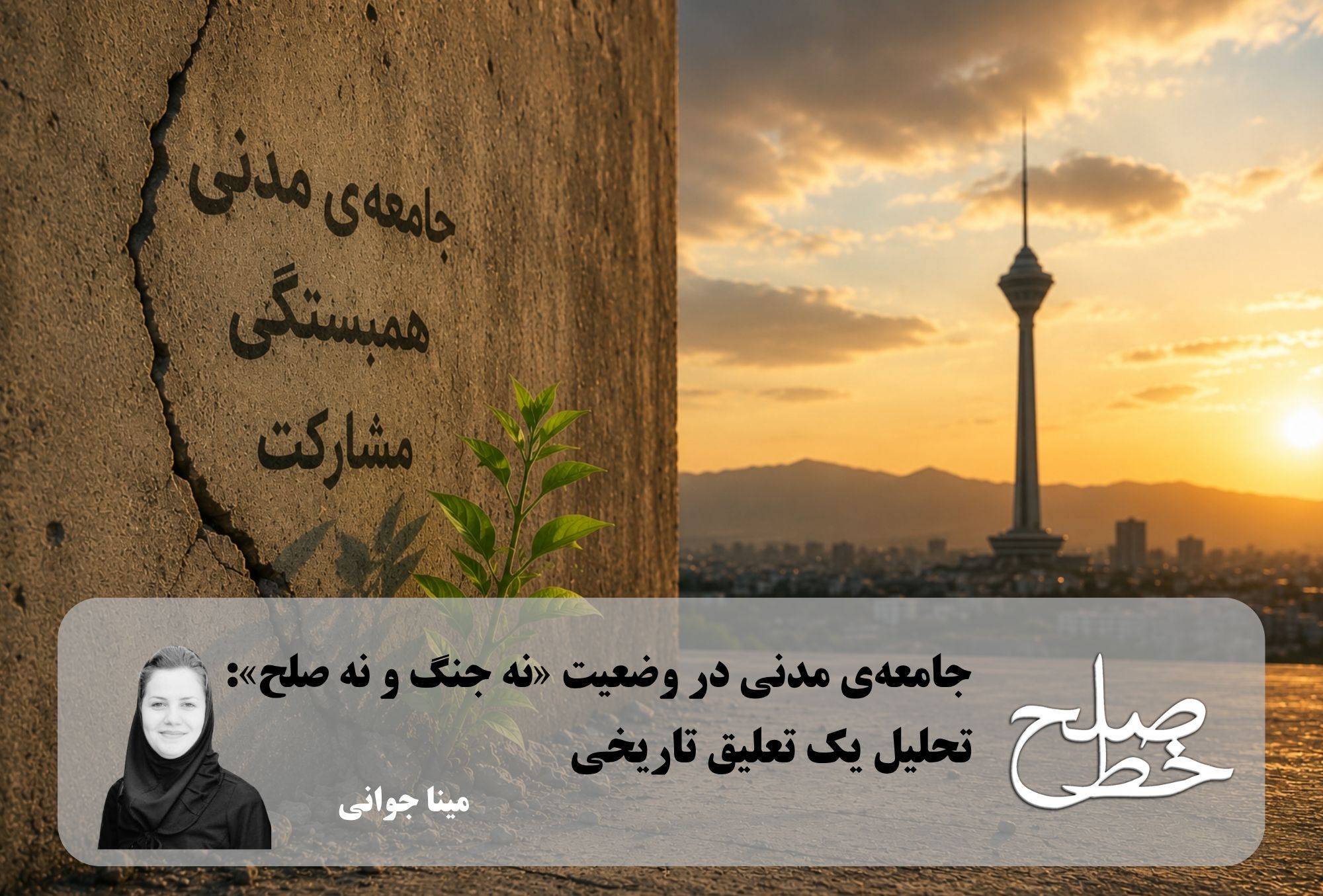
Civil Society in a State of “Neither War nor Peace”: An Analysis of a Historical Suspension/ Mina Javani
At important historical moments, what changes more than anything else is not only political and economic structures, but the way time itself is experienced. In such moments, societies no longer move along the ordinary continuum of past and future; rather, they become trapped in a kind of prolonged and suspended present. A major event has occurred, but its consequences have not yet ended; the past has ended, but the future has not yet begun. In this ambiguous interval, society waits more than it lives. It waits for the return of stability, waits for the next crisis, waits for an event that may transform everything.
Today’s Iran can perhaps be understood through this very experience of suspension. The recent war between Iran, Israel, and the United States was not merely a military confrontation; it was a point at which many accumulated political, economic, and social contradictions were laid bare before society. Despite the halt in direct hostilities, one can speak neither of a return to previous conditions nor of entry into a new order. What has taken shape is a borderland condition; a condition in which war has ended but its possibility remains present, and peace has been established but no one is certain of its durability. Society lives in the shadow of war, without officially being at war.
But the main issue in this situation is not only its geopolitical risks. What matters is the profound impact of this suspension on social life. Contemporary wars do not take place only on battlefields; they also continue in memories, in the collective imagination, in horizons of the future, and in the ways everyday life is organized. Therefore, the question of Iran after the war is, before being a question about states and military strategies, a question about society: about how people live amid uncertainty, how they hope, how they speak of the future, and how they preserve the possibility of collective action.
In the meantime, civil society becomes one of the most important arenas of this struggle. For if war always tends to organize society around the logic of survival, security, and emergency, civil society carries another logic: the logic of participation, solidarity, advocacy, and building the future. For this reason, the issue of Iranian civil society after the recent war cannot be understood only within the framework of political limitations or opportunities. What stands before us is a deeper struggle over the very possibility of society itself; a struggle between forces that seek to keep social life within a permanent horizon of crisis and forces that continue to insist on society’s right to imagine a different future. In this sense, Iran’s current situation can be called not merely a state of “neither war nor peace,” but a state of contestation over the future; a future that, more than ever before, has become the main arena of political and social struggles.
Civil Society in the Shadow of Securitization
One of the first consequences of the state of “neither war nor peace” is the gradual expansion of the logic of security in the public sphere. In conditions where a society feels itself exposed to a permanent threat, security becomes the most important political value, and other social demands are inevitably defined in relation to it. In such a situation, the issue is not only the increase in security measures or political restrictions; rather, it is a change in the way society perceives itself and its problems. In other words, before securitization is an institutional mechanism, it is a form of framing social reality that determines which issue has urgency and which demand can be postponed to the future.
In post-war Iran, this process can be observed in the shifting of public priorities. When the danger of military conflict, regional instability, or the intensification of war-induced economic crises is present on society’s horizon, many civil demands—from labor rights and civil liberties to social justice and sustainable development—are exposed to postponement; not necessarily because they have lost their importance, but because there is always a more immediate and urgent issue that draws public attention to itself. In this way, society gradually becomes trapped in a cycle of reacting to successive crises; a cycle in which the possibility of articulating long-term horizons and transformative projects diminishes.
But the impact of securitization does not remain only at the level of institutions and policies. This condition also penetrates deeper layers of social life and affects citizens’ political imagination. Civil society is fundamentally based on a form of trust in the future; on the assumption that collective action can bring about change, however limited, in the surrounding world. Yet when uncertainty becomes a permanent experience, the horizon of action also changes. Individuals and groups, rather than thinking about changing structures, become preoccupied with adapting to crises and managing everyday risks. In such conditions, politics gives way to survival, and civic participation gradually becomes overshadowed by the necessities of life in a state of emergency.
Nevertheless, reducing civil society to a mere victim of securitization also presents an incomplete picture of reality. Historical experience has shown that societies often create new capacities for organization and solidarity within crises. Precisely at the moment when the logic of security seeks to absorb all spheres of life into itself, new forms of cooperation, mutual care, and collective action also emerge. From this perspective, securitization should be understood not as the end of civil society, but as a new field for redefining it; a field in which the central question is no longer the expansion of civil liberties, but preserving the very possibility of collective action under conditions in which crisis has become the normal state of social life.
For this reason, post-war Iranian civil society cannot be understood only through its limitations and constraints. The significance of this historical moment lies in the fact that civil society has been forced to redefine its place in relation to a reality in which war is no longer an exception, but part of the permanent horizon of social life. The central question is not how civil society will pass through the crisis, but how, within the crisis, it can create new possibilities for solidarity, participation, and the reconstruction of the horizon of the future. This is the very point at which the discussion of securitization leads us to the issue of emerging forms of civic action in contemporary Iran.
Emerging Forms of Solidarity and Civic Action
In situations where crisis becomes a stable condition, classical formations of collective action gradually lose their explanatory and organizing function. Society no longer acts within a relatively stable institutional field in which civil institutions can play a clear and predictable mediating role. What replaces this condition is a kind of rearrangement at the micro and intermediate levels of social relations; a rearrangement in which solidarity takes shape not within established structures, but at the level of situational, temporary ties based on immediate necessities.
In Iran’s contemporary experience, this transformation can be seen in the expansion of informal networks of collective action. These networks become active in response to economic crises, political events, natural disasters, or livelihood pressures, and often operate without reliance on stable organizations or established legal frameworks. Digital campaigns, spontaneous relief initiatives, local forms of mutual aid, and cultural productions—notes, articles, translations, exhibitions, meetings, and so on—in limited spaces all indicate the transfer of part of civic action to domains in which the boundary between individual action and collective action has become increasingly fluid.
This shift cannot be interpreted merely as the replacement of formal institutions by informal forms. What is taking place is the uneven coexistence of these two levels of organization. Formal civil society institutions, exposed to structural and political restrictions, often face a reduced scope of action or a change in function, while around them networks take shape that are based on high flexibility, rapid response, and minimal institutional dependency. The result is the formation of a multilayered and heterogeneous structure of collective action in which institutional cohesion gives way to organized dispersion.
At the analytical level, this transformation can also be understood as a consequence of the erosion of established forms of social trust. When institutional intermediaries lose the ability to produce and reproduce public trust, social relations move toward more direct, experience-based, and time-bound forms. This type of solidarity, rather than being based on stable rules or long-term horizons, relies on situational encounters and concrete necessities. For this reason, despite its effectiveness in crisis conditions, it is highly vulnerable to the passage of time and structural changes.
Nevertheless, this situation cannot be framed solely in terms of the decline or weakening of civil society. What is observable is a change in its logic of organization; a change in which civil society is transformed from a relatively institutionalized sphere into a set of dispersed, networked forms that are reproduced within crisis. Although these forms lack classical cohesion, they make possible the continuation of a kind of collective action under conditions in which institutional stability is no longer an obvious presupposition of social life.
In this sense, civil society in this context appears not as a coherent whole, but as an arrangement of forces, rhythms, and asynchronous forms of action. Understanding this asynchrony is a necessary condition for analyzing the possibilities of collective political action in a context where crisis is not an interruption in social order, but part of its organizing logic itself.
Reclaiming the Future
In conditions of political suspension, the main issue for society is not only the management of current crises, but how to organize its relationship with the future. When crisis becomes a permanent horizon, social time exits its linear path. The future, instead of being the natural continuation of the present, becomes an uncertain and compressed domain that is constantly exposed to occupation by emergency. Under such conditions, collective action faces a kind of erosion of predictable horizons, and the possibility of long-term planning is gradually weakened.
In Iran after the recent war, this situation can be observed in a particular form. Social life moves within a framework in which geopolitical threats, economic instability, and structural pressures operate simultaneously. This simultaneity creates a concentration of crisis in which political and social decision-making continuously remains in the orbit of reacting to emergency situations. In such an atmosphere, the future is no longer experienced as a sphere for the opening of new possibilities, but is represented as an extension of uncertainty.
Civil society, meanwhile, faces a fundamental issue: the possibility of collective action in the absence of a stable horizon of the future. Civil institutions, social movements, and various forms of public participation are based on the assumption that social change requires time, and that this time must possess relative stability. When this stability is weakened, the relationship between action and outcome is ruptured. The consequence is a gradual movement from transformative politics toward reactive politics; a politics that, rather than focusing on changing structures, focuses on managing the consequences of crises.
Nevertheless, the future does not disappear completely under such conditions. What changes is the way it is produced and imagined. Within these very unstable conditions, new forms of political imagination take shape that seek to remove the future from the monopoly of the logic of emergency. These forms can be seen in small but continuous social actions, in networks of solidarity, in cultural work, and in efforts to rebuild public trust. This level of action, although dispersed and decentralized, carries a kind of resistance against the erosion of the horizon of the future.
From this perspective, the main issue of civil society in the state of “neither war nor peace” is not only preserving survival or continuing institutional activity. The deeper issue is preserving the possibility of imagining a future that has not been predetermined by the logic of crisis. Reclaiming the future means restoring society’s capacity to think about change beyond the endless cycle of emergency. This process takes shape not at the level of a single political decision, but in the continuation of diverse forms of collective action; forms that allow the future, even amid uncertainty, to remain an imaginable horizon.
Afterword
The state of “neither war nor peace” can be understood not as a historical interruption, but as a stable formation of political life in Iran; a condition in which crisis moves from the level of event to the level of structure and becomes the organizing logic of social time. Within this framework, society is placed in a prolonged present: a present that keeps the past unfinished and the future uncertain, and postpones the possibility of stabilizing collective horizons.
Under such conditions, civil society is placed in a dual position. On the one hand, under the pressure of securitization and the logic of emergency, its institutional capacities are limited and its horizons of action shortened; on the other hand, new forms of solidarity and collective action take shape in the informal, networked, and situational layers of society, preventing the social from being fully dissolved into the logic of crisis. In this sense, civil society is not a unified structure, but an unstable field of forces and asynchronous rhythms.
What ultimately stands out is the transfer of the issue from the level of “the possibility of civic activity” to the level of “the possibility of the future.” If the logic of crisis tends to reduce the future to a controllable extension of emergency, civil society finds meaning precisely where it delays this reduction. In this unstable interval, even dispersed and temporary forms of collective action carry a kind of quiet resistance: resistance against the transformation of social life into mere survival management.
From this perspective, the future is not a pre-existing horizon, but the outcome of a continuous struggle between forces that drive it into permanent suspension and forms of collective action that seek to keep alive the possibility of imagining it.
Footnotes:
1- Anheier, H. K., Lang, M., & Toepler, S. (2019). Civil society in times of change: Shrinking, changing and expanding spaces and the need for new regulatory approaches. Economics: The Open-Access, Open-Assessment E-Journal, 13(1), Article 8.
2- Buyse, A. (2018). Squeezing civic space: Restrictions on civil society organizations and the linkages with human rights. The International Journal of Human Rights, 22(8), 966–988.
3- Lewis, D. (2013). Civil society and the authoritarian state: Cooperation, contestation and discourse. Journal of Civil Society, 9(3), 325–340.
 Created By: Mina Javani
 June 22, 2026
Tags
Civic action Civil society Collective action Iran-US war Security space Solidarity The war between Iran and Israel.