


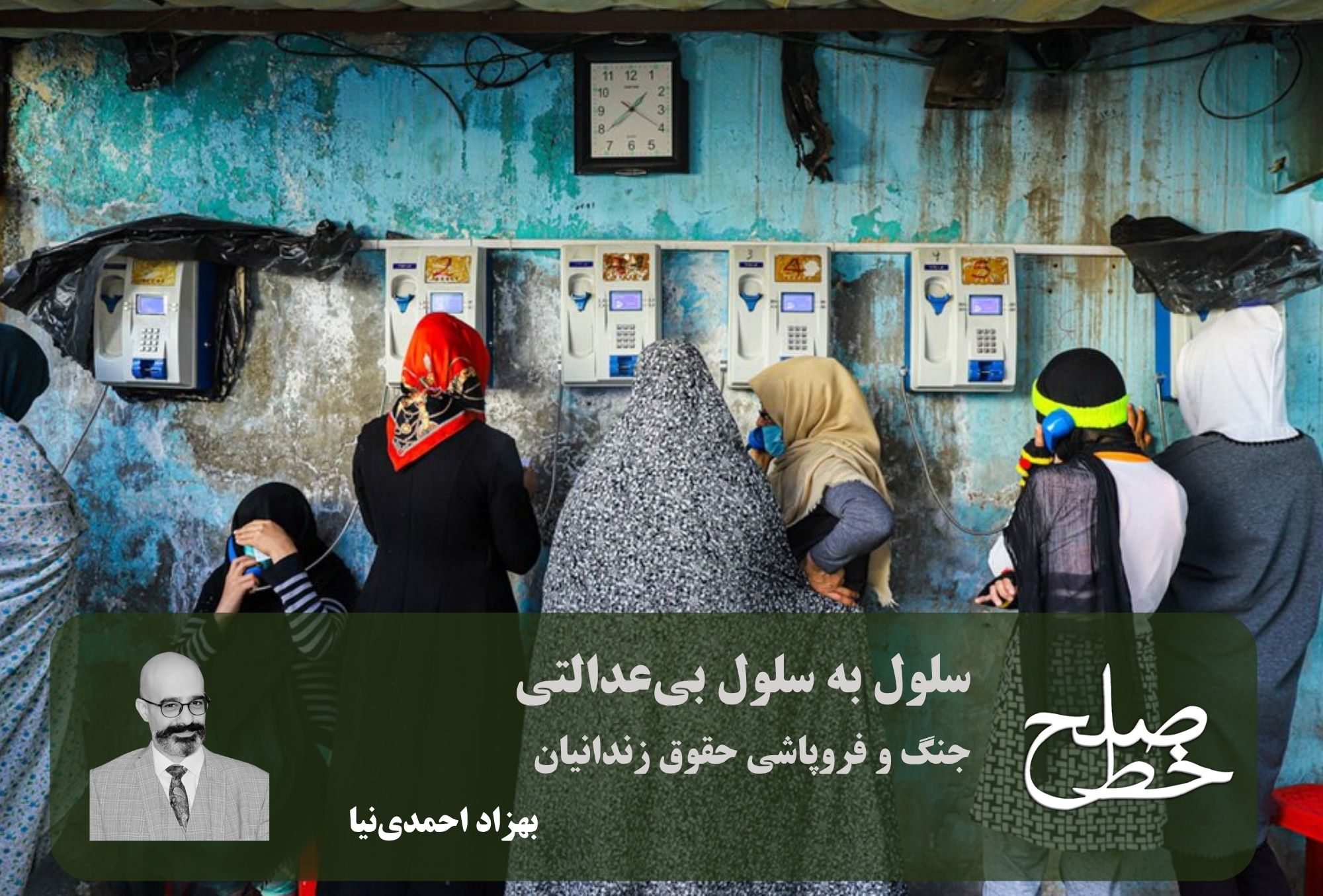
Cell by Cell of Injustice; War and the Collapse of Prisoners’ Rights/ Behzad Ahmadinia
Prisons and prisoners in Iran have perhaps never had laws or rights; there have been years when the situation was relatively better and the most basic rules were observed, and there have been dark years when Lajevardi and Dr. Ahmadi ruled over the lives and deaths of prisoners and their basic rights. The US and Israeli attack on Iran has also clouded the dark days of the Islamic Republic’s prisons for prisoners.
If there were a standard to measure it, Iran’s prisons would be among the worst in the world. Even without war, prisoners of any group have no rights in the Iranian justice system, but despite the war, this multi-faceted injustice is imposed on them. I will list some of these cases below to better understand the conditions.
Communication, the eternal hostage
In Iranian prisons, in general wards, contact with the outside world requires payment, and of course, it is very expensive. These same contacts are cut off with any excuse, such as a protest in prison or problems outside the prison or social protests. In fact, even after prisoners have received a final verdict and have passed the so-called investigation stage and have the undisputed right to contact the outside world on a daily basis, they still have to contact the outside world with the permission of the government.
This communication is no longer a right but a privilege for prisoners who are under interrogation and in the investigation phase. Interrogators take this privilege hostage in exchange for the prisoner’s cooperation, and sometimes the families of the arrested individuals do not have any information about their whereabouts or fate for weeks. Interestingly, in my personal experience in this regard, in 2003, after my arrest, the IRGC’s intelligence service denied even my presence in Evin Prison and the fact that I had been arrested for a week, and only after my hunger strike and speech strike did they agree to allow me to make a phone call, and that too for a short period of time and with the public presence of an agent.
In wartime, these two groups of prisoners face more complicated conditions. The first group, who are in general prisons, can obtain information about the health and situation of their families outside if the prison phones are working and they have a phone card with sufficient charge. However, this is also very temporary because phone cards are not on the list of essential goods of the prison organization, and in wartime – when the prison supply chain will be severely lacking – their price inside the prison will definitely skyrocket and soon become completely scarce.
Prisoners in security cells during wartime will have almost no right to contact them. Apart from the fact that their basic rights are being denied under the pretext of interrogation, permission for contact in these cells is granted at the discretion of the interrogator or, in some cases, even the case investigator. In wartime conditions – such as the one Iran is experiencing today – with no safe place to work, security pressure at the community level, and the destruction of key justice buildings, it is unlikely that anyone will have access to an interrogator to request contact. The greater danger is that in these conditions, prisoners are under intense emotional pressure to know about the health of their families and may make any confession in order to have the minimum right of making a phone call to the outside world, which will have serious consequences for them.
Food security
The quality of food in prison has been the subject of much scrutiny. At least once in Evin Prison in the 1990s, political prisoners were able to prove by weighing the amount of meat in the prison food that the quality of the food was even lower than what was stipulated in the prison’s own regulations, and this was due to economic corruption by prison guards and the prison’s supply chain.
In wartime, with infrastructure being targeted, food stores will soon be empty and even food kiosks inside the prison will be disabled. On the other hand, families who are involved in the insecurity of war outside will no longer have the same ability to provide money for prisoners, and disruptions in the banking network will also exacerbate this problem. Such a situation will greatly increase the risk of hunger and life-threatening conditions for high-density prisons in the medium term.
If we add to these cases the lawless and immoral war of Israel against Iran, then frightening news such as the targeting of the Tehran prison food warehouse can conjure up a great disaster in the mind.
Physical security
International protocols in wartime are designed in such a way that in times of war, prisoners classified as a danger to society should be able to leave and take refuge in safe places. In fact, preventing citizens from escaping from war zones is considered to be the use of human shields and a war crime. In these regulations, even dangerous or security-risk prisoners must be removed by the prison guard (prison organization or justice) away from the main danger areas and kept in prisons in places that pose a minimal threat from war.
The Islamic Republic of Iran does not observe any of these points. Partly because it does not recognize the right to life of prisoners, and partly because it does not have sufficient facilities and facilities to hold prisoners. Iranian prisons – almost all of them – are filled to several times their nominal capacity with prisoners, and even under normal conditions, life in these prisons is considered wartime conditions.
On the other hand, Israel, using media excuses such as “rescuing political prisoners,” has bombed prisons, killing and injuring those who cannot escape more than a few meters. In the first round of Israel’s attack on Iran, at least two prisons in Tehran province were bombed, and an unknown number of prisoners were injured during these attacks, but no political prisoners escaped.
delayed
In general, the rights of prisoners during war are no less than those of other citizens, and in some ways, it can even be said that they are greater, because their right to make decisions and move freely has already been taken away by the government. It is beyond the scope of this article to list all of these rights, but the most unfortunate part of the current situation is that not only does the Islamic Republic not value the lives of its prisoners as much as Nazi Germany did, but the actions of the other side—the United States and Israel—are also justified in the process.
 Created By: Behzad Ahmadinia
 March 21, 2026
Tags
Behzad Ahmadinia General prison sentences Interrogation 2 Iran-US war Justice in humanity peace line Peace Line 179 Political prisoners Prisoners' health Quality of prisoners' food War ماهنامه خط صلح