


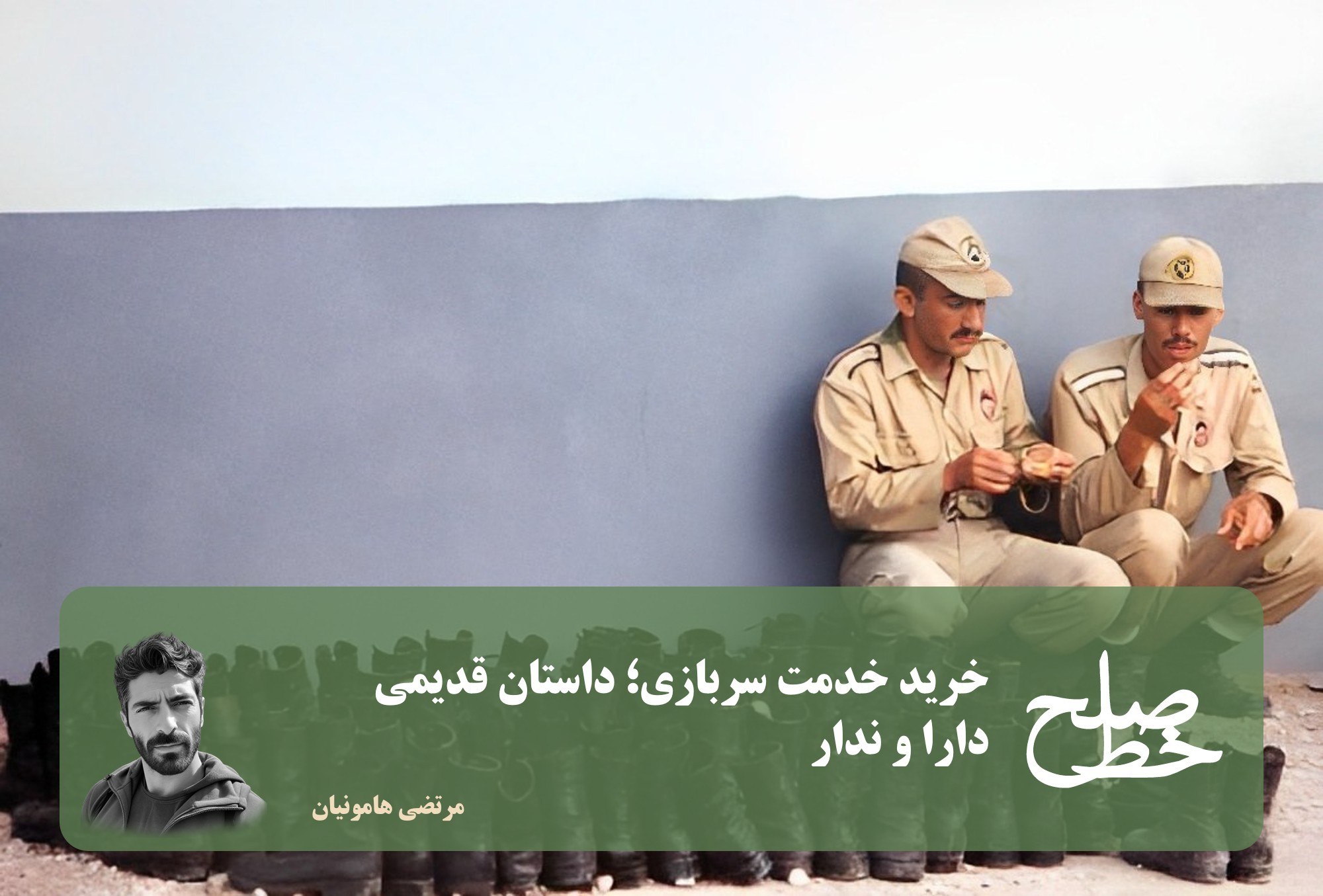
Buying Out Military Service: The Old Story of the Haves and the Have-Nots / Morteza Hamounian
The story of difference and discrimination between those who have and those who do not has always, everywhere, made itself felt. It is as though this economic inequality—where some have so much they do not know what to do with it, and others, as the saying goes, do not even have a sigh to trade for a groan—runs through every stage of an Iranian’s life: from birth to childhood, then school and university, and for families’ male children, military service. A military service that, at various times, has been made purchasable for the well-off, while those who were economically weaker were sent off to barracks, ended up in guard towers, and served along the borders. Regrettably, there have been those who, under the pressure of military service, put the barrel of a gun under their throat and, by pulling the trigger, took their own lives. Young people with a thousand hopes and dreams, who have received very little military training, yet must grapple with dangers that even trained military officers sometimes cannot face. And when matters reach a wartime situation, the tragedy is doubled.
The story of conscription in Iran begins in Khordad 1304, when the National Consultative Assembly approved that all men at least 21 years old must be forcibly sent to military service. Of course, in 1294, the first conscription law had been passed in the National Consultative Assembly. The law that was consolidated in 1304 under the name “Mandatory Service” remained unchanged for several years. Today, the name of this law has been changed to “General Duty Service,” and the implementing body is called the “General Duty Organization.” A law that, since its adoption, has gone through various ups and downs, and each time an article or note is added to it or a clause is removed, it has its opponents and supporters. (1)
However, the issue is not only military service itself. The question concerns a phenomenon called buying out military service—a phenomenon that has been raised in different periods, sometimes implemented, and sometimes remained merely a proposal. The question is: where did this story begin? From when did governments and administrations think that a price could be set for exemption from an obligation they consider a public duty? How did it happen that, in some periods, defending the land and fulfilling one’s duty to the homeland became something calculable in rials and tomans? And fundamentally, on what justification did governments allow themselves to differentiate among Iranian families’ children based on their financial ability?
This story is not only an issue of yesterday and today. Nor is it the issue of this government or that one. The matter is not even limited to the period after the February 1979 Revolution. Its background must be sought in the years before the Revolution, although in each period governments have offered different justifications for implementing it, depending on the country’s economic and social conditions and its military needs.
The issue of surplus conscripts
From the very beginning of the mandatory conscription plan, one question was present: if the number of those eligible for military service exceeded the army’s needs (at that time the only force that took conscripts), what should be done with this population? Should all of them be dispatched to service, even if the army had no need for their presence? This led to the final approval by the Senate on 6 Aban 1343 of a law titled “Law Concerning the Exemption of General Duty Conscripts Surplus to the Army’s Needs.” Under this law, those who volunteered to perform military service were dispatched first, and if the number of volunteers was less than the army’s needs, the manpower shortfall was met through a lottery among the other eligible conscripts. Those whose names were not drawn for dispatch could, by paying a sum, be permanently exempt from service under the flag in peacetime. This amount was 1,000 tomans for holders of a bachelor’s degree and above, 500 tomans for high school diploma holders, and 150 tomans for other conscripts. Under the same law, the revenue from these exemptions was to be spent on building primary schools and clinics in the country’s villages. (2)
Of course, lawmakers at the time had also foreseen a path for those who could not afford these sums. This group of conscripts would receive a temporary exemption, and if they were not selected for dispatch in the second lottery either, they would be permanently exempt from service under the flag in peacetime without paying any money. That is, unlike what later came to be called “buying out military service” in the Islamic Republic, here it was not financial means per se that made a person eligible for exemption from military service. First, it had to be established that the army did not need the individual conscript, and only then did the matter of paying or not paying money arise. (2) That said, corruption in Iran’s governance is a historical matter. What has been described was the legal regime of that time. In the real regime, however, it is not unlikely that even then some people, through influence, prevented their children from going to military service.
This law did not last long. On 30 Ordibehesht 1347—less than four years after the approval of the said law—the two chambers (the Assembly and the Senate) repealed it and approved regulations for employing conscripts surplus to the army’s needs in the country’s development and productive affairs (3); and this in an army that, in the final years of the Pahlavi rule, was one of the largest armies in the Middle East, within a system that played a gendarme role in the region.
The Revolution and the narrative of the new order
The story of taking money in exchange for exemption from military service did not end there. Years later, after a revolution and under another political system that claimed to establish social justice and defend the oppressed, this policy resurfaced. First, in 1358, with the notion that a revolution had occurred and that the army was not trusted enough to send young people to serve in it, all conscripts over 20 were exempted from service. (4) After that, war broke out. A weakened army, alongside a newly formed IRGC parallel to the army (for various reasons, including revolutionaries’ distrust of the army), together with many popular forces, confronted the invading army of Saddam’s Ba’athist regime in Iraq. Time passed. The war ended, and the era known as “Reconstruction,” under the leadership of Akbar Hashemi Rafsanjani, arrived.
It was 1370. That year, the Supreme National Security Council had a resolution under which a group of absent conscripts inside and outside the country could be exempted from military service by paying certain sums. According to an expert report presented to the Islamic Consultative Assembly on 3 Bahman 1380 regarding the status of buying out military service, those included in this plan included absentees born in 1347 and earlier with associate degrees and below. The amount was set at 350,000 tomans for those below diploma level, 500,000 tomans for diploma holders, and 600,000 tomans for holders of an associate degree. The higher a person’s educational credential, the more they had to pay to be rid of military service. In other words, the more someone had studied, the more they had to pay not to go to military service—something that later continued in the Islamic Republic as well. This became an incentive for some young people to first buy out their service and then go to university. It is not exactly clear how many young people this plan kept from pursuing university studies directly after high school.
The report also stated that between 1370 and 1376, about 70,000 people bought out their military service: 64,909 conscripts inside the country and 4,850 Iranians residing abroad. (4) On the surface, the issue was to determine the status of those who had been eligible for years and had not gone to service—those who had refused to go to war, entered the labor market, started families, and taken on the responsibility of earning a living, and who could no longer be sent to service in that situation. That was the appearance. But in reality, the issue was buying out service for those with economic means. In the end, this was money flowing from people’s pockets into the public budget. This became more evident during Seyyed Mohammad Khatami’s time; in the second year of Khatami’s government, oil prices fell sharply. An oil-dependent government that obtained a significant portion of its income from oil sales now had to address its budget deficit. One way to generate revenue was selling military service.
At this point, it was no longer necessary for years to have passed since a person’s dispatch date. Younger conscripts could also buy out their military service if they had the money. The buyout amount at the start of this plan ranged from 1,100,000 tomans for those below diploma level to 2,100,000 tomans for holders of a medical doctorate and above. (5)
Under clause “T” of Note 9 of the 1379 budget law and its executive bylaw, approved on 12 Tir of that year, diploma-level and below conscripts born from 1338 through the end of 1360, associate-degree holders through the end of 1358, bachelor’s degree holders through the end of 1356, master’s degree holders through the end of 1354, and holders of a doctorate and above through the end of 1352, subject to the age range and other stipulated conditions, could—after paying the specified amounts and completing a period of military training—be exempted from performing compulsory service in peacetime. (6) In 1379, the buyout amount was 1,210,000 tomans for those below diploma level and 2,310,000 tomans for holders of a medical doctorate. Conscripts with more than one year of absence had to pay higher amounts. The bylaw also provided discounts of 50% to 90% for beneficiaries of the Imam Khomeini Relief Committee and the Welfare Organization, and a 50% discount for eligible married conscripts. It was also stipulated that 10% of the revenue from selling service be spent on the military training of buyout applicants and improving conditions for soldiers during service. (6) Discounts were not limited to these groups. It was stipulated that relatives of martyrs’ families (including those killed in the eight-year war), the missing, and veterans with 25% disability and above would receive a 90% discount, and former prisoners of war and veterans with under 25% disability would receive a 50% discount. (6) It was also decided that 1% of the revenue obtained under this law would be placed at the disposal of the Law Enforcement Force for reconstruction, equipping, and also incentivizing General Duty personnel. (6) The result was that in 78–79 alone, at least 360,000 people bought out their military service. (7)
When 1380 arrived, everything changed, and with the approval of the parliament at the time, in the 1380s buying out service was not carried out for conscripts inside the country; it was said that this was a privilege for the wealthy that causes social injustice and oppression of the poor. (1) Yet this had already happened. Years later, when in Bahman 1400 the proposal to buy out military service was raised again, users said this was merely a solution for the children of well-connected officials to avoid military service. (8)
At that time, however, selling military service to a group of Iranians residing abroad continued. Those conscripts who had left Iran by the end of 1382 and met the specified conditions could buy out their military service by paying 10 million tomans. This option remained in place until Mordad 1392, and with the end of Mahmoud Ahmadinejad’s government, it was replaced by facilities allowing travel for conscripts residing abroad without the need to buy out service. (9)
During Hassan Rouhani’s government, the story of selling military service was raised again—only this time they changed its name. This time it was called: the fine for absent conscripts. Under clause “T” of Note 16 of the 1394 budget law, conscripts with more than eight years of absence could be exempted from military service by paying amounts ranging from 10 million tomans for those below diploma level to 50 million tomans for holders of a specialized medical degree and above. For each year of absence beyond eight years, 10% was added to the fine amount. Married conscripts received a 5% discount, and an additional 5% for each child. (10) The budget issue, of course, was still at play. Reza Talaei-Nik, then the parliamentary deputy of the Ministry of Defense, said during the Islamic Consultative Assembly’s negotiations: “We are the first country in terms of defensive capability in the region, but in terms of defense budget we rank eighth.” The then Speaker of Parliament, Ali Larijani, also said that raising this issue did not mean buying out military service, “but rather means fining absent conscripts, and like a tax fine that differs based on individuals’ level of benefit, the fine for absent conscripts will also differ based on individuals’ level of benefit.” A then member of Parliament’s National Security Commission announced the number of absent conscripts with more than 10 years of absence as more than “2.4 million.” (11) The difference was in the name and the rationale for this buyout, not in the essence of the matter. And this distinction made no difference to people. What people faced was, once again, the issue of buying out service.
This policy continued until the end of 1397. In that year’s budget law, it was stipulated that up to 1,350 billion tomans of the revenue from fines on absent conscripts be allocated to the country’s defense affairs. (12) In the 1398 budget law, however, there was no longer any news of selling military service, and only the collection of installment payments from those who had previously applied was addressed. (13)
It became 1400 and the matter reached Ebrahim Raisi’s government. In this government, too, some people thought of selling military service. On 9 Bahman 1400, Parliament’s budget consolidation commission agreed to buying out service for conscripts with more than five years of absence, with amounts between 250 and 600 million tomans. This time, justifications such as strengthening the family and encouraging childbearing were added to the previous rationales; to the point that the then spokesperson of the commission said married conscripts would receive a 20% discount per child up to a ceiling of 60% (apparently three children). (14) As though strengthening the family were only an issue for those who had several hundred million tomans in their bank accounts. And then these gentlemen even proposed a discount per child—up to a ceiling of 60%.
This approval did not last long either, and the consolidation commission retreated from its decision. (15) Since the end of 1397, the possibility of legally buying out military service has not been provided for new applicants, and during Masoud Pezeshkian’s presidency no directive has been issued in this regard either. (16) Of course, this government and parliament have probably not yet found the time to address such matters.
More than six decades have passed since the adoption of the law exempting surplus conscripts. Regimes have changed. Governments have come and gone. Each has had a justification for selling military service. There were also efforts toward forming a professional army and changing the conscription structure. In the final months of the Sixth Islamic Consultative Assembly, representatives passed a plan under which holders of a bachelor’s degree and above, after three months of military training, would be organized into the reserve force; a plan that was approved by parliament on 25 Farvardin 1383, but faced opposition from the Guardian Council, and on 13 Tir of that year the Expediency Discernment Council also confirmed the Guardian Council’s view. (17) In simpler terms, this plan fell victim to the political struggle between the government and a parliament aligned with the reformist جناح of the ruling establishment, and the other ruling faction in Iran. Not to mention that later efforts in other parliaments to professionalize conscription also did not succeed. (18) The question is: why, instead of selling military service, is there no talk of forming professional armed forces? Why, instead of sending a young person with a few weeks of military training to the top of a guard tower, do they not use trained forces who have chosen soldiering as their profession?
The slogan at the outset was that this revolution is the revolution of the oppressed. Yet in all periods when the Islamic Republic made it possible to buy out military service, it was mainly the children of well-off families who could pay money to be exempted, while the children of economically weaker families had to pay the cost of military service with their time and youth—and sometimes even with their lives. Now, if the issue of buying out military service is raised again, is this same story going to be repeated? Some have so much they do not know what to do with it, and some, from hunger, tie stones to their stomachs. In this inflation and these conditions, the question is: what is the reason for all this injustice? The answer to this question will clarify many things.
Footnotes:
1. History of military service and buying out service, Vizhgan.
2. Law Concerning the Exemption of General Duty Conscripts Surplus to the Army’s Needs, adopted 1343/08/06 with later amendments and additions, Laws, Islamic Republic of Iran Laws and Regulations System.
3. Law Repealing the Exemption of Conscripts Surplus to the Army’s Needs, adopted Aban 1343, and adding articles to the General Duty Service Law and amending the General Duty Service laws for conscripts who are diploma graduates and above, adopted Ordibehesht 1339, and the Law Determining the Status of Conscripts Born 1312 through the end of 1324, adopted 30 Ordibehesht 1347 by the National Consultative Assembly, Laws, Islamic Republic of Iran Laws and Regulations System.
4. Proposal to sell mandatory military service to Rouhani’s government, Iran Students News Bulletin, 28 Aban 1393.
5. The return of selling military service in Iran; this time only for the affluent, Radio Farda, 10 Bahman 1400.
6. Executive bylaw of clause (T) of Note (9) of the 1379 national budget law, adopted 12 Tir 1379, Laws, Islamic Republic of Iran Laws and Regulations System.
7. Ambiguities in the new law on buying out military service, Tabnak, 8 Dey 1393.
8. Buying military service in Iran; social media users’ reactions: from “commercialization” to “a solution for the children of well-connected officials,” BBC Persian, 10 Bahman 1400.
9. Halt to selling military service to conscripts abroad, Tasnim, 15 Mordad 1392.
10. The 1394 national budget law, Ekhtbar News Website.
11. Buying out military service for absentees approved in parliament, Radio Farda, 3 Esfand 1393.
12. The 1397 national budget law, Ekhtbar News Website.
13. The 1398 national budget law, Ekhtbar News Website.
14. Approval of buying out military service in Parliament’s consolidation commission: 250 to 600 million tomans, IranWire, 9 Bahman 1400.
15. Plan to buy out military service removed from the 1401 budget bill, Radio Farda, 11 Bahman 1400.
16. Rumors about buying out military service are not credible; beware of fraudsters, Tasnim News Agency, 18 Shahrivar 1405.
17. Hamounian, Morteza, The tale of “mandatory” and “mess-hall” in Iran: every year worse than the last, Peace Mark Monthly, Issue 146, Tir 1402.
18. Text of MPs’ plan for a professional soldier, Tasnim News Agency, 20 Farvardin 1400. (1)
 By: Morteza Hamounian
 November 22, 2026
Tags
Buying out military service Economic inequality General Duty Organization History of military service in Iran Mandatory Military Service Morteza Hamounian Pahlavi era peace line Peace Line Monthly Peace Mark 187 Soldier's Suicide