


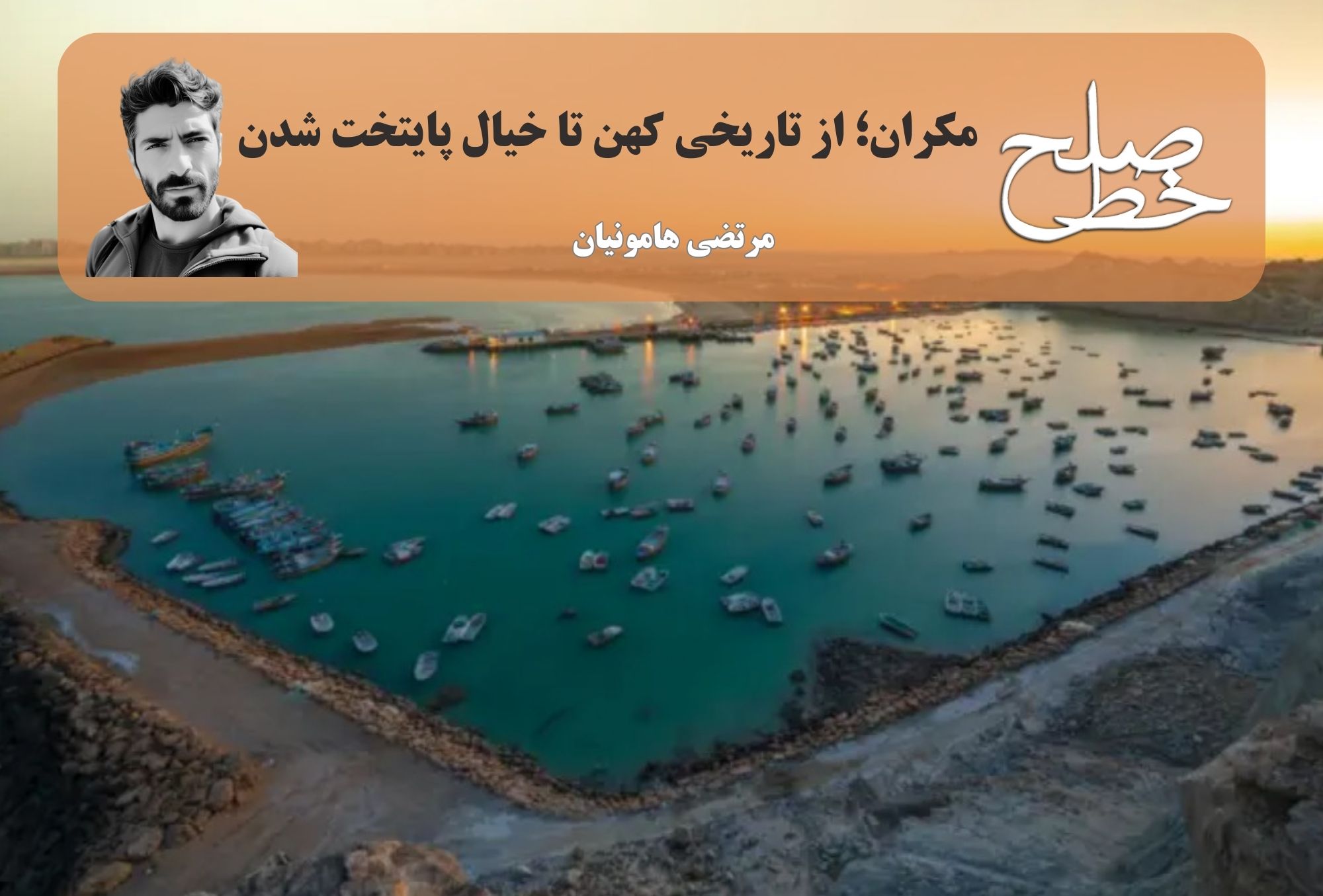
Makran; From Ancient History to the Imagination of Becoming the Capital / Morteza Hamounian
In the beginning of the winter month of 1403, Mohammad Reza Aref, the first deputy of the new government of the Islamic Republic, openly declared among the members of the Foreign Economic Relations Committee that if they come to a conclusion about the transfer of the capital, one of the regions that will be seriously considered is Makran. (1) Makran is a land in southern Baluchistan, Iran, which has been mentioned in the historical texts of Beyhaqi: it is a province in the east of Kerman, south of Sistan, north of the Indian Ocean and west of Sindh and Qasdar. It was once a large state, but in 1870 AD, due to the colonial policies of Britain, it was divided between Iran, Pakistan and Afghanistan. (2) It is a border region that currently, politicians in Iran want to transfer the city (Tehran) to, which was surrounded by a wall with four gates and 114 towers
According to Dehkhoda Dictionary, Makran is the name of a province in the middle of Kerman and Sistan regions, named after Makran bin Hital. It is also the name of a state in Baluchistan, located next to the Oman Sea, and the name of the city in this state. It is an area that is located near the city of Sand and Kij, where the ruler of Makran is located. This land was mentioned in the cuneiform inscriptions of the Sumerians and Akkadians before the birth of Christ. It played a very important role in ancient Iran and the Sassanid era, and was one of the twenty regions under the control of Darius the Great. During the time of Ardeshir Babakan, Makran was also the granary of Iran and a provider of food resources for various parts of the country.
During the Safavid era, this land was both a province and played the role of a bridge connecting Iran with its neighboring countries. Reasons such as having extensive coastlines with open waters, its unique geographical location at that time, the presence of European colonizers in India, and their interactions with the coastal inhabitants of Makran made it significant during the Safavid era. During the Qajar and Naseri periods, and when India was under British colonization, border changes were made by the British in this region, and the border between Iran and Pakistan was defined from the port of Gwadar to the eastern mountains. (4).
After the Constitutional Revolution and in the second division of the country after the approval of the law of states and provinces in the National Assembly in 1316, a province called Makran was created, which included Bam, Bashagard, Jask, Minab, and Zabol. However, after only three months and with the new national divisions and the creation of ten provinces, this area became part of the eighth province, with Kerman as its center, including the cities of Kerman, Bandar Abbas, Khash, and Zabol. In 1336, this region became part of the newly established Sistan and Baluchestan province with Zahedan as its center, and until today, it remains part of this province in national divisions. Makran is an important strategic region in southeastern Iran, with reserves of oil and gas, and due to its proximity to international waters and its location outside the tense Persian Gulf region, it holds a special geopolitical position. However, the
Development in Makran has always been associated with its strategic and commercial port location. Even before the arrival of Islam in Iran, Makran served as a trade route between Iran and the Indian subcontinent. During the Islamic era, this region maintained its importance as a major trading gateway. However, due to the focus of various governments on the central regions of Iran, Makran faced neglect and decline during different periods. For example, the importance of Bandar Abbas overshadowed the significance of this region during the Safavid era. In the 18th and 19th centuries, the presence of British and Dutch colonizers in the Persian Gulf and the Arabian Sea led to Makran being sidelined as a major trade route. This continued until the 1970s. During this time, plans were initiated for modern development in Makran and the port of Chabahar. In 1979, the Iranian Revolution took place, and with the start of the Iran-Iraq War and its focus on
As mentioned, the renewed attention to the Makran region in the Islamic Republic’s governance was initiated by the leader of the Islamic Republic. As per his orders, the Navy of the Army was stationed in this region and various budget lines were defined for the development of Makran’s infrastructure during the years 1395, 1396, 1397, 1398, 1399, 1400, 1401, and 1402, with a total budget of over 50, 60, 44, 100, 500, 1000, 1000, and 2000 billion tomans respectively. Additionally, all relevant executive bodies in this region were allocated an annual budget of between 1.5 to 3 trillion tomans as per the budget law. However, these numbers were and are not enough to be the driving force for transformation in reducing deprivation and developing and completing Makran’s infrastructure. In fact, experts say that in a situation
But this very Makran, despite all these attentions and budgets, is a place where its children do not have roads and schools due to poverty. The region, which is actually a narrow coastal strip starting from Minab, a little above the Strait of Hormuz, where the Persian Gulf connects to the Sea of Makran or the Sea of Oman and pours into the Indian Ocean. After Minab, it reaches Sirik, Jask, Konarak, Chabahar, and Dashtyari on the border with Pakistan. The region where unemployment is rampant. A significant portion of these people live in places like Minab, rural settlements, and a minority are city dwellers. The roads are rough and dark, and there are deserts around these roads that have no color of life. The people of Jask on the coastal strip of Makran say they have no access to a specialist doctor or hospital. Their daughters are forced to drop out of school due to the lack of
It is understandable that the issue of decentralization from Tehran is on the minds of the designers of these discussions. It is also worth considering that they believe that the regions have the potential for urban development and can be transformed into a modern and well-planned urban area without the traffic and weather problems of Tehran. However, the regions have a strategic location and it is worth serious consideration that the authorities, despite all the security problems in Iran, think that moving the capital to a border region is a good idea. The existing infrastructure in the regions, despite the mentioned poverty, is not sufficient for the development of this area and requires large investments and years of time. Additionally, for the presence of the country’s political and economic centers in this region, serious security considerations must be taken into account. Furthermore, the budget required for this matter will be a staggering number that it is unlikely for Iran, given its current state of sanctions and systematic economic corruption, to be able to handle. Not to mention that when
Notes:
1- We have no doubt in transferring the capital. One of the areas that can be seriously considered is “Makran”.
Online trust.
January 7th, 2025
2- Where is Makran and why has it become a rival of Tehran?
ISNA.
January 13th, 2025.
3- Same..
4- The same..
5- Where is Makran and should the capital of Iran be changed?
Bibisi Farsi.
Farsi baby.
January 8th, 2025
6- Why did Makran suddenly reveal the secrets of the plan to transfer the capital to the border with Pakistan? Who were the first ones to benefit from it?
Bright.
January 14, 2025
7- A big step towards economic growth in the maritime axis, strengthening Iran’s power through the development of Makran coasts.
Irna.
January 8th, 2024.
8- Three ideas for the development of Makran, Amir Samani.
Economic world.
“15th of Aban month, 1402.”
Where is Makran? Has poverty ended in Makran and will it become the capital?
Iranian era.
“22 Dey month 1403.”
 Created By: Morteza Hamounian
 February 19, 2025
Tags
7 Peace Treaty 1667 Balochistan Capital 2 Capital transfer Development Development of Makran coasts Makran Morteza Hamounian peace line Sistan and Baluchestan ماهنامه خط صلح