


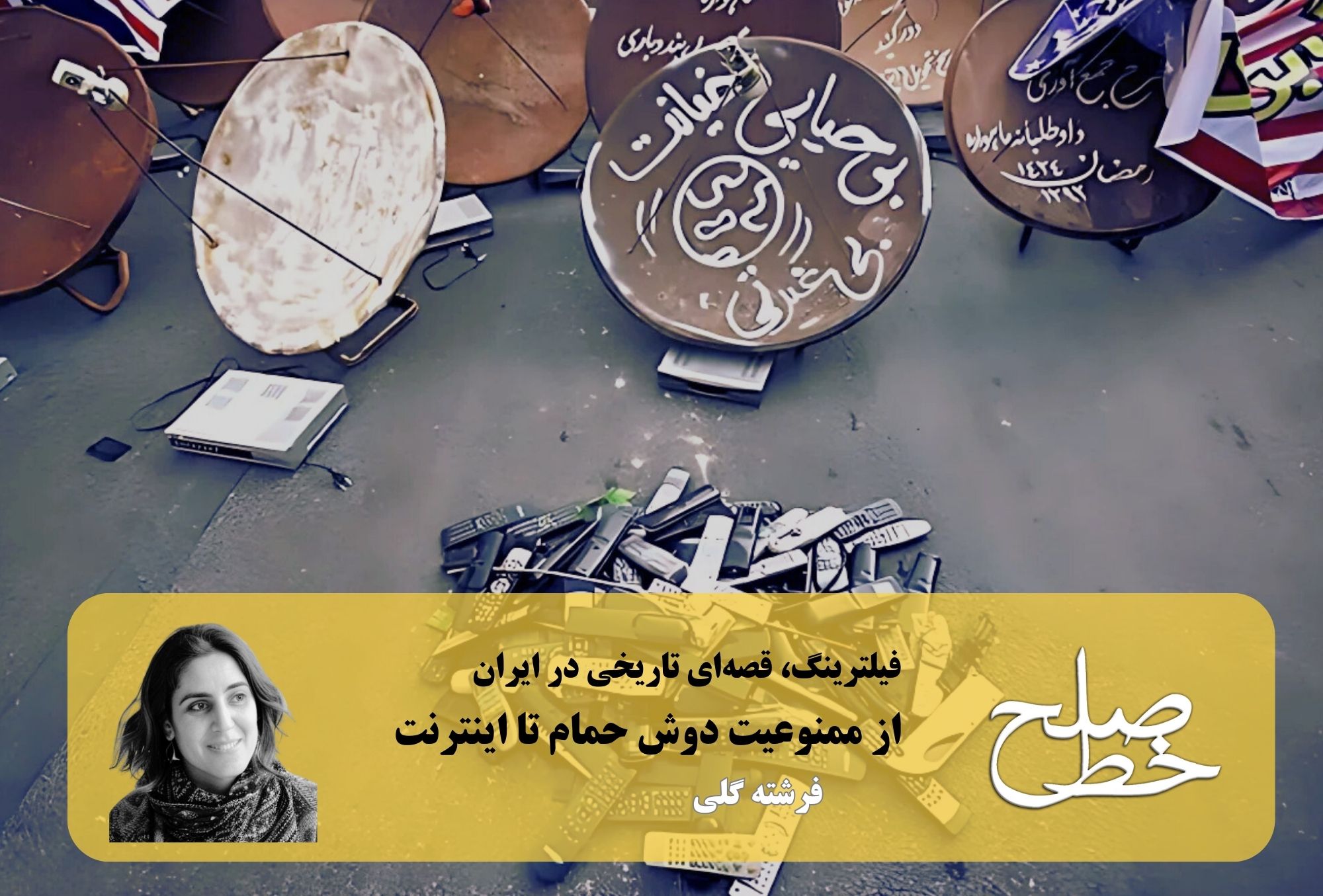
From the Ban on Showerheads to Internet Filtering / Fereshteh Goli
To understand the history of internet filtering in Iran, we need to go back to the early years following the victory of the February 1979 Revolution. As soon as the Islamic Republic was established, it declared many cultural topics—and generally anything that carried the scent of technology—either forbidden or subject to bizarre restrictions and censorship before being made available to the public. These bans, however, had started decades earlier, with the introduction of the first camera, showerhead, electricity, telegram, telephone, running water, and more. Every new technological phenomenon, upon its arrival in the country, faced reactionary resistance from religious authorities. The clergy’s opposition to the introduction of showerheads, referred to as the “Khanizeh Movement,” is a notable example of their resistance to technology and their insistence on keeping society backward at the time.
The prohibition of video players in the 1980s is a clear example of censorship during the early years of the Revolution. With the arrival of video players came bans and crackdowns. The prohibition of these devices—whose sole function was to watch films—led to the rise of a mafia involved in the sale and rental of video players and films. Among these films were pornographic content and other restricted materials. The expansive underground market for video rentals and the massive amounts of money circulating within it were beyond belief. The smuggling of the latest Hollywood films, exclusive Los Angeles shows, and various video devices was impossible without the involvement and facilitation of state officials.
A similar fate awaited satellite dishes when they became widespread. It wasn’t long before a law was passed banning satellite equipment, providing the legal groundwork for harsh enforcement and raids on private homes. Officers, acting like commandos, would scale residential walls to confiscate satellite dishes. These actions never succeeded in eradicating satellite usage. Confiscated dishes and receivers were immediately replaced with a single phone call. Buying satellite receivers became easier than purchasing bread, cheese, and greens—something that would have been impossible without a vast network supplying these banned items, essentially a “forbidden goods mafia.”
Undoubtedly, the primary factor enabling the formation of any kind of mafia is prohibition—especially prohibiting what people desire.
The History of the Mafia and Its Operations
The mafia consists of groups known as “families,” each of which controls a village, city, or region. The mafia engages in organized crimes such as bribery, fraud, gambling, money laundering, contract killings, drug trafficking, and prostitution. The term “mafia” specifically refers to networks of criminal families with Italian backgrounds, especially Sicilian ones. However, it can also be used more generally to describe various criminal families and gangs, regardless of their nationality or specific field of activity. Several theories exist about the origin of the word “mafia.” One popular theory suggests the Sicilian adjective “mafioso,” possibly derived from the Arabic word “mahyas,” meaning “aggressive boasting.” The 107-year rule of the Arabs over Sicily (from 965 to 1072 under the Emirate of Sicily) could explain this Arabic root. Other suggested Arabic origins include “mafī,” meaning “exempt from punishment,” and “marfūz,” meaning “rejected.” Some Italians believe the word “mafia” is an acronym for “Morte Alla Francia, Italia Anela,” meaning “Death to France, Italy Cries.” Within the mafia, the term “Cosa Nostra,” meaning “Our Thing” or “Our Affair,” is commonly used to refer to the organization. (1)
The Mafia in Iran
In addition to the general meanings above, it’s worth noting that the Iranian mafia has constructed its structure and revenue sources by prohibiting basic human needs—similar to the American mafia in the 1920s, which controlled the production, import, and distribution of alcohol. However, the mafia discussed in this article did not emerge in the streets of Sicily or New York but across the vast expanse of Iran. Its activities were not limited to the aforementioned crimes but extended to vital aspects of human needs, such as culture, art, and uncensored access to information. This cultural mafia, born from the same restrictive outlook on culture, education, and technology, has persisted and thrived.
The legalization of video rental stores and the sale of video players, along with the advent of CDs and DVDs, never rendered the cultural mafia ineffective. The primary reason was the continued presence of powerful censorship. Soon, even these video stores became strong branches of the mafia, as operating with severely censored films—often in a disastrously edited form—was not financially viable for their owners. Many of these business owners were families connected to the martyrs and veterans of the Revolution and the eight-year Iran-Iraq war. Perhaps the most significant reason for the mafia’s resilience is that they were often part of the ruling power—or sometimes, the ruling power itself.
Censorship: The Foundation of Iran’s Mafia
Censorship, defined as the suppression of speech, public communication, or other information, is typically justified as preventing material deemed obscene, harmful, sensitive, or “inappropriate.” Governments, private institutions, and other controlling entities may enforce censorship. This can occur across various media, including speech, books, music, films, and other arts, as well as in the press, radio, television, and the internet. Depending on the context, location, and subject matter, direct censorship may or may not be legal. Many countries provide strong legal protections against censorship, but these protections are rarely absolute, often requiring a balance of conflicting rights to determine what can and cannot be censored.
In the years following the February 1979 Revolution, the most significant driver of the cultural mafia’s vitality and evolution has been a form of censorship deeply intertwined with radical religious ideologies. Despite changes in government, this censorship has remained a powerful and influential presence in every aspect of people’s lives. Although cultural figures have devised various methods to circumvent this censorship, they have often faced rigid and reactionary perspectives, leading to disillusionment, isolation, and forced migration.
The emergence of the internet posed a new challenge to the cultural mafia. Initially, due to the slow internet speed and the general unfamiliarity of the public with the technology, there was little concern. However, murmurs of censorship were already being discussed in secret political meetings.
How Did Internet Censorship Become Possible, and What Does This Term Actually Mean?
Internet censorship or filtering refers to restricting internet users’ access to websites and online services that, according to the cultural and political authorities of each country, are deemed unsuitable for public consumption. Filtering is usually implemented by internet service providers, but governments determine the scope, examples, and policies of filtering. Countries such as Iran, Myanmar, China, Cuba, Egypt, Belarus, North Korea, Saudi Arabia, Syria, Tunisia, Turkmenistan, Uzbekistan, and Vietnam are among the largest implementers of internet censorship worldwide. Filtering in Iran is enforced based on laws passed by the Islamic Consultative Assembly and covers a wide range of websites—from pornography to political content.
Although website blocking in Iran is carried out in accordance with the laws of the Islamic Republic, the process, especially for political and social websites, is unclear, and its policies lack transparency. On November 16, 2019 (25 Aban 1398), by the order of Iran’s National Security Council, international internet access was cut off for eight days to suppress the protests of November 2019. During this period, only Iranian websites using domestic servers were accessible.
The non-governmental organization Freedom House, in its 2021 annual report on global internet freedom, reported that after China and Myanmar, Iran imposed the most significant restrictions on internet use. The report further noted that Iran was ranked among the countries with the harshest censorship in 2020. Reporters Without Borders, in its World Press Freedom Index, ranked Iran 173rd out of 180 countries, describing it as “one of the five largest prisons for media personnel” in the 40 years since the revolution. (3)
Thus, in addition to widespread internet filtering in Iran and the prevention of citizens’ free access to information, the label “a large prison for the media and its members” should also be added to the characteristics of the Islamic Republic. The conflict arises precisely here: we do not know about the condition of people in other countries that, like Iran, bear the title of “a large prison for the media and its members,” nor do we know whether they also use VPNs to bypass censorship. However, according to the authorities’ own admission, Iran’s strict filtering laws have not prevented the public from accessing the internet.
From the very beginning, people became familiar with the concept of VPNs, and this phenomenon became a crucial factor in the resurgence of the so-called mafia of VPNs. The irony lies in the fact that, despite being aware of the bypassing of filtering—through VPNs that are often hubs of diverse malware, from phishing to espionage—those enforcing the filters show little interest in reconsidering the matter.
It is noteworthy that different governments in Iran have dealt with this issue differently. Under Rouhani’s administration, there was resistance to demands for filtering, but eventually, Telegram was blocked in full coordination with a judge’s order. During that same period, nationwide internet access was cut off for a week under the pretext of national security. The memorable aspect of the order to filter Telegram was not the order itself but the judge who issued it—a figure later arrested and tried for corruption, although his order to block this widely-used platform remained unchanged.
Despite Iran’s strict internet censorship laws, which block social media platforms like Facebook and X (formerly Twitter), as well as many popular websites like Blogger, HBO, YouTube, and Netflix, Iranian politicians themselves use social media networks, including X (formerly Twitter), Facebook, and Telegram, to communicate with their followers. Internet censorship in Iran and the “National Internet” operate similarly to China’s Great Firewall. Millions of Iranians, however, continue to interact on social media using proxies or VPNs, which conceal users’ locations.
Hamidreza Ahmadi, Vice President of the Internet Commission of the E-Commerce Association, stated on the subject: “The existence of a VPN mafia cannot be ruled out, but it requires further investigation. Regardless of whether such a mafia exists or not, the easiest, cheapest, and fastest way to dismantle the VPN mafia is to lift filtering. When people want to access social media but cannot, a market for VPNs automatically develops. Some VPNs are imported from abroad, and the higher-quality ones require payment; these have been purchased from Israeli companies. Israel Express owns VPNs, and there has been information leakage from paid VPNs.” (4)
Contrary to his remarks, in various published and unpublished reports, there are many indications of the involvement of several officials and their relatives in the background of VPNs and their sale. Among the most significant cases is the issue of the son of Ansieh Khazali, Vice President for Women and Family Affairs in the thirteenth administration. (5)
This was just a small glimpse into the matter. The resistance and bizarre arguments of opponents of lifting filtering within the Supreme Council of Cyberspace can also be analyzed in this context—especially as all experts regard VPNs as a threat to the same national security that is used as an excuse for censorship.
These days, aside from the fact that the issue of filtering—given the availability of a wide variety of free and paid VPNs—has lost its significance, the arrival of SpaceX’s Starlink satellite internet in Iran (6) has become a new concern for the authorities. There is no doubt that Starlink will also be subject to bans and filtering, creating a fertile ground for the emergence of a Starlink mafia. (7) In other words, Elon Musk’s internet, which represents the future of this technology, seems to be something that Iran’s hardline establishment, as always, will be unable to accept or deal with, and thus, yet another repetitive story will begin—a story with a predictable ending.
Footnotes
- “Mafia,” Wikipedia.
- “Censorship,” Wikipedia.
- “Government Actions Against Internet Users,” Wikipedia.
- “Lift Filtering to Easily Break the VPN Mafia,” Khabar Fori website, January 8, 2025 (19 Dey 1403).
- “Ansieh Khazali’s Son in Canada: Filtering Profits for VPN-Selling Privileged Elites,” Ensaf News, September 10, 2022 (19 Shahrivar 1401).
- “The Curious Case of Starlink Satellite Internet in Iran and China,” Khabar Online, January 10, 2025 (20 Dey 1403).
- “Twenty-Fold Increase in Starlink Usage,” Haft-e-Sobh News Platform, January 8, 2025 (18 Dey 1403).
 Created By: Fereshteh Goli
 January 20, 2025
Tags
Censorship Censorship in Iran Filtering Internet Maafiuso Mafia Mahias peace line Peace mark journal Satellite Shower Sicily Starlink VPN ماهنامه خط صلح