


The Super-Crisis of Power Outages in Iran: Causes and Consequences/ Ahmad Alavi
Reliable and sustainable access to electrical energy is vital for Iran, serving as a key driver of economic and social growth. Electricity plays a fundamental role in manufacturing, agriculture, services, and information technology. Thus, disruptions in electricity production, transmission, and consumption networks have significant consequences on macroeconomic variables such as economic growth, productivity, employment, investment, and inflation. In addition to hampering industrial production and increasing costs, power outages in Iran result in considerable social, political, and environmental challenges. Structural issues such as corruption and mismanagement exacerbate these crises, further intensifying the challenges posed by electricity shortages.
The Power Outage Crisis Through the Lens of Good Governance
According to Joseph Stiglitz, the Nobel Prize-winning economist, “transparency” and “accountability” are fundamental pillars of good governance. In a transparent and accountable governance system, information regarding economic conditions, decision-making processes, and institutional performance should be accessible to the public to prevent abuse and corruption. Transparency improves resource allocation and efficiency, while accountability enables officials to answer for their decisions and actions, enhancing governance quality and mitigating economic and social crises.
In Iran, the lack of transparency and accountability creates fertile ground for structural corruption. In the energy sector, this corruption manifests as resource exploitation, mismanagement, failure to develop infrastructure, and inability to manage crises effectively. For instance, instead of allocating resources to improve infrastructure, officials and responsible institutions may divert them for personal gain. Stiglitz’s good governance framework emphasizes the need for transparency in resource allocation processes and accountability for decisions to prevent structural corruption, which, in turn, can reduce energy crises and improve management efficiency.
Causes of the Power Outage Super-Crisis in Iran
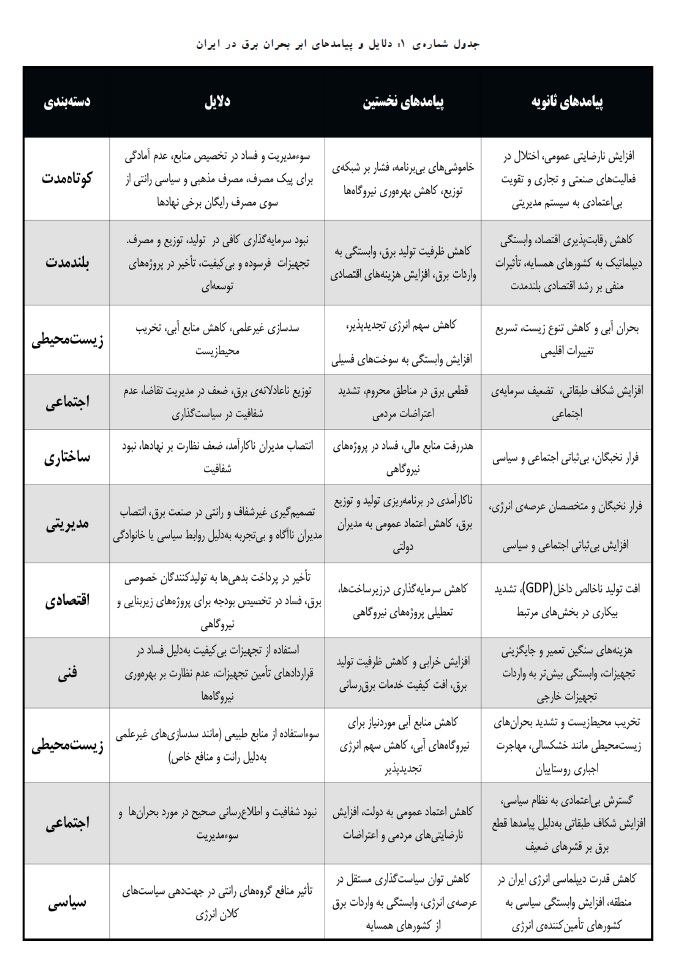
The power outage crisis in Iran stems from a combination of short-term and long-term factors, including managerial, technical, economic, environmental, social, and political issues.
In the short term, mismanagement and widespread corruption have played a critical role in inefficient resource allocation. Diverting power plant fuel to black markets and prioritizing privileged sectors have placed enormous pressure on the electricity grid. Additionally, the lack of preparation for peak demand periods and failure to implement demand management policies have led to unplanned blackouts. Free electricity consumption by unaccountable and opaque religious institutions, along with unauthorized cryptocurrency mining by privileged individuals and entities, has further strained the electricity grid.
In the long term, insufficient investment and misallocation of resources to ineffective projects have significantly degraded the quality of electricity infrastructure in production, distribution, and consumption. A portion of allocated budgets has been squandered due to financial corruption, and substandard and outdated equipment has been integrated into the grid. The absence of policies to diversify the energy mix, including renewable, clean, and sustainable energy sources, coupled with dependency on fossil fuels, has disrupted the balance between supply and demand. Delays in development projects, lack of transparency in maintenance oversight, and excessive reliance on imported equipment have constrained electricity production capacity and increased economic costs.
Environmental factors also play a role in this crisis. Unscientific dam construction projects and environmental degradation have reduced water resources and limited the share of renewable energy. This crisis, in addition to its environmental impacts, has fueled social discontent and widened class divides. Power outages in underprivileged areas have intensified public protests and increased distrust toward the government. Moreover, macroeconomic policies influenced by vested interests and dependence on electricity imports have weakened Iran’s energy diplomacy and created broader political and economic challenges.
Structural mismanagement and the absence of transparency in energy policymaking have laid the groundwork for increased corruption and inefficiency. The appointment of inexperienced and politically connected managers, weak oversight of electricity sector institutions, and lack of accountability during crises have further eroded public trust and the ability to manage crises effectively. These factors have had both short-term and long-term repercussions, including a sharp decline in social trust in the government, capital flight, brain drain of skilled and educated professionals, and social instability.
Economic Consequences of Power Outages
One of the primary economic consequences of power outages in Iran is reduced productivity in industrial and service sectors. Major industries such as steel and cement are severely affected, incurring significant costs due to power cuts. Small businesses also face equipment failures and increased repair costs. These challenges lead to reduced industrial exports and financial losses for the country. Other economic repercussions include damages caused by power fluctuations, which result in electrical equipment failures and additional replacement costs. Furthermore, reliance on alternative energy sources, such as generators, increases expenses for households and businesses.
Social, Political, and Environmental Consequences
On a social level, power outages disrupt public services such as water supply, urban transportation, and hospital operations. These issues are particularly acute during summer months, when electricity demand is higher, leading to public dissatisfaction and protests. Power outages in hospitals also disrupt medical devices, affecting patient recovery processes. Additionally, living under unstable energy conditions increases societal stress and anxiety.
Politically, power outages have sparked widespread criticism and protests against the government. Regions with weaker infrastructure are disproportionately affected, further eroding public trust and social capital.
Environmentally, the use of diesel generators and fossil fuels to compensate for power outages exacerbates air pollution and intensifies environmental crises. This situation not only contributes to air pollution but also has negative implications for climate change and the country’s energy crisis.
Economic Theories and Iran’s Power Outage Super-Crisis
In addition to the good governance framework, other economic theories can explain Iran’s power outage super-crisis. These include:
- Rentier State Theory
- Theorists: Hossein Mahdavi and others who analyze Iran’s economy.
- Explanation: Rentier states reliant on oil revenues often neglect infrastructure and production sectors, including energy. Oil revenues are used for short-term expenditures and the interests of powerful elites, rather than long-term infrastructure investments, leading to energy resource mismanagement and crises like the current electricity shortage.
- Failed Systems Theory
- Theorists: Douglass North and Manuel Castells.
- Explanation: This theory highlights how inefficient economic and institutional systems, characterized by a lack of transparency, corruption, and weak oversight, fail to allocate resources efficiently. The electricity crisis exemplifies this theory through ineffective infrastructure investment and poor demand management.
- Oligarchic Political Economy Theory
- Theorists: Daron Acemoglu and James A. Robinson.
- Explanation: In this framework, control of the economy by specific groups (oligarchs) and dependence on short-term interests result in poor prioritization of economic policies. Allocating energy resources to privileged groups and corrupt entities or inefficient facilities explains aspects of the electricity crisis.
Conclusion
Structural corruption, lack of transparency, unaccountability, and mismanagement are deep-seated issues that exacerbate short-term power outages while challenging electricity infrastructure in the long term, worsening the supply-demand imbalance.
Corruption has pervaded all aspects of management, economy, technology, environment, society, and politics in Iran. This corruption has not only hindered effective crisis management in the electricity sector but also led to economic stagnation, growing public distrust, heightened social dissatisfaction, and increased political-economic dependence on foreign countries. Resolving this crisis requires fundamental reforms in management structures, transparency in decision-making processes, and reducing the influence of vested interest groups.
Investing in a diverse and sustainable energy portfolio, particularly renewable and clean energy sources, is a crucial solution to the electricity crisis. However, this has never been a priority for the Islamic Republic, whose primary focus remains on survival, exporting its ideological agenda, intervening in other countries, financing proxy wars, and opposing modernization.
 Created By: Ahmad Alavi
 December 21, 2024
Tags
8 Peace Treaty 1648 Ahmad Alavi Electricity cut Electricity overload Energy consumption Gas valve Hard winter Mismanagement peace line فساد ماهنامه خط صلح