


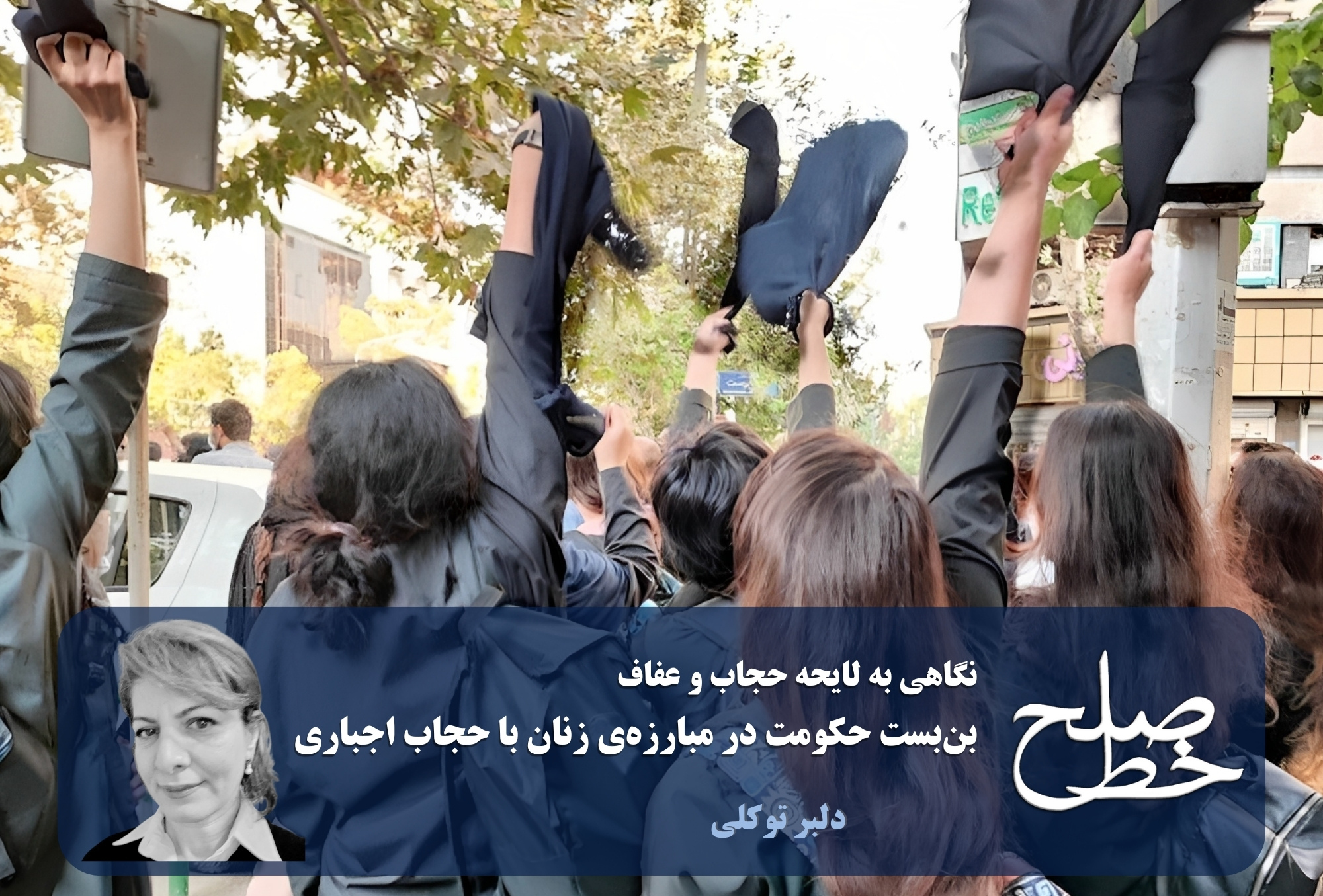
Government deadlock in the fight against mandatory hijab/ Beloved Tavakoli
It has been close to forty-five years that Iranian women, generation after generation, have passed on the torch of the fight against mandatory hijab in the Islamic Republic. The young girls of 1357 (1978) who came to the streets in protests against wearing headscarves, are now fighting alongside their granddaughters for the right to choose their own clothing in the alleys and streets of various cities in Iran, facing the morality police and harassers of mandatory hijab. This ongoing struggle led to the launch of headscarf-burning ceremonies after the killing of Mahsa Amini in September of last year. Even elementary school girls protested against mandatory hijab. In this act of civil disobedience, men also stood side by side with women against mandatory hijab, chanting “Woman, life, freedom.” The Islamic Republic was pushed to the brink of collapse, and this time even severe suppression could not force the veil and headscarf back onto the heads of girls.
Many images of girls fighting against compulsory hijab were published on social networks and for the first time after the establishment of the Islamic Republic, girls’ hair shone on the streets under the sun and they came to the streets without a headscarf. This brave move of women terrified the government and the judiciary hastily prepared a bill titled “Chastity and Hijab” and sent it to the Ibrahim Raisi government, which faced various reactions within the government.
Mohammad Dehghan, legal advisor to Ebrahim Raisi, defended this bill in an interview with ILNA news agency and said: “The government’s perspective is that the issue of hijab should not become a source of division and conflict in the country, but rather a basis for national unity. The opinions have been based on the fact that dealing with the issue of hijab should be done through cultural means, and the government has made efforts to prevent fundamental changes from being made to the drafted bill of the judiciary. Therefore, along with this bill, it has also presented its own opinions in the form of a proposed bill to the parliament.”
We did not expect more from the government of Ebrahim Raisi and it was predictable that he would defend this bill.
The modesty and hijab bill has several articles.
The Bar Association believes that the “Chastity and Veil” bill will be turned into an “abandoned law.” This abandoned law was prepared by the judiciary in 9 articles, but the government added 6 more articles and a 15-article bill was sent to the parliament. In the Legal and Judicial Commission of the parliament, they were able to add to the articles of this bill and complicate it with 70 articles that contain unprecedented punishments for women. For example, only those who are employed in government and non-governmental institutions are required to wear compulsory veils. (1)
The new bill, which has increased from 15 articles to 70 articles and has been approved by the Judiciary Commission of the Parliament, includes punishments ranging from detention to fines for those who violate the “hijab” and has also implemented gender segregation in some places. The amendments and changes proposed by the Judiciary Commission have intensified the penalties for non-compliance with the laws of the Islamic Republic regarding hijab and resistance against law enforcement compared to the initial text proposed by the Judiciary. The new bill emphasizes on the wider implementation of gender segregation in universities, offices, parks, and even in hospital treatment areas. The current bill has five chapters.
The four seasons are dedicated to the duties of offices, organizations, ministries and government agencies in terms of compulsory hijab, and based on this, all of these agencies are obligated to review and formulate laws and regulations in their executive domain to observe hijab.
Furthermore, in the new text of the Veil and Chastity Bill, programs have been planned to oblige cultural institutions and organizations to promote and advertise the veil.
In the final chapter of the draft, crimes and violations related to “immodesty” are mentioned and in detail, numerous cases are considered as criminal offenses, for which “offenders” will face punishments such as imprisonment and fines.
The prohibition of leaving the country, confiscation of passports, and deprivation of citizenship rights are also part of the punishments specified in the Hijab and Chastity Bill. In this bill, “field confrontation” with women is one of the most anticipated programs, and gender segregation in universities, hospitals and medical centers, administrative centers, educational centers, parks, and tourist sites has been emphasized.
Reactions to the Bill of Chastity and Hijab
Since the day this bill was hastily passed, the number of women with optional hijab on the city streets has not decreased and women continue to fight for their civil rights to have the choice of clothing. However, it must be said that the governments have stirred up so much turmoil this time that they have even alienated many of their supporters. Azar Mansouri, the head of the Reform Front, wrote on Twitter in response to this bill: “Instead of writing all these plans and bills for mandatory clothing, which unfortunately has become the main symbol of Islamic society, ask yourself why all this insistence and coercion and taking and closing, closing businesses and imposing heavy costs on the country, will not bring you to your desired destination. Stop this self-destruction.”
It was unexpected that even the Judiciary and the government did not expect some members of the parliament to protest against the modesty and hijab bill in the open session. Gholamreza Nouri Qazaljeh, the head of the independent faction of the parliament – who is one of the protesters against this bill – says: “This bill affects students and individuals under 18 years old, and it is concerning and problematic for society and families. We should ask the creators of this bill what they are looking for in schools? Unfortunately, those who are leading these decisions do not have a clear understanding of the contents of what they are deciding about.” (3)
According to this representative of the parliament, according to Article 46 of the bill on chastity and hijab, if students do not comply with the law three times, they will be referred to the disciplinary committee or the supervision of the educational center. Hossein Jalali, the representative of the tenth Islamic Consultative Assembly, said: “According to the Hijab and Chastity Bill, opponents of compulsory hijab under the age of 18 will be deprived of services such as passport, employment, education, bank account, internet and telephone, and this punishment will replace imprisonment for this age group.”
A group of lawyers, sociologists, and religious scholars have published a text titled “Social Research: The Issue of Hijab, Realities, and Solutions”. Interestingly, the author of the introduction to this research is Mohammad Khatami, the former President of Iran. In this research, he repeatedly uses the term “mandatory hijab” and addresses the senior officials of the Islamic Republic, emphasizing that they must accept that a large portion of society does not want mandatory hijab.
Amidst the conflict between hardline government officials, Basijis, moderates, and reformists regarding the modesty and hijab bill, one of the officials said on a TV program, “We have a daily discovery of 15 to 20 percent of women wearing hijab.” The government is unable to arrest and treat “five thousand women” daily in a criminal manner.
Although the level of unveiling of the veil is more than this on a daily basis, if we accept this as well, it can be clearly stated that the Islamic Republic and its 45-year effort and suppression for compulsory hijab have reached a deadlock.
Notes:
1- Former Head of Bar Association: The “Chastity and Veil” bill will be turned into an “Abandoned Law”, Radio Farda, 8 August 1402.
2- The “Chastity and Veil Bill” was removed from the public session with the approval of the Iranian Parliament, BBC Persian, 22 August 2023.
3- “Sharq” Interview with Nouri Ghazaljeh in response to the introduction of the Hijab bill to the student sphere; Students under 18 are introduced to Faraja, Sharq newspaper, August 19, 2023.
 Created By: Delbar Tavakoli
 August 23, 2023
Tags
Beloved Tavakoli Compulsory hijab Freedom of speech Gender discrimination 2 Hijab Mahsa Amini Monthly Peace Line Magazine peace line Peace Line 148 The bill of chastity and hijab Violence