


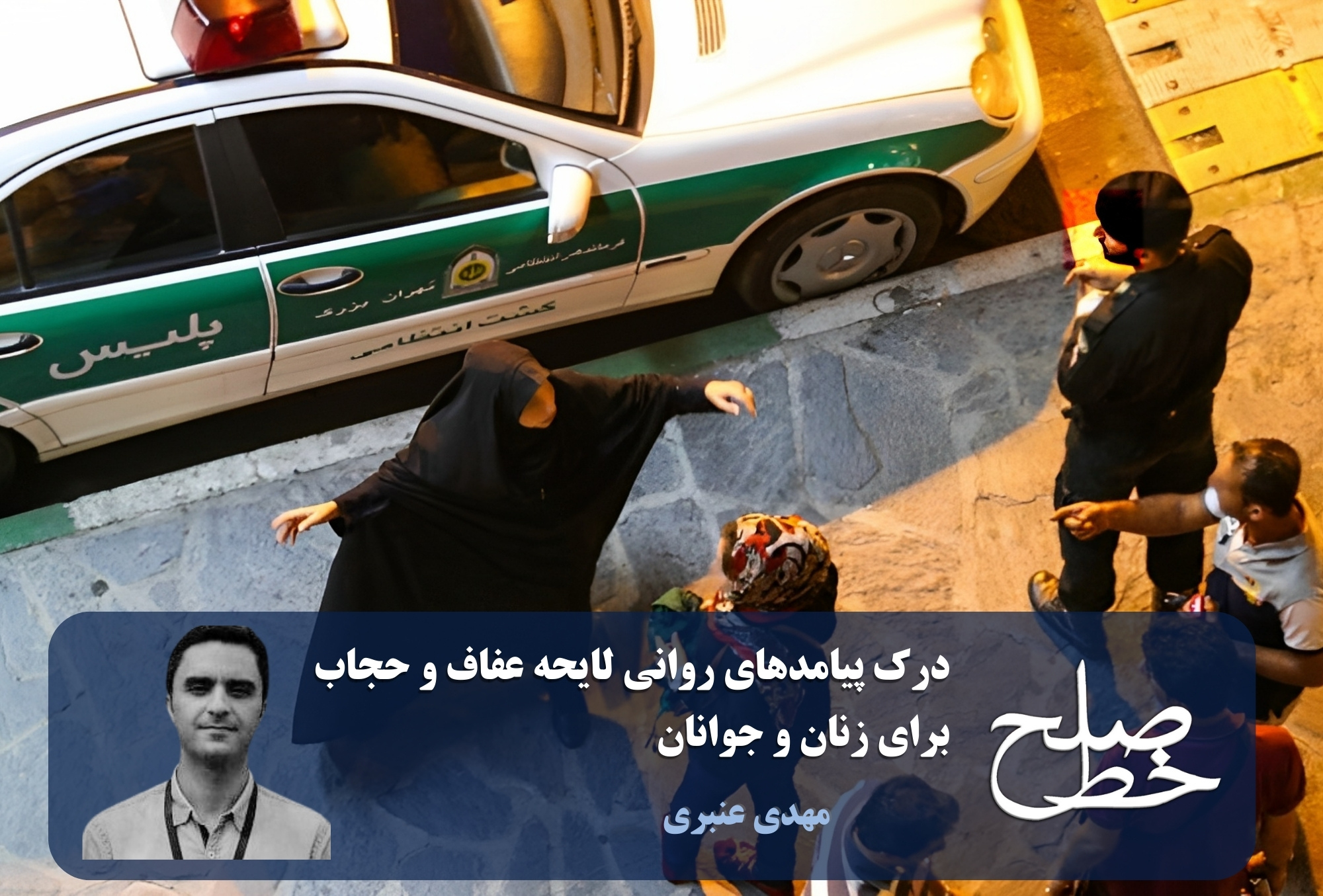
Understanding the Psychological Consequences of the Chastity and Veil Bill for Women and Youth / Mehdi Amberi
The purpose of writing this article is not to criticize the laws set in the country. Although numerous laws have been drafted and implemented in the years 1361, 1365, 1374, 1384, 1392, and most recently in the month of Ordibehesht of 1402 by various institutions such as the Ministry of Culture and Islamic Guidance, Supreme Council of Cultural Revolution, Ministry of Justice, Judiciary, and the Command of Enjoining Good and Forbidding Wrong, the current situation and the recent approval of a bill are evidence of the ineffectiveness of all the expenses incurred. Perhaps the writer has overlooked some of the approved and even implemented laws, but the bill for supporting families through promoting the culture of chastity and hijab is a bill that has been repeatedly rejected, amended, and modified between the Judiciary, Ministry of Justice, Parliament, and the government since the tragic events that began with the death of Mahsa Amini in the current year
Among the materials mentioned in the bill, there are 38 articles related to the responsibilities and duties of responsible authorities, and only 32 articles related to crimes, offenses, punishments, and penalties. The purpose of writing this article is not to examine Islamic, civil, and other punishment laws, as the author is not a legal expert. The title suggests one of the strengths of the new bill, which is that citizens can report the offenses of owners of speech, professions, and businesses, as well as the negligence of responsible authorities in enforcing the laws of modesty and hijab, to the public system of Faraja (Command of the Islamic Republic’s Police) and in fact, a special position has been defined for the people and public supervision to turn the issue of hijab into a collective demand and make citizens aware of their social responsibility. It is surprising to see such trust and respect for the nation, which is not apparently recognized in other political, economic, and other issues. But the title
It seems that two factors have played a significant role in the development of this precise draft. The first is the events and incidents that occurred after the death of Mahsa Amini, and the second is the official statistics from the judicial and prosecution authorities in the past year. The first factor is clear and evident. However, regarding the second factor, the IMNA news agency has reported on August 5, 2023 that in the past year, with the increase in the unveiling of hijabs, there has been a significant rise in moral crimes, leading to an increase in infidelity, divorce, reluctance to marry, increase in the age of marriage, prevalence of obscenity and lawlessness, rise in illegitimate relationships, superficiality and appearance-oriented attitudes, and so on.
It is reiterated that the writer has no intention of criticizing or reviewing the research conducted, even as a researcher; because it is fundamentally impossible for such research to be prepared, executed, and its results statistically analyzed within a period of less than a year. It is evident that there is still no official and accurate statistics on the number of addicts, AIDS patients, divorces, white marriages, cardboard sleepers, porters, incompetent managers, forged documents, astronomical salaries, economic corrupters, embezzlements, convicts outside of prison, illicit relationships of some managers and officials, missing oil rigs and gold, blocked oil money, and even the number of operations that were leaked during the war are not available. In a system where neither the number of martyrs of September 8, 1978 nor the number of casualties of November 1979 have been officially and accurately announced, and there are thousands of questions in our minds, as we still adhere to principles and values, how can we
However, the writer of these lines gives themselves the right to express their opinions as someone who has been a student of psychology and education for over twenty years. But before addressing the issue of mental health, I must draw the attention of readers to some points regarding the Constitution of the Islamic Republic of Iran. In Article 1 of the Promotion of Chastity and Veil Bill, it is stated that any behavior that promotes nudity, immodesty, lack of hijab, and improper dress, and actions that violate public chastity and lead to disruption of peace between men and women in the family, late marriage, divorce, and social harms and devaluation of the family, is a violation of Articles 1, 7, 3, and 10 of the Constitution and is prohibited. Now, according to the sixteen articles under Article 3 of the Constitution, which are considered the duties of the government, several questions come to the mind of any thoughtful person: Has 44 years
Yes! If all of these issues are achieved at a satisfactory level and their failure to materialize has no negative impact on the mental, spiritual, intellectual, religious, and worldly health of the youth of this land, then today is the time for the government to fulfill its remaining duty and think about covering the heads and hair and clothing of Iranian women and girls. Of course, as far as I remember, all presidents have admitted in their election slogans that the problem of the country is not the hijab of girls and women!
As for the tenth principle of the Constitution, it considers the family as the fundamental unit of the Islamic society and states that all laws and regulations should aim to facilitate the formation of families, protect its sanctity, and establish strong family relationships based on Islamic rights and ethics. However, the question is, what factors have hindered the realization of this fundamental principle? Hijab!
For years, there has been a consensus and agreement on the definition of health by the World Health Organization. Health is defined as complete physical, mental, social, and spiritual well-being, and it is not limited to the absence of disease or disability. This is the same definition that the Supreme Council of Cultural Revolution referred to in its meeting on November 8, 2007, and formulated the Women’s Health Guarantee Document. Article 2 of this document states that women’s right to health means having physical, mental, social, and spiritual health in personal, family, and social life, taking into account their characteristics at different stages of life. It is considered a natural and universal right and the responsibility of governments to ensure it.
If supporters of the mentioned bill read these lines, they will definitely say that implementing these legal provisions is necessary for ensuring physical, mental, and social well-being in personal, familial, and societal life, and this bill is being approved with that goal in mind. This opinion is certainly shared by many veiled women. On the other hand, women who consider hijab a personal matter admit that the situation and approval of such bills and laws violate their individual rights and pose a threat to their mental health. This view has also gained many supporters and official statistics support it. This is the beginning of a problem that not only endangers the mental health of Iranian women and youth, but also puts the mental health of children, who are the future builders of this land, at serious risk. Polarization and dichotomy of the nation and the production of new paradoxes is not a new story. This issue dates back to the emergence of terms such as “religious” and “non-religious”. A story
In this draft, emphasis is placed on public oversight and social responsibility, and once again people are pitted against each other, and God knows what harmful effects this confrontation will have, both internally and externally. From every aspect, if we look at it, the approval of something like the Hijab and Chastity Bill and the payment of hot fines, and being banned from leaving the country or working, and being separated from service and having their cars confiscated, will not be a cure for the society. Within the community, we should expect a lot of tension between the responsible agencies, executives, and law enforcement officials, and those who promote good and forbid evil, and educated and uneducated individuals, and those who are pro-hijab and those who are extremists and those who are slow, and so on. And ultimately, who will be responsible for these tensions, challenges, conflicts, arrests, violations of sanctity, and the escalation of family disputes, physical and psychological harm, and blood
But from an internal and family perspective, the situation will be even more serious, because today’s issue will be like a daily stain on our children and that day is not far away. Today’s children are not like us, who were born in the 1950s and 1960s. They are children of the era of advanced technology and communication, and the information that we used to read week by week in the universe of children and knowledge, is now simple for them. Today, they are used to searching in the world of information and their eyes are open, their ears are listening, and their minds are free from slogans and biased teachings. With this description, today’s children are like sacrificial lambs caught in the crossfire of conflicts between teachers, schools, official and unofficial books, education, media, satellite networks, authorized and unauthorized websites, virtual pages, Instagram and X (Twitter), while living in families where even parents do not agree and understand each other; one raises
Health is a necessary condition for fulfilling social roles, and all humans can be fully active only when they feel healthy and the society considers them healthy. Now we are facing a society that is plagued by contradictions. The government and ruling system do not consider a part of their body to be healthy and feel the need to reform, discipline, punish and penalize them. Why? Because they do not observe their own veil. A part of this society also does not feel healthy. Why? Because they are not free in their personal and individual matters and do not even have the right to choose their own clothing. What is the solution? Drafting a 70-article bill that is supposed to bring about reform. What is it supposed to reform? The society. How? Through punishment and penalties. While it has been at least a hundred years since punishment and penalties have lost their effectiveness in the foundations of education and upbringing and all Islamic and non-Islamic scholars and experts have acknowledged its ineffectiveness.
In multiple instances, while writing these lines, I have wanted to make a reference to the pure Shari’a of Muhammad and the hadiths about the non-obligation of hijab, and the extensive differences of opinion among scholars and jurists on the issue of hijab, and even to examine other Muslim countries and nations where hijab is not mandatory. However, unfortunately, I am not a student of religious studies and I am not a jurist. But read this story: “One day, a wise man passed by a village and saw a man hanging from a gallows. He asked, what has he done to deserve such a fate? They said, he was a thief and had stolen many times. The wise man approached the man hanging from the gallows and recited a Fatiha. They asked, why did you recite a Fatiha? He said, in the end, he achieved the utmost and perfection in his work.” I wish in our beloved
 Created By: Mehdi Anbari
 August 23, 2023
Tags
Compulsory hijab Gender discrimination 2 Guidance Tour Hijab Mahsa Amini Mehdi Anbari Monthly Peace Line Magazine peace line Peace Line 148 Psychological harassment The bill of chastity and hijab Trauma Unveiling Unveiling/Uncovering/Removal of the Hijab Woman, freedom of life ماهنامه خط صلح