


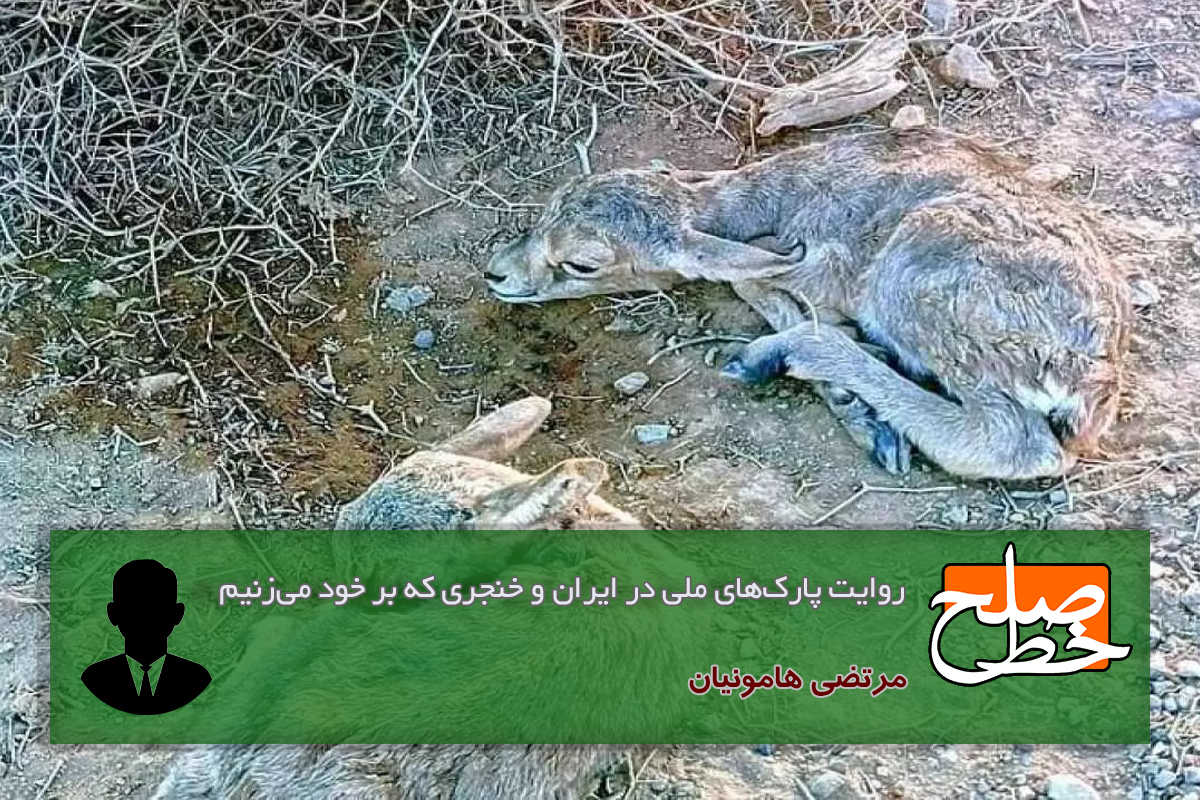
The Story of National Parks in Iran and the Dagger We Strike Ourselves With / Morteza Hamounian
It takes thousands of years for a natural source to be established on Earth; a forest or a swamp, a lake or a plain or a mountain. These natural sources, these reserves and natural treasures, are a heritage that has been passed down from generation to generation. They are the lungs of the Earth and the values that make our planet habitable and distinguish it from other planets in our solar system and other systems; resources that in recent centuries, with the beginning of industrialization and modernization of humanity, are being consumed more than they are being produced. When a resource is consumed more than it is produced, or when a resource is destroyed more than it is created, nothing remains but a memory of them. That is when we must bid farewell to human life on Earth. Over a decade ago, the late British physicist Stephen Hawking warned that “if humanity does not move beyond the Earth’s atmosphere in the next hundred years, it will face the danger of extinction.” (1) In other
This is why humans have thought of creating institutions and organizations to help improve their environmental situation. Environmental protection organizations in countries preserve and protect the diversity of ecosystems and genetic resources of plants and animals. They categorize certain parts of the Earth, which are the most pristine and unique natural areas, into four categories known as the four environmental zones and manage and protect them under specified laws. These four zones, known as “national parks”, “protected areas”, “national natural sites” and “wildlife sanctuaries”, are managed according to accepted regulations and laws among all countries and are considered the most important natural heritage of countries. (2)
Among these four regions, the subject of this short article is titled “National Park”. According to the definition, “National Parks are designated areas of natural resources, including forests, grasslands, natural valleys, rivers, lakes, and mountains, which showcase prominent examples of natural phenomena. Governments protect these areas in order to preserve the permanent status of the ecosystem, as well as to create a suitable environment for the reproduction and growth of endangered wildlife and plants, and to prevent destructive human interference.” (3) Additionally, National Parks require fundamental protection as suitable places for educational, research, and tourist activities in nature. Fundamental protection refers to the preservation of biodiversity, genetic resources, ecological integrity, and landscapes. In order to achieve this, activities related to consumptive and residential exploitation are not allowed in National Parks, and at least on paper and according to laws, National Parks are expected to have stronger legal and protective foundations compared to other protected areas. (4)
Based on laws in Iran and for the protection of these national parks in our country, lawmakers have established regulations. Some of these regulations are as follows:
Shooting and hunting are generally prohibited in national parks, except in cases where the preservation of wild animals requires it, in which case the organization will act accordingly by its officers.
– Grazing (of livestock) and cutting down trees and bushes, encroachment and destruction of the environment, and in general any action that leads to the destruction of habitats and changes in ecosystems, is prohibited in national parks. In necessary cases, in order to preserve the forest and improve national parks or conduct scientific and geological studies, actions will be taken by the Forests and Rangelands Organization or the Environmental Protection Organization, in accordance with the regulations of the law on conservation and exploitation of forests and rangelands.
Renewing and extending exploration and exploitation licenses issued for mines located in national parks is prohibited.
Entry into national parks and passing through them requires obtaining permission from the organization.
Carrying a weapon (except for environmental organization officials) without written permission from the environmental organization is prohibited. (4)
According to the fiftieth principle of the Constitution of the Islamic Republic of Iran, protecting the environment, in which the present and future generations must have a prosperous life, is considered a public duty. Therefore, economic activities and others that may result in environmental pollution or irreversible destruction are prohibited. (5)
In Iran, at least 31 natural areas have been designated as national parks, scattered across the provinces of West Azerbaijan, East Azerbaijan, Isfahan, Bushehr, Tehran, Chaharmahal and Bakhtiari, Razavi Khorasan, North Khorasan, Khuzestan, Semnan, Fars, Kerman, Kohgiluyeh and Boyer-Ahmad, Golestan, Gilan, Mazandaran, and Yazd. This means that more than half of our country’s provinces have protected areas known as national parks, and this also means that more than half of our country’s provinces have at least some natural treasures that must be preserved and protected with all our might.
In addition to what has been mentioned, these national parks are also important in other ways and can generate income through ecotourism and adventure activities such as camping, hiking, etc. They can also be a producer of a portion of the gross domestic product through their vast, natural and renewable resources. These parks have the potential to be a great source of renewable resources, including water and high-quality wood, and their production can be controlled. Additionally, in these protected areas, it is possible to ensure climate and soil stability, making them more resilient against natural disasters. All of this is happening while in less than half a century, around half of these natural resources in our world have disappeared from our planet, meaning that in less than fifty years, we have plundered resources that took thousands of years to produce, without replacing them. It is not surprising that some scientists refer to our time as a minute before extinction.
National parks in Iran are under threat and it seems as though a hand is choking the neck of these national treasures, pressuring them to sacrifice the life of Iran’s nature. The first national park in Iran is Golestan National Park, which has been registered as a biosphere reserve on UNESCO’s World Heritage List since 1354. It is a pristine and beautiful area, a natural treasure of plants and a unique sanctuary for animals, housing around 1,250 plant species and 320 animal species. These numbers are even higher than many European countries with much larger areas, but this natural reserve, as the first national park in the country, is facing various threats. These include illegal hunting on one hand, and the lack of resources and restrictions on environmentalists on the other hand, as well as recurring droughts and fires that have caused a large area of forest and pasture resources to be destroyed. The presence of nomads in various pastures, along with climate change and unsustainable exploitation of
Another example of giving up national parks in Iran is Turan National Park; an area that has been declared as a protected area since 1351. In 1355, the number 75 resolution of the Supreme Council of Environmental Protection divided this area into two parts: a wildlife sanctuary and a protected area. In the same year, these two areas were registered as a biosphere reserve at the international level. These two areas have rich wildlife resources in the wildlife sanctuary section and geopark capabilities, geological characteristics, springs, water resources, and rivers in the protected area section. (10) This park is the habitat of the Iranian cheetah, but with the liberation of mining areas in Semnan province, named Kharturan, Abbasabad, and Taroud, the habitat of this species and many other animals have been threatened; in fact, issuing permits for mining activities in the protected area of Turan, which is the main habitat of the Iranian cheetah, has put the
Ahmad Shamlou had written the famous phrase “No one ever rose to kill themselves in such a terrible way” for a romantic poem, but it seems to be a reflection of our present and our confrontation with our natural heritage. We, as humans, have willingly killed ourselves through our actions. In Iran, we are specifically at war with ourselves and no one thinks about what is happening in this country; from the droughts that are the result of decades of wrong policies in Iran, to the phenomenon of dust storms that have now reached Golestan province in northern Iran, leading to the destruction of our natural and animal life. The statistics released by the Environmental Protection Organization at the end of 2021 show that in the past half century, we have lost seventy percent of our prominent wildlife species and many species, including the Asiatic cheetah, are on the brink of extinction. Nine years ago, at least seventy-four species of Iranian animals were listed on the International Union for Conservation
Notes:
1- Hawking: To ensure the survival of humanity for another hundred years, leave the Earth, Radio Farda, August 11, 2010.
2- What are the four environmental zones and what are the differences between them?, July 6th, 2021.
3- National Park, Semnan Province Environmental Protection Department.
4- About the National Park, Nature Institute.
5- Laws and regulations, East Azerbaijan Province Environmental Protection Department.
6- What is German, Pertilo, and National Park? Green Renewable Energy Website (Spanish).
7- Why is Golestan National Park a global asset? Pinorest Magazine.
8- Karimi, Samieh, Keykha, Ahmad Ali, Ahmadpour, Mahmoud, Maddi, Meysam, Investigating Threatening Factors of National Parks (Case Study: Golestan National Park), 2nd National Conference on Environmental Hazards of Zagros, 1393.
9- Threat to 200 species of wildlife in Golestan National Park due to the construction of a bypass road, Tasnim News Agency, 29 Azar 1401.
10- Turan National Park, the news base of Iran’s environmental and wildlife watchdog, September 1, 2012.
11- Mining activities threaten the main habitat of the Iranian leopard, Tasnim News Agency, 20 Ordibehesht 1401.
12- How many animal species are endangered in Iran? Infographic, Fars Plus, 24 Esfand 1400.
13- The budget of the Environmental Organization in 1402 must be at least five times higher/ The funding for the National Dust and Sandstorm Headquarters in 1401 has not been announced yet, Rakna News and Information Agency, 29 Mehr 1401.
14- Preparation of “Victory” food as an alternative to imprisonment, Biosphere News and Analysis Base, 3 Dey 1401.
 By: Admin
 January 21, 2023
Tags
Animals are going extinct. Balochi bear Environment Extinction Golestan National Park Iranian leopard Monthly Peace Line Magazine Morteza Hamounian National Park peace line Peace Treaty 141 Turan National Park