


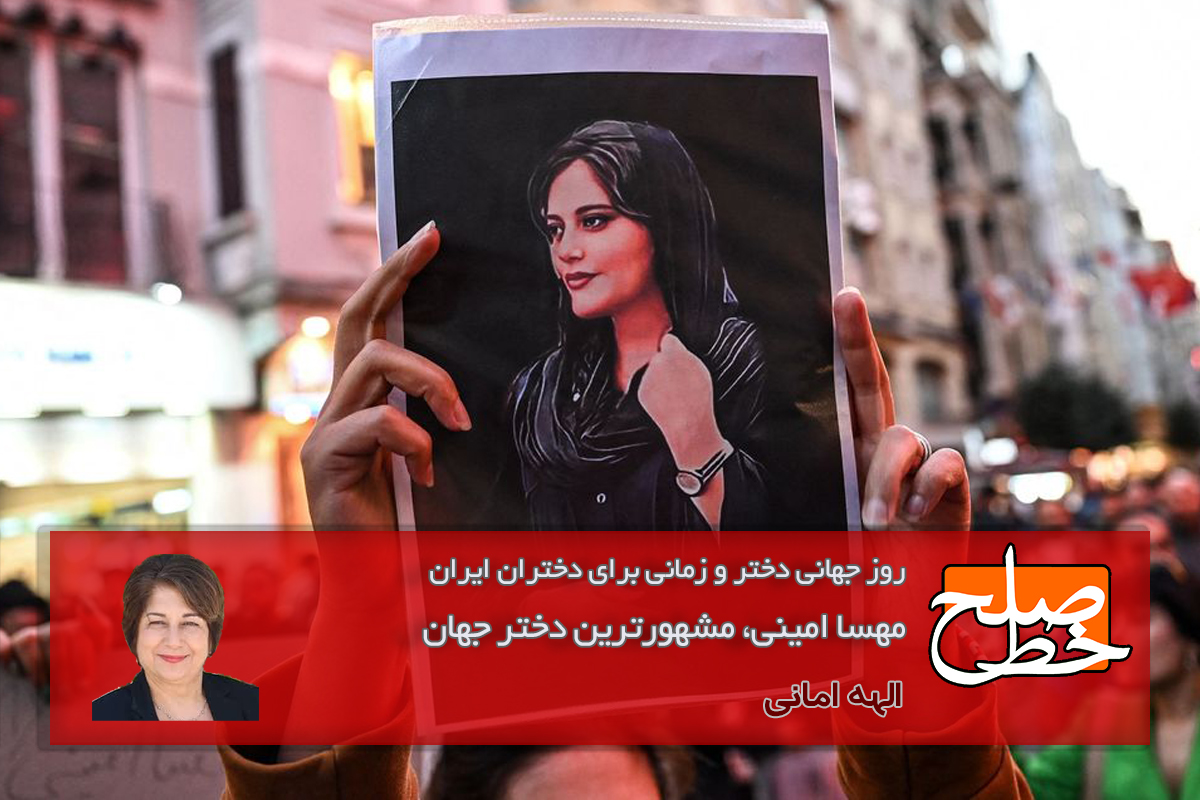
“World Day of Girls and a Time for Iranian Girls / Elaheh Amani”
Mahsa Amini, the most famous girl in the world.
October 11th was the International Day of Girls. In 2022, it marks the 10th year of recognizing this day as the International Day of Girls by the United Nations. This year’s theme is “Our time is now–our rights, our future”. It is a symbol of the resilience and determination of girls around the world to create gender equality and bring about change.
Sima Sami Bahous, Executive Director of the United Nations Entity for Gender Equality and the Empowerment of Women, in her speech on this day, mentions that “in the past, I have witnessed the interest and presence of girls in global programs and their contribution to sustainable development goals. Girls have shown themselves as leaders and advocates for social change in areas such as environment, education, gender-based violence, sexual health, and reproductive rights. Their involvement in feminist movements and mobilization for gender equality has played a key role in shaping positive and fundamental actions in local and global communities for generations to come.”
Despite progress made in the past decade, fundamental challenges still remain and the United Nations Women’s organization estimates that at the current pace, it will take another three hundred years for women and girls around the world to achieve full equality with men and boys.
In the field of education, what prepares and equips girls for their groundbreaking roles is an education that breaks the slow process of three hundred years and accelerates it by creating a foundation for agency, bringing equality to the voices of girls, and empowering them to make this process faster.
Facing the challenges that are now more dangerous than ever for girls, requires coordinated and strong actions in various layers of policymaking, information dissemination, and development of future-oriented strategies based on accurate data that considers age and gender indicators. The fact that the rights and position of women and girls at the global level are under attack from the growth of right-wing forces on one hand, and fundamentalism and extremism in all religions on the other, is undeniable; also, with the communication and technological facilities that young people have, the virtual space is another arena where the rights and security of girls and women must be preserved. Therefore, this important issue should be a priority for governments and civil institutions due to the dangers of women’s rights being diminished or taken away, and the harms that women and girls can experience in the virtual space.
Girls of the Generation Z and Alpha have a vision for the future world where leadership, agency, influential role and guidance of girls are recognized and girls have access to their full rights, living a life free from violence and discrimination in both private and family spheres, as well as in social and community spheres, experiencing equality and equal membership.
Young girls and women must be at the forefront of the changes they envision for the world. The decade of 2020-2030 is a time for countries to accelerate and focus their efforts towards achieving sustainable development and gender equality. In the past decade, young girls and women have clearly demonstrated their pivotal and historic role in the world. A review of the “Girl Declaration,” resulting from the exchange of ideas among 500 girls from fourteen countries in 2012, which was launched on this day, shows how rapidly the world is changing and how the demands and activism of girls and women in the areas of human rights, education, health, and security have become more powerful. Today, young girls and women are striving for aspirations that, with their talents, creativity, and commitment, can lay the foundation for a global world that is positive and constructive for all women and men of different generations.
Among these girls who brought valuable changes and transformations for the whole society, sixteen-year-old Greta Thunberg from Sweden played a key role in proving that young girls and women of this generation are at the forefront and leading the global world. She warned the world that “you have all pinned your hopes on us young people. How dare you? You have stolen my dreams and my childhood with your empty words, yet I feel like one of the lucky ones; others are suffering, dying, and the entire ecosystem is collapsing.” Seventeen-year-old Julieta Martínez from Chile has created an organization for environmental conservation and gender equality and is taking steps towards empowering young girls and women. Neha Shrestha, a girls’ rights and gender equality activist from Nepal, says that our girls may not know how to cook, but they quickly create a profile for themselves on social media and stay connected with the world. However, she challenges big technology companies to expand and invest more to ensure the safety
Young women are an inseparable part of the powerful force fighting for the establishment of social justice, gender equality, and development. The rights of young girls and women to participate in political and social life are guaranteed under international laws. This creates legal obligations for governments to remove structural barriers that young women and girls face in their participation.
Six hundred million young girls and women are the potential and active force of the world today. We are all responsible for creating an encouraging space for the social presence of this potential force. Our world must open its doors with courage, fearlessness, and determination for the presence of this great force at the negotiating table and decision-making for the future, as their presence and leadership is undoubtedly vital for the world as well.
Challenges of girls at the global level
Despite advancements and the promising presence of young girls and women in various fields, our world still faces numerous challenges and has kept the potential and capabilities of this great force dormant.
If girls worldwide complete high school education, it will prevent 50 million child marriages by 2030. According to the report by the Children’s Fund, this is one of the most concerning indicators for girls.
Fifteen million girls aged fifteen to eighteen experience forced and unwanted sexual relationships at a global level.
Every week, seven thousand girls between the ages of fifteen and twenty-four become infected with AIDS.
Girls living in war zones are twice as likely to be at risk of dropping out of school compared to girls living in peaceful areas.
Sixty-two million girls are of school age, but they do not attend school.
Every year, four million girls are at risk of sexual exploitation.
Without confronting the growth of right-wing, populist, and religious extremism, it is not possible to overcome these challenges and other obstacles in order to unleash the potential of girls in serving human society.
Girls in Iran
In Iran, the Day of the Girl is the birthday of Fatemeh Masoumeh, which falls on the 11th of Khordad in the year 1401.
The tenth year of celebrating International Day of the Girl has coincided with the presence and activism of young girls and women in Iran; the explosion of suppressed grievances of the Z generation in Iran and even the Alpha generation, born in the 21st century. The wave of street protests, which began after the death of Mahsa Amini following her arrest by the morality police, spread to all 31 provinces of Iran. The widespread presence of young girls and women in the streets, seeking a life free from the authority imposed on them, is a desire beyond the crackdown of the morality police and mandatory hijab. Iran is the only country in the world where hijab is mandatory and the term “bad-hijab” has been introduced into Persian and even global vocabulary. Iranian girls and women demand the right to choose their own clothing, express their identity, and freedom of speech without facing harassment, threats, and violence.
If Ms. Safura Razanjad, in the magazine “Salam Donya”, sends a message to readers that “we must appreciate these heavenly flowers (girls) more”, the insults and even blatant cases of sexual harassment towards young girls and women on the streets are a symbol of appreciation for “heavenly flowers” in Iran.
Sarina Ismailzadeh, a sixteen-year-old girl who used to go to Farzanegan School in Karaj, expresses her social concerns in her videos that she shares on social media. She says, “The Iranian teenager is no longer the same as the teenager twenty years ago. They are aware of the world and wonder what is different about them compared to American teenagers that their concerns are so different.” In her latest Telegram post, Sarina writes, “My homeland smells of homesickness.”
Young girls and women in social media emphasize that our pain is not just “mandatory hijab”; pain from economic and social pressures, lack of respect for women’s and girls’ human rights, honor killings and lack of accountability for them, structural corruption and embezzlement, gender engineering, and many other pains; pains that the girls and young women of the 80s hold the government responsible for addressing.
Now it can be claimed that Mahsa Amini is the most famous girl in the world; a girl whose name appeared nearly three hundred million times on tweets and her death was the last straw that broke the camel’s back. Truly, the theme of the 2022 International Day of the Girl is so fitting for young girls and women in Iran: Yes, the time is now and your rights and future are at stake in this moment of transformation.
Note:
۱- Mark Owen Jones, a professor at Hamad Bin Khalifa University in Qatar whose expertise is in media and communication studies.Tweet
On October 12, 2022, it was announced that the Persian version of the hashtag #Mahsa_Amini has been used more than 274 million times on Twitter. This is while the hashtag #BlackLivesMatter, which was created by the social network, has been used 63 million times on Twitter from mid-2013 to now. It should be noted that this calculation does not include the English version of the hashtag #Mahsa_Amini (MahsaAmini#).
 Created By: Elahe Amani
 October 23, 2022
Tags
1 Peace Treaty 1381 Compulsory hijab Goddess Amani Greta Thunberg Hijab International Day of Girls International Day of Girls International Day of the Girl Child Juliet Martinez Kaylash Satiarti Mahsa Amini Malala Yousafzai Monthly Peace Line Magazine Nationwide protests peace line Sima yearning United Nations Organization Woman, freedom of life Women