


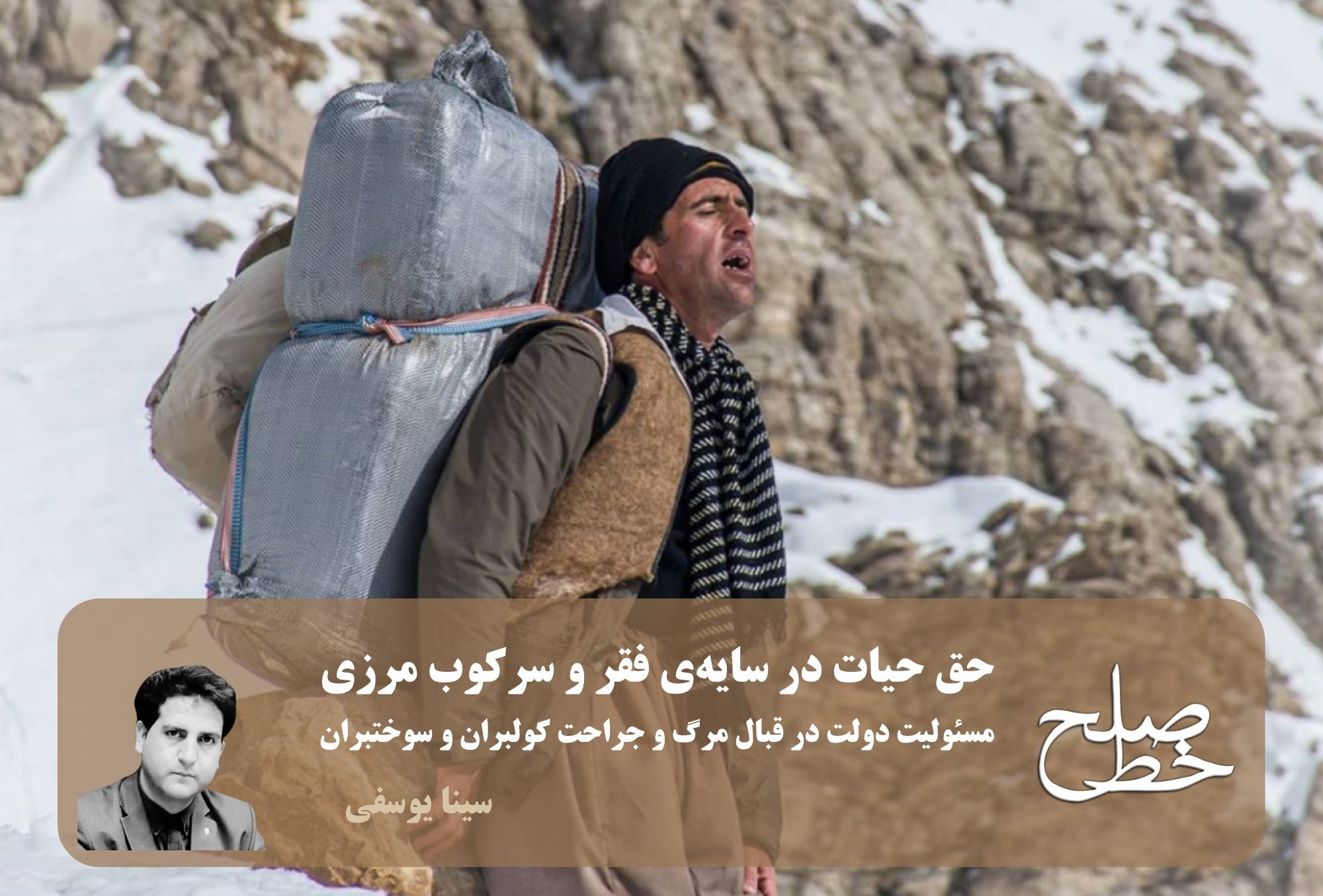
The Right to Life in the Shadow of Poverty and Border Repression/Sina Yousefi
Kolbari in Kurdish areas, fuel carriers in Balochistan and other forms of informal and risky employment in other border areas, including Azerbaijan, are part of the economic reality of regions that have faced structural poverty, a lack of sustainable job opportunities and deprivation of development opportunities for years. In these regions, a significant part of the people turn to activities to meet their basic needs that do not provide job security, do not provide sufficient social protection, and do not involve risks to life and property that are commensurate with the income they earn from their work. This situation cannot be examined in isolation from economic policies, the way resources are distributed and the development priorities of the government; especially in regions where, despite having natural resources and economic capacities, the share of local residents in the benefits derived from the exploitation of these resources remains limited. An example of this can be seen in parts of Azerbaijan, where gold mining and the transfer of exploitation of mineral resources to foreign and non-local companies and investors have sparked protests about the way the region’s wealth is managed, the local population’s share of the economic benefits, and the environmental consequences of these activities. While the extraction of mineral resources can contribute to regional development by creating jobs and improving infrastructure, residents of some of these areas speak of environmental pollution, concerns about the entry of toxic substances, including cyanide, into surface waters, damage to rural gardens and livestock, and the lack of proportionate enjoyment of the economic benefits of the mines. In such circumstances, local people sometimes turn to working in these mines to earn an income, and in unsafe environments, they face the risk of collapse and being buried under rubble. Sometimes, they are targeted by police at checkpoints while engaged in livelihood activities or traveling on routes related to the mines. Therefore, kolbari, fuel carrier and other risky livelihood activities must be examined in a broader context of regional inequality, weak employment policies and the management of public and natural resources. In such a context, the consequences of ineffective economic and development policies are not limited to reduced income or deprivation of public services. Sometimes the risks arising from livelihoods directly threaten human lives and confront families that are already facing economic difficulties with the loss of a breadwinner, medical expenses or irreparable harm. This very link between economic deprivation and the endangerment of citizens’ lives makes it a serious issue to examine the responsibility of the state for the deaths and injuries of people who turn to these activities to earn a living.
The right to life is one of the most fundamental human rights and no one can be arbitrarily deprived of it. This principle is also recognized in the Iranian legal system and the international obligations of the government. Article 22 of the Constitution protects the life of individuals from attack, except in cases prescribed by law. Also, Article 6 of the International Covenant on Civil and Political Rights, to which Iran has joined, recognizes the inherent right to life and prohibits its arbitrary deprivation. Accordingly, law enforcement and border officers do not have unlimited authority to use weapons, and any shooting resulting in death or injury must be evaluated in light of the circumstances of the incident, the necessity of using weapons, the proportionality of the officer’s action, and compliance with legal regulations. The Law on the Use of Weapons by Armed Forces Officers in Necessary Cases, passed in 1994, provides for the possibility of using weapons in certain cases, including some situations related to protecting borders and preventing unauthorized entry or exit, but this authority does not mean that shooting is permissible in all circumstances. Even in cases where the law allows the use of weapons, the officer is obliged to observe the prescribed limits and conditions, and the necessity of his action cannot be justified solely by citing the occurrence of a violation or the possibility of unauthorized passage. From the perspective of international law, the use of potentially deadly force in law enforcement should be limited to exceptional cases and circumstances that are necessary to protect human life. Therefore, the mere suspicion of committing a violation, crossing an unauthorized route, or engaging in illegal economic activity is not, in itself, a license to take life. In examining the cases of kolbars and fuel carriers, it must be determined whether the legal conditions for using weapons existed, whether the necessary warnings and measures were observed, and whether the intensity of the force used was proportionate to the existing danger. The possible illegality of an individual’s activity does not eliminate the officer’s responsibility for shooting outside the legal limits and cannot lead to a prior justification of death or injury. From here, the main question arises about the possibility of judicial follow-up of these incidents: If shooting leads to the death or injury of a kolbar or fuel carrier and there is a possibility of a violation of the law, does the injured person or the family of the deceased have the right to complain, and which authorities are obliged to handle this complaint?
The right to complain and seek legal action for the family of the deceased kolbar or fuel carrier, as well as the injured person, is one of the main foundations of the judicial follow-up of these incidents. In the Iranian legal system, the family of a person who has lost their life as a result of shooting by officers can file a criminal complaint, demanding an investigation into how the incident occurred, identifying the officer or officers involved, and determining their criminal liability. The injured person also has the right to complain about the actions of the officers and to present evidence related to the injury and how the incident occurred for consideration. In these cases, the forensic medical report, witness testimony, existing images and videos, and other evidence related to the circumstances of the shooting can play an important role in proving the claim and clarifying the truth. According to Article 172 of the Constitution, the investigation of crimes related to the specific military or police duties of members of the armed forces falls under the jurisdiction of military courts. Therefore, in cases where the conduct complained of is related to the officer’s military or law enforcement duties, the investigation will in principle be conducted through the military prosecutor’s office and the military court, although the determination of the competent authority will depend on the nature of the accusation and its connection to the officer’s specific duties. However, the possibility of filing a complaint alone is not sufficient to ensure effective redress. The investigation must be conducted in such a way that the officer’s claim that the shooting was necessary is not accepted without independent investigation and that the legal circumstances of the use of the weapon, the manner in which the incident occurred and the available evidence are carefully assessed. Finally, a distinction must be made between the legal right to complain and the possibility of achieving an effective judicial outcome, since the realization of the right to complain requires a genuine investigation of the claims and an examination of the possible liability of the officers.
In cases where shooting by officers results in death or injury, determining legal liability is not complete without clarifying the obligation to compensate for the damage. According to the Islamic Penal Code, in the event of a crime against the person or body parts and the legal conditions are met, blood money can be demanded, and determining who is responsible for paying it depends on the manner in which the incident occurred, the type of crime, and the outcome of the judicial proceedings. For example, Article 473 of this law provides for the payment of blood money from the treasury in certain circumstances. However, this provision cannot be generalized to all cases of shooting by officers, and the relevant legal conditions must be examined separately in each case. On the other hand, Article 11 of the Civil Liability Law provides a basis for examining the personal liability of a government employee or the liability of the relevant department for damages resulting from the performance of employees or the failure of administrative equipment and facilities. Accordingly, the mere fact that the officer is a government official is not sufficient to prove the financial liability of the government, and it must be determined under what circumstances the damage occurred and which person or institution is legally responsible for it. In addition to blood money, death or injury may also have other financial consequences. Medical expenses, disability, and reduced earning capacity of the injured person, and financial losses resulting from the death of the family breadwinner are among the cases whose possibility of claiming should be examined with regard to the legal basis and the conditions for proving each damage. Therefore, in handling these cases, a distinction should be made between determining the criminal liability of the officer, the obligation to pay blood money, and the possibility of claiming other compensable damages so that the rights of the injured parties are not limited solely to determining the criminal liability of the incident.
Reports from human rights organizations indicate that injured kolbars and families of killed kolbars have filed complaints with the judicial authorities about shootings by border forces, but the process of investigating and obtaining compensation has not always been effective. Some of these cases have faced long delays, unanswered complaints, or problems with the execution of sentences. For example, in a 2024 report, Human Rights Watch addressed the case of a kolbar who lost an eye in 2017 due to shooting. According to the information in this report, a military court in 2020 ordered the border guards to pay blood money, but the injured person stated that he had not yet received any compensation as of the time of publication of the report. In contrast, other reports indicate that blood money was ordered to be paid and received in some cases. Therefore, it cannot be said that the complaints have never been resolved, but a distinction must be made between registering a complaint, issuing a sentence, and its actual execution. The lack of official and comprehensive statistics on the number of cases filed, the results of proceedings, and the amount of damages paid also makes it difficult to accurately assess the performance of the judicial system. All this evidence suggests that examining the status of kolbar and fuel carrier litigation should include, in addition to the legal possibility of filing a complaint, the degree of independence and effectiveness of investigations, the duration of proceedings, and the implementation of judicial decisions.
The recent position of the UN experts on the killings of kolbars and fuel carriers has once again highlighted the need to investigate these incidents within the framework of the Iranian government’s human rights obligations. In a statement dated September 23, 2026, the UN experts called for an end to these killings and for prompt, independent and impartial investigations into every death caused by security forces, and emphasized the right of families to know the truth, accountability and reparation. The importance of this position is that it links the investigation of such incidents to a clear human rights demand and reminds the state of its responsibility for the lives of citizens and their access to justice. Fulfilling this responsibility requires that every death or injury resulting from shooting be effectively investigated, that the offending officers and responsible authorities are held accountable if violations are found, and that compensation orders are implemented. In addition to these measures, effective oversight of border forces, transparency about the number of deaths and injuries, and ensuring families have access to information and due process are essential to prevent the recurrence of violations. Also, as long as structural poverty and a lack of secure employment opportunities drive people in border areas to engage in risky activities, protecting their lives requires policies that go beyond law enforcement. The state must both be accountable for the illegal use of weapons and take action to ensure that residents of these areas can enjoy secure and sustainable livelihoods. Only by linking judicial accountability, reparations, effective oversight, and addressing structural grounds for deprivation can this cycle be prevented from continuing and the right to life and human dignity of border residents be made a practical guarantee.
 By: Sina Yousefi
 October 23, 2026
Tags
"Smuggling and fuel smuggling" Border Fuel smuggling Fuel tester Kulbar Kulbars Paragraph peace line Peace Line 186 Right to life Sina Yousefi Smuggling goods Suppression Uncontrolled shooting ماهنامه خط صلح