


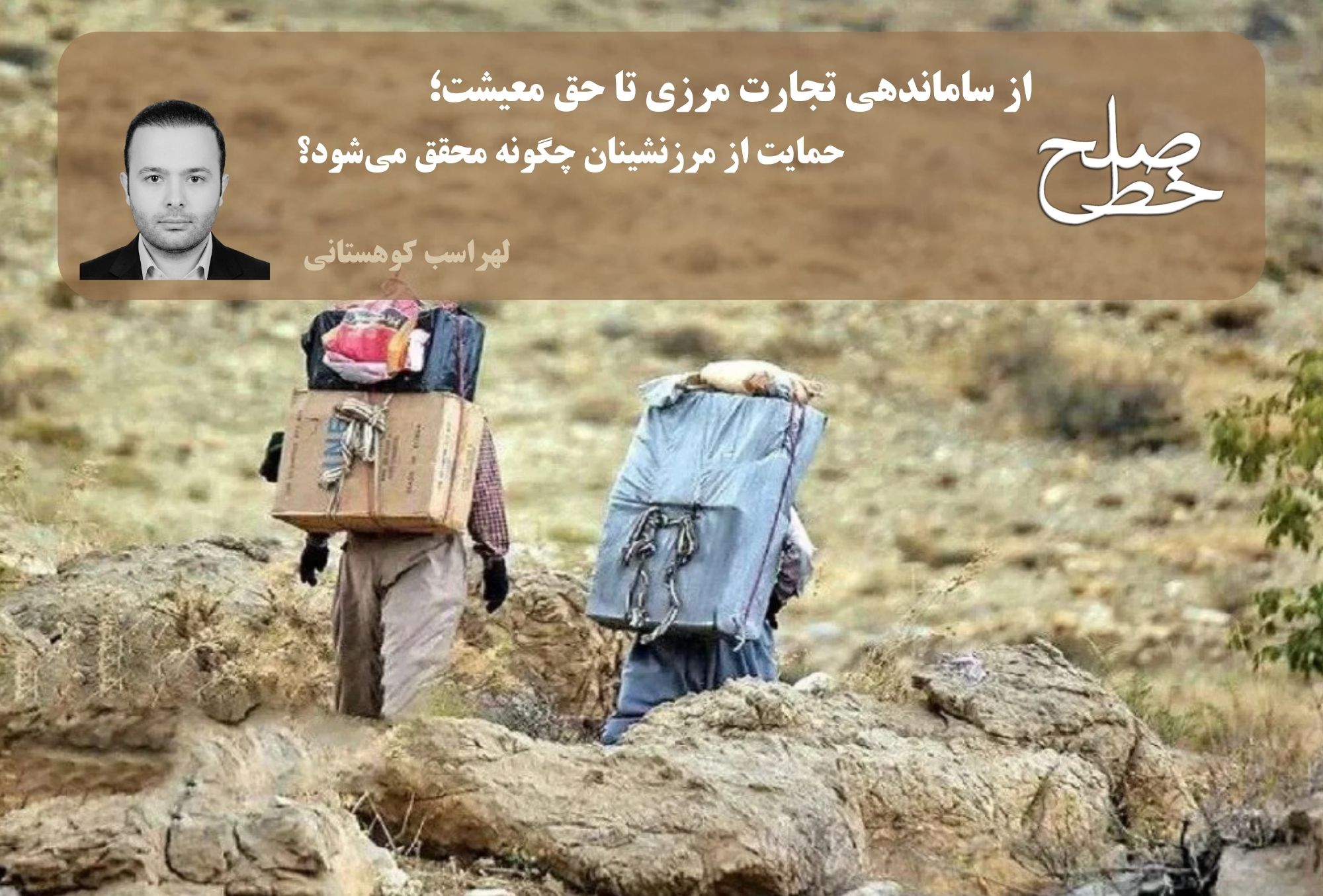
From regulating cross-border trade to the right to livelihood; how is support for border residents achieved? / Lohrasb Kohistani
Let’s say a resident of Marivan applies for a border trade quota. He has submitted his residency documents, but the answer is simply: Your conditions were not met. He does not know which document was incomplete, whether the quota capacity was filled or other people had priority. More importantly, he does not know where to go to appeal. This hypothetical example raises a real question: to what extent can support for people whose conditions for receiving and pursuing it are unclear be a support for their lives?
For a family whose income depends on cross-border trade, the decision on quotas is not simply an administrative act; it can affect rent payments, medicine purchases, and children’s education costs. From this perspective, regulating cross-border trade is linked to the right to a livelihood, social security, and human dignity. This link is also supported by the constitutional principles of human dignity, poverty alleviation, the provision of basic needs, and social protection.(1)
The Law on the Organization and Supervision of Border Trade (Kolbari and Sailors) and the Creation of Sustainable Employment for Border Residents, approved on 15 February 1402, in addition to regulating imports, obliges the government to plan and take action for sustainable employment, sufficient income, and appropriate social security. (2) The main question of this article, focusing on Kolbari, is how these duties are transformed into clear and actionable support in daily life.
The Constitution considers it the duty of the state to provide employment and social security and emphasizes the non-discriminatory distribution of resources among regions. These principles are the legal basis for demands from the state, although they do not create a trade quota or a specific amount for each individual. The Border Trade Law itself requires compliance with Article 48 of the Constitution and attention to the deprivation and underdevelopment of regions in determining the annual import ceiling for provinces. (3)
At the same time, the general interpretation of the legalization of kolbari can be misleading. The law has authorized certain import procedures for a period of five years and under certain conditions; therefore, not every activity under the title of kolbari is subject to its privileges. (4) However, not having a quota or being excluded from trade privileges does not in itself eliminate the right to legal action and public rights of an individual. Quotas are a means of supporting livelihoods and are not a substitute for secure employment opportunities and social protection.
The right to know and the possibility of objecting
The executive regulation has established residency requirements and priorities to identify eligible kolbars, and linked the number of beneficiaries to import ceilings and annual quotas; (5) as a result, an individual may meet the initial requirements but not receive a quota.
The applicant has the right to know what documents are required, which agency makes the decision, how priorities are applied, and what the status of their application will be if the capacity is full. A single, up-to-date guide, in understandable language and accessible both in person and offline, can prevent duplicate visits, unnecessary documentation, and payments to intermediaries.
The Law on the Publication and Free Access to Information also stipulates the publication of information that constitutes a public right and obligation, and considers the stages of service provision and citizen complaint mechanisms to be among the topics that can be included in the institution’s guide. (6) A guide to benefiting from border protections can provide this information to the public in one place.
The existence of a legal route without adequate enforcement facilities also leaves the support incomplete. For ports lacking infrastructure, the regulations foresee the use of the nearest equipped customs office, with the approval of the working group. (7) The implementation of this solution requires clear information about the procedures, transfer of goods and costs so that referral to another customs office does not expose the applicant to additional costs and uncertainty.
Let’s return to the Marivani applicant example. Rejecting an application due to incomplete documentation is not the same as rejecting it due to capacity constraints. In the first case, the issue may be resolved by completing the documentation; in the second case, the main issue is how to allocate quotas and prioritize. A vague answer deprives both groups of the possibility of effective objection.
The Administrative Court of Justice Act obliges the relevant agencies to notify final decisions. Also, in a request to perform or refrain from performing an administrative matter, it is mandatory to register the request, provide a receipt, and notify a written response. The general deadline for response is a maximum of three months, unless the law has set another deadline or urgency requires a faster response. Administrative decisions and actions are also subject to appeal within the jurisdiction of the Court. (8)
For these guarantees to be effective, the agency’s response must clarify the applicant’s situation. Stating the reason and documentation for the rejection, providing an opportunity to complete the documents in remediable cases, and introducing the path and deadline for objections will make the process more responsive. These details, where not specified in the relevant regulations, can be added to the executive procedure within the limits of legal authority.
The Border Trade Regulations also have a specific route for some objections; however, this route cannot be generalized to all cases of rejection of applications or quota disputes. (9) The public referral guide is useful when it identifies the objection authority appropriate to the type of decision.
Support becomes tangible when the colporteur’s share of the economic benefit is clear. The regulations assign the task force to determine the transfer rate and assign the quota to the broker in order to protect the colporteur’s interests and prevent the spread of intermediation and monopoly. (5) A clear record of the agreement between the colporteur and the broker can make it easier to follow up on this support: the amount received, the settlement time, deductible costs, and the responsibilities of each party are clear, and a copy of the agreement is provided to the colporteur. Awareness of the terms of the contract is as important as signing it. A contractual dispute with the broker also has its own appropriate course of action, and its mere connection to a commercial quota does not establish the jurisdiction of the Administrative Court.
From trade quotas to sustainable employment
The law requires the government to develop and implement a program that will provide eligible border residents with stable jobs, sufficient income, and adequate social security by the end of the fifth year of the law’s implementation. The regulations also set a six-month deadline from the date of their promulgation for the preparation and submission of the employment plan.(2)(7)
Article 1 of the law counts the five-year period of importation from the date of notification of the regulations, but the employment decree speaks of the end of the fifth year of the law’s implementation. The fact that the two periods have the same origin does not arise simply from their being five years. In any case, the horizon of achieving employment is not a license to postpone the preparation and implementation of the plan.
Assessing this task requires specific answers: What opportunities have been created? How many of them have lasted? To what extent does the income generated cover the cost of living? Who is insured and what groups remain excluded from protection?
Between the limitation of previous livelihoods and access to alternative jobs, families may also be left homeless. Temporary support, training linked to real job opportunities, access to production tools, and accident coverage can be part of the program for this period. Implementing these measures requires resources and legal permits; but the need to pay attention to the situation of families is emerging today.
The law allocates 60 percent of customs and tax revenues from its implementation to livelihoods and employment. This share is not a fixed and guaranteed amount and depends on actual income. For this reason, the task of securing funding in annual budgets and transparency in its spending is important.(2)
The law mandates quarterly provincial reporting, although the same provision does not specify public release of the reports. (10) The publication of aggregate statistics on beneficiaries, sustainable employment opportunities, insurance coverage, and resources spent, while respecting privacy, allows for public assessment. Increased trade volume alone does not indicate that households have increased incomes or that their jobs have become more stable.
The implementation of these supports begins with clarity of conditions and documents and ends with accountability for the outcome. Understandable and up-to-date guidance clarifies the application and quota process for the applicant; a reasoned response and introduction of the appeal authority enable the decision to be followed up. In relation to the broker, recording the amount, payment due date, costs and dispute resolution method allows the colporteur to claim his share. Performance reports provide a more complete picture when they show, in addition to the volume of business, the sustainability of employment, income adequacy, social coverage and the actual share of households in the benefits.
On what basis was the Marivani applicant denied the quota? Can he understand the reason for the decision and pursue his appeal? What support does he have to support himself and his family until he finds a secure job with a sufficient income?
Legal notes:
1. Article 2, paragraph 6, on human dignity; Article 3, paragraph 12, and Article 43, paragraph 1, on poverty alleviation and provision of basic needs; Articles 29 and 34 on social security and legal remedies. The use of the right to a livelihood in this article is to express the sum of these protections, not to quote the title of an independent right with the same wording from the Constitution.
2. Article 3 and Note 3 thereof, the Law on Organizing and Monitoring Border Trade (Colbari and Sailors) and Creating Sustainable Employment for Border Residents, approved on February 15, 1402. The note states the employment horizon as the end of the fifth year of the law’s implementation.
3. Principles 28, 29, and 48 of the Constitution; Paragraph 2, Article 4 of the Law on the Organization and Supervision of Border Trade, regarding determining the annual import ceiling of the provinces, in compliance with Principle 48 and taking into account the deprivation and underdevelopment of the regions.
4. Article 1 of the Law on the Organization and Supervision of Border Trade; the starting point of the five-year period stipulated in this article is the notification of the regulations subject to Article 6.
5. Paragraphs 3 and 4 of Article 1 and their notes, the executive regulations on the subject of Note 1 of Article 1 and Note 1 of Article 2 of the Law on the Organization and Supervision of Border Trade, approved by the Council of Ministers on January 16, 1403.
6. Article 5 and its note and Article 11 of the Law on the Publication and Free Access to Information, regarding the publication of information and decisions involving public rights or obligations; paragraphs B and C of Article 10 of the same law, regarding service stages and complaint mechanisms within the framework of the institution’s public information guide.
7. Notes 1 and 3 of Article 7 of the Executive Regulations approved on January 16, 1403, regarding customs infrastructure and the deadline for preparing and submitting an employment plan, respectively.
8. Articles 10 and 11 of the Administrative Court of Justice Law on handling complaints and restoring violated rights; Note 4 of Article 16, Supplementary Law 1402, on notifying the decision, registering the request, providing a receipt, and providing a written response. The three-month deadline mentioned is the deadline for the institution to respond; the deadline for complaining about decisions and actions subject to Note 3 of the same article has a separate provision.
9. The note to Article 11 of the Executive Regulations sets the deadline for objecting to its subject matter as one month from the date of notification and links the subject matter of the objection to the fact that the cases mentioned in the clauses of Article 9 occurred or were intentional. The reference of the note to Article 9 prevents this ruling from being considered as a general route for objecting to all quota decisions.
10. Article 5 of the Law on the Organization and Supervision of Border Trade; as well as Article 10 of the Law on the Publication and Free Access to Information regarding the publication of public information on the performance of institutions.
 By: Lohrasb Kouhestani
 October 23, 2026
Tags
"Smuggling and fuel smuggling" Fuel tester Kulbar Kulbars Kurdistan Mountain Lahrasb peace line Peace Line 186 Sailors Sistan and Baluchestan Sukhtabar Uncontrolled shooting ماهنامه خط صلح