


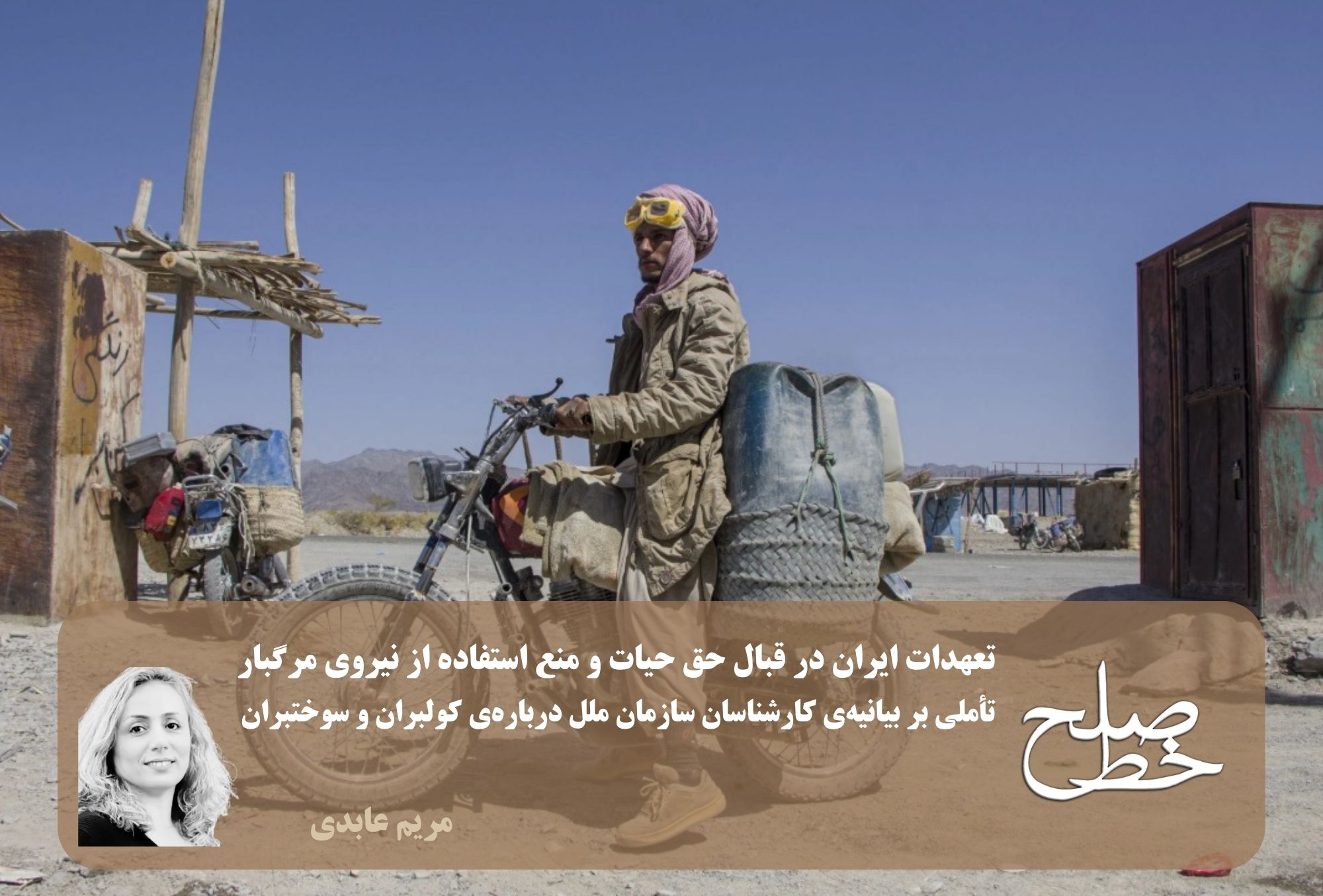
Iran’s Commitments to the Right to Life and the Prohibition of the Use of Deadly Force/ Maryam Abedi
Kolbari and fuel bartering cannot be analyzed within the classical framework of informal trade practices; this phenomenon is, first and foremost, a survival strategy in the context of structural poverty, chronic unemployment, and regional discrimination. It was in this context that the “Law on the Organization and Supervision of Border Trade (Kolbari and Melvani) and the Creation of Sustainable Employment for Border Residents,” passed on 15 Bahman 1402 and approved by the Guardian Council on 16 Esfand of the same year, was enacted with two main objectives: first, to provide a legal framework for certain border trade activities for a period of five years, and second, to commit the government to strengthening the livelihoods and sustainable employment of border residents through targeted allocation of revenues generated by law enforcement.
However, while the implementing regulations of this law, approved on 16 January 1403 and promulgated on 7 February of the same year, have not yet been fully, transparently and fairly implemented, the gap between the law on paper and reality in the border strip continues to be filled with the lives of border residents. At the same time, the joint statement of 23 September 2026 by four independent UN experts, Mai Sato, Special Rapporteur on the situation of human rights in Iran, Maurice Tidball Bains, Special Rapporteur on extrajudicial executions, Elena Carolina Diaz Galán, Special Rapporteur on extreme poverty and Nicholas Lovera, Special Rapporteur on minorities, published by the Office of the High Commissioner for Human Rights, took this gap to a new level. The importance of this statement lies not in its statistics, but in its change in the legal conceptual paradigm: shifting the formulation of the problem from combating trafficking to violating the right to life.
An autopsy of the September 23 statement: from statistics to legal rule
This statement examines the possible pattern of arbitrary deprivation of life and presents its reports and legal concerns in three areas:
A) Establishing a pattern of shooting without observing the principles of necessity and precaution: According to documented reports, at least twelve kolbars have been killed by direct fire by the Border Guards and the Revolutionary Guards since the beginning of 2026. In just two months leading up to the statement, seven kolbars have been killed by direct fire, at close range, and without any prior warning, while some of them were not carrying any goods at the time of the shooting. This description is consistent with the violation of the fundamental principles of the use of force, which prohibits shooting without warning and threat assessment.
b) Documenting objective cases with the potential for prosecution: To avoid generalizations, two cases are cited as examples of this pattern: “Madeh Kermani,” a 44-year-old colporteur from Marivan, left her home on July 28 and did not return. Reports indicate that she was targeted while not carrying any cargo. The official account gives the cause of death as a fall from the border heights, but according to experts, forensic documents they have seen confirm a gunshot wound to the head. “Milad Tabad,” 28, died on August 18, 2026; nearly a year after she fell into a coma after being shot in the head during a shootout by border guards and spent months in intensive care.
C) Spread of the pattern to Baloch fuel tankers: Experts emphasize that this pattern is not limited to Kurdistan, and at least thirteen Baloch fuel tankers were killed between January and August 2026 during shootings, chases, and other actions by military and security forces. This symmetry highlights the element of structural discrimination against marginalized regions.
The right to life as a prerequisite for legitimacy
In the body of international human rights law, the right to life is not a privilege granted by the state, but a precondition for the legitimacy of its exercise. The Human Rights Committee, in its general interpretative comment No. 36, describes it as a supreme right that cannot be suspended even in a state of public emergency under article 4 of the Covenant. This precondition means that until the State fulfills its negative obligation not to arbitrarily deprive people of their lives and its positive obligation to protect the lives of its citizens, recourse to other titles, including the regulation of border trade, is essentially excluded.
The normative core of the statement is the raising of serious concerns about a violation of article 6 of the International Covenant on Civil and Political Rights, a covenant to which Iran has been a party since 1975. The reported pattern of direct shooting at close range and without warning raises serious concerns about a violation of the principles of necessity, proportionality and precaution, the subject of General Comment No. 36 and the 1990 Basic Principles, because the transportation of goods or the suspicion of a customs violation does not in itself constitute an imminent threat to the lives of others that would justify the use of deadly force. One of the central sections of the statement emphasizes that Kurdish kolbars and Baluchi fuel carriers are among the most economically disadvantaged groups in Iran and have resorted to transporting goods due to limited alternative livelihood opportunities. Experts emphasize that these individuals should not pay the price of their poverty with their lives and that the mere suspicion of a violation of customs regulations cannot justify the use of firearms in the absence of a threat to the lives of individuals.
A commitment to effective research; where statistical silence itself becomes a violation
In the logic of the statement, any suspected or potentially unlawful death – especially one caused by the actions of government agents – raises Iran’s obligation to conduct a prompt, independent, impartial and effective investigation. This obligation is based on article 2 of the Covenant, which obliges the State to provide effective redress, and is explained in General Comment No. 36 that an investigation must meet the five characteristics of promptness, institutional independence, impartiality, completeness and transparency. The Minnesota Protocol also stipulates that an institution that itself carried out the shooting cannot be an impartial investigating authority.
The statement raises serious concerns about the observance of this obligation. In the case of Madah Kermani, the reported contradiction between the official narrative and the forensic documentation highlights the need for an independent, impartial and effective investigation. The second aspect of the violation is the statistical concealment. Since the Government has not yet published any official, disaggregated and verifiable statistics, reporters are forced to use the phrase “based on reports” with caution. While, according to interpretative comment No. 36, the Government is obliged to establish a mechanism for recording and publicly disseminating data on the use of deadly force. This silence provides the basis for systematic impunity. Therefore, the statement emphasizes: Families are entitled to the truth, accountability and reparation. This statement is a statement of the right to the truth and, as long as there is no independent investigation, the double violation of articles 2 and 6 of the Covenant continues.
Intersectional Discrimination: Why Poverty and Minority Reporters Signed the Statement
The presence of the Special Rapporteur on Extreme Poverty and the Special Rapporteur on Minorities alongside the Right to Life Rapporteurs is not a ceremonial choice, but a purposeful legal marking to change the title of the accusation. What is happening in the border strip of Kurdistan and Baluchistan is not sporadic killings, but a geographical pattern in which three layers of oppression are superimposed: imposed poverty, ethnic identity, and the militarization of the border. The victim is targeted precisely because he is a poor Kurd or Baluch living in the militarized strip.
For this reason, this violence goes beyond the scope of Article 6 and can also involve Articles 26 and 27; Article 26 guarantees equality before the law, and Article 27 protects the cultural, religious and linguistic rights of minorities. When in the center of the country, a supposed customs violation is punished with a fine and confiscation of goods, but in Baneh and Saravan the punishment is a bullet, we are faced with a hierarchy of the right to life whose value is measured by the victim’s zip code.
Legal trade, still illegal death; the paradox of Law 1402
Under Article 6, the state is not only obligated not to kill, but also obligated to create conditions in which individuals are not forced to be in the line of fire. The Border Trade Organization Law of 1402 could have been a manifestation of this positive commitment in itself; a law whose philosophy is to remove the livelihood of border residents from the criminal category of smuggling and place it under the legal category of formal retail trade. Article 3 of this law allocates sixty percent of the customs and tax revenues generated by its implementation to strengthen the livelihood and employment of border residents in the affected areas.
But the law has been abandoned in the middle of the road. The first problem lies in the law’s oversight mechanisms: although Article 3 mandates the allocation of funds and Articles 4 and 5 provide mechanisms for monitoring and reporting, the law does not establish an independent authority to verify performance or explicitly require public disclosure of the results of the implementation of these tasks. The second and more fundamental problem is the disconnect between this law and the system for the use of weapons. The Law on the Use of Weapons in Necessary Cases, approved in 1373, in Article 3 itself, stipulates necessity, proportionality, and prior warning, and the Fundamental Principles of 1990 allow shooting with the intent to kill only in the event of an imminent threat of death. In practice, none of these are taught in border areas, and there is no independent mechanism for reviewing shooting reports. To close this gap, three simultaneous actions are necessary: first, supplementing the enforcement mechanisms of Article 3 of the law by providing for a dedicated, auditable account; Second, amending the shooting guidelines to emphasize the prohibition of the use of deadly force solely because of the transportation of commercial goods or suspicion of a customs violation, in the absence of an imminent threat to life; and third, implementing mandatory training for officers on the 1990 Fundamental Principles, along with establishing an independent oversight and investigation mechanism consistent with the standards of the Minnesota Protocol and using cameras to record operations. Without implementing these measures, the law legalizes the trade on paper, but in the field, it continues to put lives at risk from the unlawful use of deadly force.
Conclusion: From Smuggling to Responsibility for Life
The September 23 statement is a legal milestone because it examined the issue of kolbari and fuel bari beyond the criminal title of smuggling, within the framework of the fundamental right to life, and in a way redefined the issue. What has occurred is a double violation: a substantive violation of Article 6 due to the shooting without establishing necessity and proportionality, a formal violation of Article 2 due to the lack of an independent investigation and statistical concealment, and a violation arising from the intersectional discrimination that is the subject of Articles 26 and 27.
To adapt and transform Law 1402 from an imperfect passage on paper into a real shield, four immediate actions are necessary: first, an immediate revision of the rules of engagement with an absolute ban on shooting at suspects carrying goods and a requirement to observe the hierarchy of warning, necessity, and proportionality consistent with Law 1373 and the 1990 Fundamental Principles; second, ensuring an independent investigation outside the forces involved in accordance with the Minnesota Protocol with public disclosure of the findings; third, recognizing the families’ right to truth, accountability, and full reparation; fourth, a rights-based implementation of Law 1402 with transparency in the list of items and the actual allocation of revenues to sustainable employment with auditable accounts.
The right to life of border residents, whether they are kolbars or fuel carriers, is a conditional, regional right that cannot be negotiated with any security justification.
 By: Maryam Abedi
 October 23, 2026
Tags
Fuel smuggling Fuel tester Kulbar Kulbars Kurdistan Maryam Abedi peace line Peace Line 186 Right to life Sistan and Baluchestan Smuggling goods Sukhtabar ماهنامه خط صلح