


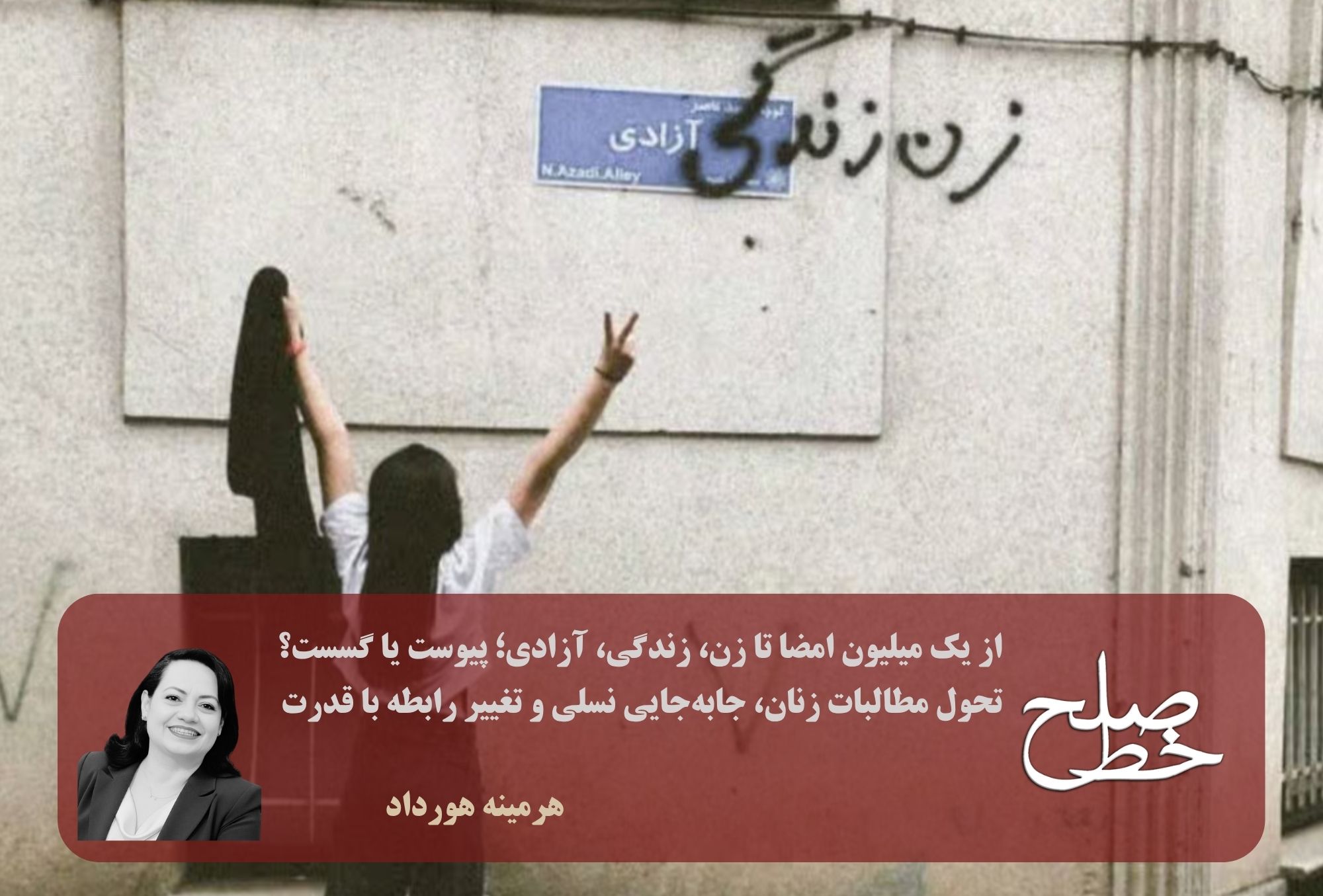
From One Million Signatures to Woman, Life, Freedom: Continuity or Rupture?/ Hermineh Hourdad
When we speak today of the “Woman, Life, Freedom” movement, there is a strong temptation to begin everything in September 2022 (Shahrivar 1401), as though the death of Mahsa (Jina) Amini suddenly gave birth to the questions of women, freedom, and the body in Iranian society. But the memory of the women’s movement tells a different story. Behind that slogan, behind those streets, and behind the women who removed their headscarves lie several decades of experience, defeat, retreat, rebuilding, silence, resistance, and rising again.
The book The Loving Passage of a Lifetime, written by Khadijeh Moghadam, is, from this perspective, not merely the personal memoir of a social activist; it is the story of a generation that witnessed the Revolution, experienced its appropriation and transformation, endured the dark and repressive 1980s, and, under circumstances in which many independent organizations and voices had disappeared, tried to find itself again. The women who returned to social and civic activism in the following decades did not start from zero; yet the society to which they returned was not the same society that had existed before the Revolution either. They had to find a new language for activism within the constraints imposed upon them.
For a large number of women activists, the 1980s were not merely a historical period; they were an experience that also affected the political language and behavior of later generations. Many women activists were forced to distance themselves from formal politics and turn toward social activities, the environment, education, neighborhoods, family, peace, and women’s empowerment, rebuilding networks within those same limited spaces. This gradual return to civil society later laid the groundwork for movements that could no longer be explained merely as individual activities.
In the 1990s and particularly during the Reform Era, the public sphere became somewhat more open for a period. The press, associations, women’s groups, and non-governmental organizations gained greater opportunities to raise the issue of discrimination. It was within this environment that Islamic feminism also became one of the important discourses. Religious women and religious intellectuals sought to demonstrate that interpretations of Islam compatible with women’s rights could be offered. Alongside them were secular feminists, human rights activists, and women with various orientations. This intellectual diversity cannot be explained with a single label, but it is essential to understanding the atmosphere of that period.
The One Million Signatures Campaign emerged in 2006 (1385) from this very experience and this very coalition. Its objective was to reform a range of discriminatory laws against women, from marriage, divorce, and custody to inheritance, diya, and testimony. Its method was also clear: legal education, face-to-face dialogue, awareness-raising, and collecting signatures. From today’s perspective, this approach may appear excessively cautious or reformist. But judging the campaign by the standards of 2022 (1401) means disregarding its historical circumstances. Those women were working in an environment in which even speaking with people and collecting signatures could lead to arrest and a security case. Nevertheless, they were still attempting to use the existing civic space and pursue change through society and the law.
But this is precisely where an important question arises: Why, despite being one of the most visible manifestations of control over women, was compulsory hijab not placed at the center of the campaign’s demands?
The answer should not be sought in a lack of concern among women of that period about the issue of hijab. Iranian women had resisted compulsory hijab from the very first days of the Islamic Republic. In March 1979 (Esfand 1357), thousands of women took to the streets against the imposition of compulsory hijab, and in subsequent decades resistance to hijab continued in individual and everyday forms. The issue was that abolishing compulsory hijab had not yet been formulated as an organized and shared demand among all currents within the women’s movement.
The One Million Signatures Campaign wanted to focus on laws that could be specifically identified, whose legal provisions could be pointed to, and whose amendment could be demanded. Hijab, however, was not merely a law. Compulsory hijab was part of the Islamic Republic’s social and ideological order—an issue connected to the government’s definition of women, family, public morality, and women’s presence in public space. Raising it directly, in addition to carrying a far greater cost, could have challenged the coalition that had formed among religious, secular, reformist, and independent women. Therefore, perhaps the more precise question is not, “Why did the campaign not demand the abolition of compulsory hijab?” but rather, “Why was the women’s movement at that point forced to prioritize among different demands in order to continue its activities?”
This prioritization can be criticized, but it must also be understood. It cannot be stated with certainty that all campaign activists thought about hijab in the same way or that its absence from the list of demands was solely a tactical decision. The historical evidence is insufficient to support such a definitive conclusion. What is clear, however, is that the political environment, the diverse composition of the forces involved, and the specific objective of reforming laws affected the kinds of demands that could become the focus of a coalition.
The One Million Signatures Campaign did not achieve its official objective. Discriminatory laws were not fundamentally reformed, and security pressure also contributed to the erosion of organized activism. But failure to achieve the official objective did not mean the end of the experience. Perhaps one of the campaign’s most important effects was something less visible at the time: large numbers of women gained experience in activism, networks were formed, and a generation of women learned how to turn a social demand into a public issue. Khadijeh Moghadam also speaks of this legacy in her account and regards the campaign as a factor in expanding the network of women activists.
After the campaign, other movements and campaigns emerged. Some addressed family laws, some the rights of prisoners and victims of repression, some peace and mothers seeking justice, and some women’s everyday lives. On the surface, the subjects differed, but beneath them lay a shared issue: Iranian women wanted to move from the position of being the object of politics to that of being political subjects.
During these same years, another line of struggle that had previously remained on the margins gradually moved toward the center: the “struggle against compulsory hijab.” This time, something important happened. The struggle no longer necessarily began with a formal organization or coalition. Social media had created a new possibility. “My Stealthy Freedom,” by publishing photographs of women without hijab in public spaces, transformed an issue that had existed in everyday life for years into a public narrative. “White Wednesdays” followed, with women using various symbols and images to speak about the right to choose their clothing.
This change was not merely technological; it was a change in the method of organization. In the One Million Signatures Campaign, activist and audience encountered one another face-to-face. In the new campaigns, a woman in Tehran, Shiraz, or Mashhad could publish her photograph, and another woman thousands of kilometers away could see herself as part of the same experience. Fear still existed, but it was no longer entirely private. An image of one woman could rapidly move from a personal experience to a public symbol.
The issue of women entering stadiums was another important example of this transformation. Efforts to gain women access to stadiums continued for years, and women activists discussed and organized around the prohibition on women’s presence in stadiums. Later, the story of Sahar Khodayari, known as the “Blue Girl,” became a painful turning point along this path in 2019 (1398). Following her arrest and amid reports that she might be sentenced, she set herself on fire and died. Her death prompted a wave of reactions in Iran and on social media and once again turned the ban on women entering stadiums into a public issue.
The significance of this issue was not limited to football. A woman who is denied the right to enter a stadium, a woman who cannot freely choose her clothing, and a woman who faces restrictions on singing, cycling, participating in the public sphere, or choosing her own lifestyle confront different issues, but all of them can arrive at a common question: Where are the limits of government intervention in women’s lives?
It was at this point that compulsory hijab gradually transformed from an issue concerning clothing into one of the tangible symbols of the relationship between the government and women’s bodies and lives.
In the meantime, the factor of generational transition should not be overlooked. Women who joined the One Million Signatures Campaign in the 2000s had lived experiences different from those of the women who took to the streets in 2022 (1401). Some activists of the first generation had witnessed the 1979 Revolution (1357) and then the dark 1980s firsthand; some had experienced imprisonment, political exclusion, war, the ideological transformation of the public sphere, and forced withdrawal from social life. For them, even establishing a small association, holding a meeting, or collecting a few hundred signatures could represent a significant achievement. Their experience of civil society’s absence had taught them the value of rebuilding it.
The generation born in the 1990s and particularly the 2000s, however, had a different experience. This generation knew the Islamic Republic not through the experience of the Revolution and comparison with the past, but as the existing system and the everyday reality of their lives. The internet, satellite television, social media, connections with the outside world, and changing lifestyles had made the gap between this generation’s actual life and official values wider and more visible. For many of these women, the question was no longer how to create a small space for activity within the existing environment; they were fundamentally asking why such restrictions should exist at all.
This generational difference also changed political language. For a generation that remembered the repression of the 1980s, caution, coalition-building, and selecting demands that could be pursued were part of political rationality. For a generation that had experienced a large part of its life through the internet and a networked world, posting a photograph, a video, or an individual act could become a political event within hours. This generation was less dependent on traditional organizational structures and operated more through horizontal networks, fluid identities, and reproducible individual acts.
But generational transition did not mean the disappearance of the previous generation. Indeed, one of the important characteristics of Iran’s women’s movement is that generations did not completely replace one another; experiences were transmitted, while languages changed. The women who rebuilt civil society after the 1980s created a foundation that later generations could move beyond. Activists in the One Million Signatures Campaign accumulated experience in organizing, dialogue, and legal advocacy; the next generation combined that experience with the possibilities offered by social media and new methods of resistance.
The new generation was not necessarily braver than the previous one. The difference was that it approached the question of freedom through a different historical experience. A generation that had experienced the absence of civil society first sought to build it; a generation that grew up with the internet, a more open world, and a profound gap between actual life and the official order no longer wanted merely to find a small space in which to breathe within that same order—it wanted to question the boundaries of the order itself.
For this reason, “Woman, Life, Freedom” can to some extent also be understood as a generational movement, but not one that cast previous generations aside. In the streets of 2022 (1401) were young women who, when the One Million Signatures Campaign was formed, either had not yet been born or were children. They did not enter the field with direct memories of the campaign, but they had grown up in a society shaped by all those struggles, defeats, and acts of resistance. They may not have known the names of many activists from the previous generation, but some of the changes those generations had introduced into the language of society had become self-evident to them.
The next generation usually does not receive the previous generation’s legacy in exactly the form in which it was produced. It does not simply consume it; it redefines it. For this reason, a young woman removing her headscarf in 2022 (1401) did not necessarily regard herself as continuing the One Million Signatures Campaign. She might not even have known the campaign’s name. But without the experience that the campaign and the movements before and after it had created within society, the social environment for such an act would not have been the same as before.
During this period, Sepideh Rashno also became one of the important figures of this transformation. In the summer of 2022 (1401), before Mahsa’s death, a video was published showing her confrontation on a bus over compulsory hijab. She was arrested and subsequently appeared on state television. Images of her face rapidly circulated on social media and generated widespread reactions. This incident demonstrated how an everyday confrontation could become a public and political issue in the age of social media. Although Mahsa’s death was a decisive spark, what followed was not the product of a single incident. A society that had lived through decades of women’s resistance, campaigns, defeats, protests, social media, repression, and civil disobedience took to the streets this time with a new language. In fact, the “Woman, Life, Freedom” movement was not the product of a single campaign. It was the product of several decades.
For this reason, perhaps the correct narrative is not that “the One Million Signatures Campaign failed and then Woman, Life, Freedom arrived.” Such a narrative makes history excessively linear. The reality is that One Million Signatures became part of an experience that later continued in different forms: some in the legal sphere, some in civil society, some online, some in stadiums, some through individual resistance, and some in the streets.
But a fundamental change had also taken place. In the One Million Signatures Campaign, a significant part of the political language of the women’s movement was still the language of reform: reforming the law, reforming society’s attitudes, reforming family rights. In “Woman, Life, Freedom,” the word “reform” was no longer sufficient for many protesters to explain what they wanted. They spoke of “life.”
This difference is extremely important. “Women’s rights” can be the subject of negotiation with lawmakers. But the “right to life” and the “right to choose” make a more fundamental claim about the relationship between the individual and power. Perhaps it can be said that what changed was not merely women’s demands; women’s understanding of the possibility of change had changed as well.
Nevertheless, this difference should not lead to the conclusion that one was more mature or more advanced than the other. Every movement takes shape in response to the conditions of its own time. The One Million Signatures Campaign operated in a political environment in which part of civil society still had limited but genuine possibilities for activity and in which legal reform was considered a practical possibility by some activists. “Woman, Life, Freedom” emerged under conditions in which repeated experiences of protest and repression had changed society’s understanding of the possibility of reform.
This is precisely where a realistic and pragmatic perspective becomes important. The One Million Signatures Campaign should not today be condemned from the standpoint of “Woman, Life, Freedom” for failing to demand everything from the outset. But its strategic limitations should not be romanticized either. The campaign did not succeed in achieving its official objective, and the political structure did not allow its energy to be translated into fundamental legal reforms. By contrast, “Woman, Life, Freedom” succeeded in placing the issues of women, the body, and hijab at the center of a nationwide protest, but transforming widespread protest energy into organization, institutions, and lasting change is an entirely different matter.
A social movement does not survive through courage alone, nor does it create change through slogans alone. It requires networks, organization, knowledge, coalitions, continuity, resources, communication between generations, and the capacity to transform demands into social and institutional power. The experience of recent decades has shown that Iranian women have been highly capable of generating protest and social energy; the more difficult issue is preserving that energy and transforming it into lasting change.
Perhaps this is the greatest lesson from the distance between One Million Signatures and Woman, Life, Freedom. The generation that followed the dark 1980s learned how to rebuild civil society in a closed environment. The One Million Signatures Campaign demonstrated that even under conditions of repression, it was possible to create networks and bring the issue of women from the private sphere into the public sphere. Later generations learned to turn cyberspace into a tool for organization, make individual acts of resistance visible, and transform issues such as hijab, stadium access, and bodily freedom from seemingly marginal concerns into public issues. And the generation of Woman, Life, Freedom condensed these scattered experiences into a short slogan: “Woman, Life, Freedom.”
Therefore, if we want to answer the question posed in the title of this article, perhaps “continuity or rupture?” is not the right choice. This history is both continuity and rupture. It is continuity because none of these movements emerged in a vacuum. The women who later stood in the streets inherited the experiences of women who had collected signatures before them, written in the press, established associations, protested legal discrimination, struggled for access to stadiums, become mothers seeking justice and peace activists, and made everyday acts of resistance visible online.
But it is also rupture, because the language and methods of struggle changed: from negotiating over the law to resisting coercion, from organization to networks, from collecting signatures to publishing images, from demanding reform to demanding autonomy, and from “women’s rights” to linking “woman” with “life” and “freedom.”
Perhaps the most important change occurred in the issue of hijab itself. Compulsory hijab, which for various reasons was not placed at the center of the One Million Signatures Campaign in the 2000s, became in subsequent years a more tangible symbol of the relationship between the government and women through women’s everyday resistance, My Stealthy Freedom, White Wednesdays, the Girls of Enghelab Street, the struggle to enter stadiums, the tragedy of Sahar Khodayari, Sepideh Rashno’s resistance, and dozens and hundreds of other acts of resistance, large and small.
Perhaps, then, the real answer to the question “Why was the abolition of compulsory hijab not a central demand at that time?” should be sought in the history that followed. Society needed experience in order to reach this point: the experience of failure, the experience of repression, the experience of the campaign, the experience of using social media, and the experience of individual resistance. None of these stages was, by itself, “Woman, Life, Freedom,” but all of them became part of the context in which this slogan was able to emerge.
From “signatures” to “hair,” one can trace the trajectory of transformation, but this trajectory should not be imagined as a direct and steadily advancing line. The history of Iran’s women’s movement is neither the story of a definitive victory nor a story of successive defeats. It is the history of numerous efforts, each of which tested some of the possibilities available in its own time. From the women who found themselves again after the dark 1980s to the women who collected signatures in the One Million Signatures Campaign; from women who stood against legal restrictions and the Family Protection Bill to mothers seeking justice; from women who fought to enter stadiums to Sahar Khodayari; from My Stealthy Freedom to White Wednesdays; from the Girls of Enghelab Street to Sepideh Rashno; and from all of them to Mahsa. This path has not been a straight line, but a river with many branches. Yet if anything has remained constant throughout these years, perhaps it is this: Iranian women have repeatedly been forced to fight for rights that are taken for granted in many societies; and whenever one generation has imagined that the struggle was over or that no path remained, another generation has begun again from somewhere else, in another language. Perhaps “Woman, Life, Freedom,” rather than being the end of this path, is the name we give today to one of its most important chapters. And perhaps the more important question for the future is no longer which generation was right and which was wrong, but what each generation took from the one before it, what it changed, where it failed, and what it left behind for the generation that followed.
From this perspective, “Woman, Life, Freedom” is neither the beginning of the history of Iranian women’s struggle nor its end. It is one of the highest historical waves formed upon the waves that preceded it—waves many of whose names were heard less often, but without which this wave, too, might have taken a different form. Continuity in memory and experience, rupture in language and strategy; and between the two, several generations of women, each of whom, with the possibilities and limitations of her own time, shifted the boundaries of what was possible a little further.
 Created By: Hermineh Hourdad
 September 23, 2026
Tags
"Million Signature Campaign" Civil society Compulsory hijab Gender discrimination 2 Mahsa Amini Mahsa Movement Peace Line 185 Woman Women's rights