


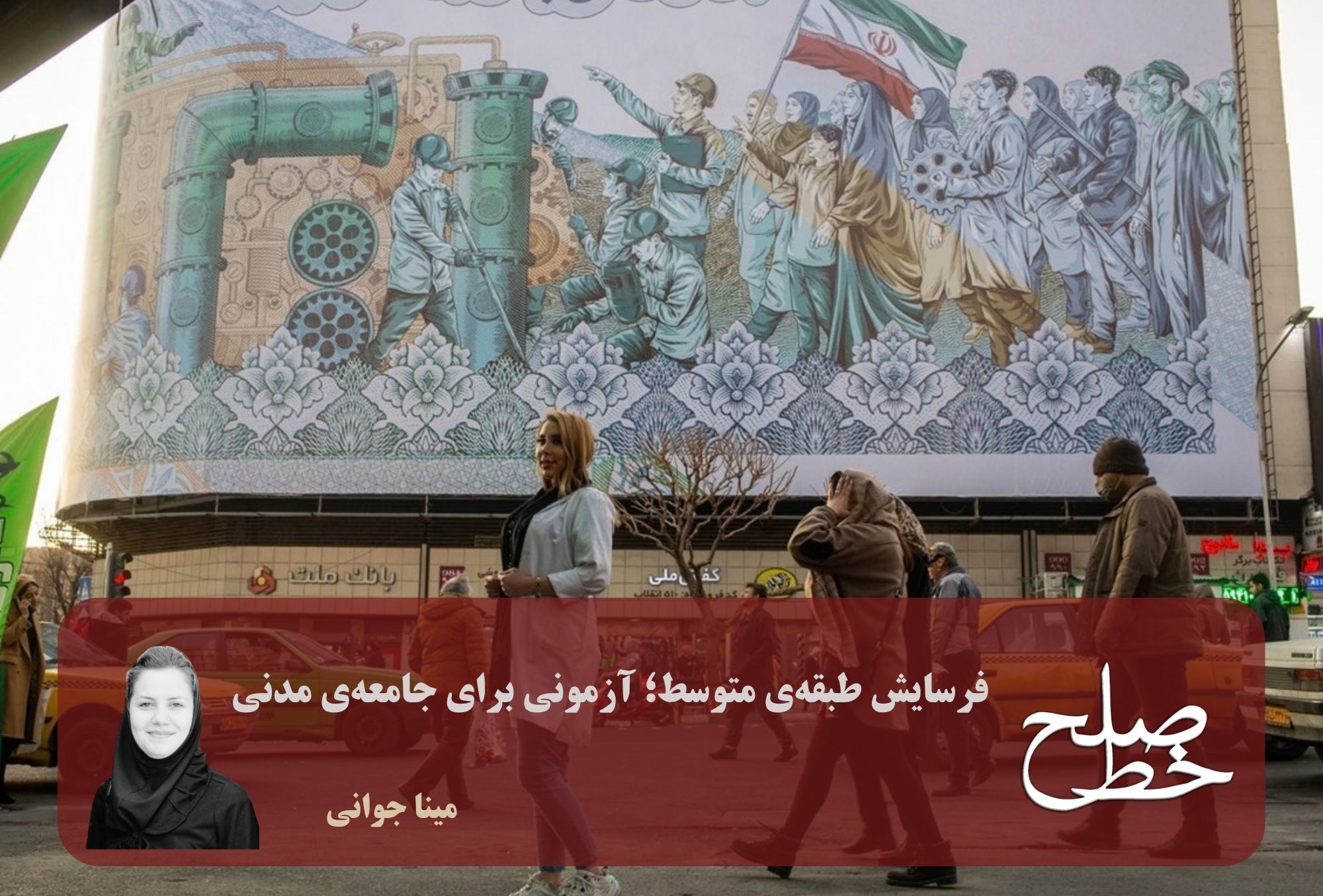
The Erosion of the Middle Class: A Test for Civil Society/ Mina Javani
The middle class is usually defined in terms of income level, consumption patterns, or educational attainment, as though the issue were merely one of drawing an economic boundary separating one segment of society from the lower and upper classes. Yet the historical and political significance of this class cannot be reduced to its economic position. What gives the middle class its importance in modern society is the position it occupies between the state and society, between private life and the public sphere, and between individual interests and collective action: a collection of individuals and groups capable of devoting some of their resources, time, and security to activities beyond the everyday reproduction of life.
From this perspective, Iran’s problem today is not limited to declining purchasing power or the spread of poverty, but rather involves the gradual erosion of the ability to plan one’s life. Chronic inflation, the housing crisis, job insecurity, declining income value, difficulties in accumulating capital, and increasing migration have not merely altered standards of living; they have also shortened the horizon of decision-making. Someone who cannot maintain a stable outlook regarding housing, employment, education, or their economic future devotes a greater share of their capacity to preserving their existing position. The issue is no longer how much individuals earn, but how much social capacity remains for participation, organization, and action in the public sphere.
It is here that the crisis of the middle class intersects with the crisis of civil society. Civil society is not merely a collection of associations and voluntary institutions; its existence requires individuals to be able to separate part of their lives from the logic of economic emergency and devote it to common concerns. The more everyday life becomes a matter of survival and preventing downward mobility, the more difficult it becomes to transform private problems into public demands and scattered individuals into collective actors.
The decline of the middle class must therefore be understood not merely as an economic transformation, but as the erosion of one of the social infrastructures of civil society. The central question is not how many Iranians no longer fit the statistical definition of the middle class, but what happens to social independence, trust, participation, and society’s capacity for organization as this class shrinks and becomes more precarious. If the middle class once made it possible to maintain a degree of distance from the state and participate in public affairs, its decline pushes society away from collective action and toward the individual management of crisis—a situation in which the issue is no longer changing the world, but enduring in a world that leaves less room for the future with each passing day.
How Was the Middle Class Formed in Iran?
The middle class in Iran has not been a static, pre-existing phenomenon; its formation was tied to the expansion of urbanization, the development of the state bureaucracy, increased access to public and higher education, the emergence of specialized professions, and the expansion of administrative and service sectors. These processes produced groups whose social position was based not on ownership of land and capital, but on education, expertise, occupation, and access to cultural resources—groups that, particularly in major cities, became among the most important carriers of modern lifestyles and social relations.
The significance of this transformation cannot be explained solely by the growing number of people with university educations or administrative jobs. What mattered was the emergence of a degree of relative independence in social life. Teachers, physicians, engineers, employees, journalists, academics, lawyers, and artists, although in many cases directly connected to the state or the market, did not have their identities and social positions completely subsumed within these two spheres. Professions, expertise, and intermediary institutions created spheres of social life situated between the state and private life.
In the decades following the Iran-Iraq War, the further expansion of higher education and urbanization intensified this process. Universities were not merely places for obtaining degrees; for a large segment of the younger generations, they provided a path toward social status, professional employment, and participation in the public sphere. At the same time, the media, press, professional organizations, cultural associations, and non-governmental organizations, despite serious restrictions, created spaces for social organization. In this way, the middle class became more than an income group; it became a network of professional, cultural, and social positions.
The connection between the middle class and civil society can be understood from this point. Civil society does not emerge in a vacuum, and the existence of laws or formal institutions alone is not sufficient to create it. It requires groups capable of moving between the private and public spheres, organizing around common goals, and separating some of their resources and time from the immediate demands of everyday life. The urban middle class, at least during certain periods, possessed this capacity: education, expertise, relatively stable incomes, and a more predictable outlook for the future made it possible to devote part of life to cultural, professional, and civic activities.
The growth of the middle class should therefore also be understood as the growth of a form of social capacity: the capacity to establish associations, produce knowledge, pursue professional demands, create media, and participate in public affairs. This, of course, does not mean equating the middle class with civil society or assuming that it is inherently democratic. The middle class itself is diverse and composed of groups with differing interests, and it can carry contradictory political tendencies. Nevertheless, its existence increases the possibility of forming networks and intermediary institutions that transform society from a collection of isolated individuals into a collection of organized groups capable of collective action.
The central question, therefore, is not the size of an income group, but whether the material and social conditions that made relative independence, planning for the future, and participation in public affairs possible still remain.
When Security Is Taken Away from the Middle Class
If the formation of the middle class is understood as the product of expanding education, expertise, professional employment, and relative stability, then its decline can primarily be explained by the disappearance of that very stability. What has changed in recent years is not merely the level of income or purchasing power, but the relationship between income, security, and the future. Income that once covered current expenses while allowing for savings and investment is now, for many households, used primarily to maintain their existing standard of living—an instrument for preventing downward mobility, rather than necessarily increasing security.
The deeper effect of inflation must be seen in the disruption of the ability to plan. When the value of income and savings changes rapidly, decisions that were once made over a horizon of several years become short-term and reactive. Buying a home, changing jobs, continuing one’s education, starting a family, or choosing where to live are no longer individual preferences, but matters of constant calculation about the possibility of enduring.
The housing crisis makes this situation even more apparent. For a significant part of the urban middle class, home ownership was one of the most important means of stabilizing social position and carrying security into the future. The difficulty of gaining access to housing has blocked or prolonged this path; the gap between income and housing prices has grown to such an extent that even specialized employment does not necessarily lead to housing security. As a result, some people who still occupy middle-class positions in terms of education and employment find themselves in increasingly precarious positions in terms of economic security.
This very gap between cultural position and economic position is one of the defining characteristics of the current situation. University education, expertise, and professional status still exist, but they no longer guarantee access to a standard of living commensurate with them. What is being eroded, therefore, is not the middle class as an income group, but the historical connection between education, expertise, employment, and social security.
Job insecurity intensifies this process. The spread of temporary contracts, multiple jobs, and supplementary economic activities transfers time and energy that were previously devoted to social life into efforts to preserve income. The issue is not merely an increase in working hours, but a change in the meaning of work: work is no longer necessarily a path toward stabilizing one’s social position, but can become an activity aimed at preventing the loss of one’s existing position.
Perhaps the most important sign of the middle class’s decline should be sought not in declining consumption, but in the diminishing capacity for accumulation. A class that cannot save, buy a home, invest in the future, or feel confident about the position of its children has moved away from part of the social meaning of this position, even if it still falls within the middle class in income statistics. To perform its social role, the middle class requires a surplus—a surplus of income, time, security, and the ability to plan. With the gradual disappearance of these surpluses, what is eroded is not merely welfare, but the social capacity to remain independent.
Consequently, the central question is not how much poorer the middle class has become, but how much of its ability to plan for the future it has lost. It is at precisely this point that the economic crisis moves beyond the sphere of private life and becomes a social and political issue.
From Citizen to Crisis Manager
The shortening of the horizon of the future does not merely change consumption patterns or economic decisions; it also transforms individuals’ relationship with the public sphere. Social participation, in its simplest sense, requires the ability to gain some distance from the immediate necessities of life. Individuals must be able to devote some of their time and energy to something that is not directly related to their daily survival. The smaller this distance becomes, the more limited participation in public affairs becomes as well.
Under conditions of instability, social life becomes a series of emergency decisions. Instead of making long-term decisions about their professional future, their children’s education, or social participation, individuals are forced continually to answer immediate questions: How can I preserve my income? Should I take a second job? Should I migrate? Life, rather than being a project for building the future, becomes a process of managing successive crises.
This change has an important consequence for the relationship between the individual and society. When economic pressures are experienced at the individual level, responses to them often become individualized as well: the housing problem becomes an individual search for a home, job insecurity becomes the search for a second job, the education crisis becomes an effort to secure better opportunities for one’s child, and economic instability becomes a decision to migrate. These problems have structural roots, but their everyday experience pushes individuals toward individual solutions.
One can speak of a kind of compulsory individualization—an individualism that is not the result of conscious choice or lifestyle preference, but a response to the weakening of collective mechanisms and shared visions of the future. Individuals are forced to assume greater responsibility than before for preserving their own position and to rely on personal resources and networks to reduce the risks of life. As a result, the social other can sometimes become a competitor for access to limited resources rather than a partner in a shared project.
It is here that the issue of the middle class becomes intertwined with the issue of civil society. Civil society rests on the assumption that individuals can transform some of their personal concerns into common issues. But when a significant share of social energy is spent preserving individual positions, this transformation becomes more difficult. Individuals may be dissatisfied with their economic situation without having the opportunity, trust, or resources necessary to turn that dissatisfaction into collective action.
The issue is not merely declining participation, but a change in the direction of social dissatisfaction. Rather than accumulating within collective institutions and stable networks, dissatisfaction can be discharged through individual pathways: migration, changing jobs, exiting the market, or social withdrawal. A society in such a condition may remain full of dissatisfaction while possessing less capacity to transform it into organization. Ultimately, a dissatisfied society is not necessarily an organized society.
This does not, of course, mean the complete disappearance of collective action. Under crisis conditions, sudden and widespread forms of solidarity and protest can emerge. The main difficulty lies in transforming these collective moments into lasting institutions. The more unstable people’s lives become and the shorter their horizon of the future, the more difficult it becomes to sustain participation and long-term investment in civil institutions. Society may mobilize at certain moments, but maintaining networks capable of transforming such mobilization into sustained action is a different matter.
The decline of the middle class should simultaneously be understood as the decline of a portion of social time—the time individuals can set aside for something beyond immediate necessities: time to trust, build relationships, become members, engage in discussion, and pursue a demand. When all available time is consumed by work and the management of instability, what is lost extends beyond income: it is the possibility of building relationships that connect the individual to society.
Perhaps the principal consequence of the shrinking middle class is not declining consumption or standards of living, but the transformation of the future from a shared horizon into a personal problem. Everyone tries to find a way for themselves and their family to get through the existing situation; and it is precisely at this point that civil society faces a fundamental question: How can a social “we” once again be built out of a collection of individuals managing personal crises?
Conclusion: Civil Society Without a Middle Class?
If we regard the middle class as one of the historical carriers of civil society, its decline does not necessarily mean the end of civil society. Civil society can take shape even under difficult conditions, and new forms of solidarity may emerge during periods of crisis. The issue is how the institutionalized and enduring capacity of civil society changes as the material and social foundations of the middle class erode.
A significant part of civil society is formed not in moments of protest, but through quieter, everyday activities: professional associations, trade organizations, voluntary organizations, media outlets, cultural institutions, and local networks. The continuity of these institutions requires more than political will; it requires people who can invest their time, skills, resources, and trust in a shared activity. Economic erosion restricts this very possibility: when professionals, academics, journalists, and those in professional occupations are forced to take on multiple jobs or migrate in order to preserve their economic position, professional and social networks also become more unstable, and sustaining the relationships necessary for producing trust and cooperation becomes more difficult.
One consequence of the decline of the middle class is a movement from institutionalized civil society toward networked civil society. Individuals can still connect with one another through social networks, campaigns, and episodic actions, but these new forms do not fully replace stable institutions. A network can draw many people’s attention to an issue within a short period of time, but building trust, dividing responsibilities, and producing collective memory require organization and institutions. Consequently, we may encounter a situation in which the capacity for social mobilization continues to exist while the capacity for sustained organization has declined. The distinction between “being together at a particular moment” and “remaining together over time” becomes important here.
This situation also changes society’s relationship with the state. One of the important functions of civil institutions is to create intermediaries between the individual and political power: associations and professional organizations can formulate scattered demands and increase the possibility of collective bargaining. The weaker these intermediaries become, the more direct and unequal the relationship between the individual and the state becomes, and instead of demanding reform of an institution, the individual exits it; instead of improving working conditions, they change their job or their country. From this perspective, migration can be understood as something more than the departure of skilled workers: a migrant is not merely a worker, but may also be a member of an association, a professional network, or a set of social relationships that are weakened by their departure. Migration is simultaneously a consequence of the erosion of the middle class and a factor contributing to its continuation.
Nevertheless, civil society should not be reduced to the middle class. Lower-income groups, working classes, women, young people, and local groups are also carriers of important forms of organization and solidarity, and at times pressure and deprivation themselves become catalysts for collective action. The relationship between the decline of the middle class and the weakening of civil society is not mechanical; it is historical and complex.
The question can now be posed: What kind of civil society is possible under conditions of middle-class decline? The answer may not be the disappearance of civil society, but rather its movement from stable institutions toward fluid networks, from long-term membership toward episodic participation, and from sustained organization toward short-term mobilizations. This change does not mean the complete erosion of social power, but it does produce a different kind of civil society: one that may be extremely powerful in moments of crisis, yet faces greater difficulty in preserving achievements and transforming scattered demands into lasting change.
The issue of the middle class in Iran is not merely about who has become poor and who still occupies a middle economic position, but about what social infrastructure remains for transforming individuals into organized citizens. The crisis of the middle class, before being the crisis of a class, is a crisis of social intermediaries: intermediaries between the individual and the state, between private life and the public sphere, between personal problems and collective demands. The weaker these intermediaries become, the more society finds itself situated between the two poles of the isolated individual and the powerful state; and the central question is no longer how small the middle class has become, but to what extent society still possesses the capacity to be together, to organize, and to imagine a shared future.
Footnotes:
1- Bayat, A. (1997). Street politics: Poor people’s movements in Iran. Columbia University Press.
2- Bayat, A. (2010). Tehran: Paradox city. New Left Review, 66, 99–122.
3- Harris, K. (2012). The brokered exuberance of the middle class: An ethnographic analysis of Iran’s 2009 Green Movement. Mobilization: An International Quarterly, 17(4), 435–455.
4- Harris, K. (2017). A social revolution: Politics and the welfare state in Iran. University of California Press.
5- Harris, K. (2020). Unraveling the middle classes in postrevolutionary Iran. In B. Eidlin & M. A. McCarthy (Eds.), Rethinking class and social difference (Political Power and Social Theory, Vol. 37, pp. 103–134). Emerald Publishing Limited.
 Created By: Mina Javani
 September 23, 2026
Tags
Civil society Crisis Development Middle class Mina Youth peace line Peace Line 185 Private life Rural areas Social capacity War ماهنامه خط صلح