


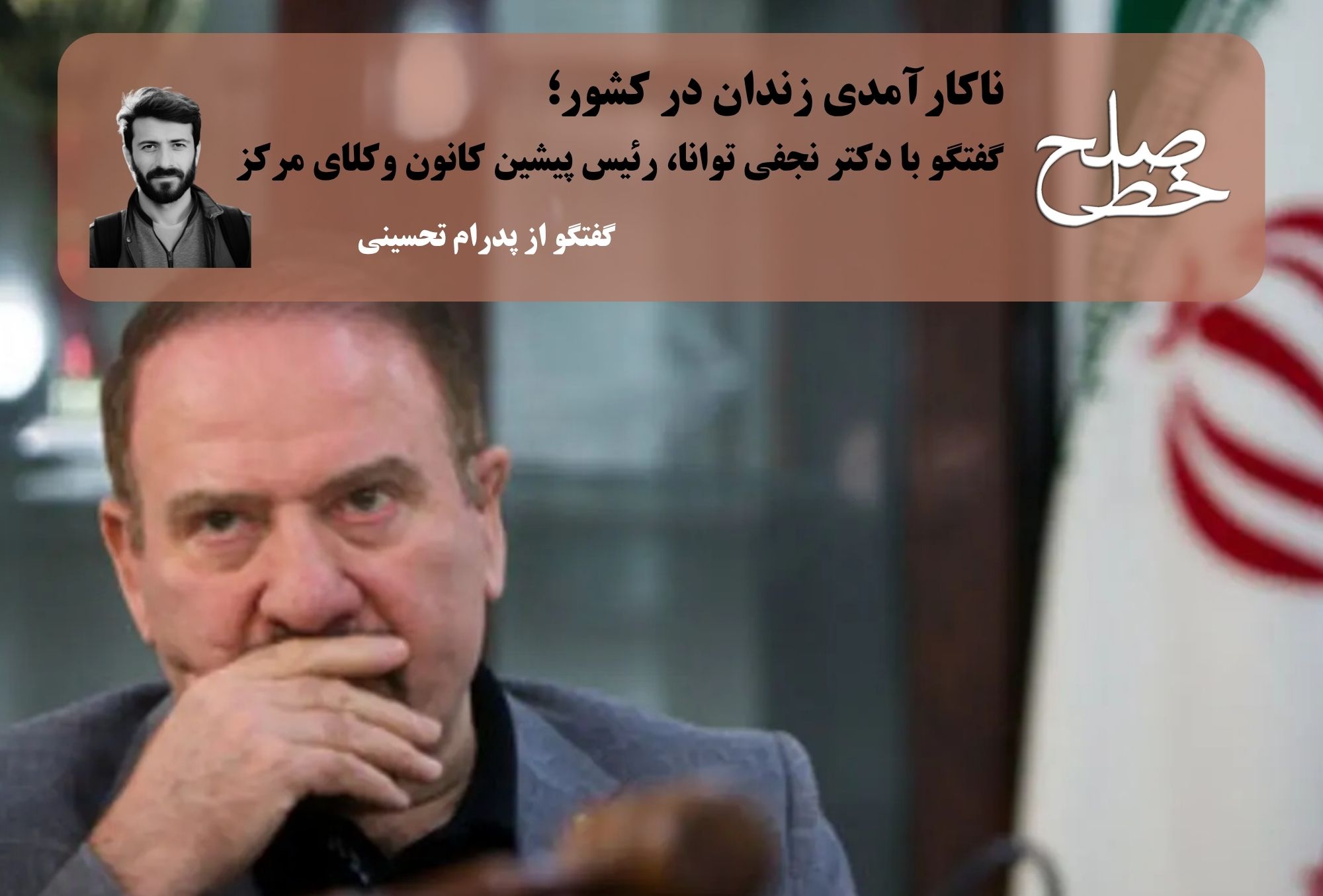
Prison Inefficiency in the Country; Interview with Dr. Najafi Tavana, Former Head of the Central Bar Association/Pedram Tahsini
Ali Najafi Tavana was born in 1953 in the Alamut region of Qazvin. He completed his primary education in Tonekabon and completed his secondary education at Hafeziyeh High School in the same city. In 1972, he entered the Faculty of Law of the University of Tehran and in 1975, he obtained a Bachelor of Laws degree. In 1979, Najafi Tavana went to France and took postgraduate courses in criminology and criminal sciences at the Faculty of Law and Humanities of the University of Toulouse, and finally received his doctorate in law by defending a thesis entitled “Crimes of Children and Adolescents.”
In this issue of Peace Line, we have discussed with this university professor and former president of the Central Bar Association about the minimum standards that should be observed in prisons and how these standards compare to the realities in Iranian prisons. In this conversation, topics such as the Mandela Rules, solitary confinement, the responsibility of governments towards prisoners’ rights, Iran’s international obligations, and solutions for reforming the prison system from the perspective of domestic and international law are discussed. You can read the full text of this conversation below.
If you were to state the most important principle in international law regarding the treatment of prisoners in one sentence, what would it be?
Adherence to humane principles for the rehabilitation and reintegration of a person who has suffered from deviance.
In the same vein that you mentioned, what gaps were the Mandela Rules, the Bangkok Rules, and the Istanbul Protocol each intended to fill in the international legal system?
Encouraging practical behaviors and reactions towards prisoners, based on slogans that are raised regarding the socialization of prisoners and are actually approved in international principles related to respecting the rights and well-being of prisoners.
Does this really fill the void?
Yes, within the framework of the Prison Principles of the Third Millennium, we are faced with several principles and regulations that have been anticipated and approved by international institutions, including in the resolutions of the United Nations and its affiliated institutions. These principles include: “establishing justice”, “preventing discrimination”, “psychological rehabilitation”, “socialization training”, “post-release care”, “support for the prisoner’s family” and “taking measures to establish continuous relations between the prisoner and his family”. These regulations and principles require that management measures, economic facilities, sufficient space and spiritual and material support be provided; otherwise, the prison will not only not be a suitable place for rehabilitation, but will also lack the necessary characteristics for mere detention. As a criminologist, I have always been critical of the country’s prison system. In assessing the world’s prison systems based on knowledge of prison management, penal science, and the provision of psychological and sociological services, countries such as the Netherlands, Norway, and Denmark have been largely successful. In addition to ensuring the economic and social rights of the people, which is itself a form of proactive prevention and criminal policy, these countries have a small prison population and, if there are prisoners, they are kept to the highest human and scientific standards. Some countries have also tried to comply with international principles, but due to the lack of facilities, their prisons are used not for rehabilitation, but simply for inappropriate detention of prisoners. The result of this situation is that about 60 percent of prisoners reoffend after their release. On the other hand, many prisons do not have standard capacity and are faced with serious shortages in terms of physical facilities.
Given what you said, in what area do you see the most significant gap between international standards and the situation in Iranian prisons? That is, where is this gap most visible?
To prevent disease, it is better to prevent people from getting sick at all. Until the basic rights of the people are met, including work, housing, freedom, and cultural and educational needs, we cannot expect a reduction in the prison population. I tell you that until these needs are met, the number of our prisoners will definitely increase; there is no doubt about it. Another point I should mention is that since 1984, I have been teaching administrators, prisoners, and especially guards at the Prisons Organization Training Center. Since then, I have always emphasized that we do not have the necessary physical facilities, the personnel are not adequately trained, and the welfare facilities are very limited. Unfortunately, we manage the prison in such a way that not only has the aspect of punishment and fear of punishment disappeared, but in some cases the conditions have become such that the prison has become a place for rest and even recreation for some; prisoners eat, sleep, and exercise. In addition, religious visits are also easily established and in some cases we even witness the birth of children for prisoners; both men and women. Post-release care is also very poor and insufficient budget has been allocated for it. On the other hand, the Prison Health Council does not have the necessary specialists and overall we are faced with a lack of economic, specialized and managerial facilities. This situation has caused many prisoners to face numerous problems inside the prison.
Do Iranian laws themselves conflict with international standards, or is the main problem in the way they are implemented and monitored?
To prevent disease, it is better to prevent people from getting sick in the first place. Until the rights of citizens are not guaranteed, we cannot expect the prison system to be efficient. In the 1970s and 1980s, I used to mention in the press that the prison regulations of our country at that time were more progressive than many laws in the field of justice. Unfortunately, those regulations underwent changes in the 1990s; while in the previous version, local prisons were defined as rehabilitation, punishment, and detention, in the new reforms, the emphasis was solely on punishment and detention, and the discussion of education and reform was diminished. As a result, our current laws are far from international standards. Although some legal provisions may be progressive in terms of content, the necessary facilities are not available for their proper implementation. We do not have the necessary physical, professional, and managerial capacity to reform and educate prisoners.
In cases involving allegations of torture or death in custody, what characteristics should an independent investigation have in terms of international law?
As lawyers, when dealing with some prisoners, we hear reports about behavioral abnormalities during the prosecution and investigation stages, as well as mental and psychological pressures on the accused. On the other hand, the country’s authorities have repeatedly emphasized the need to respect human dignity. The prohibition of torture is explicitly foreseen in both the Constitution and the Islamic Penal Code. However, in the past decades and even recently, depending on the type of management and approach of judicial officials, sometimes issues have been raised in this regard that indicate a gap between slogans and actions. The important point is that some international standards and even principles contained in domestic laws, especially in prison environments, are sometimes not observed as they should be. What is reflected in the media is evidence of this failure. However, at least we can say that we continue to face serious shortcomings and challenges in the field of meeting the spiritual and material needs of prisoners.
Is the use of solitary confinement absolutely prohibited in international law or is it permitted under certain circumstances?
In my opinion, solitary confinement in most prison systems around the world is sometimes used as a measure to protect the prisoner’s own life or to prevent conflicts within the prison. Some prisoners may self-harm or harm others due to the type of crime they have committed or certain mental conditions, and as a result, isolation is sometimes considered a temporary measure. However, restricting people and depriving them of social relations and work in prison is generally unacceptable and, in my opinion, solitary confinement can be considered a form of torture; although some may not agree with this view. In any case, although solitary confinement is not recognized as an independent punishment in the penal code, unfortunately in some countries, especially in so-called third world societies, this tool is used to obtain confessions or impose more severe punishments. This practice is not limited to a specific country and is seen more or less in different systems, albeit with different oversights.
Given the principle of separation of powers, what responsibilities do governments have under international law to protect the physical and mental health of individuals in detention?
Before answering this question, I consider it necessary to point out that a logical approach organizes the management of the prison organization into three separate parts: first, the education and maintenance part, including nutrition, exercise, internships and training, which should be entrusted to the private sector; second, the execution part, i.e. the executive management of the prisons, which should be entrusted to the executive branch; and third, the punishment supervision part, which should be the responsibility of the judiciary. Because the judge executing the sentences and the prison supervisor judge, together with other specialized judges, can continuously evaluate the effects of the punishment, especially with regard to adolescents and young people, and, if necessary, change the appropriate measures. This separation allows for the real rehabilitation and rehabilitation of prisoners within the framework of the principles of encouragement and punishment. Therefore, I generally agree with this separation.
Given that Iran is a member of some human rights treaties but not others, what obligations does it have in practice regarding prisoners’ rights, and to what extent can it rely on its non-membership?
In connection with international documents, we are faced with a condition called “Reservation”. The fact is that we have not accepted many of these documents without obtaining the approval of the Parliament, and for this reason, our membership in them is not complete. Of course, we have become a member of some international documents, such as the Civil Aviation Organization, economic organizations, or institutions such as UNICEF, and we are active. We have also applied reservations to some conventions; especially to principles that we did not accept or did not harmonize with our views, and it was not possible to fully accept those texts.
But the reality is that our constitutional framework includes progressive principles that are also seen in the Universal Declaration of Human Rights and other international documents; although there was a different approach before the revolution, these global frameworks have always been taken into account. At the same time, there are also limitations that may not be in line with global standards. In the implementation of approved ordinary laws, we sometimes witness inconsistencies that, as someone who has been active in the field of law and its practical application for nearly half a century, I must say that these inconsistencies are evident. I have repeatedly mentioned these points in my books and articles, and these shortcomings are even seen in the criminal procedure code and approved laws.
These shortcomings have caused us to be constantly exposed to criticism in international circles. Of course, some may say that our rules are flawless and transferable to others, but overall, the principles of the Constitution allow us to benefit from global standards. For example, in Article 48 of the Criminal Procedure Code, there was a note that during my term as president of the Bar Association and with the support of Mr. Larijani, fortunately he agreed that the note would not be implemented. This issue has always been mentioned in various circles and meetings of lawyers and shows that even the authorities of the system are aware that some internal rules and regulations do not fully comply with international standards.
Mr. Doctor, you raised your own reform issues during the interview, but if you were to propose an immediate reform to bring Iran’s prison system closer to international standards, what would that reform be?
The country’s prisons, especially in terms of the detention environment, need fundamental reform; that is, sufficient space and suitable accommodation must be provided for prisoners. In this regard, there is a prominent thinker who was previously a cleric and a French philosopher named Jean Mabillon. Around the 17th century, he believed that prisons should not be in dungeons, basements, and narrow and dark places, but should be built in an open environment. In his opinion, every prisoner should have an independent room, be given books, be properly fed, and be provided with an opportunity to think and rethink. He believed that if there is a just society, prisoners, criminals, and victims will not find meaning; rather, an environment must be created where people can come to their senses, think humanly, behave humanly, and act humanely. For this reason, he was later called the “prophet of modern prison science.” Interestingly, the Council of Europe introduced him with this title in the years before 2000, and his teachings became more and more evident.
Another fundamental point in modern prison management is the mental and psychological education of prisoners, spiritual support, and even linguistic support. Someone who commits a crime has actually suffered a spiritual injury, a slip, and a damage; he needs treatment like a patient. If society is just and efficient and competent administrators rule it, we will not have criminals in any society in the world. As it has been said: “Poverty is disbelief”; that is, poverty, whether material or spiritual, is the basis for disbelief and deviation. Material poverty means unemployment, homelessness, inflation, and lack of housing; and spiritual poverty means lack of faith, pretense, lies, hypocrisy, and evil behaviors in the background of religious appearances; such as eating the treasury and people’s rights by some nobles who introduce themselves as serving the people.
Another serious problem is the issue of internment for prisoners. About 90 percent of our prisoners come from poor and suffering families. These people definitely need to be trained and learn job skills. I have said many times since the revolution that I wish at least five percent of factories and large companies were required to teach prisoners jobs and professions after their release. Support after leaving prison and support for the families of prisoners is also very vital, because the children of prisoners are at risk of committing crimes and their spouses are at risk of sexual deviation. The prisoners themselves also suffer from a lack of self-confidence and depression. In fact, we take a wounded person to a more wounded environment and return him to society; as a result, many prisoners start committing crimes in this same environment and repeat them after their release. Unfortunately, more than 60 percent of prisoners in our country reoffend, indicating that prison not only has no preventive effect, but in certain circumstances has itself become a school of crime.
We have raised these issues many times in criminology books and lectures, but the words of non-specialists and self-proclaimed individuals with fake degrees and fake specializations are usually accepted; while steps should be taken to promote healthy behavior and prevent crime, both by ensuring people’s rights and by humanely treating criminals. If these measures are implemented, perhaps we can hope that prison will become a place for rehabilitation, not for fostering crime.
Thank you for giving your valuable time to Peace Line and its readers.
 Created By: Padram Tahsini
 July 23, 2026
Tags
International Covenant on Civil and Political Rights Islamic Penal Law Mandela's Rules Prisoners' harassment Prisoners' rights