


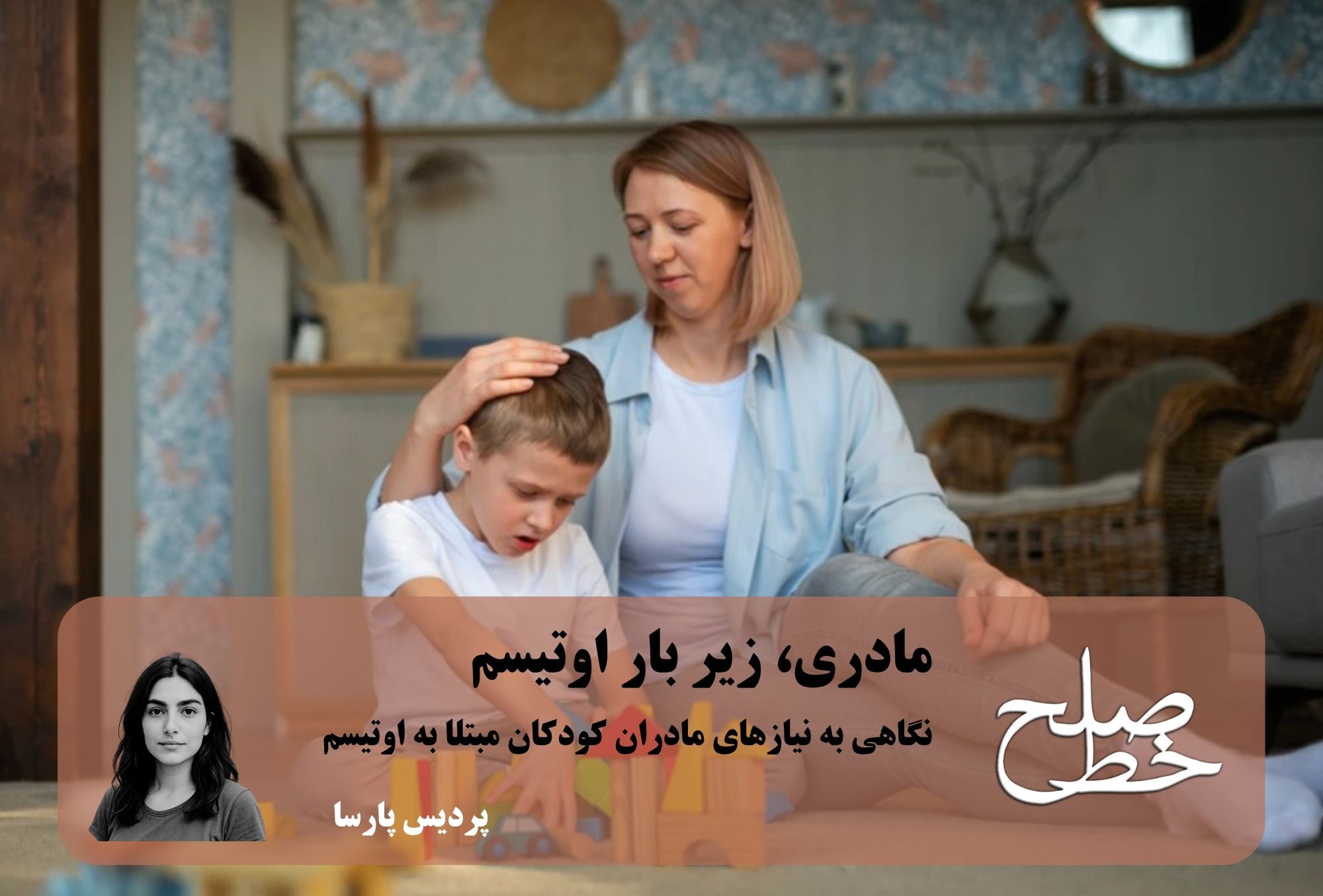
Motherhood, under the burden of autism/Pardis Parsa
Early parent-child interactions form the foundation for a child’s psychosocial development in the context of society. However, exposure to a neurodevelopmental disorder in a child presents fundamental challenges to this cognitive structure and preconceived parenting goals. Autism spectrum disorder is a group of complex neurodevelopmental conditions characterized by persistent deficits in social interaction, verbal and nonverbal communication challenges, and repetitive patterns of behavior or restricted interests. The use of the term “spectrum” reflects the extreme heterogeneity of clinical symptoms in this disorder; cognitive and language functioning in affected individuals can range from very severe impairments to completely independent and normal levels of functioning. The first signs of this lifelong disorder usually appear between 12 and 24 months of age (and in some cases even earlier).
Raising a child with autism imposes a high caregiving, emotional, and economic burden on the family system, and mothers, due to their primary caregiver role, are more susceptible to psychological burnout and social isolation than other family members. Examining the lived experience of these mothers shows how their goals, values, and needs adapt to their child’s special circumstances.
Transformation and adaptation of mothers’ parenting goals
In families with typically developing children, parental goals are usually focused on academic achievement, the development of talents, and the promotion of the child’s social status. However, in mothers of children with autism, the challenges of the child’s development cause the parents to shift their perspective from perfectionism to realism and striving for the child’s survival and relative autonomy.
The short-term goals of these mothers are focused on three main areas: building basic self-help skills, improving minimal communication skills, and controlling behavioral challenges. Achieving independence in personal tasks such as eating, going to the bathroom, and dressing is one of the most vital goals. “Maryam” is the mother of a 9-year-old child with autism. She is 36 years old and a housewife and tells the Peace Line about this: “I would like my child to be able to do his personal tasks by himself and stand on his own two feet a little. His social skills haven’t improved either. I can’t have high expectations. If he can do his personal tasks by himself, it would be great. Because this child has been with me all the time since he was diagnosed at the age of one, and we are always together like shadows everywhere. “I’m so tired, I’d like to have less physical conflicts with this kid.”
The child’s inability to manage himself in the mother’s absence also limits the mother’s freedom of action and autonomy. “Shima,” who has an 11-year-old son, points to this frustration: “My son is now 11 years old and it’s very difficult for me that I can’t leave him alone at home. I want him to learn that if he’s left alone at home, not to open the door to anyone, to lock the door. I really can’t leave my child alone at home now, even to go to the supermarket.”
“Farzaneh,” who is 43 years old and an assistant professor at a university, sees the child’s lack of verbal ability as a major obstacle to hiring a nanny or seeking help: “Because he doesn’t talk, whenever he’s hungry, he usually grabs a spoon and goes to the kitchen to stand by the stove. My most important goal is his speech. I’m trying my best to help him speak with private classes and exercises; because he doesn’t talk and doesn’t do his basic tasks, I can’t even get a nanny so he can stay home and I can go to work. But if he does talk, if the nurse yells at him or does something, he can tell me; I want him to be able to at least communicate with me.”
“Sara,” whose child is 6 years old and was diagnosed with the disease three and a half years ago, says: “Well, the most important problem is this child’s inability to speak, which greatly affects the rest of his work; because he can’t say exactly what he wants and I can’t understand exactly what he wants and I worry that somewhere in his body hurts and I don’t understand and he can’t say and he doesn’t express his desires. I can’t really understand what this child wants, what he doesn’t want, and what’s on his mind. He’s very poor at making friends; he plays but can’t adapt to other children and fights break out all the time. I want him to be better at making friends and playing with his friends. Sometimes when he plays with other children, I see the other children say, ‘You don’t know how to play, go sit down, we’ll play by ourselves.’ And this is unusual for others; “They look at it in a certain way. I don’t want it to be a finger-pointing issue in society and for others to not accept it.”
Addressing behavioral problems such as aggressive behavior, hyperactivity, or stereotypical behavior in public spaces that lead to labeling and social rejection is a major part of mothers’ efforts. Narges, whose 7-year-old son has autism, told the Peace Line: “I really want him to be able to control his anger, to be able to interact. Now he gets angry very quickly, he’s like a firecracker and explodes with the smallest thing. For example, he’s playing with his brother, and if his brother wins that game twice in a row and he doesn’t, he gets so upset, angry, sad, cries, and yells that he can’t stop talking.”
“Solmaz,” whose son is 13, points out the serious consequences of this abnormal behavior in interacting with people in the community: “Previously, wherever we went, he would cry and scream and hit himself so much that we had to leave the environment, but later, through occupational therapy and things like that, he learned to tolerate the environment a little. But he challenges the environment and this needs to be resolved. A few days ago, two people were shouting loudly on the street, and he was shouting at them from here. When I came to explain to those people that this child has autism and is not his own, one of them came and punched him in the ear! His behavior has become very tense. I don’t want him to have this behavior at home or outside the house. Because you know, people don’t accept our children. “They don’t accept healthy children either; that is, if a healthy child does something wrong, they are treated harshly, because this child has not been raised and his mother has not taught him, let alone these children.”
“Laleh” also refers to her 7-year-old son’s unusual behavior and severe tantrums in medical and school settings: “I want him to have the patience to stay in class like his peers. Now, if he gets upset or angry about something, for example, if there is food in front of him, he will turn over the food dish or go and take the milk bottle from the refrigerator door, pour too much into the glass and then end up emptying the bottle on the floor and emptying the glass on the floor… Or, for example, in the office, he will suddenly get up in the middle of the office, imagine that there are people sitting around, and he will start singing poetry to himself loudly. Sometimes he screams terribly; when he falls on his stubborn side and screams, there is nothing you can do about it. He screams in a way that a normal child would never be able to scream like that. “I really want him to behave like his peers. So that he can be present in society. He can’t be isolated all the time, in a room, he can’t be in a cage.”
Long-term goals: Increase functional independence
The future vision in the minds of these mothers is not based on competition or outstanding scientific achievements, but on functional independence. Maryam says: “In the future, he should have a job and stand on his own two feet. Now, when we want to buy something, we stand back and say, ‘Go buy these things and calculate for yourself so that he can do these things in the future. We should not do everything.’ That is, we are teaching him from now on that he should not always count on us and consider us his support. We are not always there.”
Preventing aggressive behavior from continuing into adulthood, due to its serious legal and social consequences, is another frequent concern of mothers. Solmaz told the Peace Line: “He is a child now, and his unusual and aggressive behavior is causing him, his friends, and his family a lot of trouble. He is now slowly entering adolescence. I am all scared and worried that if he behaves like this tomorrow, when he becomes a young man, it will be very painful for us, his siblings, his friends, or the neighbors he is in contact with. If he gets into a fight with someone at the age of 20, he will not stand by and watch; he will definitely grab his collar and punch him in the face. Right now, I am constantly apologizing to everyone, saying that he has autism, that he doesn’t understand, that’s how it is, please forgive me; But, for example, if it’s going to be like this when I’m 20, I should have one foot in the police station and this and that. But when I’m 20, do I have the strength to follow it all the way?
For Farzaneh, it is enough for her child to behave normally in society. In an interview with the monthly magazine Hath-e-Solh, she says: “I would like my son to be normal when he grows up in the streets. He doesn’t move his arms and legs when he walks. Now on the street, people don’t realize that he is sick because of his normal appearance; he is walking and suddenly hits a woman or snatches a water bottle from someone’s hand or slams into parked cars. In such cases, I have to immediately explain that this is the condition of this child. Then they look at him and say that there is nothing wrong with him, but for example, when a child with Down syndrome walks on the street, 99 percent of people in society know how to deal with this child and they don’t get aggressive and don’t say why you raised your child badly. Of course, I give them the right. People don’t even have the patience for their own healthy children now. “So for me, it would be great if he could observe some things like this in his social behavior, on the street, in the park, etc. in the future. He wouldn’t break anything, wouldn’t hurt himself. That’s enough for me.”
Fathers who are not with their wives
Fathers’ denial of their child’s problem and avoidance of supporting roles are one of the problems of these mothers. Laleh told the Peace Line about her husband: “The big problem I have is that until a year ago, my husband hid this child’s illness and I was the only one who was supposed to shoulder this burden. He said that the child was nothing but not talking. Now, for a year or two, he has been walking with me and cooperating. So, he should take this child to the park and outside, take him around and do things like that, and generally participate in raising the child.”
This lack of participation leaves the mother alone in the complex processes of treatment and care. Shima also says in this regard: “My wife is not a companion in any way, not at all. I mean, I have taken this child everywhere, I have gone alone. My husband has only come with me for the child’s surgeries, and that is only because he signed the agreement. I am being harassed, I am alone. Wherever I go, I am by myself. I am very tired, I have lost my spirit. I so much want to have some free time, to sit and chat for an hour or two without this child, with my sister or my friends, or, for example, to go on a trip for a day or two, but every day I am walking in the shadow of this child for ten to twelve hours.”
Sarah also told the Peace Line: “My wife provides financially, but she comes home at nine or ten at night. That’s how it was from the beginning, sleeping with her phone in her hand and watching TV. She has nothing to do with the house or the children. Now, I’m responsible for all the child’s classes. Well, you know, each class is in the same place in the city and you get tired, and I’ve often wished that my wife would take the child to class every week or two. It would help me a lot. There were times, for example, when I wanted my wife to be with me during assessments and she could hear what the evaluator or therapist was saying, or she could be there too, for example, so she could see occupational therapy and work better with the child, but in practice, it’s not good. In these situations, the mother becomes much more sensitive and fragile because she sees that she is alone everywhere.”
Unwanted interventions and pity
Families of origin have great potential for support and advocacy, but their lack of scientific understanding of autism often leads to interventionist counseling, denial of the characteristics of the disorder, and harmful pity that threatens the mother’s mental health.
Sarah adds: “The family needs to understand that this is the nature of this child. Just as you can’t expect the same from a person who is paralyzed and in a wheelchair, you shouldn’t expect the same from this child… As a grandfather or grandmother, you have no right to tell me why my child is behaving this way. I don’t want anyone, not even my family, to teach me how to raise my child. I don’t want anyone to show me the way. I don’t want anyone to show me the way. I don’t want anyone to show me the way. I don’t want anyone to show me the way. I don’t want anyone to show me the way. I don’t want anyone to interfere unnecessarily and become a friend of my aunt. This child has an aunt who doesn’t live in Iran. When she comes to Tehran, I don’t know why she wants to raise my child so much. I mean, she doesn’t see her more than two days a year, but during those two days, she yells at this child. Why are you doing this?” “Why are you doing that? I told him once, ‘Look, these two days you’ve been here to be his aunt, he doesn’t want you to raise him.'”
Narges tells the Peace Line: “The most cooperation families can do is not to interfere in the upbringing of their children and to be more supportive. Support is important. Do you know what the worst thing is? For example, when they see a child and say, ‘Wow, he doesn’t know how to do this yet?! Why does he say this like this?! Why does he do it like that?! Why does he say the same thing 25 times?! Dad, you all know what my child’s problem is, because I don’t hide it from anyone… This ‘Wow’ and ‘Why’ and this pitiful look and ‘Oh, oh, oh, oh, oh, these are very bad, very bad and annoying. It’s very important for them to be able to understand this child. For example, if he comes to you five times and asks you a question, don’t say, ‘My dear, how often do you ask this?!'” “It is very important to understand the child’s situation. Now we have come to sit together for two hours. Now my child has to go and come several times in these two hours. He has a problem coming and going, you know he has a problem, so what is the point of this nagging? These things make me feel bad as a mother. I want my family to understand me a little bit, to understand that my nerves are weak, I am tired too; little by little they will reduce the stress, a little attention, affection. My mother, for example, wants to talk to me, she says, you are a mother, you have to be in a good mood so that this child can be well too, you have to increase your tolerance. Well, I wish they understood that I am also human, I get tired, they cannot understand my hardships.”
Shima believes that the best thing families can do is to work with parents in caring for children with autism. She tells the Peace Line: “It’s great for families to keep the children for an hour, two hours, three hours, so that the parents can have time for themselves. For example, they keep the children for two hours a week so that mom can go to the pool, have guests, or sometimes even keep the children for a day or two so that the parents can go on a trip for two days.”
Maryam told the Peace Line: “Support is very necessary. I wish, for example, that one of the family members could come and be with the children on days when the mother has plans, because sometimes one has to go somewhere; for example, there is an obligatory shopping for the house and these, well, sometimes they help, but if I wanted to have someone regularly, for example, two days a week, for two hours, who could support and look after the child so that I could go to the gym or to a class, no, I never had the time and I don’t have it now.”
Acceptance and non-judgment of the child and mother
Many mothers of children with autism spectrum disorder are upset about the hurtful behaviors they or their children experience in society and want to be treated with understanding and acceptance by society. They stated that behaviors such as maternal judgment, labeling of the child, pitying behavior towards the child, harassing questions, staring, general misjudgments, and citizens’ lack of understanding of stereotypical behaviors of autism force parents to adopt avoidance strategies and self-initiated isolation.
Laleh told the monthly magazine Khat Sohl about this problem: “The general spirit and culture of people should change so that they don’t interfere with each other’s work and don’t look at each other. Don’t label them, the more natural the behavior, the better. For example, a child turned to the lab technician who took his blood and said, “You’re rude.” This is not something that the lady would want to respond to, even if he were a sane and normal child. There’s no need for you to raise your head, roll your eyes, or say something, or for example, judge me, the mother. Even if the child starts walking by himself in the middle of the office and singing poetry out loud, it’s true that his behavior is not in accordance with the environment, but no one should look at him, laugh, or cry. It should be normal for people; he should do his own thing, and that’s his own thing.”
Solmaz says: “For example, in places where there is a need to wait, sometimes it is good to have people around, but sometimes because this child is apparently a normal child, when he acts this way and is impatient, they consider it spoiled and intolerant. My expectation as a mother is that the awareness of this issue will increase so much that when I say that my child is autistic, they will say, ‘So get this started as soon as possible,’ or that these children will have a sign or something, wear a hat that makes it clear, wear a card around their neck so that others know that this child cannot tolerate many situations. For a few years, I would take this child on the subway and bring him back; some would insult him, frown at him with their eyes and eyebrows, or, for example, they would not get up when the child needed to sit on a chair. “I saw and heard a lot of insults, these should not exist in society.”
Sarah says:
“In society, I try to be very careful to hold his hand tightly so that I don’t have to answer to anyone that my child has a problem; that is, I try to be very careful that no one asks me anything about my child. When a child behaves abnormally, I say that he has autism, some people look at me a little, then seem to sympathize and say that it’s okay; but some people also say that he has it, that is, what the hell, don’t bring him out! I don’t know what to say anymore. I don’t try to put myself in situations where I have to be responsible for my child’s behavior. I try to avoid anyone saying anything to me that would make me want to explain it to someone in an angry or even calm tone.”
Infrastructure gap and health insurance
Mothers of children with autism stated that they have needs that can only be met with government assistance and support, such as dedicated parks, sports clubs, and art workshops. Many of these mothers also acknowledged that the lack of insurance coverage for effective occupational and speech therapy places a serious burden on the family’s finances.
Solmaz says: “I think our country needs a comprehensive center where mothers don’t waste their time on the streets for occupational therapy, behavioral therapy, and so on. Imagine if we could have government centers like some countries where the child goes there at nine in the morning and the child is handed over to the family at six in the afternoon. In the meantime, if the child needs a doctor, they can visit there, if they need occupational therapy, it can be done there, and in short, speech, behavior, nutrition, health, and social communication, everything can be done in that complex. His school should be there, his rehabilitation should be there, his sports club should be there so that this child doesn’t spend his energy just commuting, and on the other hand, families should find time for seven or eight hours to get on with their lives; their personal life, their career, or their social life. “If this is the case, both children will be less disturbed and families will be less likely to fall apart. One of the reasons for the collapse of families is the mother’s fatigue.”
Laleh also says: “My greatest expectation is that autism will be included in the social security insurance and accepted as a specific disease, and that they will support the costs we pay to some extent. They should include these in the special diseases section; just as some diseases like MS and these have costs for them, they should count these as well. They should also allocate some budgets for public awareness.”
Shima also adds in this regard: “Especially for families that are financially weak, the government can help a lot. Now there are families whose children are high-performing, but unfortunately they cannot take their children to places where they can be educated, they do not have the money. The government should provide places for education for these people and workshops where they can work in various artistic and business fields. For example, what is wrong with setting up a special park for autistic children? The welfare department has such large places, it can give these children the facilities to go there to be educated or have proper care centers. The government should build good clinics. We do not have any facilities for these children in Iran.”
 Created By: Pardis Parsa
 July 23, 2026
Tags
Aggression Autism Autism spectrum Gender discrimination 2 Mental disorder Parents peace line Peace Line 183 Women ماهنامه خط صلح