


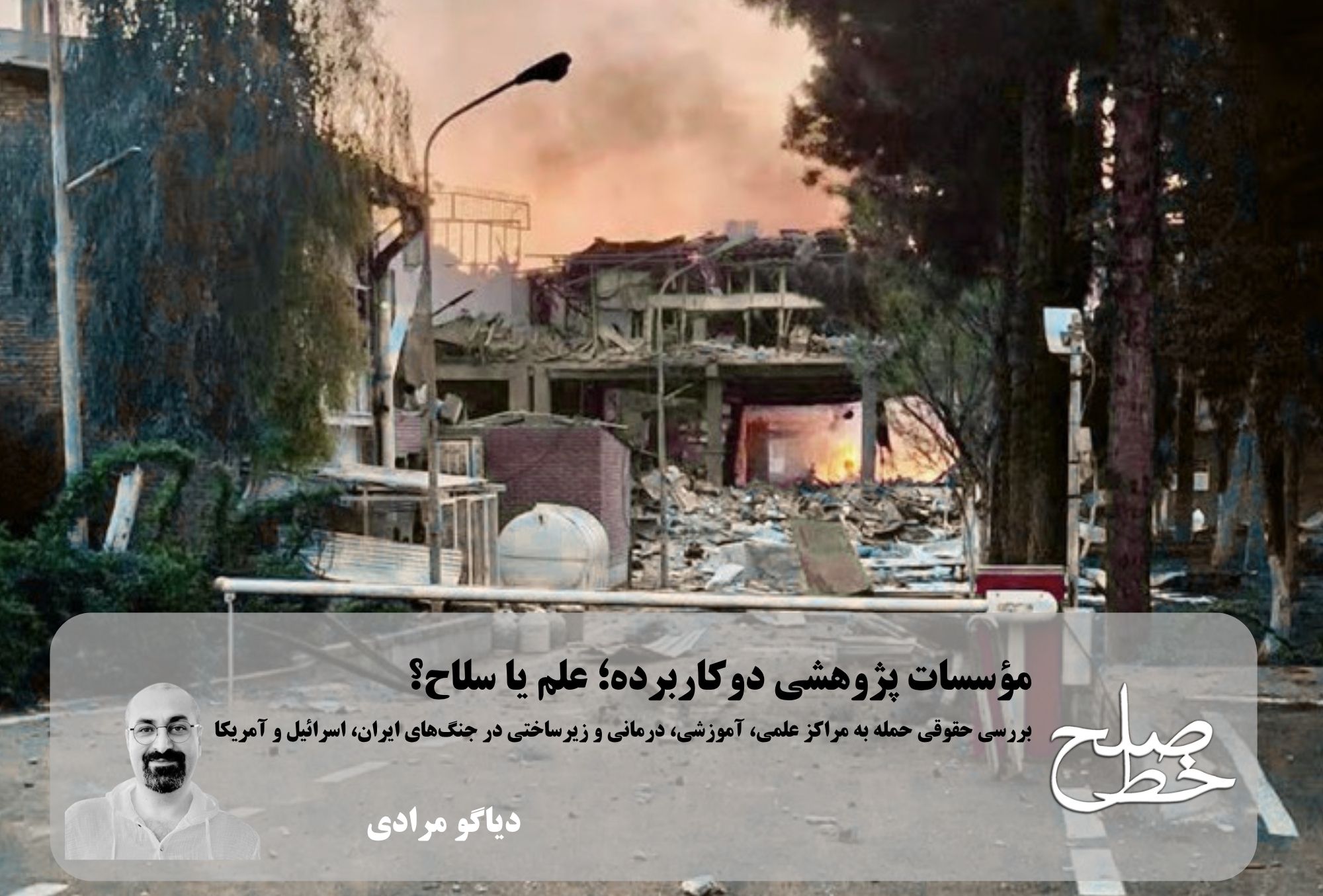
Dual-Use Research Institutions: Science or Weapon?/ Diako Moradi
Technological developments in recent decades have made the boundary between military and civilian objectives more ambiguous than ever. Universities, research centers, biomedical institutions, data networks, and communications infrastructure, while having civilian functions, can in some cases play a direct or indirect role in states’ defense capabilities. This situation has transformed the concept of “dual-use” from the field of technology export control into one of the most important issues in international humanitarian law. The wars involving Iran, Israel, and the United States in 2025 and 2026 were a clear example of this transformation; because alongside traditional military targets, scientific, medical, and infrastructural centers were also exposed to attacks or reciprocal claims. Relying on the principles of distinction, proportionality, and precaution, and citing Article 52 of Additional Protocol I to the Geneva Conventions, this article examines the legal status of dual-use targets. Its main argument is that dual-use is a technical characteristic, not an independent legal status. Only real and effective participation in military action and the existence of a direct military advantage can limit the legal protection of a target.
Introduction
Contemporary wars have challenged the distinction between the military and civilian spheres more than any other period in the history of international law. In the past, the battlefield mainly included military bases, defensive fortifications, supply lines, and command centers, and distinguishing legitimate military objectives from civilian objects was not particularly difficult. But in the twenty-first century, a significant part of states’ power has shifted from traditional military industries to knowledge-based fields. Universities, advanced laboratories, data centers, communications networks, artificial intelligence industries, nuclear technology, and biotechnology are now among the most important sources of national power.
This transformation has had profound consequences for international humanitarian law. The legal system designed after the Second World War to protect civilians was based on the assumption that a relatively clear distinction could be drawn between civil society and the war machine. But in a world where academic research plays a role in the development of intelligent systems, biological technologies have dual-use applications, and data networks serve citizens and security institutions simultaneously, this foundational assumption faces new challenges.
The wars involving Iran, Israel, and the United States in 2025 and 2026 revealed this challenge in tangible form. In these conflicts, the issue was not merely military facilities; rather, nuclear centers, research institutions, hospitals, universities, schools, airports, ports, and communications infrastructure were also at the center of disputes. In some cases, different parties considered these centers legitimate targets because of their possible role in supporting the enemy’s military capabilities, while critics regarded these attacks as violations of the fundamental principles of humanitarian law.
At the center of this dispute lies the concept of “dual-use.” This term originally referred to technologies and equipment that had both civilian and military applications. But in recent years, this concept has moved beyond the field of trade and export control and become one of the most contentious issues in the law of war. The fundamental question is whether the mere dual-use nature of a technology, institution, or infrastructure can eliminate its legal protection.
This article seeks to answer this question through the framework of international humanitarian law. Its main argument is that dual-use status, in itself, does not authorize an attack. What determines the legal status of a target is its real and effective role in military operations and the existence of a direct military advantage resulting from the attack. Preserving this distinction is necessary not only for the protection of civilians, but also for the survival of humanitarian law itself in the age of knowledge.
The Historical Evolution of the Principle of Distinction and the Emergence of the Dual-Use Concept
The principle of distinction between military and civilian objectives seems self-evident today, but it is in fact the product of a long process in the evolution of the law of war. In many ancient societies, war was fought not between armies but between communities. The destruction of farms, the siege of cities, the demolition of water resources, and the forced displacement of populations were considered ordinary tools of war. Under such conditions, the enemy’s entire society was regarded as part of the objective of war.
From the seventeenth century onward, thinkers such as Hugo Grotius and Emer de Vattel sought to impose limits on the conduct of states during war. They argued that even in conditions of conflict, a balance had to be maintained between military necessity and humanitarian considerations. Although these ideas initially had limited practical impact, they formed the theoretical foundation of modern humanitarian law.
The First and Second World Wars were turning points in this process. The widespread bombing of cities, attacks on industrial centers, and the use of nuclear weapons showed that technological progress could turn civilians into the primary victims of war. The result of this bitter experience was the formation of the Geneva Conventions and the gradual development of the principle of distinction; a principle that today is considered one of the fundamental and customary rules of international law.
But just when it seemed that the boundary between military and civilian objectives had been stabilized, the technological revolution created a new challenge. From the second half of the twentieth century onward, countries’ national security became increasingly dependent on advanced technologies. Nuclear energy, space technology, computer science, biotechnology, and later artificial intelligence all entered fields in which the boundary between civilian and military applications is very thin.
During this period, the term “dual-use” entered international discourse. States realized that many advanced technologies could not be considered entirely civilian or entirely military. A satellite can provide public communications services while simultaneously playing a role in military intelligence gathering. An artificial intelligence software program can be designed to diagnose diseases and at the same time be used in defense systems.
The problem began when this concept moved from the field of export control into the law of war. In export control regimes, mere potential capability for military use is sufficient to restrict the transfer of a technology. But humanitarian law is based on a different logic. Here, the issue is not “possible use,” but “actual use.” If mere potential capability is made the criterion, almost all universities, research centers, and advanced industries in the world could be placed among legitimate military objectives.
For this reason, a large part of contemporary humanitarian law literature emphasizes preserving the distance between these two meanings. An engineering university may in the future train specialists for defense industries, but this does not mean it is participating in military operations. A biomedical institution may produce knowledge with dual-use applications, but as long as it does not participate in a specific military activity, it does not lose its legal protection.
The Legal Framework Governing Dual-Use Targets
The most important legal basis for analyzing dual-use targets is Article 52 of Additional Protocol I to the Geneva Conventions. This article provides one of the most restrictive existing definitions of the concept of a military objective, and its purpose is to prevent the excessive expansion of the range of targets that may be attacked.
Under this article, an object is considered a military objective only when two essential conditions exist simultaneously. First, by its nature, location, purpose, or use, it must make an effective contribution to military action. Second, its destruction or neutralization, in the circumstances existing at the time, must create a direct and definite military advantage.
The existence of either of these two conditions without the other is not sufficient. This very feature means that many scientific and infrastructural centers are not considered legitimate targets merely because of their economic or technological importance. Humanitarian law distinguishes between strategic value and legal status.
Another important point is that the assessment must be directed to the time of the attack. The law of war does not judge what an institution may do in five or ten years; rather, it focuses on its current role. This limitation prevents possibilities and hypothetical scenarios from replacing legal criteria.
Alongside the principle of distinction, the principle of proportionality is the second main pillar of the protective system of humanitarian law. Even in cases where a target is considered a legitimate military objective, the attack must not cause excessive civilian harm in comparison with the expected military advantage. This principle has special importance with regard to dual-use targets, because such targets usually provide vital services to society.
In recent decades, the concept of “reverberating effects” has also been added to legal discourse. According to this view, the assessment of harm must not be limited merely to physical destruction. The destruction of a scientific center may wipe out years of research; damage to a medical institution can reduce public health capacity; and the destruction of a data center may disrupt the functioning of hospitals, banks, and schools.
The principle of precaution also obliges states to take all possible measures to reduce harm to civilians. Choosing the appropriate time for an attack, using precision weapons, and adopting warning measures are among the manifestations of this principle.
Therefore, the existing legal framework shows that the concept of dual-use is far more limited than political and media interpretations suggest. Dual-use status is neither a license to attack nor sufficient grounds for the loss of legal protection. What matters is actual participation in military action, direct military advantage, respect for proportionality, and the adoption of precautionary measures.
The Wars of 2025–2026 and the Practical Test of the Dual-Use Concept
If the previous discussions outlined the theoretical and legal framework of the issue of dual-use targets, the wars of 2025 and 2026 were the first arenas in which these concepts confronted battlefield reality on a broad scale. The significance of these conflicts lay not merely in the volume of military operations or the damage caused, but in the fact that many of the disputed targets were neither entirely military nor entirely civilian. This situation caused the concept of dual-use to move from a theoretical debate into a practical issue for states, international organizations, and legal scholars.
Iran’s Nuclear Facilities: Natanz, Fordow, and Isfahan
Among all the targets attacked, Iran’s nuclear facilities were more than any others at the center of legal debates. Natanz, Fordow, and the Isfahan complex had been the subject of political and security disputes for years before the war. The common feature of these centers is that the technologies used in them have a dual-use nature. Uranium enrichment, nuclear fuel cycle technology, and some activities related to atomic energy can be used in both civilian and military programs.
Nevertheless, from the perspective of humanitarian law, the mere existence of dual capability is not decisive. The main question is whether, at the time of the attack, these centers made an effective contribution to a specific military action. In other words, humanitarian law distinguishes between potential capacity and actual function.
Regarding Natanz, arguments in favor of the attack were mainly based on the claim that enrichment capacity could play a role in the development of future strategic capabilities. By contrast, critics emphasized that the law of war cannot operate on the basis of long-term assumptions and must focus on the practical and immediate role of a target in the conflict. This very difference in interpretation turned Natanz into one of the most important examples of the challenge between the logic of national security and the logic of humanitarian law.
Fordow was more complex in certain respects. The importance of this center was not limited to its technical activities; its geographical location, level of protection, and place in regional strategic calculations also played a role in assessments. However, international humanitarian law distinguishes between strategic value and legal status. A facility may be highly important from the perspective of national security, but this importance alone does not make it a legitimate military objective.
The situation was similar regarding the Isfahan complex. This complex contains part of the country’s scientific and industrial infrastructure. From a legal perspective, destroying such a center is justifiable only when it has a direct and specific effect on the opposing side’s military capability. Otherwise, long-term economic, scientific, and technological effects cannot replace the legal criteria set out in Article 52.
The Weizmann Institute and the Place of Science on the Battlefield
On the other side of the conflict, the Weizmann Institute became one of the most controversial examples of scientific targets. This institute is one of Israel’s most prestigious research centers and one of the world’s best-known scientific institutions in the field of basic sciences. Research conducted there in physics, chemistry, biology, and computer science has played an important role in the advancement of knowledge.
However, like many advanced research centers in the world, part of Weizmann’s research has also had links with defense industries and security institutions. This issue led some analysts to place it among dual-use targets.
But from the perspective of humanitarian law, research cooperation with defense institutions does not mean direct participation in military operations. If mere scientific or research ties with defense industries were sufficient to legitimize an attack, not only Weizmann but also many universities and research institutions in the United States, Europe, and Asia would have to be considered legitimate targets.
Such an interpretation would have broad consequences for the international system of science. In the contemporary world, a significant part of scientific research is conducted with government support, and the boundary between basic and applied research is not always clear. If the criterion for the legitimacy of attack is expanded to include scientific cooperation, a large part of the world’s scientific community would effectively be exposed to militarization.
Soroka Hospital and Special Protection for Medical Centers
The case of Soroka Hospital was one of the most important examples relating to the special protection of medical centers. Since the First Geneva Convention, hospitals have had a privileged position in humanitarian law. The reason for this protection is clear: their main duty is to save human lives and provide medical services.
Protection for hospitals is not limited to buildings, but also includes medical staff, patients, medical equipment, and the overall functioning of the healthcare system. Damage to a hospital can have consequences far beyond direct casualties. Closure of medical wards, reduced capacity of medical services, and disruption of relief efforts are among these consequences.
Even in conditions where it is claimed that a military target is located near a hospital, the principles of proportionality and precaution still oblige states to take all possible measures to reduce harm to patients and medical staff. For this reason, medical centers continue to enjoy some of the strongest legal protections in the system of humanitarian law.
The Expansion of the Conflict to Scientific and Social Institutions in 2026
If 2025 largely revolved around strategic and nuclear facilities, in 2026 the scope of the discussion extended to scientific, educational, and social institutions as well. This development showed that the concept of dual-use is no longer limited to advanced technologies, but can extend to broader areas of civilian life.
Iran’s Pasteur Institute
Iran’s Pasteur Institute was one of the most important examples of this development. This institute is considered one of the country’s oldest research centers and plays a prominent role in infectious diseases, vaccine production, microbiology, and public health.
Some analyses attempted, by citing the dual-use nature of biotechnology, to raise the possibility of legitimizing attacks on such centers. From a technical perspective, biotechnology truly has dual-use capabilities; the same knowledge used to develop vaccines can, under specific conditions, also acquire security applications.
But humanitarian law distinguishes between “potential capability” and “actual use.” If mere theoretical capability for military use were sufficient, almost all biomedical institutions in the world would have to be placed among potential targets. Such a result is not only incompatible with the philosophy of humanitarian law, but also threatens global public health.
Moreover, institutions such as Pasteur are not merely research centers; they are part of the country’s public health infrastructure. Damage to such centers can weaken the capacity to confront diseases, produce vaccines, and manage health crises for years.
Universities and Higher Education Centers
Universities were also at the center of legal debates in 2026. In a knowledge-based economy, universities play a role beyond education. They are places for producing knowledge, training human capital, and developing technology.
But this role must not lead to confusion between scientific activity and military participation. If training engineers or researchers for defense industries is considered participation in war, almost all advanced universities in the world would be exposed to the legitimization of attacks.
For this reason, humanitarian law distinguishes between educational activity and direct participation in military operations. As long as a university does not actually play a role in a specific military action, the presumption is that its legal protection remains intact.
Schools and the Protection of Children
During the conflicts, some schools and educational centers were also damaged. The legal importance of this issue is not limited to the status of schools, but goes back to the special protection that international law provides for children.
Children are among the most vulnerable human groups in wartime. Therefore, attacks on educational centers have consequences beyond physical damage. Disruption of education, deprivation of learning opportunities, and long-term psychological effects are among the results of such attacks.
For this reason, many international bodies emphasize that schools must enjoy the highest level of practical protection, and only under exceptional circumstances may their legal status be called into question.
Dual-Use Infrastructure in Israel and the Gulf States
The challenge of dual-use targets is not limited to scientific centers. Airports, ports, communications networks, data centers, and energy infrastructure are also important examples of targets with dual functions.
Airports are used in peacetime for transporting passengers and goods, but in wartime they may also acquire a logistical role. Ports, in addition to their economic role, may be used to move military equipment.
However, humanitarian law distinguishes between possible use and actual use. The mere fact that an airport or port could, under certain conditions, assist military operations is not sufficient to remove its legal protection.
Communications networks and data centers are among the most complex examples of dual-use targets in the digital age. These infrastructures simultaneously serve banks, hospitals, universities, and military forces. This feature has made assessing their legal status more difficult than in the past.
In such cases, the concept of “reverberating effects” gains special importance. The destruction of a data center may affect not only military capabilities, but also the functioning of medical, banking, and educational services. Therefore, the proportionality assessment must also take these indirect consequences into account.
Afterword
The examination of the wars of 2025 and 2026 shows that the concept of dual-use has become one of the most important challenges of international humanitarian law in the twenty-first century. The cases of Natanz, Fordow, Isfahan, Weizmann, Soroka, Pasteur, universities, and regional infrastructure all show that the boundary between military and civilian has become more complex than before in the age of knowledge.
However, technological complexity must not lead to the weakening of the fundamental principles of humanitarian law. The principle of distinction, the principle of proportionality, and the principle of precaution remain the most important legal tools for protecting civilians. These principles do not allow every target with a potential military use to be automatically considered legitimate.
The most important conclusion of this study is that dual-use is a technical characteristic, not an independent legal classification. What determines the legal status of a target is its real and effective role in military action and the direct military advantage resulting from the attack. Eliminating this distinction would carry the risk of expanding the battlefield to universities, hospitals, research centers, and other civilian institutions.
Ultimately, the survival of the principle of distinction in the age of the knowledge-based economy depends on preserving the boundary between “capability” and “use.” As long as this boundary is preserved, the possibility of protecting science, education, health, and civilian life amid armed conflicts will also be preserved. But if this boundary disappears, not only civilian institutions but the very philosophy of humanitarian law itself will face a serious threat.
 Created By: Diako Moradi
 June 22, 2026
Tags
Diako Moradi Dual infrastructure Dual-use infrastructure Infrastructure International rights Iran-US war Pasteur Institute Research centers Research institutions The war between Iran and Israel. War