


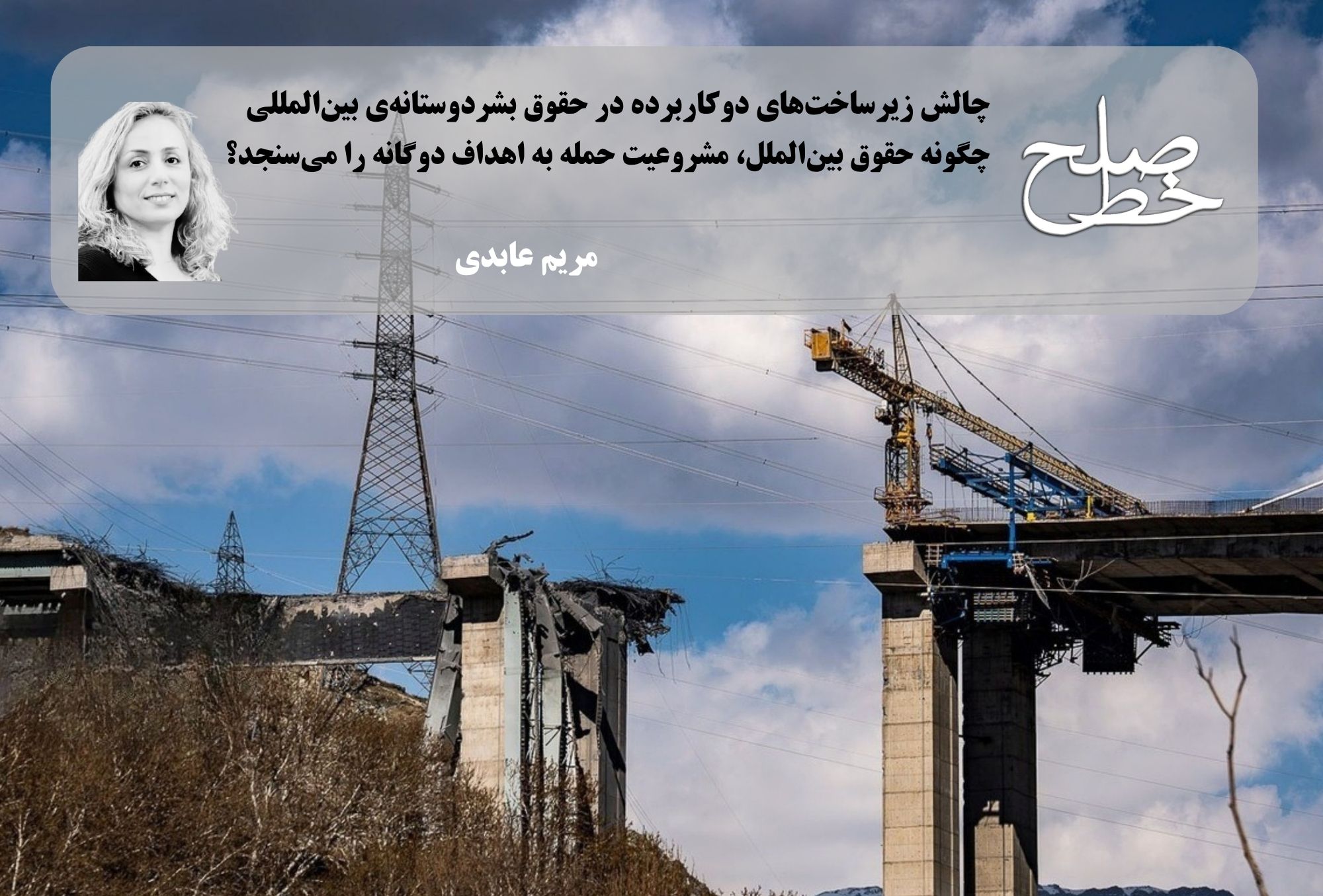
How Does International Law Assess the Legitimacy of Attacks on Dual-use infrastructure Targets?/ Maryam Abedi
Dual-use infrastructure is precisely the gray area of international humanitarian law; because it has neither an independent definition in treaties nor an absolute prohibition. Therefore, its definition must be sought within legal texts.
In international law, the term “dual-use infrastructure” is not used directly, but its definition can be inferred from Article 52, paragraph 2, of Additional Protocol I of 1977 as follows: “Military objectives are limited to those facilities which, by their nature, location, purpose, or use, make an effective contribution to military action…” Based on this article, dual-use infrastructure means property or facilities that are inherently civilian and are usually used for civilian purposes, but under the circumstances prevailing at the time of the attack, due to their current use or purpose, have acquired an effective role in military operations.
The criterion in Article 52, which indicates duality, is stated by the International Committee of the Red Cross (ICRC) in its official commentary as follows: a facility can lose its civilian status and become a military objective only for four reasons:
- The criterion of nature: the inherent character and type of the facility is military, such as a barracks, tank, arms factory, and so on. These are built for war from the outset and are never dual-use, because their primary function is military.
- The criterion of location: the facility is located somewhere that has military importance in itself, such as a bridge built on the only road leading to the front line. A bridge is a civilian structure, but because it is located in a strategic position, occupying or destroying it prevents the enemy’s advance; therefore, its location gives it a military character.
- The criterion of purpose: the facility is intended for future military use. It is not currently being used militarily, but the intention and plan are deferred to the future. For example, an airport that is entirely civilian, but the army decides to equip its runway for future air operations. From the moment this commitment and planning become definite, it can be considered a military objective. This criterion is highly sensitive and has a thin boundary with mere possibility.
- The criterion of use: this is the most common reason infrastructure becomes dual-use; meaning that the facility is being used right now, at the moment of attack, for military operations. For example, a telecommunications tower that simultaneously provides people’s internet and is also used to guide a military drone, or a power plant that supplies electricity to the city and also powers a military center. Therefore, as long as it has no military use, it remains civilian.
From these four criteria, it can be shown that the criterion of nature never applies to dual-use infrastructure. The main dispute and legal gray area concern the criteria of “use” and “purpose.” Legal experts and international lawyers disagree over how the attacking commander must prove that this power plant or tower is being used militarily right now.
The important point is that in case of doubt as to which of the above criteria applies, the presumption must be civilian status.
However, Article 52, paragraph 3, establishes the key principle of civilian status; meaning that in case of doubt as to whether a facility normally dedicated to civilian purposes is being used for military objectives, it shall be presumed that such use is not taking place. In fact, doubt is interpreted in favor of civilian status, and only by establishing two conditions simultaneously—(a) an effective contribution to military operations, and (b) destruction bringing a definite military advantage—can this presumption be overcome.
Treaty Foundations of the Principle of Distinction: From the General Rule of Article 48 to the Criteria of Article 52 of the 1977 Additional Protocol
The principle of distinction, as the foundational principle of international humanitarian law, is rooted in both customary and treaty law. The most important treaty manifestation of this principle is reflected in Additional Protocol I of 1977 to the four Geneva Conventions. The principle of distinction was explicitly codified for the first time in Protocol I and is today recognized as a binding customary rule for all states.
Article 48 of Additional Protocol I, known as the “basic rule,” provides: “The parties to the conflict shall at all times distinguish between the civilian population and combatants and between civilian objects and military objectives, and accordingly shall direct their operations only against military objectives.” This article creates a general and absolute obligation for the parties to a conflict and makes distinction between the two categories of persons and facilities mandatory. Violation of this rule is considered a grave breach and entails international responsibility.
Article 51, in explaining the protection of the civilian population, establishes two key prohibitions: first, the prohibition of direct attacks against civilians; second, the prohibition of indiscriminate attacks that are incapable of distinction. Paragraph 5 of this article also establishes the principle of proportionality, according to which incidental harm to civilians must not be excessive in relation to the direct and concrete military advantage anticipated.
Article 52 guarantees the protection of civilian property and facilities. Paragraph 2 of this article, by providing a negative definition, limits military objectives to property and facilities which, in the circumstances prevailing at the time of the attack, by virtue of their nature, location, purpose, or use, make an effective contribution to military operations, and whose destruction brings a definite military advantage.
Paragraph 3 of this article, by establishing the principle of interpretation in favor of protection, provides that in case of reasonable doubt regarding the military use of property and facilities normally dedicated to civilian purposes, they shall be presumed civilian.
Normative Developments of the Principle of Distinction After 1977
Although Additional Protocol I of 1977 codified the normative framework of the principle of distinction, later developments in international humanitarian law have strengthened enforcement of this principle through three paths. First, international criminalization under Article 8 of the 1998 Rome Statute of the International Criminal Court. This article defines war crimes, and subparagraphs (i) and (iv) directly criminalize the principles of distinction and proportionality and, for the first time, establish individual criminal enforcement for violations of the principle of distinction.
The extension of Article 14 of Additional Protocol II of 1977 expanded the obligation of distinction to non-international armed conflicts and largely addressed the protection gap in civil wars. In addition, the 2005 study by the International Committee of the Red Cross confirmed that the foundational rules of distinction, including the prohibition of direct attacks against civilians and civilian property and facilities, have customary status and are binding on all states, whether or not they are parties to Protocol I. Accordingly, today the principle of distinction, regardless of treaty ratification status, is regarded as a peremptory rule of international law.
Legal Criteria Governing Simultaneous Dual Use and the Loss of Special Protection
The protection of facilities such as hospitals, under Article 19 of the Fourth Geneva Convention and Article 13 of Protocol I, is conditional upon refraining from acts harmful to the enemy outside their humanitarian functions. Therefore, establishing a military command center in part of a hospital does not in itself cause the loss of protection; because loss of protection depends on two cumulative conditions: first, establishing actual and effective military use of that location in directing ongoing operations; second, giving prior warning with a reasonable time limit for ending that use. According to Article 13, as long as these formalities are not observed and effective military role is not established, the facility continues to enjoy full protection.
Humanitarian law constrains the concept of military objective by the requirement of the present time. As Article 52, paragraph 2, explicitly states, contribution to military operations must exist in the circumstances prevailing at the time of the attack. The official commentary of the International Committee of the Red Cross also understands the criterion of purpose as referring to planned and definite imminent use. Therefore, attacking infrastructure such as a bridge or power plant merely on the basis of capacity or possible future military use lacks legal basis.
In such cases, the principle of interpretation in favor of protection, the subject of Article 52, paragraph 3, applies and places the burden of proving immediate intent on the attacker.
Applying the Principle of Proportionality to Incidental Harm Resulting from the Destruction of Dual-Use Targets in Light of Article 51
The legality of attacking a military objective does not prevent the application of the principle of proportionality, set out in Article 51, paragraph 5, to collateral damage. Whenever the destruction of a military objective requires disabling dual-use infrastructure, the commander is obliged to take into account the foreseeable reverberating effects on the civilian population, such as disruption to hospital services, water, heating, and so on. If the expected collateral damage is excessive in relation to the direct and concrete military advantage, the attack is prohibited. Article 57 also makes it mandatory to take all feasible precautionary measures to avoid or reduce these effects.
The Outcome of What Was Stated Above
Examining the normative system of the principle of distinction in light of Articles 48, 51, and 52 of Additional Protocol I of 1977, and applying it to the challenges of simultaneous dual use, future intent, and foreseeable indirect effects, confirms that the principle of distinction is not a moral recommendation, but the inviolable red line of international humanitarian law and the ultimate benchmark for assessing the legitimacy of military actions.
In modern conflicts, where the boundary between military and civilian matters has been blurred by dual-use infrastructure, adherence to the narrow criteria of Article 52 is the only minimum guarantee of humanity. Any interpretation that weakens this red line under the pretext of battlefield necessities amounts to departing from the purpose of humanitarian law and returning to the logic of total war; because the principle of distinction is the main pillar and foundation of humanitarian law, and any harm to it destroys the credibility and effectiveness of the entire legal system of armed conflicts.
 Created By: Maryam Abedi
 June 22, 2026
Tags
Dual infrastructure Dual-use infrastructure Human rights Infrastructure International rights Iran-US war Launcher Maryam Abedi Military base peace line Red Cross The war between Iran and Israel. Ukraine War War