


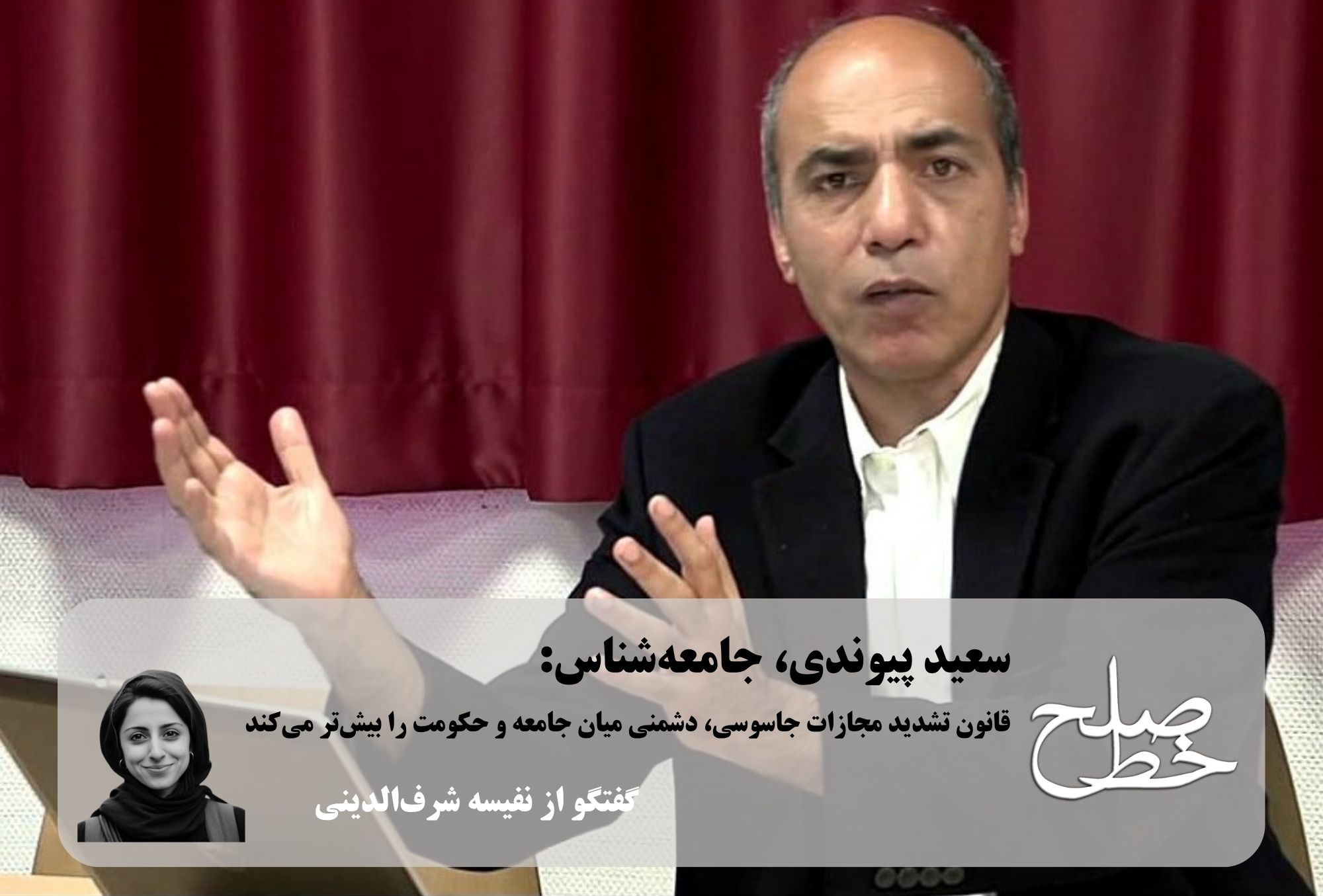
Saeed Peyvandi: The Law on Intensifying Punishment for Espionage Will Deepen Hostility Between Society and the Government/ Nafiseh Sharafaldini
Following the adoption and communication of the “Law on Intensifying Punishment for Espionage and Cooperation with the Zionist Regime and Hostile States Against National Security and Interests,” extensive debates have emerged regarding the legal, political, and social consequences of this law. Many critics believe that the expansion of concepts such as “cooperation with a hostile state,” “security activity,” and “action against national security” could further blur the boundary between civil, academic, media, and security-related activities, while paving the way for expanded surveillance, control, and social repression. To examine the sociological dimensions of this law and its impact on civil liberties, social trust, self-censorship, and the securitization of society, Peace Mark Monthly Magazine spoke with “Saeed Paivandi,” Iranian sociologist and director of the LISEC-Lorraine research center at the University of Lorraine.
Below is the full text of the interview with Saeed Paivandi:
How does the “Law on Intensifying Punishment for Espionage and Cooperation with the Zionist Regime and Hostile States Against National Security and Interests” expand the concept of “security” from a purely legal-security category into a tool for regulating and controlling social, media, and even academic relations? Can it be considered an example of the “securitization” of society in the sociological sense?
In my view, this law and the current actions of Iran’s judiciary, intelligence organizations, and law enforcement forces all fall within this framework. In other words, we are dealing with a comprehensive process of securitization in Iranian society, and under such definitions, anyone can be accused in areas such as cooperation with foreign or hostile countries, security-related activities, and similar matters. One could say that the government, from its own perspective, is trying to create a kind of deterrence against potential cooperation by certain members of society with foreign forces. But in practice, what this means is that the government will, in one way or another, regard all outsiders as suspicious.
If you look at the cases and trials of defendants in recent weeks and months—especially those accused of cooperating with Israel or hostile states—you do not see much in their files, at least based on what is announced in the media. These individuals are accused of matters for which there is insufficient evidence to prove them, at least in the indictments presented by the courts, and the evidence does not appear particularly strong or convincing. It is mostly a series of interpretations and accusations that can be raised, but until they are proven, they remain merely accusations. In reality, Iran’s courts have long operated in this manner. If there truly were strong evidence against these individuals concerning cooperation with foreign countries, why would the courts fear holding public trials, allowing defendants to have lawyers of their own choosing, and ensuring that public opinion is fully informed? In fact, there should be a form of transparency so that we can be certain these accusations are real and that the evidence is sufficiently solid to justify convicting someone. We are not even entering the discussion of the types of punishments, because there is a huge gap between the accusations brought against individuals and the punishments imposed on them. For example, in the case of those executed on these charges, in many instances it is unclear why someone should receive such a severe punishment for conduct that may not even clearly constitute espionage.
When the boundary between “academic, media, or civil cooperation” and “cooperation with a hostile state” becomes blurred, what impact will this have on social trust, freedom of expression, and social capital?
Creating such a broad framework for defining hostile states or contact with hostile states effectively gives the judiciary a free hand to categorize many activities that should not fall under such accusations as cooperation, espionage, or collaboration with an enemy country. This issue can also apply in academic fields, just as we saw in some cases in recent years involving dual nationals or people working in research centers inside Iran. The speed with which courts convict these individuals—especially those sentenced to death—has always raised doubts about how accurate these accusations are and to what extent they are intended to intimidate others and create an atmosphere of fear and security domination in society.
Therefore, Iran’s tragedy is that we are dealing with a non-accountable judiciary and security forces. We are dealing with prisons that are neither transparent nor accountable. We are dealing with a system of defense for defendants that is not standard, where people cannot have lawyers of their own choosing, and where lawyers themselves do not have access to all the information necessary to defend their clients properly. As a result, we are faced with a dysfunctional system that, during wartime, turns into a monster and becomes a tool in the hands of the state for repressing and restricting society.
What impact will this law have on the emergence of “self-censorship” among journalists, researchers, civil activists, and even ordinary citizens? Can it be said that fear of security-related accusations becomes a tool for social control?
When the definition of the crime of cooperation with foreign or hostile states is this broad and can encompass a huge range of situations that are often meaningless—such as contact with a publication or media outlet that is probably affiliated with government opponents and accused of being funded by one government or another, where simply contacting such media can be interpreted as cooperation with hostile governments or media—the consequences are obvious. The clear consequence is that people become extremely cautious and are forced either to self-censor or to accept a form of top-down censorship imposed on society. This is because the scope for interpretation and application of the law is so broad that it can include many different situations, and individuals can easily become criminals for actions that would be considered entirely ordinary in another country or society.
Even until now, what has existed has always been the shadow of fear of becoming the target of accusations, hanging over journalists and the academic community like the Sword of Damocles. Therefore, it can be said that such laws and approaches within Iran’s judiciary, security agencies, and even law enforcement, with this broad capacity for interpretation, can have extremely negative consequences for matters such as freedom of expression and freedom of communication in society. This is because anyone can potentially become a suspect, and this is a camel that may sleep at everyone’s door—especially given that our courts rarely observe the ordinary standards common in judicial systems around the world. The judiciary can easily make accusations, extract confessions under torture, and then use those same confessions as grounds for conviction. Individuals also do not enjoy ordinary rights of defense. As a result, this ongoing judicial injustice truly causes people to become afraid, to censor themselves, and to avoid any involvement with the judiciary because serious accusations can be directed against them. The record of this system also shows that through false confessions they can fabricate cases against people, level serious accusations, and even issue death sentences, which is profoundly unjust. We are in a situation where there is no healthy, transparent, and independent judiciary in Iran, and anyone who becomes entangled with this existing system has no idea what fate awaits them.
Some sociologists believe that governments, during periods of crisis, use security laws to redefine the boundary between “insiders” and “outsiders.” Can this law be viewed as an attempt to redefine political loyalty and impose stricter control over social and cross-border relations in Iran?
That is correct. From a sociological perspective, especially in closed and non-democratic governments, wartime and military crises always create conditions that encourage governments to engage in behavior that gives them greater freedom to carry out actions such as making accusations, arresting people, detaining them without justification, and imposing excessively harsh punishments that they could not normally implement under ordinary circumstances. By exploiting these conditions, the state seeks to take revenge on those it considers outsiders within society, to control them, and to place them under intense security surveillance. It also seeks to eliminate any possibility of protest or dissent. One of the fears of authoritarian governments is that military crises—especially when accompanied by economic crises and multiple social problems—can create the conditions for widespread dissatisfaction. Even during wartime, this dissatisfaction can turn into a public uprising or protest movement.
For this reason, broadening the net of convictions and making the atmosphere more securitized is not merely about the country’s real security, but about the security of the government, state institutions, and official bodies. This type of approach to national security is not always truly connected to national security and what threatens it. When we see that the Israelis have such extensive knowledge of military information or the residences of the country’s military and political leaders and can easily target them wherever they are, this demonstrates that the government has failed in ensuring national security. A government that has failed to establish national security then seeks to compensate for its failure by taking revenge on citizens, restricting them, and imposing comprehensive security surveillance upon them, attempting to repair its weakness in that sphere through displays of power in another sphere—something that will not fundamentally change the situation. Our national security weaknesses will remain where they are, and in this sphere, the government and ruling establishment will gain nothing except greater hostility between society and the state.
Thank you for giving Peace Mark Monthly Magazine this opportunity.
 Created By: Nafiseh Sharafaldini
 May 22, 2026
Tags
Espionage Forty Days War peace line Peace Line 181 Saeed Peyvandi Spy Twelve-day war