


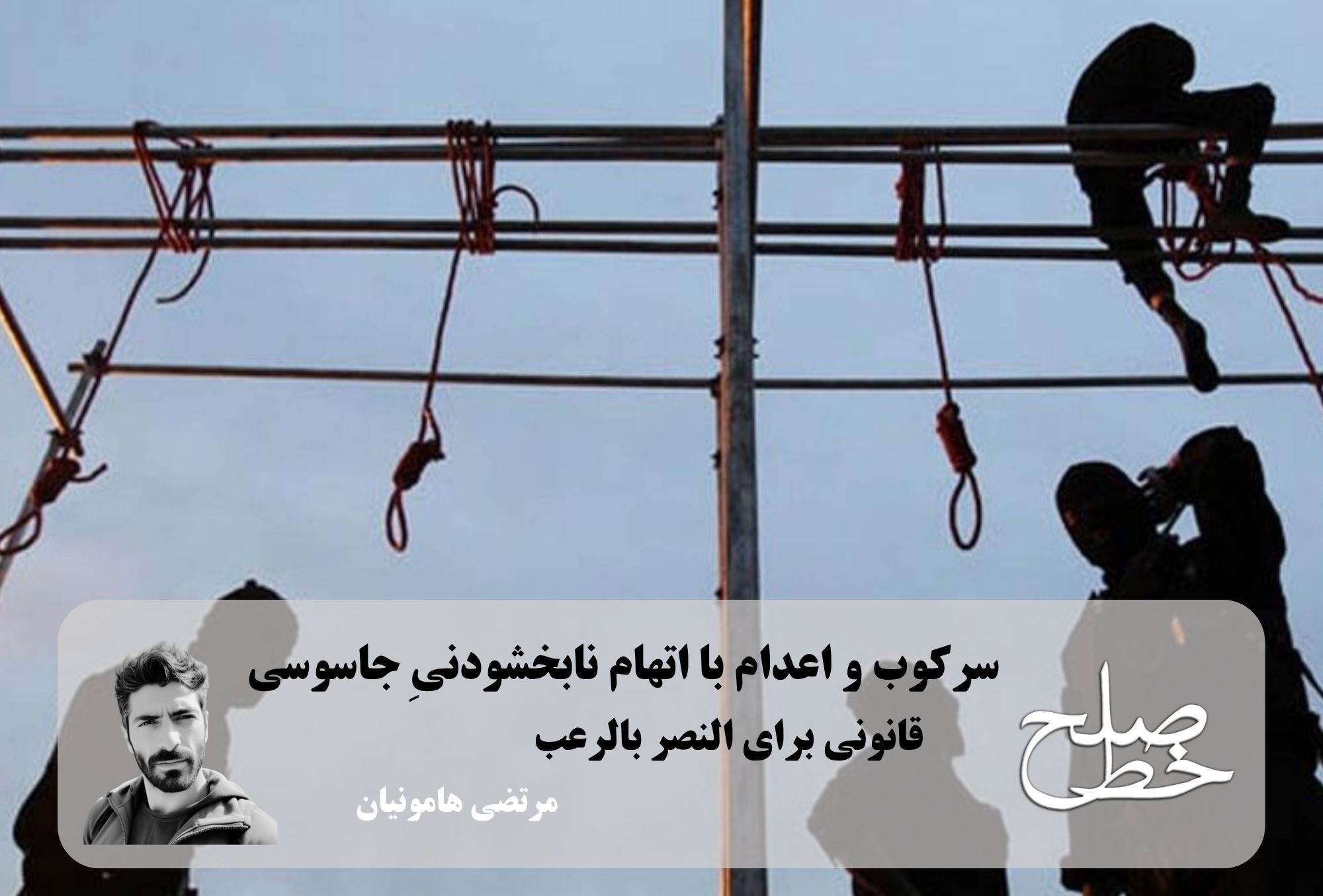
Repression and Execution Under the Unforgivable Charge of Espionage/ Morteza Hamounian
Each time, the government finds a new pretext to take human lives; a government that, throughout its existence, has shown that it places no value on the lives of citizens. The latest example became clear during the war between the United States and Israel and Iran, when it was revealed that for years, massive budgets allocated to passive defense had either been spent on unknown matters or had no real function in protecting the people. The result was that citizens under missile attacks were deprived even of the most basic possibility: a safe shelter to preserve their lives.
Hesameddin Ashena, a former security official and head of the Center for Strategic Studies, affiliated with the presidential institution, in the eleventh and twelfth administrations, said in the first episode of Espresso, hosted by Mohammad Delavari and broadcast on the Rubika platform, that by referring to Switzerland and the existence of a large nuclear shelter there, Iran should have paid attention to preserving people’s lives. But what happened in practice was the exact opposite of protecting people’s lives. Not only was there no will to preserve citizens’ lives, the government simultaneously created a new legal path for taking human lives. The result was the adoption of the “Law on Intensifying Punishment for Espionage and Cooperation with the Zionist Regime and Hostile States Against National Security and Interests”; a law that is presented under the name of security, but in practice places another tool of repression in the hands of the ruling establishment so that, under the pretext of espionage charges, it can expand the scope of executions and the elimination of opponents. (1)
If, in the summer of 1988, the massacre of political prisoners took place in the form of extrajudicial executions—a term Amnesty International used in its December 2018 report because those executions took place outside judicial procedures—this time, political opponents are to be executed or intimidated through a legal instrument and an accusation that targets the defendant’s dignity and reputation: the charge of espionage and cooperation with Israel and hostile countries against Iran’s security and national interests. Under Note 1 of Article 1 of this law, the United States and Israel are recognized as “hostile states,” and the determination of whether other countries are hostile has been entrusted to the Supreme National Security Council. This means giving the Council a free hand to declare any country hostile whenever it wishes, and under this law, even the slightest interaction with that country could carry the death penalty. That is to say nothing of the fact that, in principle, even interaction is not needed for execution and accusation. The various intelligence bodies of the Islamic Republic produce their security scenarios by relying on confessions extracted under pressure and torture, and in the absence of a fair trial, those same narratives become the basis for issuing sentences. In such an atmosphere, the head of the judiciary tells those opposed to executions: “You are wrong to say that so-and-so should not be executed.” (2)
The Law on Intensifying Punishment for Espionage was communicated on October 14, 2025 (22 Mehr 1404), by the president, Masoud Pezeshkian, to the judiciary, the Ministry of Intelligence, the Ministry of Justice, the Supreme National Security Council, and the Ministry of Defense and Armed Forces Logistics; a communication that effectively made the law enforceable. The enforcement of this law also gave Iran’s multiple security agencies an opportunity to launch a new wave of arrests of dissenting and protesting citizens under the pretext of espionage charges. Less than a month after the law was communicated, the Intelligence Organization of the Islamic Revolutionary Guard Corps announced the arrest of a number of people in several provinces on charges of spying for the United States and Israel. (3) These arrests took place before the recent 40-day war. However, in its announcement, the IRGC Intelligence Organization claimed that the arrests were connected to matters related to the 12-day war and accused the detainees of acting with the “aim of disrupting the country’s security in the second half of autumn 2025 (1404).”
They published news of the arrests of several people about a month later. But for carrying out executions on espionage charges, they did not even wait half that time. On October 18, 2025 (26 Mehr 1404)—less than a week after the law was communicated—“Javad Naeimi,” who had previously been sentenced to death on charges of “espionage,” was executed in Qom Prison. (4) Although his death sentence had been issued before the communication of this law, its execution showed from the outset that the charge of espionage was set to become a new pretext for expanding the execution machine in the Islamic Republic.
Another victim of this charge was “Aqil Keshavarz,” who was executed on December 20, 2025 (29 Azar 1404), in Urmia Prison. According to the judiciary’s media center, the contents of Mr. Keshavarz’s case state that he “had contact through cyberspace with the army and the Mossad service of the Zionist regime and began his cooperation by sending messages and information. To gain trust, he sent the details of several suspected warehouses and buildings and was gradually encouraged to carry out more missions.” The judiciary also claimed that Aqil Keshavarz had carried out more than 200 missions in the cities of Tehran, Isfahan, Urmia, and Shahroud before his arrest; missions that included photographing locations, placing transmitters, opinion polling, and examining the traffic conditions of roads. Finally, it stated that Aqil Keshavarz had cooperated with Israeli intelligence services and “groups affiliated with the Monafeqin,” and had provided them with information and images related to sensitive sites. (5)
This package of accusations, however, serves more as propaganda for government supporters. In a country where the attacking side has intelligence penetration as far as the residences and sleeping quarters of senior military commanders and targets those sites, the claim that an ordinary citizen, by sending a few images and locations, was the main source of a security threat resembles a staged narrative more than a credible case. Ali Younesi, the intelligence minister in Khatami’s government, warned in the summer of 2021 that the level of Mossad penetration in the Islamic Republic was so extensive that officials of the system should be worried about their lives. (6) These remarks themselves reveal the depth of the security crisis within the ruling structure. Nevertheless, the government accuses Aqil Keshavarz of having cooperated simultaneously with Mossad and groups affiliated with the Mojahedin-e Khalq Organization. In such cases, it appears that the Islamic Republic’s judiciary places a collection of scattered and unproven accusations beside one another; accusations that, in the absence of access to a fair trial and effective defense, the defendant is practically unable to refute, and in the end, his life is turned into a tool for displaying power and creating public fear.
Another victim of this charge in Iran is “Ali Ardestani.” He was executed at dawn on January 7, 2026 (17 Dey 1404), on charges of spying for Israel. According to the official narrative, Ali Ardestani was accused of providing images and information about certain locations and targeted individuals to Mossad officers on their orders, and of receiving payments in cryptocurrency for each mission. (7) This pattern of accusation is the same recurring scenario seen in many similar cases. This is despite the fact that even in domestic applications such as “Neshan” and “Bale,” the geographical coordinates of many places are publicly available, and ordinary citizens essentially do not have direct access to secret and security centers. Nevertheless, the judiciary of the Islamic Republic bases death sentences on such accusations, and Ali Ardestani was ultimately executed on the same charge.
In February 2026 (Bahman 1404), this charge claimed another victim: “Hamidreza Sabet Esmaeilpour,” who was executed on January 28, 2026 (8 Bahman 1404), on charges of espionage. This case, too, is the same old story. The Islamic Republic’s judicial system claims that there was a Mossad officer who contacted Mr. Sabet Esmaeilpour through cyberspace and told him to carry out tasks in exchange for money. (8) Even if the ruling gentlemen themselves believe these stories, which resemble the Islamic Republic’s security-produced police films, public opinion is not obliged to believe them. When, by showing a few codes on a screen, green and blue texts, and vague dialogues lacking technical logic, they try to create a cinematic scene of “infiltration” and “espionage,” it is only natural that these repetitive scenarios are not very believable to many citizens who have even minimal familiarity with the country’s political and security atmosphere.
The last victim of this charge in 2025–2026 (1404)—at a time when the U.S. and Israeli attack on Iran had begun—was a dual national: “Kourosh Keyvani,” a Swedish-Iranian dual citizen, who was executed on March 18, 2026 (27 Esfand 1404), on charges of spying for Israel. (9) In the view of the Islamic Republic, dual nationality itself is an unforgivable sin. The charge attributed to Mr. Keyvani did not differ much from previous cases: espionage through sending images and information related to sensitive sites in the country. This is while, as stated earlier, the geographical coordinates of many public and visible places are also accessible through domestic applications, and ordinary citizens essentially do not have direct access to secret and security centers. Yet this apparently does not matter to the accusing institutions. In such an atmosphere, dual nationality and even traveling in a group can become a pretext for attributing links to Israel and, ultimately, bringing espionage charges and issuing a death sentence. What is also absent in all this is anything called due process and a fair trial; a concept that has practically no place in such cases.
In the first days of April 2026 (Ordibehesht 1405), “Mehdi Farid,” a prisoner accused of espionage, was executed. The judiciary’s media center also claimed that Mr. Farid had worked in one of the institutions related to passive defense and had established contact through cyberspace with a person introduced as a “Mossad officer.” The report claimed that after initial contact by email, he gradually entered into intelligence cooperation and provided information about organizational structure, infrastructure, and personnel details to the other party. (10) The issue is that, according to media reports, despite full cooperation with the authorities, Mehdi Farid was initially sentenced to 10 years in prison by Branch 26 of the Tehran Revolutionary Court, and after a retrial, this time in Branch 23 of the Tehran Revolutionary Court, he was sentenced to death on charges of spying for Israel. (11) This process shows that there was a serious will to carry out his execution. It is not clear, of course, how much of this will stemmed from the new law on intensifying punishment and how much resulted from pressure and influence by security agents; agents who, in practice, play a more decisive role than judges themselves in many political and security cases, whereas the opposite should be true. Farid was executed at the beginning of April 2026 (Ordibehesht 1405); a month with a large number of citizens executed on espionage charges. It was as though the main season of executions resulting from that law on intensifying punishment had arrived.
Ten days after Mehdi Farid, “Yaqoub Karimpour,” a citizen following the Yarsan faith, and “Nasser Bakerzadeh,” who had been sentenced to death on the same charge of espionage, were executed. The alleged grounds for these executions, carried out on May 2, 2026 (12 Ordibehesht 1405), were similar to the previous cases. The judiciary’s media center described the accusations against these individuals as “sending information and images of military sites,” “sabotage activities,” “making sound bombs,” “collecting information from sensitive centers,” and “field cooperation with Mossad officers.” (12) The same model of accusation, the same method, and the same path. Citizens deprived of the most basic elements of a fair trial, and security institutions that cut and stitch the cases and dictate the sentences to judges.
Less than ten days after these executions, on May 11, 2026 (21 Ordibehesht 1405), the judiciary’s media center announced the execution of “Erfan Shakourzadeh,” a master’s student in aerospace engineering. Erfan Shakourzadeh had previously been sentenced to death on charges of intelligence cooperation and espionage. According to the official narrative, he was accused of communicating with individuals linked to Mossad and the CIA through platforms such as email, LinkedIn, and WhatsApp. (13) Erfan Shakourzadeh was an aerospace student, and it is natural that he would use a platform like LinkedIn—which is a common tool for communication and academic exchange in the global university space—to connect with people in his field and pursue academic activities. Yet in the security atmosphere of the Islamic Republic, even this type of communication can be used as a basis for bringing espionage charges. As it appears in many of these cases, security institutions are less interested in discovering a crime than in finding an example to establish the accusation and issue a sentence; the very thing Navid Afkari described as “looking for a neck for their rope.”
Two days later, on May 13, 2026 (23 Ordibehesht 1405), another educated person was executed in Iran on the same charge of espionage. “Ehsan Afrashteh,” a graduate with a master’s degree in civil engineering and a specialist in networking and information technology, had previously been sentenced to death on charges of “spying for Israel,” and the sentence was carried out at dawn on May 13, 2026 (23 Ordibehesht 1405). (14) The pattern of accusation in this case did not differ much from previous cases; the same repetitive security narratives and the same process seen in many similar cases.
The danger of more executions is also on the way. On May 17, 2026 (27 Ordibehesht 1405), the commander-in-chief of the country’s Law Enforcement Command announced that since the start of the U.S. and Israeli war with Iran, more than 6,500 people had been arrested in the country on charges including “espionage.” (15) This means more than 6,500 lives are at risk of execution under this charge. More than 6,500 necks for which the gentlemen may reach a point where they find ropes.
After the start of the war between the United States, Israel, and Iran, more than 30 citizens were executed by the Islamic Republic on political and security charges. At least six of them were executed on charges of espionage. If we count from the time the Law on Intensifying Punishment was communicated, at least 10 citizens had been executed on charges of espionage in the Islamic Republic of Iran by the time this text was written. These executions took place while, in the 12-day war, the attacking side knew the sleeping quarters of the country’s senior military commanders from the very beginning and targeted them. These executions are taking place while the attacking side, in this recent war, even identified Ali Larijani’s secret place of residence. This is a government whose former intelligence minister warned less than five years ago that Mossad’s infiltration of the Islamic Republic was so extensive that officials of the system should worry about their lives. In reality, it is precisely this level of infiltration into the most secure pillars of the system and military institutions that enables Mossad to attack Ismail Haniyeh’s residence in Tehran and kill him. On the other hand, Mahmoud Alavi, the intelligence minister in Rouhani’s government, also said that the perpetrators of the assassination of Mohsen Fakhrizadeh were “always half an hour ahead” of Iran’s intelligence agencies and that “all of them escaped.” (16) Nevertheless, instead of being accountable for this level of infiltration, the Islamic Republic’s security institutions are busy fabricating cases and building resumes for themselves, sending citizens to the gallows under the charge of espionage. That is to say nothing of the fact that even if one percent of these accusations were true, it would not diminish the reality that execution is an inhuman punishment that deprives people of the right to life.
The regime’s security agencies, instead of catching spies, are building work portfolios for themselves and performing for their rulers and superiors in the political system governing Iran. For these executions, they also pass a law on intensifying punishment so that this time their killing will no longer be extrajudicial, and they can justify their crimes and executions by citing the existence of law, court, and verdict; never mind that their law is, from the very foundation, inhuman, unlawful, and subject to the whims of tyrannical rulers.
Under these circumstances, both the country’s security is adrift and the lives of Iran’s children are being cast to the wind by the ruling authoritarian establishment. The government kills under the pretext of espionage in order to frighten a nation through the policy of “victory through terror.” A nation that, most recently, in December 2025 and January 2026 (Dey and Bahman 1404), experienced the largest massacre of protesters in contemporary history will not, of course, be frightened by these executions. A day will come when the regime’s blade of repression and execution will also lose its force, and this time it will be the people who, through their presence, rewrite their own destiny; a destiny without execution under any pretext or charge. In the hope of a time without executions and the abolition of this inhuman punishment in Iran.
Notes:
Law on Intensifying Punishment for Espionage and Cooperation with the Zionist Regime and Hostile States Against National Security and Interests, Islamic Parliament Research Center.
“Ejei: You were wrong to say that so-and-so should not be executed + video,” Hamshahri Online, April 30, 2026 (10 Ordibehesht 1405).
“Arrest of several people on charges of espionage by the IRGC Intelligence Organization,” HRANA, November 11, 2025 (20 Aban 1404).
“Supplementary report: number of those executed in Qom Prison rises to two,” HRANA, October 22, 2025 (30 Mehr 1404).
“Aqil Keshavarz executed in Urmia Prison,” HRANA, December 20, 2025 (29 Azar 1404).
“Warning by Ali Younesi, Rouhani’s aide: Mossad’s infiltration of the Islamic Republic is so extensive that officials should worry about their lives,” BBC Persian, June 29, 2021 (8 Tir 1400).
“A defendant accused of ‘espionage’ executed,” HRANA, January 7, 2026 (17 Dey 1404).
“Espionage charge: Hamidreza Sabet Esmaeilpour executed,” HRANA, January 28, 2026 (8 Bahman 1404).
“Kourosh Keyvani, Iranian-Swedish dual citizen, executed on charges of ‘espionage,’” HRANA, March 18, 2026 (27 Esfand 1404).
“Mehdi Farid executed on charges of ‘espionage,’” HRANA, April 22, 2026 (2 Ordibehesht 1405).
“Iran says it executed an employee of one of the country’s ‘sensitive organizations,’” Radio Farda, April 22, 2026 (2 Ordibehesht 1405).
“Yaqoub Karimpour and Nasser Bakerzadeh executed,” HRANA, May 2, 2026 (12 Ordibehesht 1405).
“Erfan Shakourzadeh, aerospace engineering student, executed on charges of ‘espionage,’” HRANA, May 11, 2026 (21 Ordibehesht 1405).
“Ehsan Afrashteh executed on charges of ‘espionage,’” HRANA, May 13, 2026 (23 Ordibehesht 1405).
“Commander-in-chief of the Law Enforcement Command: more than 6,500 people arrested since the start of the war,” HRANA, May 17, 2026 (27 Ordibehesht 1405).
“Former Iranian intelligence minister: perpetrators of Mohsen Fakhrizadeh’s assassination were always half an hour ahead,” Radio Farda, November 26, 2024 (6 Azar 1403).
 Created By: Morteza Hamounian
 May 22, 2026
Tags
Ali Ardestani Aqil Keshavarz CIA Ehsan Afrashte Erfan Shakourzadeh Espionage Espionage for Israel Execution Javad Naeimi Mehdi Farid Morteza Hamounian Mossad Nasser Bekerzadeh peace line Peace Line 181 Spy Yaqoub Karimpour