


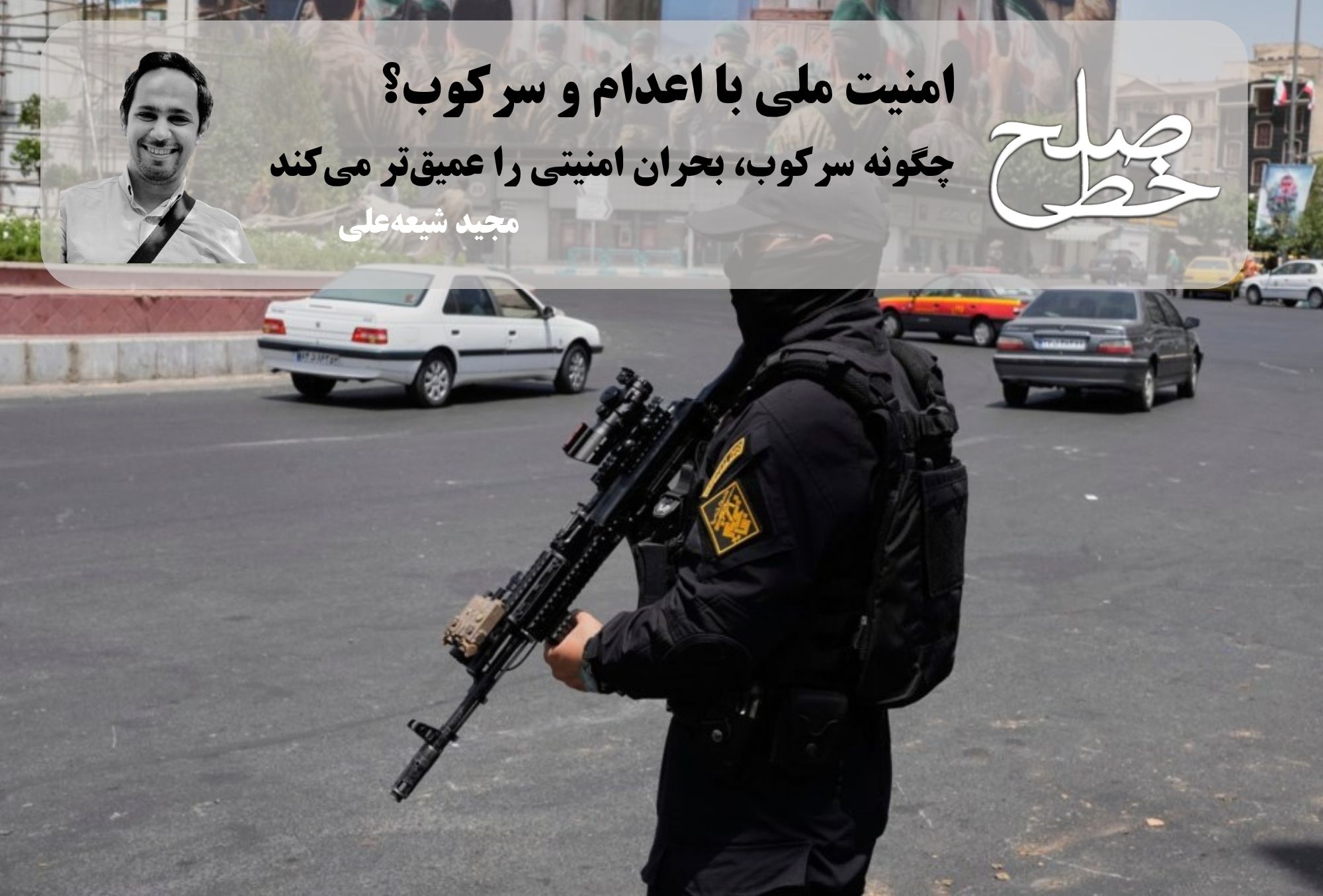
National Security Through Execution and Repression?/ Majid Shia’ali
Since the beginning of the war, human rights violations by the ruling establishment in Iran have increased significantly. In the days after the ceasefire, not a day goes by without news of executions carried out on the basis of death sentences issued through a deeply flawed judicial process and with clear political orientations. The process of arresting civil and political activists did not stop even amid the bombings. While university classes have not returned to normal, the disciplinary committees of some universities have quickly become active and have used events from several months ago as a pretext for issuing convictions. In our time, cutting off the internet means depriving citizens of access to freedoms they have the right to use. The continuation of this shutdown after the ceasefire, in addition to causing irreparable damage, is a deprivation of citizenship rights reinforced by structural discrimination. The continuous and discriminatory presence of only one political viewpoint in the street is itself a form of discrimination whose aim is clearly to practically strip other political viewpoints of their right to express themselves in the street. All these doubled violations of Iranians’ citizenship rights are being justified with the claim of ensuring national security. But the question is: what is national security? How are crime, discrimination, and repression supposed to ensure it?
Security studies and the concept of national security, as a young field of knowledge, drew the attention of researchers, political thinkers, and academics after the Second World War and amid the Cold War. This field initially emerged from international relations and gradually came to be regarded as an independent discipline. The early answers to the fundamental questions of security were very clear. Every approach to security is faced with this question: whose security must be ensured, and how, and by what factor, is this security threatened? In traditional schools, the referent whose security had to be placed on the agenda was understood to be the state, and its security was to be ensured against other states that threatened it through military challenges. This state-centrism and militarism in the definition of security were among the features of early views. Views such as realism and liberalism, although formulated during the Cold War, each had intellectual roots that went back further.
In the next step, critical schools seriously challenged traditional answers to the fundamental questions. They questioned the scope of answers regarding the referent of security. In critical approaches, ensuring the security of the state alone is no longer the issue. The subject can be defined from the smallest unit, meaning the human individual, to the environment across the entire planet or all of humanity. In their view, today one can no longer refuse to regard the threats women face in everyday life as security issues, or fail to see environmental catastrophes as security issues, or separate economic decisions from security matters. In critical approaches, the security agenda expands so much that it includes issues that are not only ignored by the ruling establishment in Iran, but are meaningfully trampled underfoot. For example, women’s security, whether at home or in society, especially in the experience of wars, can be included in the security agenda; failing to include it is not mere neglect, but a meaningful disregard.
In addition to the referent of security, the agent that threatens the security of that referent was also questioned in critical schools. Harm no longer comes only from another state and through military forces. Militarism in the understanding of security was set aside in these approaches. In these views, threats to security can also be understood through environmental damage and destruction. But this was not the end of defining the concept of security. The expansion of security agendas faced a broad reaction from scholars loyal to traditional views. They raised several objections to this expansion. First, expanding the security agenda in practice challenges the coherence of the concept of security, and in effect, dealing with everything means dealing with nothing. If you include the environment alongside the issue of war, and both alongside feminist issues, you have dealt with everything and deeply addressed nothing. Second, expanding the security agenda reduces attention to a prominent threat such as war and military action and lowers this important issue to the level of everyday challenges. Whereas it is better to place war separately on the security agenda as a specific issue and examine it on its own.
Of course, over time, this state-centrism of traditional schools itself led to diverse and broad understandings of the examples of the state in practice. Throughout the modern era, the newly emerged political unit of the nation-state has sought its own survival and the elimination of existential threats against itself. But how the state is understood has undergone serious transformation over time. In the first stages of the formation of new nation-states, ensuring the security of the state was limited to preserving the survival of the royal dynasty, because governance in absolute states was monopolized by them. But with the expansion of democracy and the right to govern, the concept of eliminating existential threats to the state gradually came to include broader strata of the people as well. This expansion continued to the point where, in today’s liberal democracy in some societies, it has been able to include all citizens as rulers in modern states. In this sense, even if we take the subject of security not to be the citizen or humanity, but, according to the traditional view, “the state,” the conduct of the ruling establishment is still contradictory. The ruling establishment’s contradictory claim about ensuring national security through the violation of Iranians’ citizenship rights begins precisely here. It is as though the claim is that citizens are executed in order to ensure the security of citizens. The only way out of such a contradiction is for the ruling establishment to define the rulers as separate from the citizens and to seek the security of the rulers rather than that of the general body of Iranian citizens.
In the dispute between traditional and critical approaches to security, the work of Barry Buzan and his colleagues created a strong point of moderation. They placed issues into three general categories. First, the non-political, which has nothing to do with the state and is not a matter of public debate or decision-making. Second, the political, which is part of public policy and requires state decision-making and allocation of resources. Third, the security issue, which arises when there is an existential threat to a referent and emergency measures are needed; as a result, actions beyond the normal boundaries of political procedure are justified. In practice, security issues remove the matter from collective discussion and ordinary political bargaining and legitimize the violation of laws. The transformation of an issue from political to security-related is the result of a process, a process called securitization. The process of securitization has two steps. First, a securitizing actor presents an existential threat to a referent and emphasizes the necessity of emergency action for its survival. In the second step, the audience accepts the securitizing actor’s view, and that issue is, in practice, taken out of the normal political path and turned into a security issue.
In this theory, all previous issues can be placed on the security agenda only if the securitizing discourse about them is met with acceptance by the audience. Audience acceptance is a fundamental principle. They even argue that the attempt to securitize the issue of Vietnam in the United States failed because it could not convince the political audience that Vietnam posed an existential threat to the United States. In this sense, even the most traditional understanding of national security, namely foreign war, may fall outside the security agenda. Also, in Barry Buzan’s view, securitizing an issue means accepting a failure. An issue is removed from ordinary political pursuit and turned into a security issue when actors have been unable to resolve that issue through the normal political process and the increase in danger leads to the justification of necessary measures for survival. In this sense, the ruling establishment’s attempt in Iran to securitize all issues is a daily admission that it has been unable to resolve any of its challenges in various areas within the existing political institutions. As a result, the structure is broadly inefficient in the face of everyday challenges, both in domestic politics and foreign policy. The outcome of this process is an attempt to securitize all issues. In fact, the ruling establishment’s inability is supposed to be compensated for through the violation of citizenship rights and the creation of intimidation.
Let us go one step further. If we accept the ruling establishment’s understanding of security, can crimes be justified from that perspective in order to ensure national security? Let us proceed with the ruling establishment and assume that the subject of security is only the elimination of existential threats to the survival of the state. Let us also assume that the state does not include citizens, and that we consider the state to be merely the survival of the rulers and the existing central structure, whose survival and life must be protected from threats. In this state-centered view, what existential challenges are posed against them, and how can they be eliminated? These challenges can be divided into two broad categories: internal and external. External challenges mean a military attack by a foreign enemy, and internal challenges can be examined in two main groups. First, groups that claim statehood, such as separatists and autonomy-seekers, ethnic groups dispersed among several nation-states, insurgent movements, and so on. Second, groups that do not claim statehood, such as militias or mafia groups that merely have the security of their own forces in mind. In fact, the issue of the government’s survival is overcoming these challenges. In a linear view, it is imagined that a sharp blade can be an appropriate threat for confronting all of them, whereas politics requires a more complex view.
In confronting a foreign enemy, ensuring peace cannot be reduced to military action. First, creating a democratic condition helps ensure peace, as expressed in the idea of democratic peace, according to which no two democracies fight each other. Second, creating political treaties and international institution-building are appropriate buffers against the outbreak of wars, as Europe’s tense relations over the past few centuries have turned into the most peaceful possible condition after the Second World War. This result emerged while, with the collapse of the Eastern Bloc, on the one hand the removal of a single threat and the previous balance of power, and on the other hand the creation of new multipolarity, had made the expectation of regional wars serious. Third, global trade in our time has been able to help ensure security. In such a way that we have now been able to impose a ceasefire on the other side by holding the global economy hostage. Iran and the region’s engagement with the global economy is itself a guarantor of security. Fourth, military power requires economic, technological, scientific, and other foundations. Also, a larger share of gross production at the global level creates power even if it is not converted into military force. Halting economic growth, crises at scientific and technological levels, and the suspension of civil society inflict double damage on military power.
The issue is that not only have many of the above not been placed on the ruling establishment’s agenda for ensuring security, but various cases of violating citizenship rights have led to damage in many of these areas. For example, regarding the components related to the economy, cutting access to the internet seriously harms both scientific growth and economic growth. The repression of citizens and civil society, and the widespread implementation of executions, lead to a decline in social capital within society, an increase in anger, greater polarization of society, and so on, which seriously undermine the possibility of cooperation within society; in the absence of this social capital, as the oil between the gears, society loses the possibility of development. All these cases are merely in the field of economic damage, which makes the challenge of establishing security against a foreign enemy more serious. Meanwhile, the mere existence of this level of repression and execution follows a path opposite to that of establishing democratic peace, and by reducing international legitimacy, helps the foreign enemy gain legitimacy for its military action.
The issue is the same when confronting internal challenges. It seems that the security apparatuses within the ruling establishment have reached the conclusion that, due to the political system’s lack of efficiency and legitimacy, any citizen protest quickly turns into an existential threat to the ruling establishment. But instead of increasing legitimacy and efficiency by taking steps toward democratization, they try to eliminate citizens’ opportunity to protest by increasing repression. The issue is that this action has the opposite effect. The reasons for its reverse effects are as follows:
First, Erica Chenoweth examines in a study what components in society increase the likelihood of widespread popular protests. Although her initial prediction, and probably that of other researchers, is economic crisis, she reaches a different conclusion. The violation of citizens’ human rights is the greatest predictor of popular protests. It appears that people are more sensitive to the observance of their citizenship rights than to their livelihood. As a result, implementing the policy of al-nasr bil-ru‘b — victory through terror — against citizens is not only ineffective, but has the opposite effect. Carrying out political executions is not only a violation of human rights, but also makes the possibility of the return of an existential threat to the ruling establishment more prominent. Second, increasing this level of repression leads society to become more radical. In many cases, the failure of nonviolent movements has led to their turn toward military actions. This change lays the groundwork for a lose-lose game for both the opposition and the ruling establishment. From this perspective, with the increase in violations of citizenship rights, we should be prepared for the strengthening of opposition militia organizations. Third, the legitimacy of the system does not increase by silencing those who challenge its legitimacy; rather, it decreases legitimacy and increases the likelihood that every political protest will turn into a security challenge.
Based on what has been said, from the perspectives of different political approaches — whether by taking traditional state-centered and militaristic views as the criterion, or critical schools as the criterion, or more moderate approaches, and even by taking the interests of the authoritarian ruling establishment as the criterion and defining national security according to its view — repression, execution, internet shutdowns, and the violation of other citizenship rights lay the groundwork for greater security crises and do not ensure national security. For this reason, it would be better for the security apparatus to change its policies in this regard, even for the sake of its own interests.
 Created By: Majid Shia’ali
 May 22, 2026
Tags
Espionage Execution Forty Days War Iran-US war Majid Shia Ali National security peace line Peace Line 181 Spy Suppression The war between Iran and Israel. Twelve-day war ماهنامه خط صلح