


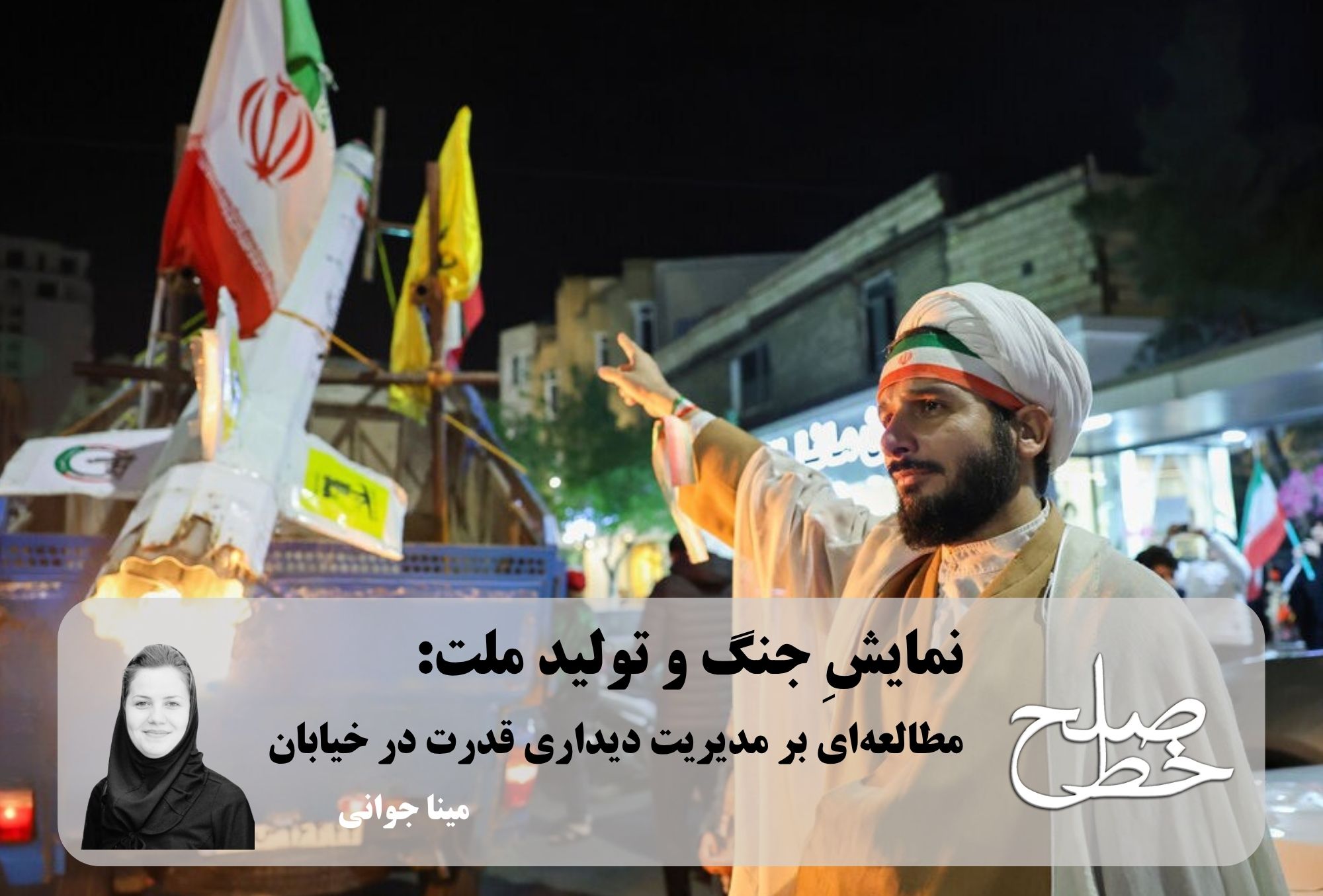
The Spectacle of War and the Production of the Nation: A Study of the Visual Management of Power in the Street / Mina Javani
Since the first nights of the war, the streets of Iranian cities have become the stage for a form of theatrical politics: gatherings, supported by the government, filled with lights, flags, anthems, and mowkebs, which seemed less a natural reflection of the social situation than an attempt to produce a uniform and coherent image of a “nation supporting the war.” In these gatherings, the government is not merely seeking to organize political presence; beyond that, it is trying, through the management of space, image, and emotion, to make visible its desired narrative of society. The street at night became a ground for the symbolic reconstruction of legitimacy; a place where power tries to control not only public opinion, but also the “visible form of society.”
But at the same time, not far from these illuminated scenes, war was spreading another reality through the city as well: a reality made up of destruction, fear, anxiety, mourning, poverty, and death. While cameras were focused on flags and slogans, many victims of the war were left in silence and imagelessness; people who were neither part of the television and media frames nor had any place in the official narrative. The gap between these two images — war as a devastating experience and war as a spectacle of solidarity — shows how politics, in a state of crisis, becomes increasingly dependent on managing images and eliminating disturbing realities.
From this perspective, the government gatherings around the war can be considered part of the process of the “spectacularization of politics” in the Islamic Republic; a process in which political power seeks, instead of confronting the diverse and contradictory reality of society, to produce a compressed, orderly, and ideological image of “the people.” In this situation, the street is no longer merely a public space, but becomes a stage for performing legitimacy; a place where desirable bodies, desirable slogans, and desirable emotions must be continuously reproduced and displayed so that the gap between the government and society remains hidden. What is eliminated in the process is not only a group of citizens, but social reality itself: people who have no place in the official frame, sufferings that cannot be turned into a heroic image, and experiences of war that speak of exhaustion and fear rather than fervor and unity. In this sense, the issue is not merely the holding of government gatherings; it is, in fact, the transformation of politics into a kind of management of visibility: what must be seen, who has the right to represent the “nation,” and which part of society must remain in the shadows.
The Production of the “Legitimate People”
In the logic of the nightly war gatherings, what appears on the surface as “popular support” points, at a deeper level, to a more complex process: the production and stabilization of a kind of “legitimate people.” Here, “the people” are not a pre-existing and plural reality, but the product of a visual and institutional mechanism that determines who can appear as the nation and who is fundamentally included within the frame of political visibility. In other words, the issue is not the representation of society; it is, in fact, its selection, filtering, and rearrangement at the level of image.
In this situation, the street, as public space, becomes a selected stage. Presence there does not automatically mean belonging to the “nation”; rather, it is a particular kind of presence, a particular body, a particular dress, and a particular form of emotional expression that is recognized. The visual homogeneity of the crowd, the repetition of signs, the uniformity of slogans, and the ritual order of the gathering all work toward producing the impression that society is in a state of complete consensus. Yet this consensus, more than being a social matter, is a visual effect: the result of arrangement, elimination, and highlighting.
Therefore, what takes place in these gatherings is not a display of support for the war, but the formation of a kind of “politics of visual selection.” Part of society — especially that part incompatible with official models or left outside the logic of dominant participation — is removed from the field of visibility. This removal is not necessarily physical; it operates at a visual and symbolic level, to the point that absence from the image is understood as absence from the “nation.” In such a situation, society is not experienced as a plural whole, and is gradually reproduced in the form of a uniform and unanimous whole.
These nightly gatherings can be understood not as an expression of solidarity, but as a mechanism for producing the “visible nation”; a nation that is constructed in the moment of display, not within complex social processes. In this sense, politics passes beyond the level of representation and enters the level of performance: the nation is neither represented nor represented politically; rather, it is performed. And whatever stands outside this performance is gradually fixed in a state of invisibilization.
The Elimination of the Invisible: The Economy of Suffering and the Politics of Visibility
Following the logic of producing the “legitimate people,” what gradually becomes apparent is not only the selective representation of society, but the formation of a kind of political economy of visibility; an economy in which anything that cannot be transformed into a coherent, heroic, or solidaristic image is pushed to the margins. Within this framework, spectacle is not the adding of images; at the same time, it is an organized process of elimination: the elimination of those parts of social experience that are not compatible with the logic of symbolic homogenization.
In the experience of war, this elimination shows itself above all at the level of everyday sufferings that cannot be heroized. Destroyed homes, displaced lives, prolonged anxieties, quiet deaths, and gradual collapses are elements that hardly fit within official frames. These forms of suffering are removed from the circuit of representation not because they lack reality, but because they lack imageability. As a result, war is gradually reduced from a multilayered social experience to a consumable and visual narrative; a narrative in which only those parts of reality that can sit alongside concepts such as “unity,” “epic,” and “solidarity” remain.
This logic of elimination does not operate only at the level of content, but also extends to the level of subjects. The part of society that does not fit into this visual order — whether because of non-participation, a different experience of war, or distance from official language — is gradually pushed out of the field of visibility. Elimination here does not mean physical negation; it means a kind of structural invisibilization: existing at the level of the lifeworld, but being absent at the level of the political image.
It can be said that the spectacle of war is not a simple reflection of a situation; it constructs a visual regime that determines what is seen and what is removed from view. What is placed within the official frame is not the entirety of society, but a purified image of it; an image that marginalizes sufferings incompatible with the official narrative. For this reason, the more pronounced the visual coherence of gatherings and official narratives becomes, the more visible their distance from the fragmented and unequal reality of lived experience becomes.
At this level, the issue cannot be considered merely a disruption in representation. What is taking place is the domination of image over social reality; a situation in which the visible replaces the lived, and lived experience only gains importance when it can be placed within the field of vision.
The Suspension of Rights in the State of Spectacle
Within the logic of the spectacularization of politics, the issue is not only inequality in visibility or the symbolic elimination of some groups; the deeper issue is the gradual suspension of the relationship between “right” and “social presence.” In this situation, citizenship rights are redefined not as universal and equal matters, but as conditional and situational ones: the right to be seen, the right to be present in the street, and even the right to speak become dependent on the degree of conformity with the spectacular order of power.
Within such a framework, the state of war is not merely regarded as a security crisis; it becomes a ground for readjusting the legal boundaries of society. The street, too, as public space, gradually loses its rights-based character and becomes a privilege-based space; a space in which presence does not carry the meaning of an equal right and instead more closely resembles a “conditional permission” granted to certain groups in particular situations. At the same time, the absence of some groups from these scenes is no longer understood as a social reality, but is regarded as a sign of their exclusion from the circuit of political legitimacy.
From this perspective, what takes place in the nightly gatherings is not only the representation of society, but a kind of practical redefinition of the relationship between law, right, and presence. The spectacular order, by تثبیت a particular image of the “nation,” simultaneously تثبیت a framework in which only certain forms of political life possess the right to appear. In this way, politics moves beyond the sphere of the distribution of power and becomes the sphere of regulating existential possibilities: who can appear in public space as a political subject, and who is already in a state of suspension. The issue is not the elimination of voices; it is the gradual suspension of the link between right and appearance; a situation in which “right” no longer has an abstract existence and is redistributed and made conditional in moments of spectacle.
Conclusion: From the Politics of War to the Aesthetics of Power
This writing is not a description of nightly gatherings in the context of war; it is an attempt to understand a deep shift in the logic of politics: the passage from politics as a field of social conflict to politics as the production of image, and from society as lived plurality to society in the form of a frameable stage. In this process, war is not merely regarded as a military situation; it is a moment in which the possibilities of display, elimination, and redefinition of the “nation” are activated with doubled intensity.
Nightly gatherings can be understood not as simple acts of support, but as mechanisms for producing the “legitimate people,” regulating visibility unequally, and rearranging the street as a ritual stage. What is highlighted in these scenes is visual coherence and emotional simultaneity; but this coherence, more than being a reflection of social reality, is the result of a process of selection, elimination, and homogenization in which some bodies and some narratives acquire the capacity to enter the image, while others remain invisible at the level of lived experience.
Therefore, the main issue should not be sought in the “display of support for the war.” What is taking shape is a kind of visual order that pulls politics from the arena of the distribution of power and rights into the arena of regulating the possibility of being seen. In such a situation, rights no longer have an equal and universal character and become increasingly tied to the degree of conformity with the spectacular forms of power; to the point that presence in the public arena itself becomes a criterion of legitimacy.
Ultimately, what appears in this situation is a kind of “aesthetics of governance”; a form of managing society that seeks coherence not in resolving contradictions, but in producing the image of coherence. Yet behind this image, a gap always remains: the distance between what is seen and what is lived. It is this distance that reveals invisible sufferings, eliminated subjects, and experiences left outside the official frame. This writing, too, pauses on this very gap: on the distance between politics as spectacle and politics as life.
 Created By: Mina Javani
 May 22, 2026
Tags
Basij Government gatherings Iran-US war Mina Youth peace line Peace Line 181 Security forces Sepah The war between Iran and Israel. War ماهنامه خط صلح