


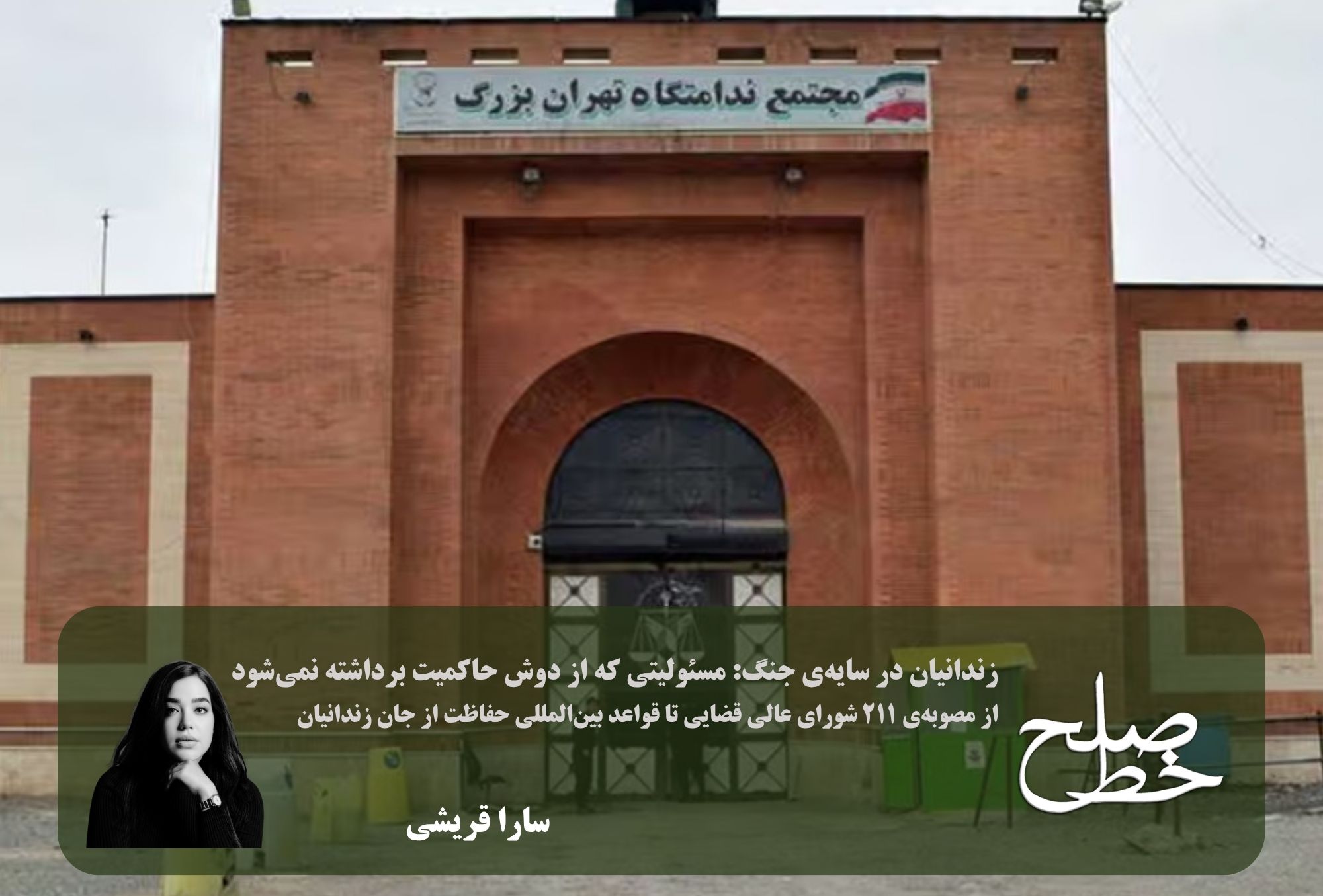
Prisoners in the Shadow of War: A Responsibility That Cannot Be Lifted from the Shoulders of the State/ Sara Ghoreishi
With the escalation of military tensions and the possibility of expanding conflict, concerns about the safety of prisons and the lives of prisoners have significantly increased. Prisoners are among the most vulnerable groups in any crisis situation, as they have no independent ability to decide where they live, access medical care, or even secure their most basic needs, and are entirely dependent on prison administrative structures. For this reason, in every legal system, the responsibility for safeguarding the lives and health of prisoners rests directly with the state.
In Iran, this issue has taken on more alarming dimensions. A significant number of prisoners are held on political or security-related charges, with cases that human rights organizations have identified as raising serious doubts. Among prisoners, there are also multiple vulnerable groups, including students and minors, women, mothers with children, persons with disabilities, and prisoners suffering from serious illnesses. The widespread detention of these individuals on vague charges or without adherence to fair trial standards has not only led to severe overcrowding in the prison system, but has also intensified the state’s responsibility to protect their lives and health.
Prison Conditions Under Wartime Tensions
Numerous reports from Iranian prisons indicate that even under normal conditions, prisoners face serious limitations in access to medical care, medication, food, and sanitary facilities. In a situation where the country is confronted with military tensions or the threat of conflict, these conditions can quickly escalate into a humanitarian crisis.
Disruptions in access to medicine, difficulties in transferring ill prisoners to external medical facilities, limitations in the provision of food and sanitary resources, and the intensification of security conditions within prisons are all factors that place prisoners’ health and lives at risk. Under such circumstances, prisoners are effectively trapped in a closed environment—one that, if exposed to military attacks, can become an extremely dangerous space.
Prisons at Risk
Although Evin Prison has received the most media attention, the situation of prisons in Iran is not limited to this facility. Greater Tehran Prison (Fashafouyeh), Adelabad Prison in Shiraz, Mashhad Central Prison, and Qazvin Prison are among the facilities where numerous reports in recent years have documented harsh detention conditions.
Overcrowding, limited access to medical services, poor sanitary conditions, and difficulties in transferring sick prisoners to medical centers are among the problems reported in many of these prisons. In a context of rising military tensions, keeping large numbers of prisoners in such environments may pose serious risks to their lives.
The Situation of Evin Prison Under Military Tension
Evin Prison, as one of the most well-known prisons in Iran, has repeatedly been at the center of human rights concerns in recent years. A large number of political, civil, and ideological prisoners are held in this facility. In conditions of heightened military tension, keeping this population in a closed and overcrowded environment without effective protective measures may put their lives at risk.
In such a situation, concerns arise that, if wartime risks are ignored, prisoners may effectively be placed in conditions that could be interpreted as exposing individuals to danger in a manner akin to the use of human shields—a situation that is explicitly prohibited under international law.
Iran’s Experience in Recent Crises and the Twelve-Day War
Despite the existence of legal capacities, Iran’s experience during various crises has shown that these measures have not been effectively implemented. During what became known in public discourse as the “twelve-day war”—a period of intensified military tension that raised concerns about the vulnerability of infrastructure, including prisons—no large-scale action was taken to reduce the prison population.
At that time, reports indicated that prisoners’ access to medical care, medication, and basic necessities had become more difficult, and concerns about prisoner safety had increased. This situation once again raises the question: when the state is aware of the risks, why does it not use existing legal tools to protect prisoners’ lives?
Directive No. 211 of the Supreme Judicial Council and an Overlooked Legal Capacity
Within Iran’s domestic legal system, mechanisms have been предусмотрены for such situations. One of the most important is Directive No. 211 of the Supreme Judicial Council, dated January 12, 1987 (22 Dey 1365), adopted during the Iran-Iraq war. This directive allows the judiciary, under emergency wartime conditions, to use tools such as modifying detention orders, accepting bail or guarantees, granting conditional release, and temporary release to reduce prison populations. The purpose of this regulation was precisely to reduce humanitarian risks for prisoners during crises.
However, recent crises have shown that this legal capacity has been underutilized in practice, despite the fact that its very purpose was to prevent such dangers.
The Obligation to Release Low-Risk Prisoners
In conditions where prisons are effectively exposed to the risks of war, the first rational and humane step should be the immediate reduction of prison populations. Based on Directive No. 211 and in line with international standards, the judiciary can and must use tools such as bail, conditional release, and temporary release to remove from unsafe prison environments all prisoners whose continued detention is not necessary for public security.
This group includes political and ideological prisoners, financial prisoners, individuals convicted of non-intentional offenses, and those convicted of minor crimes. Keeping these individuals in prison under conditions of increased wartime risk may expose them to unnecessary danger.
International Legal Standards on the Protection of Prisoners
At the international level as well, clear standards exist for the protection of prisoners. The United Nations Standard Minimum Rules for the Treatment of Prisoners, known as the Nelson Mandela Rules, emphasize prisoners’ access to healthcare, adequate food, and proper sanitary conditions.
International humanitarian law, particularly the Geneva Conventions, also obliges states to protect the lives and health of individuals under their control during armed conflict.
Placing individuals in situations that expose them to the risk of military attacks, or using them as instruments of military deterrence, may constitute serious violations of international law.
The Experience of Other Countries
In some countries, measures have been taken during wartime to reduce humanitarian risks in prisons. For example, during the war in Ukraine, as the conflict expanded, steps were taken to transfer prisoners from high-risk areas to safer locations and, in some cases, to reduce prison populations.
Such measures demonstrate that even in times of crisis, decisions can be made that prioritize the safety and health of prisoners.
Conclusion
Being imprisoned does not mean the loss of human dignity. Even in wartime conditions, states are obligated not to deviate from minimum humanitarian standards in their treatment of prisoners.
At a time when prisons are exposed to danger and their populations have increased due to widespread arrests and vague charges, the responsibility of the state not only does not diminish, but becomes heavier. Neglecting this responsibility may place the lives of thousands of prisoners at risk—a risk that is neither remote nor unforeseeable.
Footnotes:
United Nations. (2015). United Nations Standard Minimum Rules for the Treatment of Prisoners (the Nelson Mandela Rules). United Nations.
International Committee of the Red Cross. (1949). Geneva Conventions of 12 August 1949. ICRC.
International Committee of the Red Cross. (n.d.). Detention in armed conflict: Legal standards and guidance. ICRC.
Penal Reform International. (n.d.). Protecting prisoners during armed conflict and emergencies. Penal Reform International.
Office of the United Nations High Commissioner for Human Rights. (n.d.). Reports on detention conditions in conflict situations. OHCHR.
Human Rights Watch. (n.d.). Reports on prison conditions and armed conflict. Human Rights Watch.
Amnesty International. (n.d.). Detention and armed conflict reports. Amnesty International.
 Created By: Sara Qoreyshi
 March 21, 2026
Tags
Evin Prison Fashafouyeh Iran-US war Justice in humanity peace line Peace Line 179 Prisoners' rights Sarah Qureshi Tehran Grand Prison War War conditions ماهنامه خط صلح