


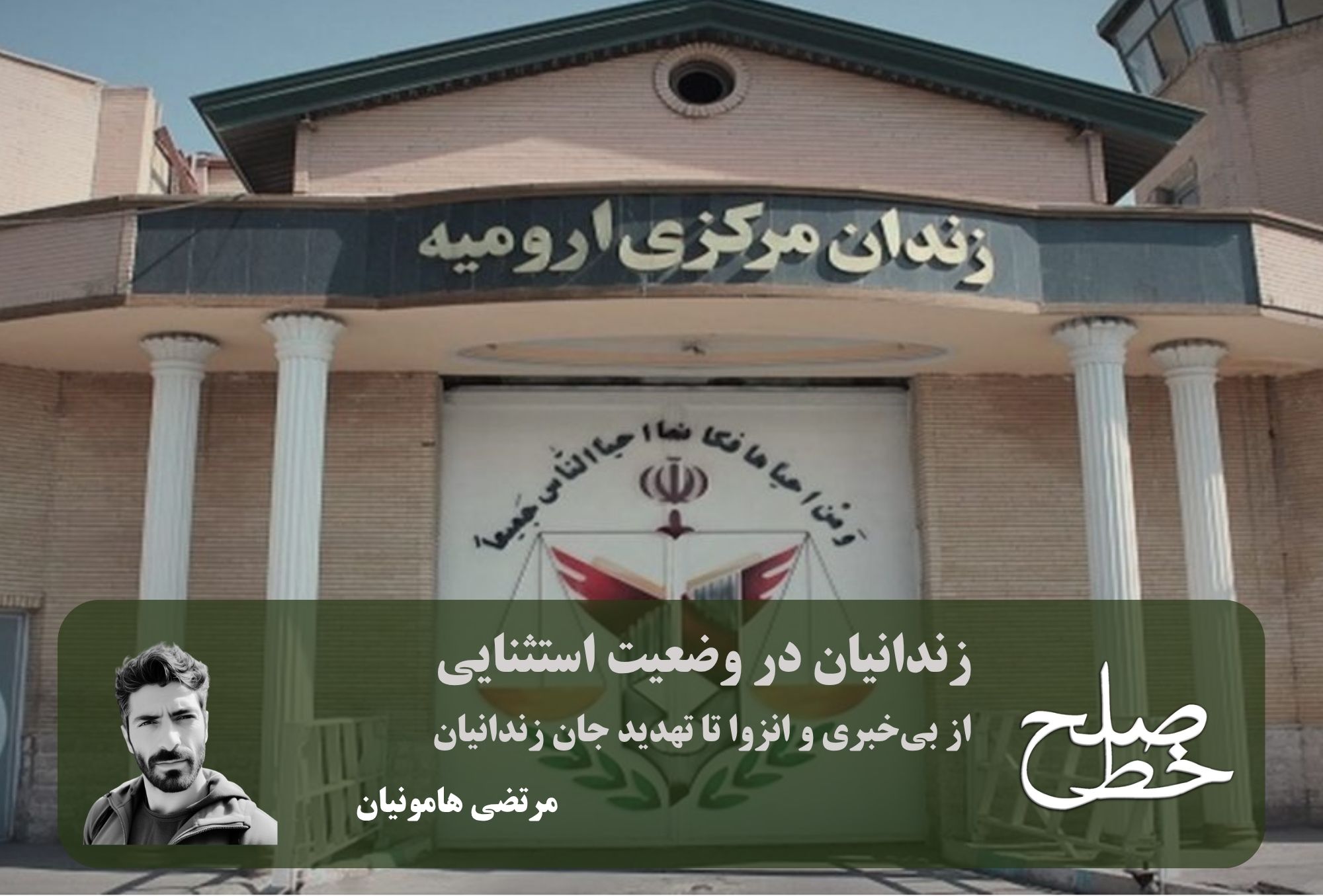
Prisoners in a State of Exception/ Morteza Hamounian
There is an uproar outside. Voices echo and the roar of shouting can be heard. Among the guards and in the corridors, there is constant whispering. But no one tells the prisoner anything. The prisoner is treated as an outsider. From time to time, from near and far, the sound of explosions reaches the ear. Everything has become chaotic. It is as if outside the cold, rigid four walls enclosed by bars, everything has fallen apart. Yes—outside, there is war, and yet inside the prison, the prisoner is an outsider whose life holds the least value for the jailer. Beyond these walls, a war is underway, and the prisoners do not know what is happening.
Such a scene is more than a narrative image. This unawareness—or suspension, this liminal state between being and non-being—is itself a sign of what can be described as the hidden vulnerability of prisoners. A prison appears, on the surface, as a solid, closed, and controlled structure—a space meant to be separated from the disorder outside. Yet this very separation, in conditions of urban warfare, turns it into one of the most fragile points. The prison is neither fully within order nor entirely outside the chaos that has upended everything; rather, it exists on a suspended boundary that may collapse at any moment. For instance, in detention wards such as 209 and 2-Alef in Evin Prison, doors constantly open and close. The corridors are crowded. Yet a prisoner held in solitary confinement does not know what is happening outside. Prisoners in shared cells talk among themselves, each trying to make sense of the situation through speculation. One of the essential traits of human beings is the need for awareness of their surroundings. But here, the walls obstruct that awareness. This is the condition of being uninformed. Only signs remain for the prisoner—signs such as sound and light, the echo of nighttime slogans, and the noise of missiles and explosions that penetrate the prison walls and reach the prisoner’s ears. These scattered signs gradually turn into mental narratives. Each person constructs an explanation to fill the void. In a closed space with no access to the outside, imagination and fear easily replace reality.
Urban warfare during the attack by the United States and Israel on Iran in March 2026 (Esfand 1404) has blurred boundaries and heightened concerns about prisoners. Prisoners who, even under normal circumstances, struggle with severe overcrowding, lack of medical facilities, and restricted contact with family and lawyers, now face even harsher conditions. Conditions that have made them more vulnerable. There are also bitter memories of prisoners’ encounters with war—for example, the memory of Israel’s attack on Evin Prison during the twelve-day war has intensified these concerns. The danger that catastrophe may come not from prison guards, but suddenly from the sky in the form of missiles and bombs that collapse walls upon prisoners and take their lives, creates an even deeper anxiety. In this situation, prisoners face two dangers. The first is the wartime condition itself, whose consequences for them are unknown. The second is the post-war situation, where it is unclear how a wounded system—having suffered external attack and the loss of its leaders—might unleash its anger upon prisoners, or how it might take revenge on them for the actions of the United States and Israel.
Instead of opening prison doors and facilitating the release of prisoners under “wartime conditions,” the judiciary has even rejected requests from families of political prisoners for temporary leave during such circumstances. Some reports during this recent war have also indicated the transfer of prisoners from wards such as Ward 209 of Evin Prison. For instance, Shayelin Asadollahi, sister of Ali Asadollahi—a poet and imprisoned member of the Iranian Writers’ Association—announced that her brother had been transferred from Ward 209 to an unknown location. This transfer occurred despite the fact that, according to the family, bail had been set for his release.(1) Here, the issue is not merely the relocation of prisoners. The issue is assurance—assurance for families regarding the prisoners’ condition, and assurance for the prisoners themselves. The prisoner no longer knows where they are. Before the war, however limited, there was a degree of predictability: visitation times, the possibility of phone calls, judicial procedures, and even hope for eventual release. But with the onset of war, even these fragile threads are severed. Transfer to an “unknown location” is not just a relocation; it is the removal of the prisoner’s last mental anchor.
In wartime conditions, prisons themselves become high-risk zones. A prison is a closed space where prisoners are deprived of free movement; in the event of bombings, missile strikes, collapse, or explosions, they have no means of escape. Moreover, if something happens to the prison authorities, it is the prisoners who must wait for water, food, and basic sanitary necessities. Prisoners remain alone behind bars and locked doors. In Iran, given the condition of prisons, the lack of transparency, restricted communication with families, and the possibility of transfers to unknown locations, these dangers are intensified. Even if prison staff remain present, it is still the prisoners who must grapple with shortages. During the ongoing war at the time of writing, reports indicate shortages of potable water, reduced quantity and quality of food, limited operation of prison stores, shortages of medicine, and diminished medical services. According to HRANA News Agency and accounts from former and current prisoners, drinking water is not suitable; therefore, prisoners are forced to purchase bottled water from prison stores. However, under recent conditions, the supply of bottled water to some prisons has decreased, and the price of each bottle has reached approximately 25,000 tomans—a cost that many prisoners reportedly cannot afford. In addition, food conditions have worsened significantly: portions have decreased and quality has deteriorated. Meanwhile, many prison stores are facing shortages of goods; in some cases, they have been closed for several days or have operated with nearly empty shelves. These conditions further intensify concerns.(2)
Another issue is the increase in tensions among prisoners and within prisons. Psychological and emotional pressure is high. Prisoners are cut off from their families. There are shortages of water and food. Constantly, the sounds of explosions, bombs, and missiles are heard from outside. If prisoners have access to television and watch state broadcasting, they see images of destruction and casualties from the war. Under such circumstances, the psychological state of prisoners is far from normal. This increases the risk of internal conflicts within prisons. These issues affect both ordinary prisoners and political and ideological prisoners. The latter group, however, faces greater pressure and hardship—prisoners detained under security pretexts, with heavy legal cases, severe sentences, and sometimes charges such as enmity against God and execution. In such conditions, reduced public oversight and restricted communication increase the risk of intensified repression against political prisoners. There are also concerns about the accelerated implementation of death sentences, increased security pressures, and transfers to remote prisons.
Among all this, certain groups of prisoners face even greater danger. Women prisoners are among them—especially those who are imprisoned with their children. Even under normal circumstances, women in prisons face specific limitations and shortages, from sanitary facilities to medical services tailored to their needs. In wartime, these conditions worsen. Access to medical care becomes more difficult, resources become scarcer, and priorities shift. In such a situation, the female body—already requiring specific care—is subjected to greater pressure. For mothers imprisoned with their children, the situation becomes even more complex and тяжел. A child does not fundamentally understand what is happening, yet directly experiences its effects. The child perceives the sound of explosions, the mother’s anxiety, and changes in nutrition and hygiene. A prison, which is already an unsuitable environment for a child’s development, becomes far more unstable during war. Here, the issue is no longer just deprivation or a sense of danger; it is the transmission of anxiety to a child who has no agency in this situation—a child who absorbs fear and distress from a mother who is imprisoned and confined amid war.
From a legal perspective as well, the current situation of prisoners is contrary to the law. Under the Fourth Geneva Convention, civilians detained by a state are considered “protected persons,” and governments are obligated to safeguard their lives and security. Directive No. 211 of Iran’s Supreme Judicial Council (dated January 12, 1987 (22 Dey 1365)) also sets specific duties for judicial authorities in emergency and wartime conditions. According to this directive, prosecutors are required to review prisoners’ cases, temporarily release non-dangerous prisoners, and, if necessary, transfer dangerous prisoners to safe locations. However, these measures have not been implemented. No one has been released due to wartime conditions; on the contrary, more individuals have been detained on security-related charges. One may set aside suspicion, yet it appears that the Islamic Republic is now applying the same hostage-taking policy it once used toward foreign nationals, this time toward prisoners in its own custody.
In wartime conditions, prisoners face the risk of death and injury from the war. At the same time, basic services in prisons—such as the distribution of food and water and access to hygiene—can be disrupted, exacerbating a humanitarian crisis within prisons. Another danger is repression and executions under conditions of lack of information, an area in which the Islamic Republic has a long record. Forced transfers add yet another layer of hardship. All of this creates a situation in which prisons become hidden points of vulnerability during war—places largely out of sight. But this is not the whole story.
Let us assume the war ends and the wounded Islamic Republic remains in power. In such a scenario, a government that has lost leaders and sustained injuries may seek revenge against prisoners, especially political and ideological prisoners. This has happened before: during the eight-year war, after the Islamic Republic accepted United Nations Security Council Resolution 598, the summer of 1988 became a bloody summer for political prisoners. This danger exists in the current situation as well—that in the post-war period, the Islamic Republic may turn to prisoners for revenge, leading to outcomes that must be prevented. Awareness and vigilance are necessary to prevent such a scenario.
The current situation may be understood as what Giorgio Agamben describes as a “state of exception”—a condition in which the law formally remains in place but is effectively suspended, and certain individuals are reduced to “bare life”: a life under control yet deprived of real protection. In wartime conditions, the prison becomes such a place—a space where the prisoner is neither within the war nor outside it, yet is deeply affected by both its visible and hidden consequences. Everything that prisoners endure during war reflects this suspension. From this perspective, describing prisons as “points of vulnerability”—and not visible but hidden ones—is not merely descriptive. It expresses a condition in which vulnerability arises not from obvious weakness, but from being removed from visibility and protection—where human beings, in silence, become more defenseless than ever.
This war—its beginning, continuation, and eventual end—has created a condition of suspension and vulnerability for prisoners. A war that began without their agency, continues to harm their lives at every moment, and whose end may bring serious dangers for them. This is the impossible condition: a situation in which every possible outcome leads to the vulnerability of prisoners—those who, in a state of exception, have been forgotten.
Footnotes:
Interview with Shayelin Asadollahi on the program with Kambiz Hosseini, Iran International TV.
“War; increased pressure on prisoners due to shortages of water, food, and medical services in many prisons across the country,” HRANA, March 10, 2026 (20 Esfand 1404).
“A conversation with Giorgio Agamben: The state of exception as a paradigm of governance in our time,” Meydan website, November 2, 2020 (12 Aban 1399).
 Created By: Morteza Hamounian
 March 21, 2026
Tags
Agamben Exceptional situation Iran-US war Justice in humanity Morteza Hamounian Naked life peace line Peace Line 179 Political prisoners Prisoners' rights Twelve-day war ماهنامه خط صلح