


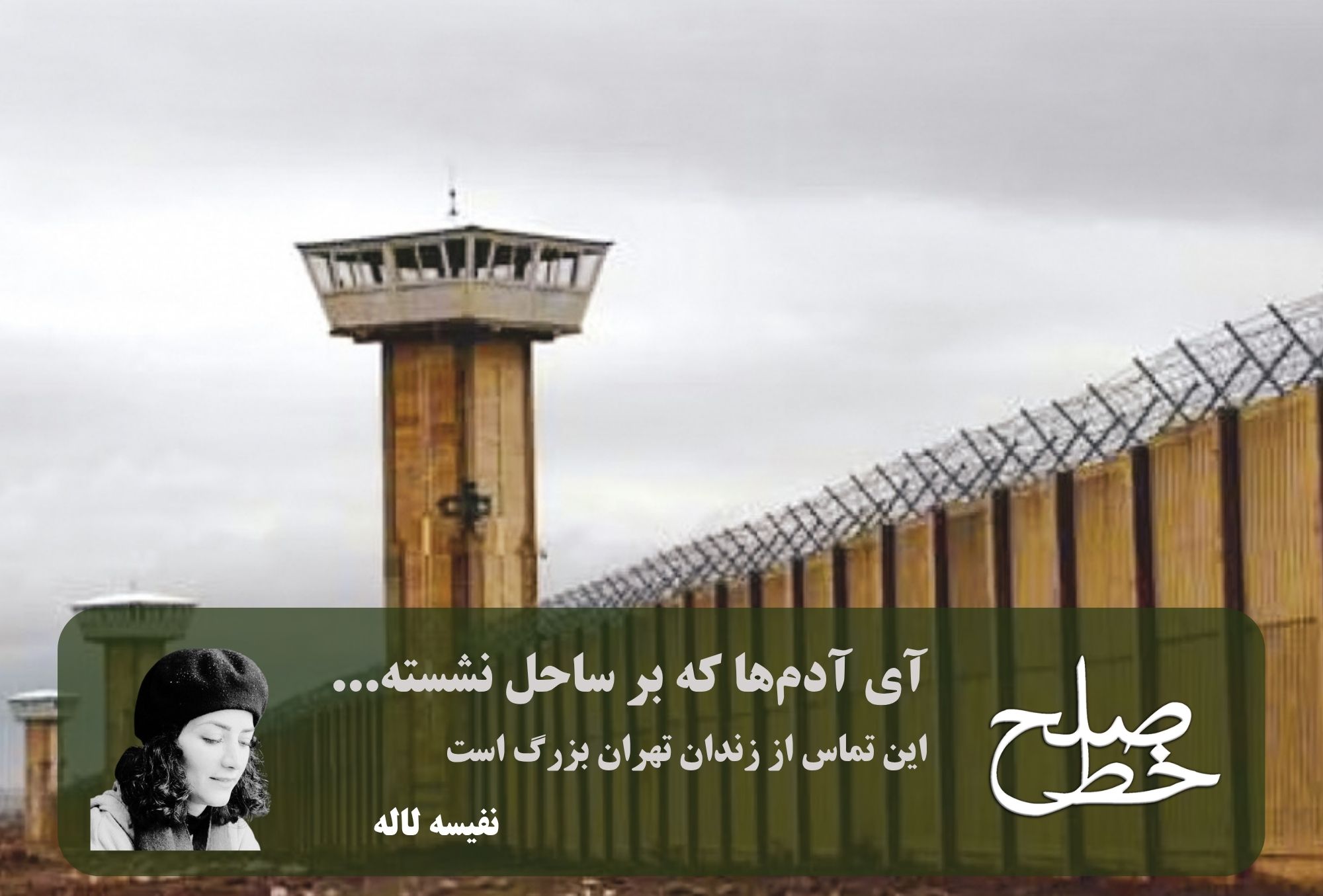
O People Sitting on the Shore… This Call Is from Greater Tehran Prison/ Nafiseh Laleh
The young Iran of yesterday is old today, and has lost its way. An Iran in which the concept of life has been reduced to “bare life,” and the “state of exception” belongs not merely to yesterday and today, but is the product of long years of erasing the boundary between life and death. A tangible borderlessness between law and lawlessness. Law? The limbo of nowhere. And now the subject is the condition of the lives of people in this limbo—people whose lives, as a result of the slightest rightful protest against disorder and in pursuit of their demands, are emptied, under the title of law, of the characteristics of an ordinary citizen’s life.
“Homo sacer,” in the context of bare life, possesses the least of the most basic facilities, but the Iranian human being is “more sacred” still. This sacredness is owed to a compulsory covering placed upon the body. Within this covering, no protest against any deprivation is permitted, and being stripped of the legal rights of an ordinary citizen is itself a sacred matter, befitting the exalted station of “the people.” A station for which, according to expediency, various spectrums of those in power become its voice and weave stories in its name. “The people” are traded among them. They lose their elasticity. They unravel, and their existence remains tied to only a single “thread”: “being.” A being devoid of any quality. The concept of the human being as a “rational animal,” whose speech arose from thought and grew in interaction with others, becoming reflective and social, is abridged into “being,” “mere being.”
In such a reading of the text of life and being in today’s aged Iran, the political prisoner, in the continuation of bare life, is the most sacred of human beings. In Iran’s perpetually exceptional condition, they are the most prominent among this vast multitude left in captivity. In the context of the limbo of nowhere that is law, they are recognized as criminals so that, within that same context, the law may fail to enforce against them the law it has itself established. The same duality of the exalted station of “the people,” of course, according to expediency.
Iran’s seven-thousand-layered political structure has left thousands upon thousands bewildered in the valley of quest, with no sign of the final destination. In a land where, at the slightest internal or external disorder, the first reaction of its governing system is to sever the lines of communication, how is one to reach the final valley? Where, in any case, is that final valley? The road is lost, and the lost, fearful, rub themselves against every door. And among these thousands upon thousands, a vast multitude remain behind iron bars. In Evin, Fashafouyeh, Mahabad, Adelabad of Shiraz. They remain, and are forbidden from hearing anyone’s voice or from having their own voices heard. They are forbidden from placing a period at the end of a sentence. They are even forbidden fear—the fear of being killed by a foreign enemy amid the raining of bullets, shells, and bombs. Forbidden, too, from the possibility of receiving water and food and medicine. From the possibility of moving through the small open space of the prison. From the possibility of contact as well… the possibility of contact… contact… which means being socialized and being part of that whole. And from the possibility of growth in interaction with another, and of reflection. And from being a rational animal. And from being. Being!
How can one speak of social rights or freedom of thought when life itself is at stake? When the body is in torment, the soul becomes trapped in the labyrinth of “being.” It cries out, hoping perhaps that some kind heart may answer its cry. Its cry becomes knotted with not knowing about a friend, a family, a mother, a father. Even the jailer is not there. For he too is human, and out of fear that harm may reach his own dear life, he has fled. He has shut the door on the prisoners, melted the iron bars behind the two panels of the door, and sewn his lips together, just like the lips of the prisoners. And now the prisoners are left with heaps of shattered glass after the explosions and the rain of bombs and missiles—and, of course, a small amount of bread. No water. No electricity. No place from which to buy any necessities. The food ration is running out, and yet the punishment for raising the voice of protest never runs out. What is the answer to this protest and demand? Is there any answer? When they have cut off the lines of communication across an entire country from its people, what care have they for cutting off the voices of those left imprisoned? But the silence of the imprisoned becomes a cry. A cry that echoes in the silence of Evin and Fashafouyeh and Zanjan and … a thousand other nowheres. The voice is familiar! It is the voice of Baktash Abtin: “I have entrusted the telephone to ring.” The sound of explosions near the prison reverberates in the air. This time, the voice of the imprisoned resounds. They are reading Nima: “O people sitting on the shore, happy and laughing, one person is” — “This call is from Greater Tehran Prison and you are hearing the voice of a prisoner” — “giving up his life. One person is thrashing about with hands and feet forever” — “This call is from Greater Tehran Prison and you are hearing the voice of a prisoner” — “on this swift, dark, heavy sea that you know.”
 Created By: Nafiseh Laleh
 March 21, 2026
Tags
Conditions of the day George Agamben Iran-US war Justice in humanity Nafiseh Laleh Naked life peace line Peace Line 179 Political prisoners Prisoners' rights War ماهنامه خط صلح