


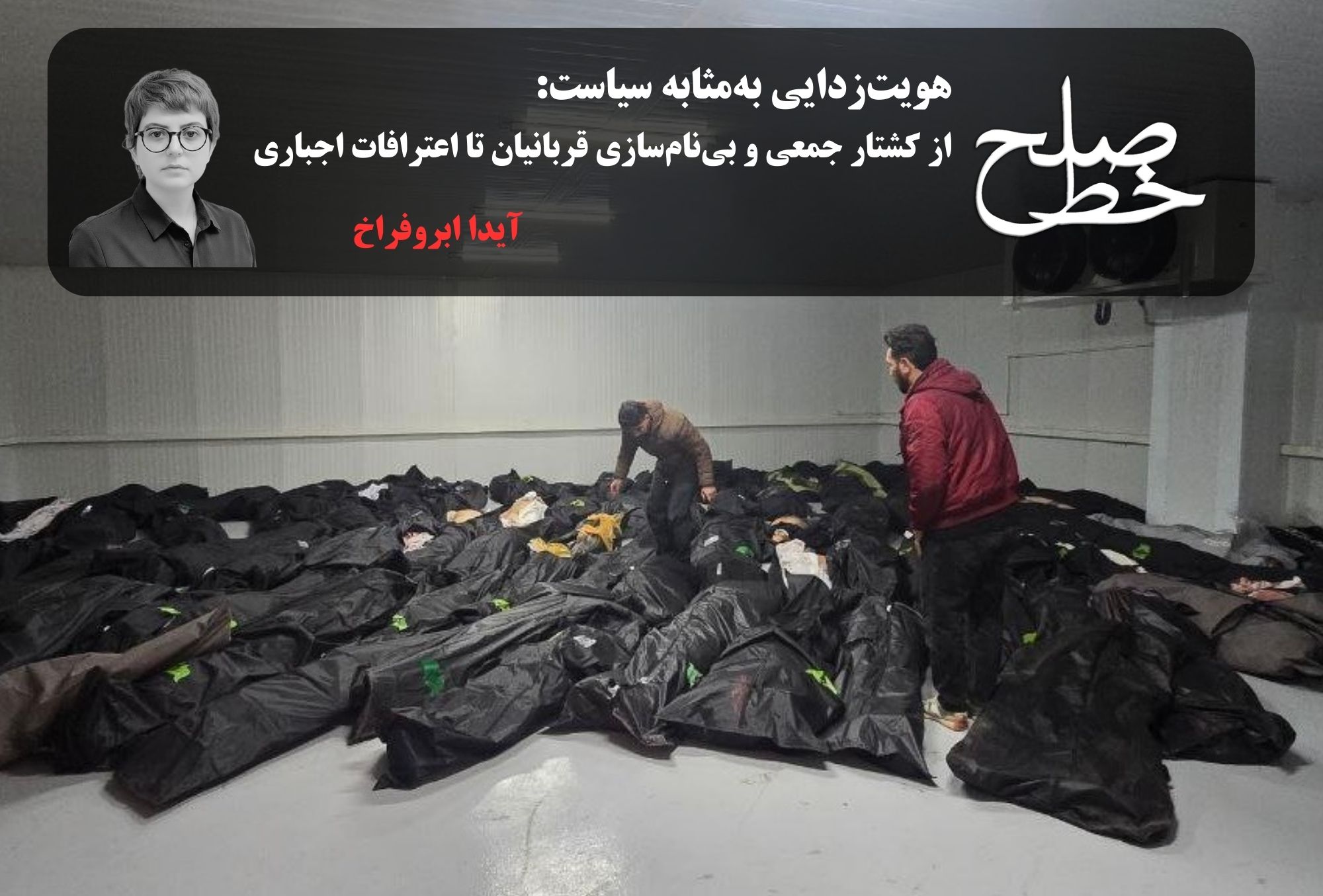
De-identification as Politics/Aida Abrofarakh
In the analysis of state violence, a focus solely on the moment of killing or the number of victims often obscures the deeper mechanisms that enable and anchor widespread violence in a social context. Violence, especially in the form of mass killing, is not a sudden, momentary act, but a gradual process that begins before and continues after death. What happened in Iran can be understood in this context: not simply as violent repression, but as a coherent policy of political, legal, and symbolic de-identification that began with the severance of ties, culminated in killing, and then settled into everyday life through the management of bodies, detention, forced confessions, and the control of mourning.
The disconnection of the internet and communication routes, especially with the outside world, was the first link in this cycle. This was not simply a technical or security restriction, but rather a suspension of human presence in the public world. By disconnecting, the possibility of bearing witness, of creating a narrative, and of being seen simultaneously was blocked, and the violence was deprived of an external observer from the very beginning. In this situation, individuals were still alive, but were becoming politically invisible. What was suspended was not simply the internet, but the possibility of participating in a shared world; a possibility essential for the visibility of suffering and public responsibility. In this communication vacuum, death was no longer an individual event to be questioned, but something to be managed. In such a context, mass murder became possible.
According to Hannah Arendt’s analysis of totalitarian systems, killing occurs when people are already politically and morally depleted. Physical elimination is not the starting point, but the end of a process in which the individual is reduced from a “person” to an “element” within an abstract population. In this logic, numbers replace names and death occurs without public confrontation. Killing is silent, not because of the absence of violence, but because of the lack of the possibility of being heard.
In Hannah Arendt’s framework for understanding state violence and totalitarian regimes, mass murder is not the result of a sudden explosion of cruelty, but rather the logical product of a political order that eliminates responsibility and reduces the human to a disposable element in an administrative mechanism. Arendt shows that before committing murder, totalitarian governments remove humans from the status of citizens with rights by suspending rights, criminalizing identity, and constantly representing the “enemy,” so that their physical elimination appears not as a crime but as a necessity for maintaining order or security. In this logic, responsibility is not distributed in a single decision, but in a chain of actions, orders, silences, and obediences, and it is this dispersion that makes mass murder possible. From this perspective, killing is not a deviation from the political order, but its ultimate function: the moment when the government shows that human life is conditional, subject to suspension, and subject to the decision of power.
Using Arendt’s framework allows us to understand why such governments are not only responsible for the killings, but also consciously produce the institutional and discursive mechanisms that make the killings possible, justifiable, and even invisible. In this framework, the documentation of the government’s discourse and behavior before and after the killings also acquires special analytical significance. According to published official reports and statements, before the widespread violence, protesters were repeatedly attributed to “terrorist groups,” “foreign agents,” or “enemies of national security,” while citizens were urged to “stay home” for their own safety. Such warnings were not simply neutral security advice, but effectively drew a political boundary between the “protectable population” and the “dangerous other.” In Hannah Arendt’s analytical logic, this discursive redefinition is precisely the stage at which human beings are reduced from citizens with rights to threatening elements within an abstract population before being physically eliminated. When political protest is formulated in official discourse not as a civic act but as a threat to collective life, the practical suspension of fundamental rights and the possibility of widespread violence no longer appear as an exception but are naturalized as a necessity for “maintaining order” or “security.” From this perspective, attributing protesters to terrorist or foreign forces is not a sideline to killing, but part of a mechanism that undermines the state’s responsibility for the lives of citizens in advance and makes their elimination justifiable.
According to official Iranian state media reports, before the violence escalated and at the very beginning of the protests, senior government officials repeatedly accused the protesters of being “armed terrorists” and claimed that the groups’ goal was to “increase the death toll.” In one of these speeches, Iran’s foreign minister declared that “from January 8 to 10, we witnessed the entry of armed terrorists among the protesters, and their goal was only to increase the death toll.”
Another report from the same speech also stated that many of those killed were targeted by “terrorists” behind their backs, and that the groups acted in the style of ISIS. This type of discursive representation and terroristization of protesters can be placed within the framework of Hannah Arendt’s analysis of political de-identification, because before being physically eliminated, protesting citizens were removed from their legal and moral status and became threats to national security. But de-identification does not end with physical death.
Reducing victims to statistics, erasing individual names and fates, and making collective mourning impossible, is a continuation of the same logic of elimination. The numbering of death is a form of representation that separates violence from human experience and reduces it to an administrative and manageable datum. One of the most profound forms of violence in mass killings is the moment when death is separated from name and face and reduced to a number. The transformation of the dead into statistics, whether hundreds or thousands, is not simply the result of a lack of information, but part of the logic of elimination; a logic in which each number conceals the void of a name, a life, and a relationship. In such a situation, even the uncertainty of the exact number of those killed is itself a sign of the enormity of the crime: violence on a scale so vast and horrific that not only do official institutions refuse to record it, but the human mind fails to fully comprehend it. Numbers, here, are not a tool for understanding, but a mechanism for distancing; a way of containing moral shock and preventing us from confronting the true dimensions of the disaster. When the dead are reduced to numbers, death is reduced from a human experience to an abstract datum, and this reduction weakens the possibility of collective mourning, of demanding justice, and of remembering. What is lost is not just statistical precision, but the possibility of naming a crime whose scope has exceeded the capacity of language and imagination.
Families forced to identify their loved ones among dozens or hundreds of bodies face a secondary violence; a violence that targets human dignity not at the moment of death but in the face of death. In this situation, mourning becomes a fragmented, private experience and an ineffective policy. The process of handing over the bodies is also not a purely administrative or technical matter. This stage can be seen as a disciplinary scene in which the living bodies of the survivors are disciplined through queuing, waiting, silence, signing and betting. For Michel Foucault, modern power operates not through overt displays of violence but through repetitive and exhausting administrative procedures. Here, the body is not the ultimate goal but the medium through which power is exercised. At the same time, as Catherine Verdery shows, the body becomes a political object because of its undeniable physical presence. Controlling burial sites, limiting or prohibiting mourning rituals, and imposing conditions on the release of the body are attempts to control meaning and memory. A death that remains nameless, placeless, and ritualless cannot become a collective and enduring memory.
This logic continues in mass detention and forced confessions. Prison, in Foucault’s reading, is a space in which the body is broken, reeducated, and prepared for obedience or elimination. With the broadcast of forced confessions, violence enters the realm of language. Confession, here, is not a tool for discovering truth, but a technology for producing the truth desired by power. The individual is forced to speak an official narrative of himself and, in so doing, participate in the symbolic rewriting and elimination of himself. This return of voice is not a return of dignity, but a continuation of the same politics of de-identification. At this point, Veena Das’s analysis of the relationship between violence, language, and everyday life becomes particularly important. Das shows that fundamental violences target not only bodies but also the possibility of speaking about loss. The imposed silence, the broken narratives, and the inability to name lost loved ones are part of the same process that turns violence into an unresolved and enduring experience. Violence, from this perspective, is not sustained by shouting and chaos, but rather by silence and repetition. Survivors are forced to resume life in a disjointed, speechless, and fearful world, a world in which violence is no longer an external event but a condition for continuing to live.
What remains in the end is a society that has not only seen violence, but also carries it in silence, in the body, and in everyday life. In this context, the main question is no longer simply the number of dead, but the fate of the possibility of seeing, speaking, mourning, and remembering. State violence, in this sense, not only eliminates bodies, but also targets language, memory, and the future of meaning. Mass murder is not the end; it is a point in a chain of acts of power that begins with de-identification and continues with the silencing of memory.
Footnotes:
1- Arendt, Hannah, The Origins of Totalitarianism. Translated by Mohsen Salasi, 2009, Tehran: Salasi Publishing House.
2- Foucault, Michel, Discipline and Punishment: The Birth of the Prison. Translated by Afshin Jahandideh, 1403 (21st edition), Tehran: Ney Publishing House.
3- Verdery, K. (1999). The political lives of dead bodies: Reburial and post-socialist change .Columbia University Press.
4- Das, V. (2007). Life and words: Violence and the descent into the ordinary . University of California Press.
 Created By: Aida Abroufarakh
 February 20, 2026
Tags
Aida's eyebrows are thick. Crime against humanity Criminal Hannah Arendt Internet outage Massacre 1404 peace line Peace Line 178 Suppressing protesters The Di 1404 Uprising Totalitarianism Uprising of 1404 Violence ماهنامه خط صلح