


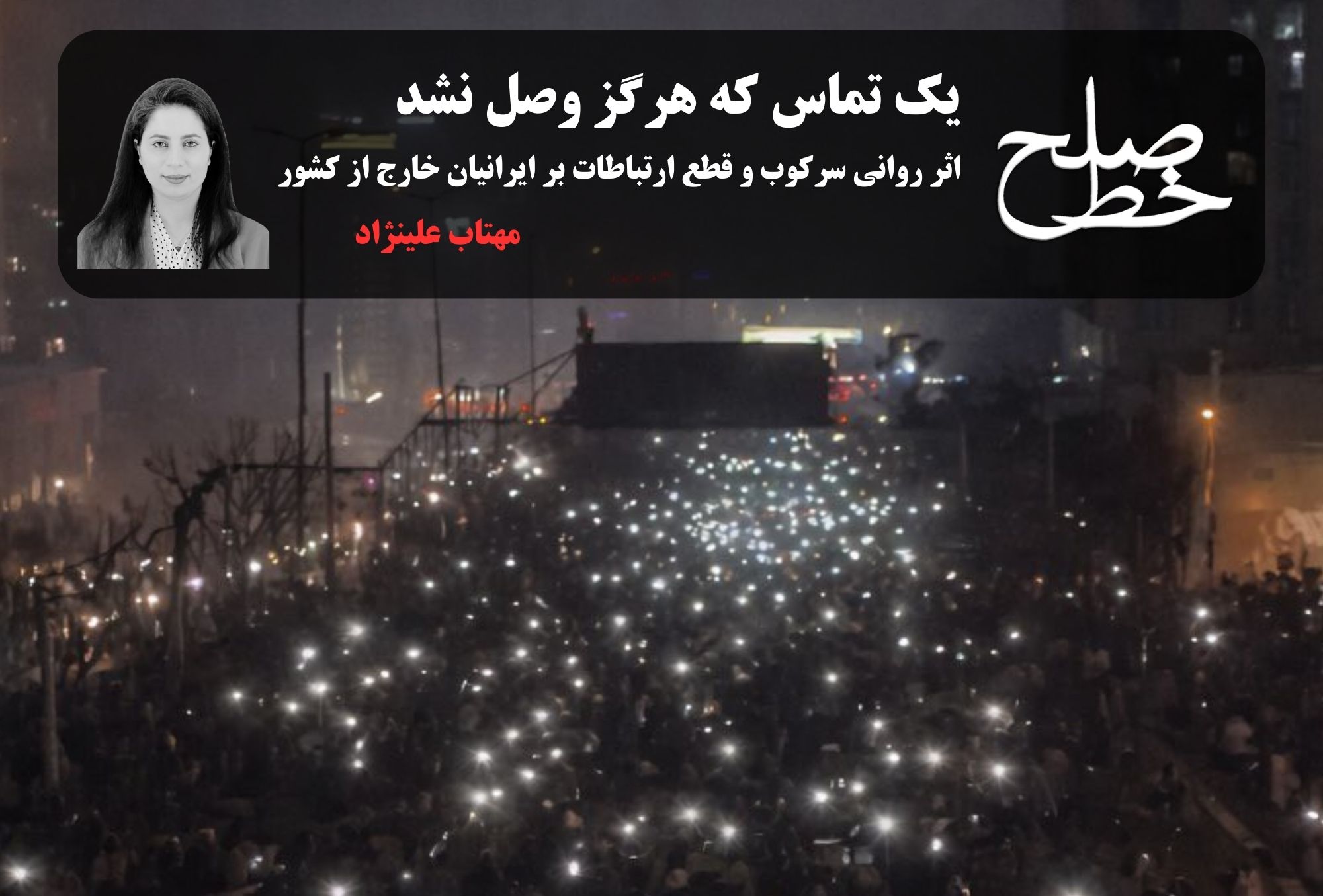
A call that never connected/ Mahtab Alinejad
It’s almost three in the morning. The cold light of a mobile phone illuminates the room, and the hands of a young girl in a European city restlessly glide across the screen. She dials her mother’s number for the umpteenth time. It beeps, then hangs up. Again. No messages are exchanged. The internet is down in Iran. The news is contradictory. Social media is full of short, blurry, and clipped videos from the streets. It’s January 18, 1404; the day the widespread crackdown on protesters in Iran began, and at the same time, Iran’s connection with the outside world was suddenly and completely cut off.
The daughter sits a thousand kilometers away, but her mind is on the alley that her mother passes every day. She doesn’t know if her mother has reached home safely or is trapped in the crowd, smoke, batons, and screams. Time is stretching. Every minute passes like an hour. Anxiety crosses the line from worry to terror. This is not just the fear of losing a loved one; it is the fear of not knowing, of absolute ignorance, of complete helplessness, and…
This experience was the experience of thousands of Iranians abroad in those days; a generation scattered around the world who, with a sudden disconnection, were exposed to a wave of collective anxiety, grief, and anger.
Disconnection as psychological violence
In psychology, “sudden disconnection” is not just a technical or communication problem. It is a form of psychological violence, especially in the context of political repression. Humans need a constant flow of information to regulate emotion, feel safe, and feel the world is predictable. When this flow is suddenly cut off, the mind goes into a state of constant alert.
For Iranians abroad on January 18, 1404, the internet and phone shutdown meant not only that messages would not reach them, but also that they would lose their last shred of psychological control over the plight of their loved ones. They could neither help, nor seek information, nor even mourn. This situation is a classic example of “learned helplessness,” a state in which a person feels utterly helpless after repeatedly being exposed to uncontrollable situations.
In clinical and social psychology, violence is not limited to physical acts. Any mechanism that systematically disrupts a person’s sense of security, agency, and psychological connectedness can be defined as psychological violence. The sudden and purposeful interruption of communication in the context of political repression is one of the most obvious forms of this type of violence, because it directly engages with the most fundamental psychological needs of humans.
The first level of this violence is the destruction of the sense of predictability. The human mind requires a minimum of predictability of the near future to maintain psychological balance. Continuous contact with loved ones, especially in turbulent situations, acts as a psychological anchor. The severance of this connection leaves the mind in a state of absolute ambiguity; a state in which no scenario is confirmed or rejected. This persistent ambiguity is one of the most powerful triggers of intense and persistent anxiety.
At the second level, disconnection leads to the denial of psychological agency. Agency refers to the feeling of “power to influence” a situation. For Iranians abroad on 18 Dey 1404, the possibility of calling, inquiring, or even hearing the voices of loved ones was the least form of psychological agency. Removing this possibility places the individual in the position of a passive observer; an observer who witnesses danger but has no means of intervention. This situation has significant overlap with what is described in the theory of learned helplessness and can lead to emotional numbness or psychological collapse.
The third level of psychological violence is the manipulation of mental time. In a state of disconnection, time is not experienced linearly. Endless expectations, constant updates, and repetitive obsessive behaviors such as frequent calls cause mental time to stretch and the experience of suffering to intensify. This stretching of time itself becomes a factor in psychological erosion, such that a few hours of inattention can be equivalent to several days of psychological stress.
At a deeper level, disconnection damages a person’s relational identity. Human identity is not just individual, but relational; we define ourselves in relation to others. When the possibility of mutual affirmation of these bonds is lost, a sense of identity rupture develops. For immigrants, for whom family ties are a central pillar of the continuity of cultural and emotional identity, this rupture can lead to an intensified experience of alienation and rootlessness.
The important point is that this type of psychological violence is indirect and at the same time pervasive. Unlike physical violence, which targets specific bodies, disconnection involves a network of minds; minds that may be thousands of kilometers away from the scene of oppression, but experience its psychological consequences fully. In this sense, disconnection removes the geographical boundaries of violence and turns it into a transnational phenomenon.
Finally, it should be emphasized that the psychological violence resulting from the disconnection is not simply a side effect of repression, but part of its logic. Creating ignorance, anxiety, and helplessness beyond borders weakens emotional and social solidarity networks and extends the scope of the effect of repression beyond the domestic space of the country. From this perspective, the disconnection can be seen not only as a tool for information control, but also as a means of exerting systematic psychological pressure on a large population of people.
Acute anxiety and the body in war mode
In the days following December 18, many Iranians abroad experienced symptoms of acute anxiety: heart palpitations, insomnia, digestive pains, panic attacks, and an inability to concentrate. Their bodies went into “fight or flight” mode, with no real action possible.
The mind constantly creates scenarios: if the mother was on the street, if she was arrested, if she was injured and no one was there, these disturbing thoughts are a direct result of the lack of information. In such situations, the brain generates the worst-case scenarios to fill the void. Anxiety is no longer a rational response to danger; it becomes a chronic and debilitating state.
The important point is that this anxiety is not just individual. When thousands of people experience the same thing at the same time, we are faced with a collective, cross-border anxiety.
In situations where a person faces a serious threat to their life or the safety of their loved ones, but is unable to respond directly or actively protect them, the body enters a state known in neurobiological psychology as “chronic activation of the stress response.” The disconnection in the context of the repression of January 18, 1404 created exactly such a situation for many Iranians abroad; a situation in which the body, before the mind, recognized the danger and went into a state of constant war.
The “fight or flight” response is essentially an evolutionary mechanism for dealing with short-term threats. In this response, the sympathetic nervous system is activated, hormones such as adrenaline and cortisol are released, the heart rate increases, and the body prepares for immediate action. But in a disconnected state, this readiness never ends. The danger never ends, there is no new information to moderate the threat, and the body is forced to maintain this state continuously. The result is acute, persistent anxiety, not a temporary reaction.
A key feature of this condition is the disconnect between mind and body. Cognitively, the person may know they are in a safe place, but the body does not receive this message. The body experiences the threat as real, imminent, and ongoing, because the emotional bond with the person at risk renders geographical boundaries ineffective. For this reason, many Iranians abroad experienced symptoms typically seen in people directly involved in high-risk situations: severe insomnia, palpitations, muscle spasms, diffuse pain, digestive problems, and panic attacks.
In this state, the mind is constantly engaged in monitoring for danger. Behaviors such as obsessively checking social media, constantly refreshing the news, or repeatedly trying to make contact are unconscious attempts to regain control. But each time these attempts fail, the message of helplessness is reinforced, and the cycle of anxiety intensifies. The body learns that calmness equals neglect, and the only way to survive is to be constantly alert.
Another important point is the experience of vicarious anxiety. In this type of anxiety, the individual experiences a strong physical reaction not because of a direct threat to the self, but because of a threat to another. Deep emotional bonds, especially the parent-child bond, cause the individual’s nervous system to process the danger as if it were the person themselves. In situations of disconnection, the lack of information confirming safety maximizes this vicarious anxiety.
This state of being can have long-term consequences. When the body remains in a state of war for a long time, the nervous system loses its ability to return to balance. As a result, even after communication is restored, some people continue to experience hypervigilance, extreme reactions to minor stimuli, or profound mental and physical exhaustion. These symptoms blur the line between acute anxiety and trauma.
In sum, the anxiety experienced by Iranians abroad during the 1925 Iranian blackout cannot be simply interpreted as “natural worry.” It was a bodily response to a real, ongoing, and unresolved threat; a threat that had no end, no response, and no possibility of action. In the absence of information, the body filled in the reality with worst-case scenarios, remaining in a state designed for survival, not for living.
Ambiguous grief: When you don’t know what you’ve lost
One of the key concepts for understanding this experience is “ambiguous grief”; a type of grief in which the loss is not certain or confirmed. Iranians abroad in those days did not know whether they had lost a loved one. This not knowing disrupts the grieving process.
In typical grief, the death or loss is clear, and rituals, words, and time help the person. But in ambiguous grief, the person is left in suspense. They can neither hope nor grieve. This is a very psychologically draining situation and can lead to depression, emotional numbness, or explosive anger.
For many, every little piece of news, even a rumor, could bring both hope and devastation at the same time. The mind constantly oscillated between these two poles.
Grief, in its classical definition, is a psychological response to a specific, nameable, and socializable loss. Death, separation, or loss, when objectively confirmed, allows for the activation of grieving processes. But when the loss remains vague, unspecified, or unconfirmed, the mind is caught in a suspended state that is referred to in psychology as “ambiguous grief.” The experience of Iranians abroad during the 18th of January 1404 (1925) blackout is a prime example of this situation.
In this experience, it was not simply the fear of death or the harm of loved ones, but the inability to know the reality of what had happened that formed the core of the psychological suffering. The person did not know whether to be hopeful or to mourn. This inability to determine the situation prevents the organization of emotions. The mind cannot choose between the two opposing poles of hope and loss and is forced to carry both at the same time; a situation that is extremely psychologically exhausting.
One of the main consequences of ambiguous grief is the blockage of the grieving process. In the absence of definitive information, the mental and social rituals of grief, such as crying, saying goodbye, or gradual acceptance, are not activated. The person is neither given full permission to grieve nor is it possible to return to normal life. This suspension can lead to emotional numbness, a feeling of emptiness, or, conversely, sudden outbursts of sadness and anxiety.
On a cognitive level, ambiguous grief is associated with repetitive thoughts and mental scenario-building. The mind attempts to fill the information gap by constantly reconstructing possibilities. Each scenario, whether hopeful or catastrophic, temporarily creates a sense of control, but ultimately leads to a breakdown of that control. This ongoing cycle drains the person’s mental energy and prevents them from processing emotions in a healthy way. .
Another important point is that the loneliness of grief is ambiguous. Since the loss is not acknowledged, it is often not fully recognized by those around you. The person may encounter statements that unintentionally minimize their suffering: “Maybe nothing happened,” “You should think positively.” These reactions, although often said with the intention of consolation, make grief invisible and intensify the feeling of emotional isolation.
For Iranians abroad, this ambiguous grief was tied to the experience of migration. Geographic distance, the inability to be physically present, and the guilt of the survivor added new layers to this grief. Not only did the individual not know what he had lost, but he also felt that he had been denied the right to mourn because he had not been “there” and had not been a “direct witness.”
Persistent ambiguous grief can lead to long-term psychological consequences. These include chronic depression, persistent anxiety, difficulty trusting the stability of relationships, and extreme sensitivity to any sign of ignorance or disconnection. In such a situation, any subsequent disconnection can reactivate unresolved grief and return the person to the same point of suspension.
Finally, it must be emphasized that the ambiguous grief experienced during the 18th of January 1404 (1825) was not an exaggerated individual reaction, but an understandable response to an inhuman situation. When knowledge, as the most basic psychological need, is taken from an individual, grief also takes on an unconventional form. A grief that has neither a clear beginning nor a clear end, and the only way to heal it is to recognize the ambiguity and suffering that lies within it.
Collective anger and sense of injustice
Along with the anxiety and grief, there was anger—deep, focused, and collective. This anger was not just directed at the repression inside Iran, but at the mechanism that deliberately kept Iranians abroad in the dark.
From a social psychological perspective, anger is heightened when an individual or group feels:
- Serious harm has been done to his loved ones;
- Has no control over the situation;
- And this situation is the result of a conscious and cruel decision.
The disconnection on January 18, 1404, produced exactly this feeling. Many Iranians abroad experienced, for the first time, in a profound way, that even “knowing” had been taken away from them.
Anger, at the individual level, is an emotional response to the experience of threat, humiliation, or deprivation. But when this experience is simultaneously and widely formed among a social group, anger crosses individual boundaries and becomes a collective phenomenon. During the events of January 18, 1404 and the severance of Iran’s ties with the outside world, the anger experienced by Iranians abroad can be analyzed within the framework of “collective anger arising from the perception of injustice.”
The first component of this anger is a sense of structural injustice. Iranians abroad not only witnessed the violent suppression of protesters, but were also denied their most basic human right, namely, to know the status of their loved ones. This deprivation was not seen as accidental or technical, but rather as a conscious and purposeful decision. In social psychology, when an injury is attributed to a deliberate decision by a system, the intensity and persistence of anger increases significantly.
Collective anger in this context was a response to a combination of three factors: a real threat to the life and safety of loved ones, a complete inability to intervene or provide support, and a systematic blockage of communication channels. This combination creates a feeling of existential humiliation; a feeling in which the individual or group realizes that they are not worthy of respect or accountability, even as observers. Such an experience transforms anger from a momentary reaction to a deep, identity-based emotion.
One of the important features of collective anger in the diaspora is the oscillation between outburst and suppression. Many Iranians abroad did not express this anger directly, but rather experienced it in silence, restlessness, or scattered actions. Geographic distance and the lack of direct intervention allowed anger to accumulate in the body and manifest itself in indirect forms: irritability, insomnia, guilt, or even emotional exhaustion.
At the same time, this anger played a dual role. On the one hand, it could become a source of psychological erosion, especially when there was no way to channel it into meaningful action. On the other hand, collective anger provided a platform for solidarity. Social networks, protest rallies abroad, and shared narratives of the experience of ignorance were all spaces in which anger was translated into language, image, and symbolic action. This translation allowed individuals to reduce their sense of isolation and make sense of suffering within a collective framework.
The sense of injustice also led to a redefinition of the individual’s relationship to power. Many Iranians abroad, during these events, came to understand for the first time in a profound way that repression was not limited to geographical borders and could also target their psyche. This realization, although painful, was a transformative one in political and moral awareness, and in some cases led to lasting changes in individual and collective identity.
On a psychological level, unresolved collective anger can have long-term consequences. These include chronic distrust, pessimism about the future, and heightened sensitivity to signs of repeated injustice. Each new disconnection or news of oppression can reactivate this anger and reproduce a similar emotional cycle.
However, if anger is recognized and given the opportunity to be consciously expressed and directed, it can become a source of moral and social action. In this sense, the collective anger of Iranians abroad on January 18, 1404, can be seen not simply as a sign of harm, but as a sign of moral sensitivity and a deep emotional bond with the community of origin, a bond that even severance of ties could not destroy.
Identity Trauma: The Split Between “Here” and “There” »
For immigrants, identity is constantly fluctuating between two geographies. The sudden disconnection deepened this gap. Iranians abroad were in relative safety in those days, but they experienced survivor’s guilt: “I’m safe here, they’re being beaten down there.”
This conflict can lead to an identity crisis. The person can neither fully continue with their daily life, nor can they truly be with their family. The result is a kind of existential suspense; a feeling of placelessness, timelessness, and rootlessness.
Immigrant identity is inherently fragmented and negotiated; one that oscillates between the current lifeworld (here) and emotional, historical, and familial ties (there). Under normal circumstances, continuous contact with family and community of origin serves as a psychological bridge, allowing the individual to reconcile these two spaces to some extent. The sudden severance of communication in the context of the repression of January 18, 1404, abruptly collapsed this bridge, revealing the identity split in an acute and painful way.
For many Iranians abroad, this disconnect was not merely emotional, but existential. They lived in a place where their bodies were relatively safe, but their minds and emotions were in a space filled with danger, instability, and threat. This dissonance between physical and psychological experience created a form of “identity dissonance,” a state in which a person could not feel fully a part of either space.
One of the main manifestations of this identity damage is the experience of survivor guilt. The feeling of “I am safe here and they are being beaten down there” was constantly reproduced, placing the individual in a moral-emotional situation from which it was difficult to escape. This guilt was not the result of individual choice but the structural consequence of distance and disconnection; however, it was often experienced internally and led to a weakening of the individual’s self-image.
At a deeper level, the disconnection caused a shake-up in the personal narrative of life. Many immigrants had made sense of their life stories based on a continuous connection to their family and homeland. When this connection suddenly became invisible and inaccessible, the coherence of the narrative collapsed. The individual was faced with fundamental questions: “Where exactly do I stand?” “To which world do I belong?” These questions, if left unanswered, can lead to a sense of rootlessness and identity suspension.
The “here/there” dichotomy also affected everyday relationships. Many Iranians abroad reported that it became difficult for them to carry on normal conversations, professional work, or social interactions. They were physically present in one space, but psychologically trapped in another. This gap exacerbated feelings of being invisible and misunderstood, as those around them were often unable to understand the intensity of their psychological experience.
What is remarkable is that this identity damage was collective in nature. The simultaneous experience of ignorance, anxiety, and anger created a kind of wounded shared identity in the diaspora. An identity that was formed not only on the basis of nationality, but also on the basis of the shared experience of deprivation of knowledge and powerlessness. This collective identity, although born of suffering, in some cases led to a platform for solidarity and a redefinition of meaning.
Finally, it must be said that the severance of communication on 18 January 1404 did not create, but rather exposed, the split in the identity of migrants. “Here” and “there” have always been present in the lives of migrants, but this event showed that in moments of crisis, these two spaces can be painfully torn apart. Repairing this damage requires acknowledging this split and accepting the fact that migrant identity, in conditions of repression and ignorance, pays a very heavy psychological price.
Collective memory and trauma
The events of January 18, 1404 are not just a bitter individual memory; they have entered the collective memory of Iranians abroad. Each subsequent internet outage, each news of repression, can reactivate the same anxiety reactions. This is what is called “reactivated trauma” in psychology.
The body and mind learn that ignorance equals danger, so even years later, a simple disruption in communication can revive a wave of old anxiety.
Trauma is not just an individual experience; when millions of people experience an event or witness its consequences, it can enter collective memory. Collective memory, in short, is the set of memories, narratives, and emotions that a society or social group accepts and transmits as a “shared experience.” The experience of Iranians abroad during the severance of communications and repression of January 18, 1404, is a clear example of the formation of such a traumatic collective memory.
The sudden loss of communication, acute anxiety, vague grief, and collective anger produced, in addition to individual effects, collective psychological consequences. People abroad were constantly being subjected to mental reconstructions of the situation of their families and communities of origin; minds that were forced to reconstruct worst-case scenarios, which reinforced and consolidated the trauma. Collective memory collects and shapes these individual experiences, transforming them into a narrative that transcends personal experiences.
One of the characteristics of traumatic collective memory is its ability to be reactivated by environmental stimuli. Any news, any short video, any rumor, and even subsequent disconnections can rekindle the collective memory and reproduce anxiety and anger reactions. This process causes the experience of trauma to not only be limited to the time of the initial crisis, but also to remain unstable and active for years afterward.
Trauma in collective memory also affects social and cultural structures. The narratives, images, and discourses transmitted from these events shape collective identity and shared understandings of justice and injustice. For Iranians abroad, collective memory did not include narratives of anxiety, grief, anger, and attempts to intervene or support, but rather became part of a diasporic identity; an identity that shared suffering and trauma and was connected to other members of the diaspora community.
The long-term consequence of such a collective traumatic memory is the formation of a persistent sensitivity to injustice and the weakening of social trust. Individuals learn that lack of information and disconnection can be a real threat; therefore, any similar event or small trigger allows the activation of past anxiety and anger. These repeated reactions, if not managed, can lead to psychological erosion and disruption of interpersonal and social relationships.
However, collective memory also has the capacity for reconstruction and resistance. Narratives, sharing experiences, and creating collective spaces for expressing suffering can make some of this trauma digestible and meaningful. In other words, collective memory is not simply a record of harm, but a platform for solidarity, collective identity, and coping with the psychological consequences of traumatic events.
Overall, the experience of the severance and repression of January 18, 1404, demonstrated that trauma can transcend geographical boundaries and become embedded in the collective memory of Iranians abroad. This memory carries anxiety, grief, anger, and identity fragmentation, and its constant reproduction creates both a psychological challenge and a social opportunity; a challenge that requires recognition, expression, and collective action to allow for healing and reconstruction.
Paths to Recovery: From Empathy to Collective Action
Healing these wounds is not simply an individual process. While psychotherapy, dialogue, and self-care are important, a large part of the healing occurs at a collective level. Empathy among Iranians abroad, sharing experiences, and acknowledging this suffering are the first steps.
Also, transforming paralyzing anger into conscious action, whether cultural, media, or advocacy, can restore a sense of agency to some extent – an agency that was completely taken away in those days.
Paths to Recovery: From Empathy to Collective Action
The experience of anxiety, grief, anger, and identity fragmentation, while profound and painful, is not irreparable. In group psychology and trauma studies, healing is not achieved by individual intervention alone; it requires interaction between the individual, social networks, and cultural structures. In the context of Iranians abroad during the 18th of January 1404 (1925) shutdown and repression, this multi-layered process can be analyzed.
1. Empathy and recognition of suffering
The first step in healing is to acknowledge the experience and suffering of others. When individuals’ ambiguous anxiety and grief are understood and validated by peers and a community that has experienced similar experiences, psychological distress is reduced. Empathy not only reduces feelings of isolation, but also strengthens social bonds and provides a basis for the reconstruction of collective identity. In the diaspora, social networks, cultural associations, and immigrant groups played an important role in this empathy.
2. Narrative and collective testimony
Transforming individual experience into a collective narrative is a powerful tool for trauma management. Narratives organize fragmented memories and repressed emotions, allowing for understanding and making sense of the experience. Reports, videos, notes, and digital platforms were places where Iranians abroad could share their suffering, anxiety, and anger with others and reduce their individual psychological burden. This process transforms collective memory into a platform for reconstructing meaning and allows traumatic experiences to become an element of collective identity.
3. Collective action and sense of agency
Part of the healing comes from channeling anger and anxiety into conscious action. When an individual or group can find ways to express protest, support, or engage in social activism, a sense of control and agency increases. This action can be cultural, media-based, educational, or advocacy. For example, fundraising for families, outreach, or documentary production about oppression are all ways to restore a sense of agency to individuals. This type of action breaks the destructive cycle of anxiety and helplessness and helps with psychological reconstruction.
4. Safe space and personal care
In addition to collective action, creating a safe space and practicing self-care are crucial. Psychotherapy, meditation, talking with friends and colleagues, and participating in support groups allow the individual to release and rebuild the psychological tensions caused by anxiety and grief. Such spaces allow the individual to not only confront their experience, but also to place it in a healthy and manageable framework.
5. Reconstructing identity and meaning
Ultimately, healing requires the reconstruction of individual and collective identity. Recognizing the dichotomy between “here” and “there,” accepting ambiguous grief, understanding collective anger, and the narrative of experiences all contribute to the redefinition of identity. Individuals can construct their identities not based on loss or anxiety, but on social bonds, moral resistance, and shared experience. This reconstruction allows individuals to make past experience a part of their lives, rather than a factor that keeps them in suspense and isolation.
Final words
Disconnection in the context of repression is not just a political tool; it is a tool to break the psyche of people, even those thousands of kilometers away. The experience of Iranians abroad on January 18, 1404 showed that geographical borders do not reduce the severity of psychological trauma.
The girl who could not contact her mother is not just an individual; she is a symbol of a collective experience. An experience of anxiety, grief, and anger in the midst of ignorance. Recognizing this suffering is the first step to healing it. The experience of Iranians abroad during the repression and disconnection of January 18, 1404, was a clear example of the psychological effects of structural and pervasive violence on individuals in the diaspora. Acute anxiety, ambiguous grief, collective anger, and identity fragmentation created not only individual consequences but also collective and structural consequences that entered the collective memory of the immigrant community and solidified the experience of suffering and threat beyond geographical borders.
Psychological analysis shows that disconnection is a complex form of psychological violence; violence that simultaneously targets the mind and body, disrupts individual agency, and blocks natural processes of mourning and emotional regulation. Ambiguous grief, collective anger, and the split between “here” and “there” are interconnected, demonstrating that the psychological suffering of migrants in conditions of ignorance goes beyond personal experience and also affects the collective and identity levels.
However, psychological research and diaspora studies suggest that there are also pathways to healing. Empathy and recognition of suffering, narrative and collective witnessing, conscious action and social participation, self-care, and identity reconstruction are all strategies that can reduce the psychological effects of trauma and help rebuild the individual and society. These processes not only lighten the psychological burden, but also restore a sense of connection, agency, and meaning.
As a result, the experience of January 18, 1404, while deeply traumatic, can be analyzed as a case study in understanding the complex interplay between structural violence, geographical distance, collective memory, and migrant identity. This analysis suggests that managing the psychological effects of such crises requires attention to both the individual and psychological levels, as well as the collective and social levels, and pursuing healing strategies within a multi-layered and empathetic framework.
 Created By: Mahtab Alinezhad
 February 20, 2026
Tags
Access to the internet Censorship Criminal Internet Internet outage Internet rights Massacre 1404 Mehrab Alinejad Mental control Mental violence peace line Peace Line 178 The Di 1404 Uprising Uprising of 1404 Violence ماهنامه خط صلح