


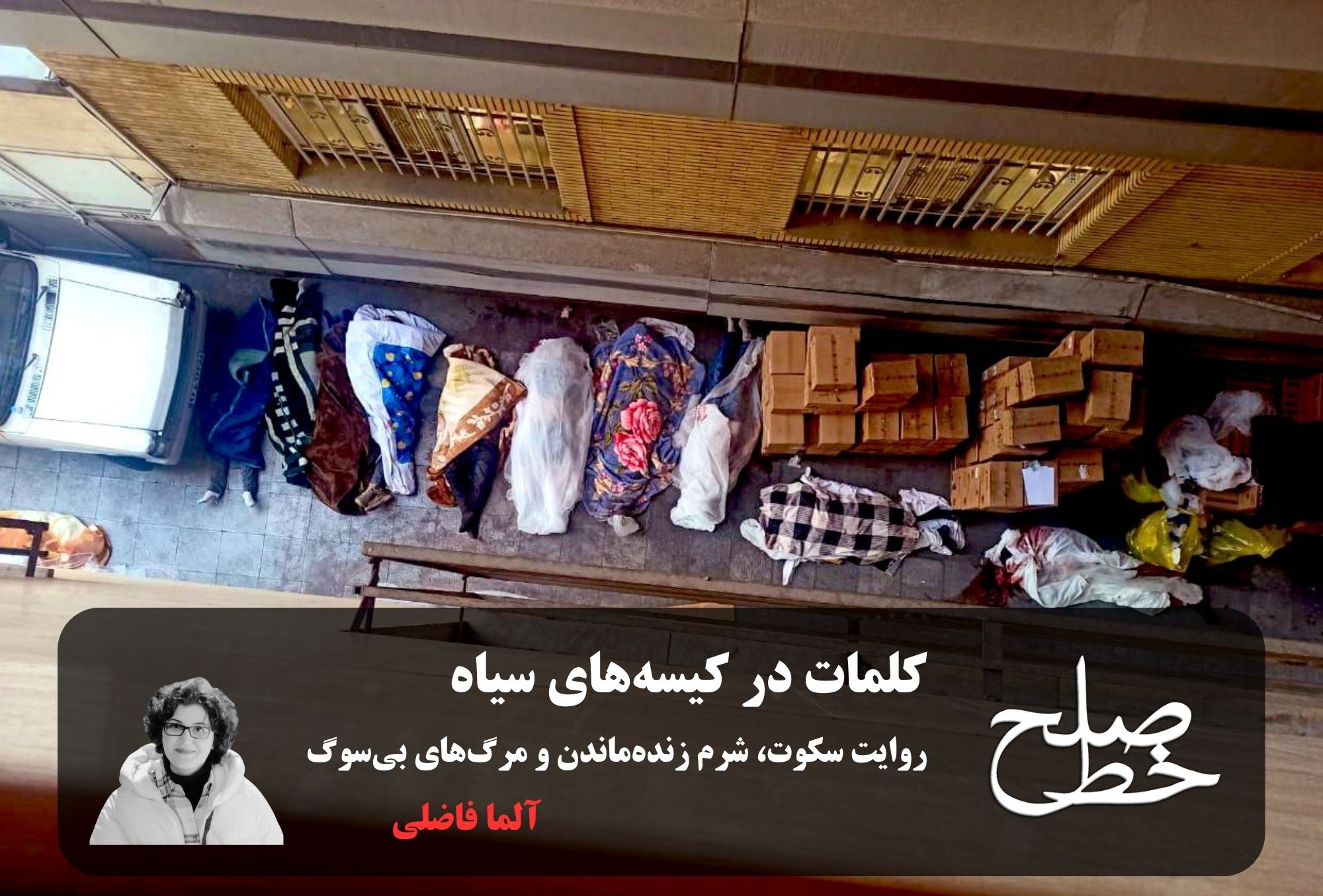
Words in Black Bags/Alma Fazeli
It has been more than sixteen years since the first image of Neda Agha Soltan’s last look was released, and about forty days since the first film of the pile of black bags for human corpses was released. Let me not go back any further, because to write about the experience of these days, I have to refer to the most vivid contemporary memories: for someone like me, in my mid-forties, Neda’s blood and gaze were the first encounter with blood on the asphalt of the street; Neda could have been any of us who were on the street in the same vicinity a few hours earlier. Now, I do not live in Iran and have not been on the streets this year. I am a witness at a distance and by proxy. These few lines are to remind me from where I look at this horrific image. I am not writing with a cold mind either; I believe that if referring to lived experience as a valid method of understanding a phenomenon is, then this is one of those human twists that gives cognitive validity to human perception, no matter how mixed with astonishment, anger, despair, or sadness.
It has been more than sixteen years since the first image of Neda Agha-Soltan’s last look was released, and about forty days since the first film of the pile of black bags for human remains was released. In these sixteen years and several months, many young people have been killed in various “rounds” of protests at the hands of the Iranian government, and we, the distant survivors, have often been able to turn their lives into documents with images and songs that testify to the commission of the crime, and in this way, perhaps, we have mourned: “The tulips of the homeland have been blown from the blood of the youth.” And this has been the bloody struggle of years and the back and forth between death and life and everyday life… until the first image of the pile of bodies in black bags and the living wandering among the multitude of the dead.
Perhaps this is the point: what we, the survivors, are facing today (or perhaps it would be better to say what we have been immersed in) is the first direct encounter for many of us with the “genocide.” We, who have heard, seen, and read the stories of Auschwitz and have been watching the massacre in Gaza for more than two years, are now frantically knocking on doors and searching for words to understand the event. And this time the event is so horrific that words fail. Thousands of unarmed and defenseless people have been slaughtered in the most horrific way by “inside” soldiers and militias at a time when protest is more or less a human “right.” And this, with all its details, does not seem to be something that is straightforward, simple, or even possible for an entity shaped around survival to understand.
Whether they witnessed the hot blood of their comrades and fellow citizens gushing out in the streets, or those fathers, mothers, sisters, and brothers who, in search of their loved ones, looked across hundreds of lifeless faces in that terrible desert, or those who, like me, wandered from a distance and indirectly among countless torn bodies like wandering spirits to witness, all fell into stunned silence: Is such a thing possible? Who were we? What did we want? We were the “other” of the murderers, just as the Jews were the other Christians, or the blacks were the other whites, or the Palestinians were the other Israelis? Not that this “othering” is a license for mass murder, no; the problem is that the event seems to be outside the scope of our understanding. The witness is all the poems that have not been written and all the poems that we have written and now do not cure any pain and are being rubbed in our mouths. Shattered skulls, split foreheads and chests, the open eyes of young people and children who seem not yet accustomed to their death, the screams of mothers and fathers who hold their shattered faces in their hands and their world suddenly turns dark. These images, these sounds, and these looks make words flee and leave the survivors in silence, ashamed of being alive.
The Holocaust has disrupted the rules of life and death as we knew them until January 18. We live in a new world. It seems that we do not yet know the way and method of this living. We have not yet created our words for the event or for the aftermath. Have we become the Muslims, as Agamben describes them, who lost the ability to speak in Auschwitz and, beyond human pain and emotions, lived alone on the border between humanity and inhumanity? The Muslims were unwitnesses, witnesses to a crime beyond the realm of understanding and words. What about us? We, the survivors on the border between life and death, without words to help us understand what has happened to us?
My psychologist friend says that a disaster is an event that completely disrupts the framework of “normal” and security, and this is incomprehensible to the human mind. So, in order not to collapse, the mind enters into stillness, inaction, and silence, so to speak, it “freezes” in order to just survive so that it can, over time, recognize and rebuild its empowering connections and connections. My psychologist friend puts a “maybe” after his last sentence and says, “In a catastrophic atmosphere where our survival is in doubt, in an atmosphere where uncertainty ripples through human emotion, the brain can navigate with greater focus in silence and inaction.”
Another friend of mine talks about the need for collective mourning after a disaster, and believes that when we are not allowed to express our grief even through collective rituals in the current situation, it is as if we are being denied permission to resolve this tragedy within ourselves; the silence and stillness are due to external pressure and the lack of recognition of our mourning. She says, “Silence is pent-up grief, mourning without form or language, pain without evidence.” Judith Butler also talks about a concept called grievability and divides death into “grievable” and “ungrievable”; valuable lives and worthless lives.
Which of yesterday’s survivors are we, the survivors of today, most similar to? Perhaps to some extent to all of them and to none of them. And perhaps that is why we are so lost and so slow to find our way. Will words or possibilities emerge from this carnage? Perhaps.
 Created By: Alma Fazeli
 February 20, 2026
Tags
Alma Fazeli Censorship Crime against humanity Criminal Kahrizak Massacre Massacre 1404 peace line Peace Line 178 The Di 1404 Uprising Uprising of 1404 ماهنامه خط صلح