


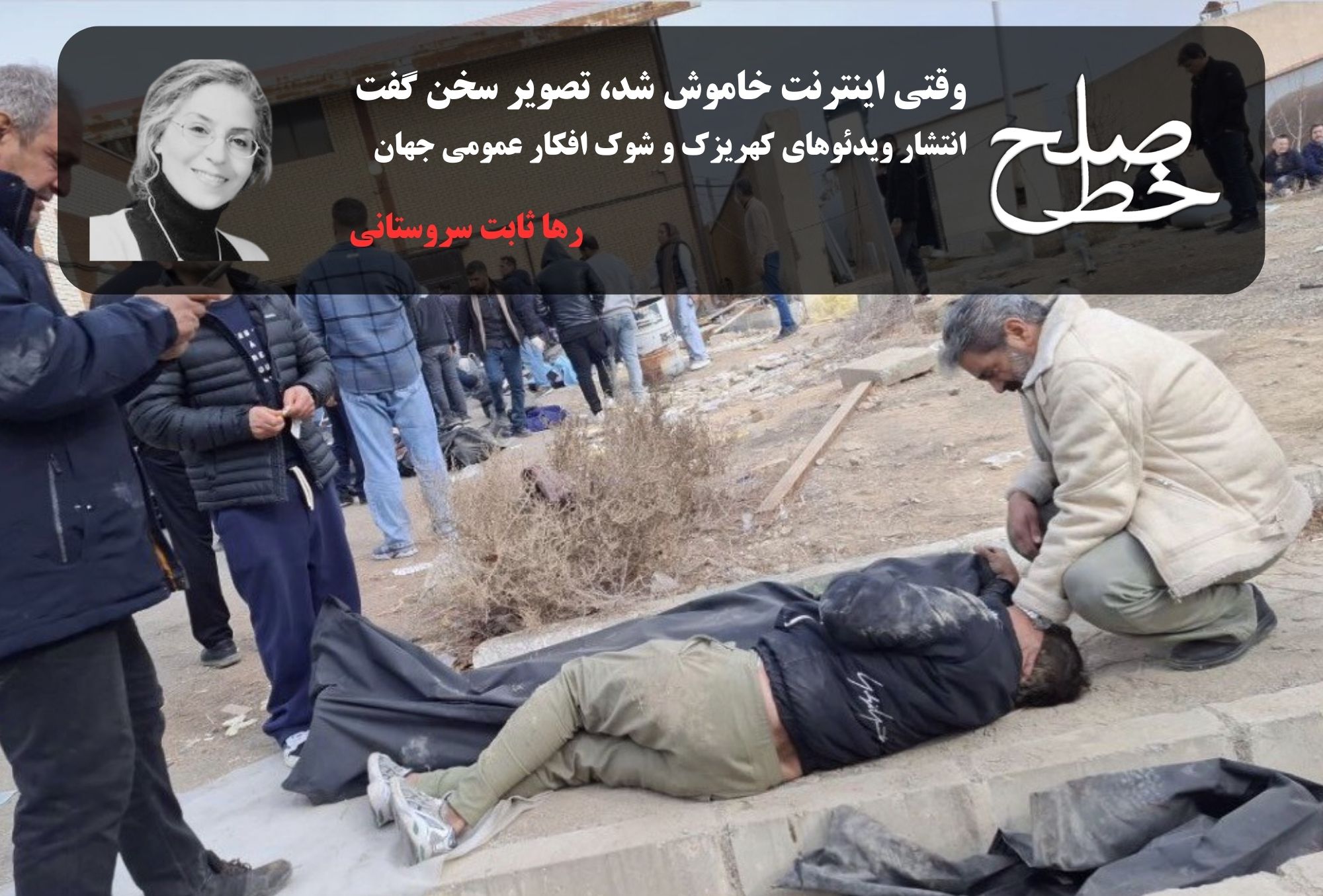
When the Internet Was Shut Down, the Image Spoke/ Raha Sabet Sarvestani
The release of videos related to the events of Kahrizak, at a time when the internet was widely shut down inside Iran, triggered a wave of shock and reaction among public opinion abroad—particularly among the Iranian diaspora, international observers, politicians, and human rights activists. This phenomenon cannot be regarded merely as a media event; rather, from the perspective of social and political sciences, we are confronted with a multilayered issue that has taken shape at the intersection of power, communication, and political action.
Internet shutdowns, as a tool for controlling the flow of information, are typically employed with the aim of containing protests and limiting the representation of violence. However, the widespread global dissemination of these videos challenges this assumption and raises fundamental questions about the effectiveness of such policies and their unintended consequences.
The central question of this article is how, under conditions of domestic communication blockage, content of such sensitivity managed to be disseminated globally and what socio-political message it conveyed. Specifically, two key questions are pursued: while the internet was shut down inside the country, which individuals, institutions, or networks were responsible for publishing these videos, and how did the path of information circulation take shape? What socio-political messages and meanings did the release of these videos produce for transnational audiences?
To answer these questions, a qualitative-exploratory research method has been employed. The unit of analysis consists of the published videos, their initial channels of dissemination, and the networks that republished them. Data were collected through temporal tracking of the first video releases, examination of communication platforms (particularly Telegram and overseas media outlets), and analysis of the trajectory of information circulation. The primary limitation of the research is the lack of access to internal systemic data and domestic communications during the internet shutdown, which makes the analysis necessarily reliant on external sources and indirect reconstruction of the pathways.
This study draws on a combination of theories of power and communication, transnational collective action, and symbolic politics to analyze the dissemination of the Kahrizak videos. Within the theoretical framework of communication power, media and images are considered not merely tools for transmitting information but mechanisms for exercising and reproducing power; thus, control over or disruption in the flow of communication itself becomes a field of political contestation. (1) From this perspective, the published videos can be understood as part of transnational communication networks that enable the bypassing of territorial restrictions and state censorship, transferring communicative power from the national to the global level. Furthermore, drawing on the literature of social movements and the concept of “moral shock,” this study demonstrates that images of state violence can, even in the absence of formal organization, provoke empathy, moral outrage, and the mobilization of public opinion at the transnational level. As articulated in theories of transnational collective action, the moral shock resulting from exposure to overt violence is considered one of the primary drivers of political participation and international responses to human rights violations. (2)
At the discursive level, the analysis in this study is grounded in securitization theory. According to this approach, governments, by framing social protests as threats to national security or as the result of foreign actors’ intervention, create the conditions for legitimizing extraordinary measures, including violent repression and internet shutdowns. (3)
Attributing popular protests to “foreign enemies” or “terrorist elements” can be seen as an example of symbolic politics, aimed at shifting the conflict from the sphere of social demands to the sphere of security and suspending ordinary norms of accountability. Overall, this theoretical framework makes it possible to analyze the Kahrizak videos not only as documents of violence but also as instruments for producing meaning, representing power, and shaping political action at the transnational level. The findings of the research indicate that the dissemination of news and images related to the killing of protesters was possible up to the final stages before the complete shutdown of the internet. This content was published both through overseas news media and via communication platforms such as Instagram and Telegram. In other words, before the complete blockage of communication infrastructure, there existed a kind of “temporal window for information transfer” that enabled visual and news data to leave the country. Based on the conducted examinations, the first images related to the events of Kahrizak were published on January 11 (21 Dey), coinciding with the initial days of the implementation of the internet shutdown policy. These images were first released through the Telegram channel “Vahid Online” and were subsequently republished by foreign media outlets such as BBC Persian. At the time this content was released, according to available reports, approximately 63 hours had passed since the beginning of the internet shutdown. Several hypotheses can be proposed to explain this phenomenon. First, there is the possibility of the physical transfer of data through the departure of an individual or individuals carrying the content out of the country and sending it after entering another country—an alternative pathway for information circulation conceivable under conditions of communication blockage. Second, the possibility of controlled dissemination of content by actors affiliated with official or semi-official power structures can be raised; a scenario that can be analyzed within the framework of “crisis management through controlled disclosure.” Third, the involvement of foreign actors through cyberattacks or informational infiltration is also subject to examination. Finally, the limited use of alternative communication technologies, such as satellite internet, cannot be entirely ruled out.
The ambiguity surrounding the source of publication has itself become an analytical variable, contributing to the intensification of the media and political shock. At the same time, the socio-political message of the videos is highly dependent on this origin. If the dissemination originated from internal power structures, it may be interpreted as an indication of prioritizing the display of power over the costs of international discredit. In this case, overt violence can function as a deterrent message for both domestic and foreign audiences. If the source of these videos was the intervention of foreign actors and cyber infiltration into communication infrastructure, the analysis shifts from the media level to a security-survival level. Within this framework, the internet shutdown is interpreted not merely as a tool for controlling protests but as a mechanism for protecting sensitive centers and the heads of government and preventing potential security threats. From this perspective, the dissemination of videos of state violence is not necessarily the primary concern of the ruling establishment, since the priority lies in preserving political power and the physical security of governing elites; consequently, reputational costs and international criticism assume secondary importance. In contrast, if the publishers were ordinary citizens, the release of the videos must be understood within the framework of transnational grassroots information activism—an action aimed at documenting repression, drawing the attention of global public opinion, and creating grounds for seeking justice and legal follow-up. This pattern has also been observed in many previous protest movements and has become one of the few tools of civil resistance under conditions of structural blockage.
In sum, the dissemination of the Kahrizak videos, despite the profound shock it inflicted on global public opinion, revealed signs of a severe erosion in the relationship between the state and society. These images were not merely momentary representations of state violence but can be interpreted as indicators of a multilayered crisis in governance—a crisis that gains meaning alongside human casualties, mass arrests, economic decline, social insecurity, and the deterioration of quality of life. From this perspective, these videos marked a revelatory moment that highlighted the inefficiency of the existing political order at both the domestic and transnational levels, while simultaneously raising fundamental questions about the capacity of the global order to protect human beings against violence and injustice. The findings of this limited research suggest that without structural reforms at the national level and a redefinition of accountability mechanisms at the international level, the continuation of the current situation may lead to the reproduction of cycles of violence and instability throughout the region and even the world.
Footnotes:
1- Castells, M. (2013). Communication power (2nd ed.). Oxford University Press.
2- Jasper, J. M. (1997). The art of moral protest: Culture, biography, and creativity in social movements. University of Chicago Press.
3- Buzan, B., Wæver, O., & de Wilde, J. (1998). Security: A new framework for analysis. Lynne Rienner Publishers.
 Created By: Raha Sabet Sarvestani
 February 20, 2026
Tags
Censorship Filtering Internet outage Kahrizak Massacre 1404 peace line Peace Line 178 Raha Sabt Sarvestani The Di 1404 Uprising Uprising of 1404 ماهنامه خط صلح