


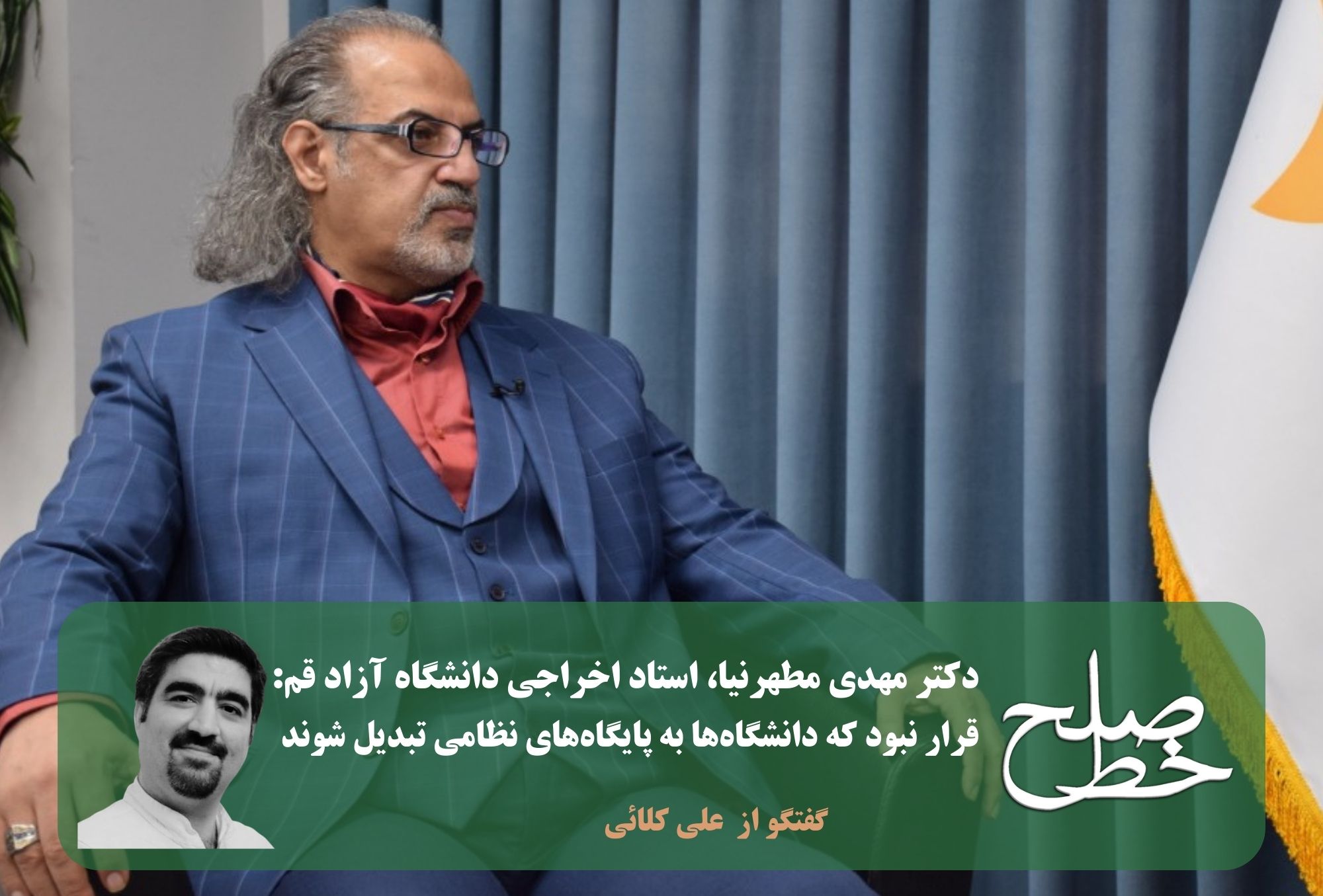
Mehdi Motaharnia: It was not intended for universities to be turned into military bases / Ali Kalaei
Mehdi Motaharnia, a professor at the Azad University of Qom, Tehran Central, and Tehran North, and a visiting professor at the National Defense and Shirazi Hunter universities in the fields of political science, futurology, sociology, and cultural management. He is one of the development theorists in Iran who considers himself a transformationist. In addition to teaching, he has also served as the director of the Social Sciences and Revolution Research Center at the Central Organization of the Islamic Azad University and various content departments at the Islamic Republic of Iran Broadcasting. He has written numerous books and articles on social and political sciences, futurology, communications, media, as well as security and psychological operations.
In the present conversation, we discussed various issues with Professor Motaharnia. The opinions of this university professor about the different topics that are happening in Iranian universities are noteworthy. He believes that many of our higher education centers are not under legal supervision, but rather under political preferences. He also talks about the lack of structured programs in Iranian free universities, saying: “The authorities there are not serving the law. Systems are not formed based on laws, and there are no systemic laws or thinking in these systems.” He believes that extra-legal institutions are directly responsible for creating a safe environment in universities and are the real decision-makers in expelling professors and students. This university lecturer talks about the university’s security environment as follows: “Wasn’t the plan for these issues to be resolved? Didn’t Ayatollah Khomeini mention that he hopes all these issues will be resolved? It was planned for the Basij bases to be turned into centers for intellectual development after the war, not for
After the fall of Ibrahim Raisi’s helicopter, the Medical Government took over with the slogan “National Unity”. Mohsen Motehharinia, regarding this slogan, says: “Unity is a discourse. It is not just a slogan. It needs a model. It needs words and speeches prepared. We cannot just speak in the name of national unity.” He also speaks about events that may change the situation, saying: “As a futurist and university expert, I say that the bells will no longer ring. The bells will ring. The trends show this and events can accelerate it.”
You can read the explanation of the monthly conversation with Mehdi Motaharnia below.
Several weeks have passed since the eighth of Shahrivar of this year, and the medical order to the Minister of Science is underway for the return of expelled students and a review of the conditions of expelled professors. However, evidence suggests that no positive developments have occurred in this regard so far. To what extent will this order be implemented and to what extent is this issue within the jurisdiction of the Ministry of Science and the head of government?
According to the laws and regulations of the Islamic Republic system, the president is considered the first executive and second political figure in this system. In other words, in the executive and executive power, the highest position in the constitution and various levels is the president, whose authority includes various monitoring and information systems. Within the university, issues related to students and the university are referred to external institutions. These external institutions are located in the executive and executive power. Therefore, the executive institutions cannot enter these areas against the president’s orders. Internal executive institutions also cannot disobey his orders. This is stated in the law.
For a while, executive institutions of the regime were involved with universities. In other words, government and ruling institutions were active in creating a safe environment in universities. This activity led to the expulsion of some students and professors, the consequences of which were evident in the 1403 elections. In these elections, a large number of people showed dissent and the social capital of the system decreased. Essentially, in the ruling trends, the emergence of physicians is considered an effort to repair this dissent. If the president’s orders are not implemented in this regard, or if the physicians and their government do not pay attention to it and issues like it, not only will the reconstruction of this social capital not be possible, but the system will also suffer more destructive blows. Today, for the current regime, convergence between the people and the executive power on one hand, and the executive power and the ruling government on the other hand, is a fundamental principle. This is in line with the reconstruction of various social and political
Manual.
In 1401, the disciplinary measures resulted in heavy penalties for students and one of the main demands of the students is the complete cancellation of this policy. Can we have hope for the new government in this regard?
The government can have a meaningful and definable role in this field. It can enter into negotiations with legislative power so that the issue of universities and the non-interference of non-legal institutions within universities can be turned into a passed and enforceable law with strong authority. It is not enough to just demand the production and expansion of knowledge and communication with target communities based on the university’s mission, but you must also consider the freedom of thought and belief for students and professors.
From an academic and scientific perspective, the university has meaningful methods. We cannot speak of the unity of the field and the university, but only see active and mission-oriented individuals in the field at the university who are trying to advance the university’s scope with specific methods. The university is a place of knowledge and knowledge is faced with doubt, skepticism, uncertainty, dynamism, and dynamic thinking. Science accepts excess signs, not adherence to one or a few signs and absolute obedience to various symbolic signs. Contrary to this, in universities around the world, this leads to the blocking of scientific production. When science is not productive, the country does not develop. Today, national flags in the world are not indicative of the greatness of knowledge and wisdom and national development of countries. Although flags are widely accepted and respected as symbolic signs, it is necessary to have dynamic and pioneering universities and renowned professors, referable and powerful articles, new books and theories, and intellectual professors as the main criteria for national development
It seems that these words and points have lost their color and meaning, and we must strive to turn the university into a center of scientific power in service of common perspectives and discussions. Now, at least fourteen years have passed since this effort began and we can measure its outcomes and give it a grade. With this measurement and grading, we can have a precise evaluation and assessment. Is it not time to reconsider our policies? If previous policies have not yielded results and have not had the desired outcome, should we continue to insist on them? These are questions that require accurate answers.
The expulsion of students and professors in Iran has a long history. In your opinion, why does such a thing happen in general?
Change and Transformation in the Taste of Political Power Chairs – Considering the numerous frictions between diverse social and political attitudes among people – in a structure of conflict between various layers of social-political positions and the lack of training of managers committed to laws and not relying on personal preferences, it causes the taste of that manager or university president to dominate over all laws. As a result, with the domination of that taste and the centralization of agency instead of the system, laws are easily disregarded and even the existing laws related to the subject are hidden from the perspective of the rights holders and stakeholders. Many of our higher education institutions are not under legal supervision. Rather, they are under the supervision of political preferences.
The most important and prominent of them is the Islamic Azad University, where with a change of a president, a board of trustees, or a manager, changes are easily made and there is no significant disruption. The authorities there are not in service of the law. Systems are not formed based on laws and there is no systemic thinking. Because they are not systems to begin with. So can we achieve results in such a structure? As the saying goes, “Building a palace on shifting sands is not rational.” What achievements have all the quantity created in the academic sands of Iran had? It is because you do not find the foundations and pillars of academia. Plato, who as a student of Socrates, founded the Academy in the gardens of Academus in Greece, did not blindly follow Socrates and his student Aristotle never thought like his teacher. Their criticisms of each other’s ideas blossomed the Western world. Here in the academy, they say that this idea, this ritual, this law
At the university and in academic thinking, what is authentic is doubt in realities to attain truths. Whether in the field of theology, philosophy, or empirical sciences, it is the product of human rationality and intellect, each with its own specific methods, epistemological foundations, and systematic approaches that must be respected by others. We cannot, due to our own perceived superiority and self-centeredness, impose this same meaning in the realm of science. The authenticity of the scientific field is in doubt. Its authenticity lies in its dynamism. Its authenticity lies in questioning all statements that claim superiority and greatness. If a student stands against the deputy of the US president and spills three drops of blood (on December 7, 1953), it has a political mission. But when faced with the coercion resulting from arrogant, dogmatic, and opportunistic movements, they must pay a high price and their legitimacy, acceptability, and legality are called into question. We cannot see the student as an element
I was accepted in 1366 (1987) myself. There was no other option for this major except for the University of Tehran. There were no universities in Isfahan, Shiraz, or other cities that offered this major. But suddenly, all the major universities in the country accepted this major. The Azad University also added it to their curriculum. Non-profit and applied science universities also added it. It’s like instead of an institution, it’s a business. When we look at universities as a business for making money, this is what happens. We have built so many mosques. We have so many cultural systems and organizations. Did Ayatollah Khomeini not say to Mohammad Reza Pahlavi, “Just give me endowments and enjoin good and forbid evil, and in one year, we will prosper the country?” How many cultural organizations and institutions exist today besides the national or Islamic Republic of Iran Broadcasting? How many mosques are there and how much are
What happens when professors are expelled from the university? How are the expelled professors replaced and what is the situation like?
I am Mehdi Motaharnia, a student at the esteemed Mr. Bashiri’s university and the father of Iranian political sociology. He wrote the introduction to my first book and I am grateful for it. When they expelled him from the University of Tehran, people like me became his students, and we are small students like him. Although he is kind and writes in his writings for me: “Intellectuals after us must be better than us and you were like this.” But this kindness is his servitude and studentism. Who did we educate? Did Mottahari educate the seminary, or was he himself educated by his own efforts? How many Ayatollah Tabatabai do we have today? How many Morteza Mottahari do we have? How many Mohammad Taqi Jafari do we have? How many Hossein Bashiriyeh do we have? How many Shafiei Kadkani do we have? In music, how many
Mr. Physicians came to work with the slogan of national unity. Do you think this national unity can be crystallized in the university? What should happen?
“Unity is a meaningful matter for creating convergence. Unity has a model and a pattern. If you want to create unity, you need a few “two-eyed” and the university must theorize it. It is a “coherence”; you cannot prove yourself by denying others. With logocentric and word-centered attitudes, consider yourself absolute and dismiss others. You cannot say that I am the queen of the bees and when I enter, all the worker bees must stand up and show their respect for me. Everyone must sit together. As it is said in religious literature, when the Prophet entered a mosque, he would sit in a circle with those who were discussing knowledge, not on a high platform. He would try to teach and learn.”
After merging, you must have “companionship”. Sit next to them, not above them. Why in prestigious academies and universities around the world, students sit from top to bottom and the professor’s podium is at the lowest level, not the highest? Look at the University of Tehran. Go to Room 212 of the Faculty of Law and Political Science. The arrangement of the classes is such that students sit in rows from top to bottom and the professor teaches at the lowest level and in the lowest place. All students also look up to the professor, not down. This is the power of academia. This image shows the position of the university. The university tells the professor to sit at the lowest level. Because you don’t rise up by sitting above others. Knowledge must elevate people, not claims.
Another is “collaboration”. To create collaboration, you must synchronize and show it in action. The Prophet of Islam did not sit and watch when building the mosque in Medina. He also moved bricks. He knows that if they collaborate and want to have scientific and religious activities in the mosque, he is also with them.
“When they come together, hearts become closer and when hearts become closer, ‘happiness’ and unity are created. Unity is a discourse, not a slogan. It needs a model, and words and speeches must be prepared for it. We cannot simply talk about national unity. We cannot speak of love and friendship for our homeland and people of a country, while contradicting and opposing the religion of mercy. Until these issues are resolved, fundamental actions cannot be taken in the light of a slogan.”
Are responsible institutions in dealing with students and universities, such as security departments, under the control of the Ministry of Science and its policies? You said at the beginning of your speech that it should be possible. But how and from where? Considering the reality we are facing today, are these controllable?
If a minister cannot control their security and the president cannot control their minister of information or any other position, they should resign and step down. They should give their power to someone who can do better. When the decision-maker is the minister and they are actually helpers and facilitators, what does this mean? Is it a difficult matter, like cosmic equations or unknowns that James Webb must capture and discover?! Are the ministers serving these institutions or are these institutions serving the ministers? The ministers serve the president, who is the top authority and decision-maker. Is he accountable or are the ministers? Everyone must act according to the law and not impose their own personal preferences. Students must also be committed to the laws. University professors must also be committed to the laws and carry out their mission within the framework of the law. As a professor, I cannot immediately cry out and make accusations if I am expelled, forced to retire, or fired. I must follow the law. We have universities in this country
To what extent do law enforcement and security agencies outside of universities have influence within universities in Iran? Can the Ministry of Science prevent these agencies from dealing with students and professors?
“When it is planned for a preacher or a young person to teach at Sharif Industrial University in a general course, instead of great professors, or when a great teacher like Dr. Mashayekhi, who is the second person after him in the theory of systems and system data processing, and his student, Dr. Bararpour, resigns to escape from pressures and leaves sooner than a university like Sharif Industrial, what will be the future of this country? The person who takes the place of these professors also loses his own personality. He can have the enthusiasm for this meaning for two or three days, or at most three or four semesters. Then he sees that he has entered a place where his worth is ignored and he suffers. In other words, not only our university and great professors are oppressed, but also those who replace them are also oppressed. History will say and see this. It is said that the number of students is not high. Why did you open so many
What is your prediction for the upcoming academic year? Will we see more vibrancy in the university and more activity from students?
Today’s society, with the changes in tastes that have occurred, is waiting and smiling. It is smiling. If this smile and smile are not accompanied by major changes and only remain in slogans and even in action, but do not expand beyond that, the increasing expectations of the people will create a high level of social emotions and political upheavals. Many discourse and value systems have collapsed and are unable to rise. The field, the field is very difficult and therefore they must appreciate this smile and this smile.
Thank you for the time you have given us in the Peace Line magazine.
 Created By: Ali Kalaei
 September 22, 2024
Tags
"Student suspension" Ali Kala'i Azad University of Qom Download the app. Executive power Expelled professors Expelled students Masoud Pazhakian Mehdi Motaharnia National unity peace line Peace Treaty 161 Student movement ماهنامه خط صلح ماهنامه خط صلح