


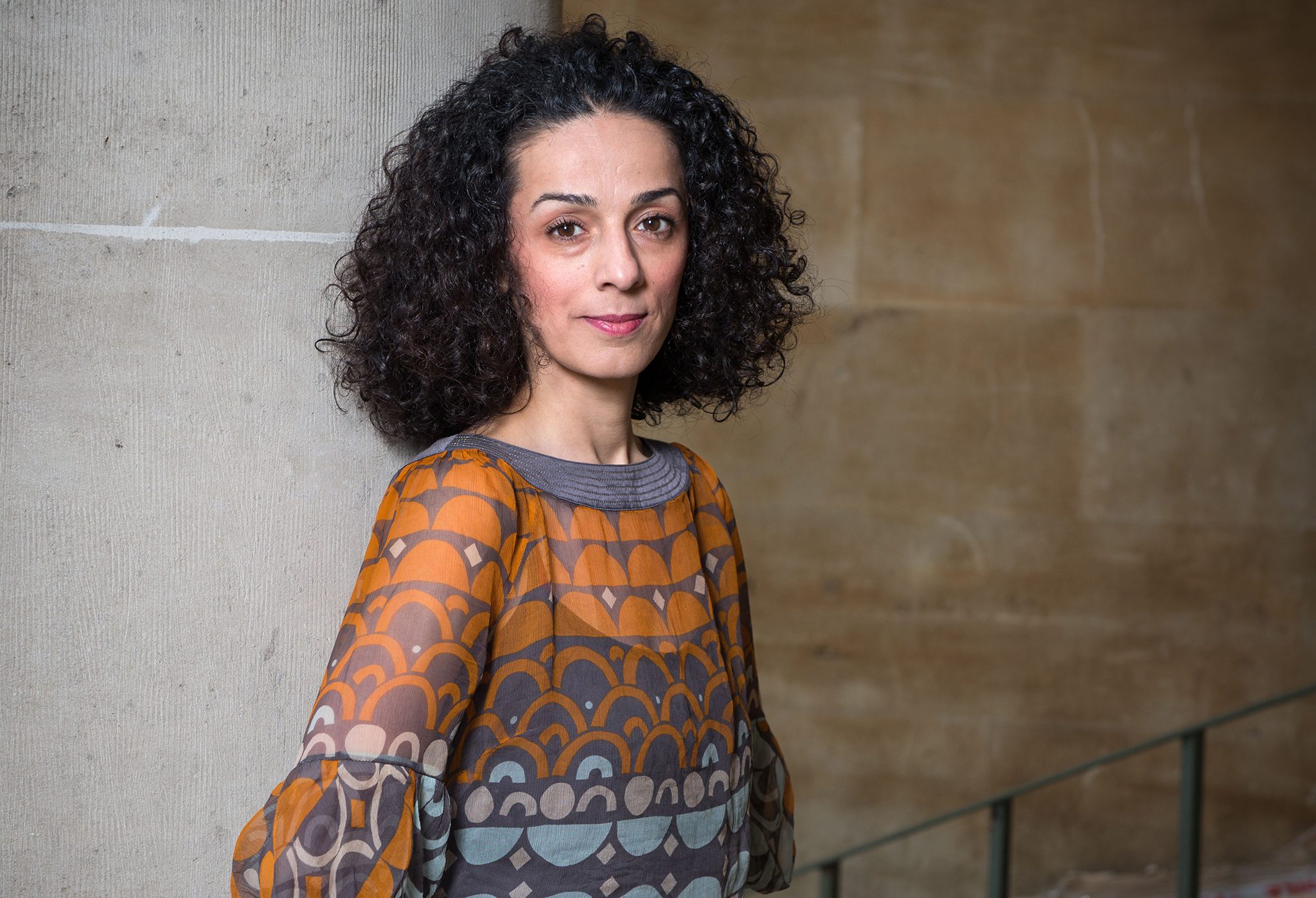
Masih Ali-Nejad: Protests against the executions of the 1990s became public on social media networks.
Masih Alinejad, an Iranian journalist, launched one of the most popular and controversial Persian campaigns on social media in 2014. The “My Stealthy Freedom” campaign currently has over one million followers on Facebook. This campaign shares photos of Iranian women without hijab and provides them with a platform to speak about their experiences of being denied the freedom to choose their own clothing and express their desires and aspirations. It has gained support from prominent media outlets and influential figures around the world, making it a successful campaign.
Given the topic of the special issue of the peace line, we have had a conversation with Ms. Ali Nejad regarding social networks and their role in empowering civil society and women in Iran, as well as asking them about the approach of the Iranian government towards these networks.
In this conversation, Massih Ali Nejad, while referring to the fact that social networks play an important role and act as a “supporting arm” for citizens and civil society, says: “In the 1990s, mass executions took place in Iran; prisoners of different ideological groups, while serving their prison sentences, were executed in groups… But it was actually through widespread protests on these very issues, later on and through these same social networks, that took shape or became public.”
Mrs. Ali-Nejad, considering the influence of various social networks in the lives of Iranian people, for example, can we imagine the absence of these networks in the shadow of establishing a national internet? In fact, given the level and extent of these types of relationships in today’s Iranian society, do you think this elimination is conceivable?
The progressive society of Iran cannot be censored or filtered. It is essentially impossible to try and turn back a society that is advanced and does not base its way of life on imposed laws, religious laws, and existing fatwas. A society that does not give up its way of life – even if it is costly and even if it is legally punishable. For example, consider when the leader of the Islamic Republic declares that women riding bicycles is forbidden and prohibited, and says it is better for women not to ride bicycles in public spaces. But we are actually witnessing that the new generation does not care about such fatwas and does not adjust their lifestyle based on issued fatwas. Or it is repeatedly announced that women should observe their hijab and not attend mixed parties, but in reality, no one cares about these laws, fatwas, and guidelines. The reason is that it is impossible to regulate someone’s lifestyle who has access to the world of communications and modernity with a set of backward laws
Therefore, I think it is unrealistic and impossible to try to turn the internet into a national internet. This is because a significant portion of Iranian society is made up of young people who have access to the internet and virtual space, and they do not rely on official networks or media to shape their lifestyles according to those standards.
Given the fact that there are multiple social media networks, in your opinion and in comparison to developed countries, can it be said that a specific section is being used and in fact, are we missing out on some advantages or uses of these networks in Iranian society?
Ironically, I’ll give you an example: When I was a journalism student at Oxford Brookes University, I always saw my classmates using social media solely for gatherings or friendly parties; sharing photos of these parties or their dances with others. But at the same time, I saw a different use of social media in the Middle East and countries like Syria, Iran, and Iraq. In fact, that part of society and citizenship that was censored, used social media to reclaim their share of the mainstream media. This difference was a wake-up call for me, as a journalism student, to see how different we are from modern societies that now only use social media as entertainment to share their personal lives and joys.
In fact, in third world countries and governments where information is classified and a form of systematic censorship is in place, citizens use social networks in a different way and it can be said that they have even increased their usage. In these countries, social networks are used as alternative media or as substitute for official media; citizens feel that their voices are not heard in the main and credible media, and as a result, these virtual social networks act as a supportive arm. For example, when I, as a journalist, am expelled and removed from Iran, social networks become a supportive arm for me, helping me to obtain real news and information that is happening in society. While totalitarian governments try to create subjects and produce news, and force journalists to disseminate information based on the news line that has been produced, they also hold roundtables, conferences, and various meetings. Social networks and alternative media have completely changed this issue. We see news that is buried and remains underground, news that is considered taboo and
You have worked as a journalist and have closely followed the developments of social networks in Iran and their widespread growth over the past decade. In your experience, how much has this expansion played a role in empowering Iranian civil society? Some believe that before the emergence and prevalence of social networks, the fate of many issues was determined on the streets and through real activities, but now the virtual world has become the cause of the superficiality and degradation of civil or political struggles. What is your opinion?
In the 1960s, mass executions took place in Iran; prisoners of different ideological groups were executed in groups while still under imprisonment. At that time, there was no news of social media networks, but did we have any street protests in this regard? Let me give another example: for years, we have witnessed that people’s way of life has turned into a daily war between the government and the people; when people are supposed to have a simple wedding or birthday celebration, because they choose a different lifestyle from the one determined by the government, security forces give themselves the right to invade people’s privacy and consider them for punishment according to the same laws. Have we ever seen a street protest against the sentences issued for mixed parties or alcohol consumption in gatherings in the past few decades?
Currently, however, social networks allow people to protest against such laws – which are against human rights. If you look at the Yavashaki Freedom Campaign, the foundation of this campaign is for people to protest against their own freedom being restricted. We have two Irans; the authorized Iran and the unauthorized Iran. The authorized Iran has its own mosque, parliament, government, and social base, but the unauthorized Iran is also the one where despite the ban on women singing solo, dancing and stomping, being unveiled, and also the prohibition of reading certain books and following some news, Iranian citizens do not stop their lives and do these things quietly.
Of course, the government is not afraid of freedom and a peaceful life. It is not scary for them that you have your freedom and lifestyle in a corner, at a party, or by the seaside. What scares the government is challenging the law and making these kinds of freedoms public. Our government only feels insecure when peaceful freedom is publicly voiced and discussed. Ordinary citizens take back their censored voices through social media from official media outlets. In the 1990s, mass executions, floggings, and stabbings of those who wore short sleeves were common. But ironically, it was through these same social media platforms that widespread protests against these issues later took shape or became public. Ordinary people impose their voices of protest on mainstream media through these same social media platforms. This means that if we did not choose the streets as our place of protest in all these decades, it does not mean that “we” do not exist. Therefore, we cannot say that social media has taken the lead
“Good, it seems that you agree that social networks have helped empower civil society in Iran. But the question that arises is how effective can protests against events be on social networks? Are such protests ultimately translated into the real world?”
See, women politicians from different countries who used to come to Iran to meet with Iranian officials, would comply with the mandatory hijab; however, in the past, we have never witnessed any protests against this issue. We have never seen a non-Iranian female politician come and say that this hijab that you are imposing on me is a backward, shameful, and medieval law that you want me, who is not a believer in Islam, to dress like those who are. But now, with the help of social media and the soft power of the freedom campaigns, we see that in the Swedish Parliament, one of the representatives stands up and protests against other representatives and members of the Swedish government who went to Iran and wore the hijab, saying: “How can you comply with the mandatory hijab without protesting? How do you not see the millions of protesting women in Iran?” As a result, after years, the voice of Iranian women is heard. If the Swedish government is truly a
This topic could be a clear answer to this question. That is, in the past, the issue of Western women wearing hijab during their travels to Iran was not a topic of discussion for mainstream media and the world media never challenged this issue; it was not even seen. But we must ask, why is it seen now? For an ordinary citizen, a housewife, a 14-year-old girl who gets beaten by the morality police, now through Instagram, Facebook, or other social networks, can openly express their suppressed freedom and challenge the laws of the Islamic Republic with a loud voice. She asks, why should I, when I take the risk to protest against this law – while it is a crime and punishable in my country – be forced by female politicians to comply with it?
Mr. Zarif, when he came to France, told a French female politician that hijab is our culture and you must respect our culture and laws. But in return, where is our culture when a 7-year-old girl is sentenced to wear a veil or when we force a Jewish or Christian woman to wear hijab in Iran? This is where we see that powerful media is no longer only in the hands of politicians and those in power in Iran; ordinary citizens and those who belong to the fabric of society, through social networks, impose their voices on mainstream media and gain power. Now they have power and are so influential that they can even challenge their own minister in the global community.
Another point that is worth mentioning is that in the West, there is a very important issue under the title of “identity”. People have been struggling for years to find their true identity. However, the government, by resorting to laws, censors our true identity. We fight for our lost identity and hope to have a second chance at life. The only platform on social media that can empower such women is one that can give them a say in determining their own lifestyle, just like politicians.
We have been not seeing women in their true sense in the official media of Iran for almost four decades; we see a woman who is in line with and believes in the current laws of the Islamic Republic. But when we enter social networks, we see a different image and a different country. We see an Iranian who is known as an underground and illegal Iran. This underground Iran must introduce itself and talk about its true identity. Considering that this Iran has no share in the official media, it can only do this on social networks and small media outlets. Even actors and famous figures in Iran, when they have objections to existing laws, raise it on Instagram or Twitter. In such circumstances, when a woman finally finds the opportunity to introduce herself – with her true and censored identity – she can also be assertive and questioning about her other rights and speak more powerfully and boldly. That’s why, contrary to some who think that social networks are shallow and trivial – and sometimes their content is just
Mrs. Alinzhad, your analysis of the fact that many social networks, including Twitter, are filtered in Iran, but some high-ranking officials such as members of parliament and ministers are members of these networks and also speak a lot on them, what is it?
You asked a very good question. This issue is indicative of the instability and inconsistency of a government that, based on its own laws and power, prohibits citizens from entering social networks, but uses those same networks to mislead the global community. For example, the leader of the Islamic Republic is not fundamentally in favor of using Twitter, Facebook, and Instagram, which are products of global arrogance and the West, but he himself uses those networks! The goal is to guide the global community towards falsehood based on its own beliefs. In fact, you are removing yourself as a citizen from the virtual community so that you can more easily operate in that space in order to mislead the global community.
Therefore, the leader of the Islamic Republic, Mr. Rouhani, Mr. Zarif and Ms. Ebtakar – or other ministers of Mr. Rouhani’s cabinet – are inevitably present on these social networks, despite being aware of the filtering that exists and the ban on entering these networks – whose founders and founders are Western and American countries – because they cannot ignore the role of these networks in shaping global developments, they come and join these networks to spread false information and mislead the global community about what is happening in Iran. However, ordinary people and ordinary citizens are also present on these networks to the same extent to engage in a war; a war that exists and I have called it the war between two lifestyles; the one that the government wants to impose on its people and the one that the people themselves want to pursue. Perhaps many are concerned about nuclear talks or wars that are military and necessarily involve the use of weapons, but the reality is that it is a daily war that
Why are some social networks like Facebook or Twitter – which have advanced standards and tools – filtered, but social or news networks like Telegram can continue to exist?
Although Facebook and Twitter have been filtered, filtering is not an easy task. They know that the modern and progressive generation of Iranian society can bypass filtering, so they are pushing for a new solution, such as monitoring or registering Telegram channels. Keep in mind that those in power in Iran are not foolish people. They are aware that the younger generation in Iran has learned how to bypass filtering, so they will definitely consider other methods to confront and counter it.
Therefore, the fact that Telegram has not been filtered does not mean that the Iranian government supports freedom of speech. I believe they cannot control the younger generation and have resorted to managing news and information; which will surely lead to failure in a short time.
Why don’t we have a successful domestic social network? Do you think the discussion is more about technology and knowledge or security issues and possibly people’s lack of interest in domestic networks?
Domestic social networks have surrendered to the power of free global social networks. Domestic social networks, which are government-owned and operate systematically, have nothing to say in the face of ordinary citizens whose voices are imposed on mainstream media. In addition to Aparat (as a domestic social network), media outlets such as Fars News and even IRIB have Instagram accounts, which means they have surrendered to ordinary citizens.
We cannot arm ourselves and enter the media to physically eliminate them, but we can overpower them. One of these ways to save Iran is through dialogue, acceptance, and entering the virtual space instead of physical spaces. But we must be careful not to close the main window of dialogue on social networks. This means that we must be very intelligent so that if the government or suppression finds a space on social networks and feels the need to enter the conversations, we should not enter the path of insults, indecency, and dispersion; we should not contaminate our demands and demands for freedom with the deviant space that the suppression wants.
Thank you for the opportunity you have given us in the monthly magazine “Khat-e-Solh”.
I’m sorry, I do not understand.
متاسفم، من نمی فهمم.
 Created By: Admin
 February 24, 2017
Tags
"Slowly, the campaign for women's freedom in Iran" Aparat Censorship Facebook Filtering Freedom slowly Instagram Masih Alinzhad Monthly Peace Line Magazine Objection peace line Sixties Social networks Swedish Parliament Telegram Twitter پیمان صلح ماهنامه خط صلح ماهنامه خط صلح