


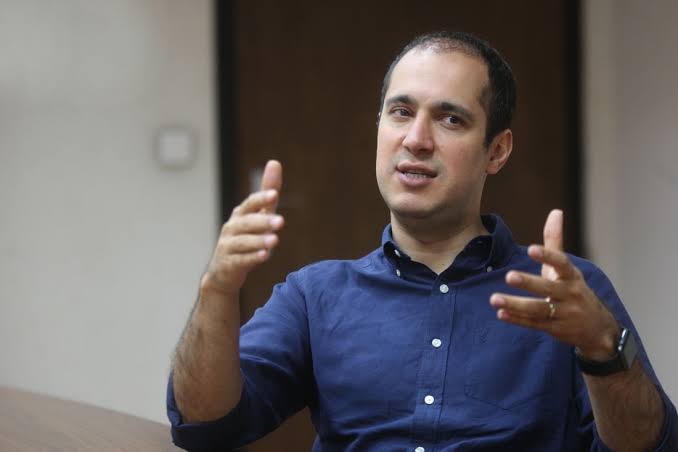
The problem of waste is a sign of an infectious disease called unsustainable development; in conversation with Dr. Kaveh Madani/Conversation with Siamak Malamahmoudi.

Kaveh Madani (born August 1981, Tehran) is a scientist, researcher, and environmental activist. In 2009, he received his PhD in Environmental Civil Engineering from the University of California, Davis. He then completed a postdoctoral fellowship in Environmental Economics and Policy at the University of California, Riverside.
Dr. Madani is currently a Professor of Systems Analysis and Policy at the Imperial College London. Prior to joining Imperial College, he was an Assistant Professor at the University of Central Florida. He is also a member of the Editorial Board of the Journal of Water Resources Planning and Management of the American Society of Civil Engineers and the Journal of Sustainable Cities and Societies published by Elsevier.
On September 17, 2017, by the order of Isa Kalantari, the Deputy President and Head of the Department of Environment of Iran, he was appointed as the Deputy for International Affairs, Innovation, and Cultural-Social Cooperation of the Department. However, during the arrest
How do you see the current situation of waste management in Iran? In what priority does this issue stand in terms of environmental concerns?
Prioritizing environmental issues can lead us to serious mistakes. This is because all the issues in this field, which we see around us, are the result of unsustainable development and all these issues are important and are somehow interconnected and interdependent. For example, you cannot say that the water crisis is necessarily more important than biodiversity loss or that air pollution is more important than the water crisis, or that waste is not a priority. The issue of waste management is not only a major problem in Iran, but also in the Middle East and in most developing countries and should be taken seriously. The path of development in our country has always been such that we have tried to hide waste from our eyes. That is, most of our actions in this field have been to remove waste from cities and residential areas and dump it elsewhere, without considering the damage we are causing to those places. Now we are witnessing the consequences and seeing how in some areas this issue has opened its mouth like a dragon and its toxic waste
The lack of integrated management is one of the main causes of the existing problem, as you mentioned, isn’t it true that waste is only seen from a distance?
I answered the first question with a broader view of policy-making and beyond our country, and discussed the issue for all developing countries. This means that humanity as a whole has behaved in this way during its development stages. However, if we want to address the issue at the level of our country, waste management is like air pollution, a topic that has many stakeholders and contributors. Therefore, the example you mentioned is one of the examples that shows the multiplicity of contributors in this field. For example, the Ministry of Health has a duty in this regard, and the Ministry of Interior and municipalities also have other responsibilities as relevant institutions.
Waste management is a complex issue. The majority of people do not know much about it, and even the organizations and institutions involved are not familiar with it. There are many issues regarding waste management, such as where to bury waste, at what stage and under the supervision of which organization it should be collected and recycled, how to fight its pollution, and so on
According to your estimates, which areas of the country are critical points? How is the distribution of crises?
The problem is that the waste issue has turned into a crisis in some areas, which requires high costs to be addressed, and in some areas it is on the verge of a crisis that needs to be addressed before it’s too late. In areas of Iran with higher population density, the surrounding areas have become victims of waste disposal. This issue is more visible in the northern part of the country.
During my time in office in Iran, I have emphasized multiple times that if Lake Urmia is a national problem, we must also address the waste issue in Gilan and Mazandaran with the same seriousness as a national problem. Unfortunately, we have not taken the environmental issues in the north of the country seriously because we always see the north as green and assume that a place that is green is free from any environmental problems. Recently, with the help of some environmental activists, media and local activists, attention has been drawn to waste issues in Gilan and Mazandaran, but we still have
You mentioned the “Zero Waste” movement, how should our lifestyle be adjusted to produce less waste?
We are a consumerist society and this consumerism has resulted in heavy costs for us in all areas. It is this consumerism that has caused the pattern of water consumption in Iran to be very different. We waste a lot of food, essentially pouring water and energy down the drain. We produce food waste, plastics, and various other waste in industrial, urban, and agricultural areas that essentially remain in nature. Unfortunately, we do not have high volume recycling or efficient programs for collecting waste. We may be able to keep it out of sight for a while, but eventually it will rear its head as a problem, as we are seeing now.
My emphasis since I started working in Iran has always been on the issue of civic responsibility, promoting environmental education, proper policies to reduce consumerism, moralizing this issue, laws and economic incentives, or even punitive and capacity-building tools for markets and incinerators or any other tools used for waste collection, recycling, and disposal, each of which is
There is a lot of emphasis on recycling, what is the capacity for waste recycling?
Our actions in the field of waste collection and management in Iran have been initial. In some places, we buried the waste, in others we focused on recycling. And there is also the issue of what to do with the existing waste, which is still a problem. However, it should be noted that it may be painful for people to know that the waste management sector is a dirty economy, and this polluted economy makes me remember that even during my working hours, we have places where investments have been made, but the facility that can incinerate or recycle waste is operating at less than 20%. This is because it cannot attract waste, even though there is waste! But due to the hands of many intermediaries and polluted hands in the middle, the waste does not go where it should go, which is the same issue I mentioned. This long chain creates both opportunities and dangers for us. Opportunities to do useful work at each stage, and dangers such as from production to consumption, disposal,
As it is said, related technologies such as waste incinerators or waste-to-energy plants do not require significant costs; how is it that in places where urgent action is needed, the actions are taken so slowly?
Firstly, we have an issue that arises in many cases, whether incineration is a good idea or not. Should we burn waste or convert it into energy and capture gas from it? These discussions have sometimes caused delays for us. All of these technologies have their drawbacks and lead to these issues. Sometimes there are political disputes and obtaining permits is not easy. Environmental assessments are not easy and in some cases, people may oppose the establishment of an incinerator in their area. This means that not everyone is willing to allow some of these events to happen, sometimes due to lack of knowledge or sometimes due to legitimate concerns they have. Additionally, I mentioned that prioritization is important. When we always have the solution to turn a blind eye and ignore the problem, waste is hidden from the eyes of those who sit in power centers and provincial centers, and this problem that has been created in peripheral or less populated areas is not seen to create public sensitivity or political sensitivity and decision-makers to come
How can dumping and littering affect the ecosystem and wildlife?
The simplest things you can think of right now is that where it gets dirty, insects increase and this has consequences. Some animals can feed on waste, in Canada or America they are still trying and making all kinds of garbage cans that raccoons cannot discover and they come to feed on the waste, and these animals love this waste. But this is extremely dangerous because the feces of these animals can have very bad effects on human food. Ultimately, this ecosystem cycle is a very important and vital cycle and unfortunately we do not pay attention to it and this problem exists. But to be clear; these sewages are poison, both for humans and for nature.
Alongside waste management, we have the issue of wastewater or sewage; what is the situation regarding this in the country?
So far, the main concern of our country, especially in the field of development management, has been the quantity of water and not the quality of water. Now that the path of development has advanced to some extent, we have seen that not only the quantity of water, but also the quality of water has become a problem. In some places, we have extracted so much water that the quality of groundwater is no longer usable, meaning that not only has the city’s water and purification systems faced problems, but our water resources have also been depleted and limited, and its quality has decreased. On the other hand, traditionally, we used to pour our sewage into the ground in urban areas, allowing the earth to absorb it. Perhaps this was acceptable in small cities like Tehran in the past, but such methods are no longer possible in today’s Tehran with its millions of population. It is not right to ignore this issue and assume that it will not cause any problems. We still dispose of our municipal and
Thank you for the time you have given to the peace process.
 Created By: Siamak Molamohammadi
 November 22, 2019
Tags
Conversation Interview Kaveh Madani Monthly Peace Line Magazine Number 103 peace line Siamak Malamhamedi Waste Waste crisis پیمان صلح ماهنامه خط صلح ماهنامه خط صلح